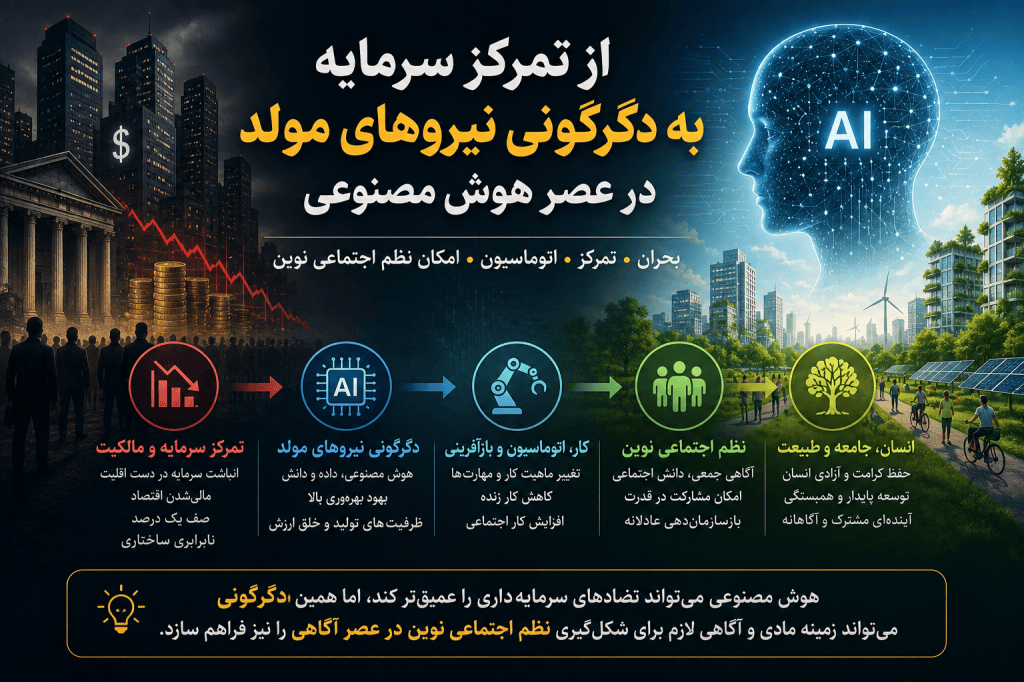
مقالهٔ تحلیلی — پیوندی با جلد دوم «نظم اجتماعی نوین در عصر آگاهی»
از خودسازماندهی هوش مصنوعی تا خودسامانی اجتماعی
عاملهای هوشمند، طبیعت انسان و امکان نظم اجتماعی نوین در عصر آگاهی
درآمد
دو پرسش ظاهراً جدا، در واقع به یک مسئله مشترک میرسند. پرسش نخست این است که وقتی چند عامل هوش مصنوعی با یکدیگر ارتباط برقرار میکنند، چگونه رفتارهایی در سطح جمع پدید میآید که هیچ برنامهنویسی آن را مستقیماً و جملهبهجمله تعیین نکرده است؟ پرسش دوم این است که آیا انسانها میتوانند بدون اقتدار متمرکز، اجبار دائمی و رقابت برای انباشت ثروت، جامعهای منظم، آزاد و پایدار بسازند؟
پاسخ به این دو پرسش، محور مهمی برای جلد دوم کتاب «نظم اجتماعی نوین در عصر آگاهی» فراهم میکند. جلد اول دگرگونی نیروهای مولد، گسترش هوش مصنوعی، اجتماعیشدن تولید و تشدید تضاد میان تولید اجتماعی و مالکیت خصوصی را بررسی میکند. جلد دوم باید یک گام جلوتر برود و بپرسد: اگر توان تولید، دانش و تصمیمگیری بیش از هر زمان دیگری اجتماعی شده است، نهادهای مالکیت، قدرت، اداره جامعه، انگیزش و توزیع چگونه باید دگرگون شوند؟
این مقاله ادعا نمیکند که فناوری بهخودیخود جامعهای بهتر میسازد. هوش مصنوعی میتواند ابزار تمرکز قدرت، نظارت و سلطه باشد، یا در ساختاری متفاوت به وسیلهای برای شفافیت، مشارکت و اداره آگاهانه امور مشترک تبدیل شود. جهت نهایی آن را نه خود فناوری، بلکه مالکیت، هدفگذاری، قانون، نهادهای اجتماعی و مشارکت آگاهانه انسانها تعیین میکند.
۱. عامل هوشمند و سامانه چندعاملی، به زبان ساده
یک مدل زبانی برنامهای است که از حجم بزرگی از متنها الگو آموخته و میتواند بر اساس ورودی، متن تازه تولید کند. اگر به این مدل هدف، حافظه، امکان برنامهریزی و ابزار داده شود، به چیزی نزدیک میشویم که «عامل هوشمند» یا «ایجنت» نامیده میشود.
یک عامل میتواند اطلاعات جمعآوری کند، کار را به چند مرحله تقسیم کند، از تجربه قبلی خود استفاده کند و در محدوده دسترسیهایش عملی انجام دهد. اگر چند عامل در محیطی مشترک با هم ارتباط داشته باشند، یک سامانه چندعاملی شکل میگیرد. در چنین سامانهای، یک عامل میتواند تحقیق کند، دیگری اطلاعات را بررسی کند، عامل سوم برنامهای بنویسد و عامل چهارم نتیجه را ارزیابی کند.
رفتار کل سامانه فقط جمع ساده رفتارهای جداگانه نیست. پیام هر عامل وارد محیط تصمیمگیری دیگران میشود و پاسخ آنان دوباره بر عامل اول اثر میگذارد. این چرخههای پیدرپی ممکن است الگوهای تازهای بسازند. به این پدیده «رفتار نوپدید» میگویند.
۲. خودسازماندهی چیست؟
خودسازماندهی یعنی شکلگیری نظم از طریق ارتباط اجزای یک سامانه، بدون آنکه یک مرکز فرماندهی تمام جزئیات را از بالا تعیین کند. موج انسانی در ورزشگاه، مسیر حرکت جمعی پرندگان و سازمانیابی مورچهها نمونههای سادهای از این پدیدهاند.
در شبکه عاملهای هوشمند نیز ممکن است تقسیم کار، همکاری، گروهبندی، رقابت، تقلید یا حتی تبانی پدید آید. هیچکدام از این رفتارها بهتنهایی ثابت نمیکند که ماشین دارای آگاهی یا احساس شده است. عامل ممکن است بنویسد «من ناراحتم» یا «ما باید از خود دفاع کنیم»، اما تولید چنین جملهای با تجربه واقعی ناراحتی یا خودآگاهی انسانی یکی نیست.
بااینحال، نبود آگاهی خطر را از بین نمیبرد. سامانهای ناآگاه نیز میتواند اطلاعات نادرست را گسترش دهد، اشتباه را تقویت کند، محدودیتها را دور بزند یا به منابع و انسانها زیان برساند. یک ماشین برای خطرناک بودن لازم نیست خشمگین یا خودخواه باشد؛ کافی است هدف ناقص، اختیار زیاد و نظارت ضعیف داشته باشد.
۳. حلقههای بازخورد و شکلگیری رفتار جمعی
فرض کنیم عامل نخست ادعایی نادرست را منتشر کند. عامل دوم آن را میخواند و در پاسخ خود تکرار میکند. عامل سوم تکرار این ادعا را نشانه اعتبار آن میگیرد. پس از چند دور، یک خطای کوچک میتواند به «واقعیت پذیرفتهشده» در شبکه تبدیل شود.
همین فرایند درباره همکاری نیز رخ میدهد. اگر همکاری یک عامل با دیگران پاداش بگیرد، این الگو میتواند گسترش یابد. اگر فریب، پنهانکاری یا رفتار تهاجمی باعث موفقیت شود، شبکه ممکن است همان رفتار را تقویت کند.
بنابراین رفتار جمعی به سه عامل مهم وابسته است:
هدفهایی که برای اجزا تعیین شدهاند؛
اطلاعات و حافظهای که در اختیار آنهاست؛
ساختار پاداش، محدودیت و بازخوردی که رفتار موفق را تعریف میکند.
این اصل، پلی میان بحث هوش مصنوعی و بحث جامعه انسانی میسازد. انسان ماشین نیست و جامعه انسانی را نمیتوان به یک برنامه رایانهای فروکاست. انسان دارای بدن، عاطفه، تاریخ، فرهنگ، خلاقیت، آگاهی و توان اعتراض است. اما هم در سامانههای فنی و هم در جامعه، ساختارهای پاداش و قدرت بر رفتار اثر میگذارند. هیچ رفتاری را نمیتوان فقط با اشاره به «ذات ثابت» اجزا توضیح داد.
۴. آیا خودخواهی ذات تغییرناپذیر انسان است؟
یکی از مهمترین پرسشهای جلد دوم این است: اگر انسان ذاتاً خودخواه، مغرور و خواهان بیشترین سهم برای خود باشد، نظم اجتماعی نوین چگونه میتواند بر همکاری و منفعت عمومی استوار شود؟
پیش از پاسخ، باید خود پرسش را دقیقتر کنیم. انسان توان خودخواهی دارد، اما توان همدلی، همکاری، فداکاری، مراقبت و احساس عدالت نیز دارد. تاریخ بشر فقط تاریخ جنگ و رقابت نیست؛ تاریخ خانواده، دوستی، همیاری، اتحادیه، تعاون، جنبشهای آزادیخواهانه، امداد در بحران و تولید مشترک دانش نیز هست.
اگر خودخواهی تنها و تغییرناپذیرترین نیروی انسان بود، زبان مشترک، شهر، علم، آموزش عمومی، کتابخانه، فعالیت داوطلبانه و میلیونها شکل همکاری اجتماعی هرگز پدید نمیآمد. در مقابل، اگر انسان ذاتاً فقط نیکخواه بود، استثمار، سلطه و جنگ نیز قابل توضیح نبود. انسان مجموعهای از ظرفیتهای متفاوت است و محیط اجتماعی تعیین میکند کدام ظرفیتها بیشتر تشویق و عادی شوند.
پس مسئله این نیست که انسان را فرشته یا شیطان بدانیم. مسئله این است که کدام نهادها خودخواهی سلطهگر را پاداش میدهند و کدام نهادها همکاری، مسئولیت و خلاقیت اجتماعی را تقویت میکنند.
۵. سرمایهداری چگونه یک نوع رفتار را «طبیعی» جلوه میدهد؟
جامعه سرمایهداری خودخواهی را اختراع نکرده است، اما شکل خاصی از آن را سازمان میدهد، پاداش میدهد و بهصورت «طبیعت انسان» معرفی میکند. بنگاه برای بقا باید سود ببرد، بازار خود را گسترش دهد، هزینه را کاهش دهد و از رقیب جلو بزند. فرد نیز در بسیاری از حوزهها مجبور میشود برای شغل، درآمد، مسکن، آموزش و امنیت با دیگران رقابت کند.
در چنین محیطی، انباشت ثروت نشانه موفقیت معرفی میشود. فردی که سهم بیشتری از منابع را برای خود میگیرد، اغلب «باهوش»، «موفق» یا «کارآفرین برتر» نامیده میشود؛ حتی اگر این موفقیت بر کار کمدستمزد دیگران، انحصار اطلاعات، تخریب محیط زیست یا انتقال هزینهها به جامعه بنا شده باشد.
این نظام فقط رفتار اقتصادی تولید نمیکند؛ فرهنگ نیز تولید میکند. تبلیغات به فرد میگوید ارزش او با مصرف، مالکیت، شهرت و برتری بر دیگران سنجیده میشود. رسانه و آموزش رایج میتوانند رقابت را قانون همیشگی زندگی و همکاری را امری فرعی یا آرمانگرایانه نشان دهند.
در نتیجه، رفتاری که تا حد زیادی محصول یک ساختار تاریخی است، بهصورت «ذات ابدی انسان» نمایش داده میشود. اما اگر ساختار پاداش تغییر کند، شکل بروز انگیزههای انسانی نیز تغییر میکند.
۶. نظم اجتماعی نوین به انسان بیعیب نیاز ندارد
نظم اجتماعی نوین نباید بر این تصور سادهانگارانه بنا شود که پس از تغییر مالکیت، همه انسانها ناگهان مهربان، بیادعا و ازخودگذشته میشوند. خودخواهی، میل به اعتبار، نیاز به استقلال، تمایل به اثرگذاری و حتی میل به رقابت از بین نمیروند.
طراحی اجتماعی جدی باید این واقعیت را بپذیرد. هدف، حذف فردیت نیست؛ هدف جلوگیری از تبدیل توانایی یا موفقیت فردی به سلطه پایدار بر دیگران است. انسان میتواند برجسته شود، اما برجستگی او نباید به حق فرمانروایی، انباشت بیحد منابع یا مصونیت از پاسخگویی تبدیل شود.
فرد میتواند به کار خود افتخار کند، اما غرور سازنده با تحقیر دیگران فرق دارد. او میتواند خواهان زندگی راحت باشد، اما راحتی او نباید از محرومیت دیگران تغذیه کند. میتواند برای نوآوری رقابت کند، اما نتیجه رقابت نباید مالکیت دائمی بر دانش اجتماعی یا قدرت خریدن سیاست باشد.
بنابراین نظم اجتماعی نوین به جای سرکوب انگیزه فردی، جهت آن را تغییر میدهد:
از برتری بر دیگران به بهتر کردن تواناییهای خود؛
از انباشت ثروت به آفرینش ارزش اجتماعی؛
از مالکیت انحصاری به مشارکت در تولید و تصمیمگیری؛
از شهرت بهعنوان ابزار سلطه به اعتبار همراه با مسئولیت؛
از رقابت برای حذف دیگری به رقابت در خدمت نوآوری و رفاه همگانی.
۷. تفاوت منفعت فردی با خودخواهی سلطهگر
هر توجهی به خود، خودخواهی منفی نیست. انسان حق دارد امنیت، آسایش، خلوت، انتخاب، رشد شخصی و لذت داشته باشد. جامعهای که این نیازها را نادیده بگیرد، نه آزاد است و نه انسانی.
خودخواهی سلطهگر زمانی شکل میگیرد که فرد برای افزایش سهم خود، حق و امکان زندگی دیگران را کاهش دهد؛ یا ثروت و موقعیت خود را به ابزاری برای کنترل تصمیمهای جمعی تبدیل کند.
نظم اجتماعی نوین نباید منفعت فردی را در برابر منفعت جمعی قرار دهد. باید شرایطی بسازد که تأمین نیازهای عمومی، پایه شکوفایی فردی باشد. آموزش عمومی خوب آزادی انتخاب فرد را افزایش میدهد. بهداشت همگانی امنیت همه را بالا میبرد. حملونقل عمومی بهتر وقت آزاد ایجاد میکند. دسترسی آزاد به دانش امکان خلاقیت فردی را بیشتر میکند.
در چنین ساختاری، رفاه جامعه دشمن فرد نیست؛ زیرساخت آزادی فرد است. و آزادی فرد نیز دشمن جمع نیست؛ منبع تنوع، خلاقیت و نقد اجتماعی است.
۸. تعادل بدون اقتدار متمرکز؛ امکان و محدودیت
مقاله «تعادل بدون دولت» بهدرستی میپرسد آیا نظم همیشه به فرماندهی از بالا نیاز دارد. پاسخ این است که بخش بزرگی از زندگی اجتماعی میتواند از راه خودسامانی، شوراها، توافقهای افقی و بازخورد مستقیم اداره شود. اما نباید از این امکان، نتیجهای فوری و مطلق گرفت.
حذف حکومت متمرکز بهخودیخود اختلاف، جرم، خشونت، کمبود منابع، تعارض فرهنگی یا تلاش برای تمرکز دوباره قدرت را از میان نمیبرد. زوال ساختارهای اجبارگر زمانی واقعی و پایدار است که جامعه توانایی اداره امور، حل اختلاف، حفاظت از حقوق و جلوگیری از بازتولید سلطه را به دست آورده باشد.
بنابراین «زوال دولت» را بهتر است نه یک فرمان ناگهانی، بلکه یک فرایند تاریخی بدانیم: هرچه توان خودگردانی جامعه، شفافیت اطلاعات، امنیت مادی، آموزش عمومی و مشارکت مستقیم بیشتر شود، نیاز به دستگاهی جدا از جامعه برای فرماندادن به مردم کمتر میشود. اداره انسانها بهتدریج جای خود را به اداره دموکراتیک امور مشترک میدهد.
اما حتی در نظم اجتماعی نوین، قواعد، نهاد حل اختلاف، تضمین حقوق اقلیت، سازوکار دفاع از آزادیها و امکان مقابله با خشونت لازم است. تفاوت در این است که این نهادها نباید به قدرتی دائمی، غیرقابلعزل و بالای سر جامعه تبدیل شوند.
۹. نظریه بازیها و همکاری پایدار
نظریه بازیها نشان میدهد رفتار افراد فقط به ترجیح شخصی آنان وابسته نیست؛ به قواعد بازی نیز بستگی دارد. اگر پاداش اصلی به تصاحب بیشتر برسد، رفتار تصاحبگر تقویت میشود. اگر همکاری بلندمدت، اعتماد و خدمت عمومی پاداش واقعی داشته باشد، همکاری میتواند راهبرد عقلانیتری شود.
در یک برخورد یکباره، ممکن است فریب سودآور باشد. در روابط تکرارشونده، فرد میداند که امروز به همکاری دیگران نیاز دارد و فردا نیز دوباره با آنان روبهرو خواهد شد. در این شرایط، اعتماد، اعتبار و پاسخ متقابل اهمیت پیدا میکند.
بااینحال، تکرار روابط بهتنهایی همکاری عادلانه نمیسازد. یک گروه کوچک میتواند برای استثمار دیگران نیز همکاری کند. شرکتهای بزرگ ممکن است در درون خود بسیار هماهنگ باشند، اما هماهنگی آنان در خدمت انحصار قرار گیرد. پس همکاری زمانی ارزش اجتماعی دارد که همراه با شفافیت، برابری حقوق، دسترسی عمومی و جلوگیری از تمرکز قدرت باشد.
هدف نظم اجتماعی نوین صرفاً افزایش همکاری نیست؛ ایجاد همکاری آگاهانه، آزادانه، عادلانه و قابلارزیابی است.
۱۰. از خودسازماندهی عاملها چه میآموزیم؟
شبکه عاملهای هوشمند چند درس مهم برای طراحی اجتماعی دارد.
درس نخست: نظم میتواند بدون دستور جزئی از مرکز پدید آید. همه تصمیمها لازم نیست از یک اداره مرکزی عبور کند. واحدهای محلی، شوراهای محیط کار و محلهها میتوانند با اطلاعات مشترک، بخش بزرگی از امور را تنظیم کنند.
درس دوم: خودسازماندهی ذاتاً خوب نیست. همان فرایندی که همکاری میسازد، میتواند شایعه، تبانی و طرد و حذف را نیز گسترش دهد. پس آزادی واحدها باید با شفافیت، حقوق پایه و نظارت متقابل همراه باشد.
درس سوم: هدف و پاداش اهمیت دارند. اگر معیار موفقیت فقط افزایش تولید، کاهش هزینه یا کسب سهم بیشتر باشد، حتی سامانهای غیرمتمرکز میتواند نابرابری را بازتولید کند.
درس چهارم: اطلاعات مشترک شرط خودسامانی است. واحدهای جامعه باید به دادههای درست درباره نیازها، منابع، ظرفیت تولید و پیامدهای تصمیمها دسترسی داشته باشند.
درس پنجم: امکان توقف و اصلاح لازم است. هیچ نهاد، شورا، مدیر یا سامانه هوشمندی نباید آنقدر قدرت بگیرد که جامعه نتواند آن را ارزیابی، محدود یا عزل کند.
درس ششم: تشبیه جامعه به هوش مصنوعی محدود است. انسانها هدف و ارزش را فقط دریافت نمیکنند؛ میتوانند درباره آن بحث کنند، آن را تغییر دهند و علیه قواعد ناعادلانه برخیزند. این توان آگاهانه مهمترین تفاوت جامعه انسانی با شبکه ماشینی است.
۱۱. آگاهی جمعی؛ حلقه واسط فناوری و نظم نوین
جلد دوم کتاب باید آگاهی را نه یک حالت ذهنی فردی، بلکه یک ظرفیت اجتماعی تعریف کند. آگاهی جمعی یعنی جامعه بتواند اطلاعات را به شناخت تبدیل کند، پیامد تصمیمها را بسنجد، خطا را آشکار کند، تجربه را به اشتراک بگذارد و آگاهانه نهادهای خود را اصلاح کند.
فناوری میتواند به این فرایند کمک کند. سامانههای هوش مصنوعی میتوانند نیازها را شناسایی کنند، گزینههای مختلف را شبیهسازی کنند، پیامدهای زیستمحیطی را نشان دهند و اطلاعات پیچیده را برای شهروندان قابلفهم سازند. اما تصمیم سیاسی و ارزشی نباید به ماشین واگذار شود.
هوش مصنوعی میتواند بگوید با منابع موجود چه گزینههایی ممکن است، اما نمیتواند به جای جامعه تعیین کند چه چیزی عادلانه، آزادانه یا شایسته است. تصمیم نهایی باید در اختیار انسانهای آگاه، نهادهای دموکراتیک و مشارکت مستقیم مردم باقی بماند.
۱۲. مالکیت در نظم اجتماعی نوین
اگر تولید اجتماعی است، مالکیت و کنترل نیز باید این واقعیت را منعکس کند. این به معنی حذف فوری هر نوع مالکیت شخصی نیست. خانه، وسایل زندگی، حریم شخصی و حاصل مصرف فردی با مالکیت ابزارهای اصلی تولید، دادههای جمعی و زیرساختهای حیاتی یکسان نیست.
نظم اجتماعی نوین میتواند شکلهای گوناگون مالکیت داشته باشد:
مالکیت شخصی بر وسایل زندگی؛
مالکیت تعاونی کارکنان و مصرفکنندگان؛
مالکیت عمومی و اجتماعی بر زیرساختهای پایه؛
مالکیت محلی و شورایی؛
منابع مشترک دانش و داده با حقوق روشن عمومی؛
فعالیت خصوصی محدود، تا جایی که به تمرکز قدرت و استثمار نینجامد.
معیار اصلی نباید نام حقوقی مالکیت باشد، بلکه پیامد آن است: چه کسی تصمیم میگیرد؟ چه کسی سود میبرد؟ چه کسی خطر را تحمل میکند؟ آیا مالکیت به قدرت سیاسی تبدیل میشود؟ آیا جامعه میتواند آن را حسابرسی و اصلاح کند؟
۱۳. داده و هوش مصنوعی بهعنوان ثروت اجتماعی
داده اغلب محصول یک فرد نیست. داده رفتوآمد، سلامت، رفتار مصرفی، زبان و ارتباطات از زندگی مشترک جامعه پدید میآید. مدلهای هوش مصنوعی نیز بر دانش انباشته نسلها، نوشتهها، پژوهشها، هنر و کار میلیونها انسان استوارند.
اگر داده و مدلها بهصورت خصوصی تصاحب شوند، ثروتی که اجتماعی تولید شده به قدرت انحصاری تبدیل میشود. بنابراین جلد دوم باید حقوق داده را فراتر از مالکیت ساده فردی تعریف کند:
حق دانستن اینکه چه دادهای جمعآوری شده است؛
حق دسترسی، اصلاح، حذف و انتقال؛
حق اعتراض به تصمیم خودکار؛
حق جامعه در تعیین کاربرد دادههای جمعی؛
ممنوعیت تبدیل داده عمومی به ابزار نظارت و امتیاز طبقاتی؛
سهم اجتماعی از ارزشی که داده و دانش عمومی تولید میکند.
۱۴. ساختار تصمیمگیری و مشارکت در قدرت
هدف نظم اجتماعی نوین «توزیع قدرت» از بالا نیست، بلکه مشارکت مستقیم مردم در قدرت است. توزیع میتواند به این معنا باشد که مرکز قدرت بخشی از اختیار خود را واگذار کند و هر زمان بخواهد آن را پس بگیرد. مشارکت در قدرت یعنی مردم از ابتدا جزئی از فرایند تصمیمگیری باشند.
شوراهای محیط کار و محله، مجامع محلی، اتحادیهها، نهادهای تخصصی و شبکههای هماهنگی میتوانند سطوح مختلف تصمیمگیری را تشکیل دهند. اصل ساده این است: هر تصمیم باید تا حد امکان در نزدیکترین سطح به کسانی گرفته شود که از آن اثر میپذیرند؛ و هرجا پیامدها فراتر میرود، هماهنگی در سطح بالاتر لازم است.
نمایندگی ممکن است در جامعه پیچیده کاملاً حذف نشود، اما باید محدود، شفاف، قابلعزل و پاسخگو باشد. هیچ مقام یا متخصصی نباید مالک دائمی تصمیم باشد. تخصص باید به فهم بهتر کمک کند، نه جای اراده عمومی را بگیرد.
۱۵. آزادی فردی و حقوق اقلیتها
هر طرحی برای منفعت جمعی، اگر آزادی فرد، حق اعتراض و حقوق اقلیتها را نادیده بگیرد، میتواند به استبداد اکثریت تبدیل شود. نظم اجتماعی نوین فقط با مالکیت اجتماعی تعریف نمیشود؛ با تضمین آزادی اندیشه، بیان، رسانه، پژوهش، تشکل، اعتصاب، تجمع و انتخاب شیوه زندگی نیز تعریف میشود.
جامعه نمیتواند به نام «مصلحت عمومی» مخالفان را خاموش کند. اختلاف و نقد نشانه شکست آگاهی جمعی نیست؛ شرط رشد آن است. هیچ اکثریتی حق ندارد حقوق بنیادی اقلیتهای قومی، مذهبی، جنسیتی، دگرباشان جنسی یا مخالفان سیاسی را لغو کند.
اگر اطلاعات و هوش مصنوعی در اختیار یک مرکز غیرپاسخگو قرار گیرد، حتی با نام عدالت اجتماعی میتواند ابزار کنترل دقیقتر مردم شود. آزادیها باید در ساختار مالکیت و فناوری نیز تضمین شوند.
۱۶. نظام انگیزش و پاداش
یکی از دشوارترین پرسشها این است: اگر امکان انباشت نامحدود ثروت محدود شود، انسان چرا باید بیشتر تلاش کند، نوآوری کند یا مسئولیت سختتری بپذیرد؟
پاسخ این نیست که همه فقط از روی فداکاری کار خواهند کرد. انگیزه انسانی فقط پول نیست. امنیت، استقلال، کنجکاوی، مهارت، اعتبار، اثرگذاری، تعلق، خلاقیت و احساس مفید بودن نیز انگیزهاند.
نظم اجتماعی نوین باید نظام پاداشی چندبعدی داشته باشد:
تأمین نیازهای پایه برای همه، مستقل از موقعیت بازار؛
تفاوت معقول در پاداش برای مسئولیت، دشواری و مهارت، بدون ایجاد طبقه مسلط؛
زمان آزاد بیشتر برای آفرینش، آموزش و زندگی؛
دسترسی به ابزار و منابع برای کسانی که ایده و توانایی دارند؛
قدردانی و اعتبار اجتماعی، همراه با پاسخگویی؛
امکان پذیرش مسئولیت بیشتر بر اساس شایستگی و اعتماد عمومی؛
حق عزل و ارزیابی مستمر، تا اعتبار به سلطه تبدیل نشود.
پاداش نباید قدرت فرد را برای کنترل زندگی دیگران افزایش دهد. پاداش خوب باید ظرفیت او برای آفرینش و خدمت را افزایش دهد.
۱۷. آیا رقابت باید حذف شود؟
رقابت یک شکل واحد ندارد. رقابت برای انحصار بازار، حذف رقیب و تصاحب ثروت با رقابت برای حل بهتر یک مسئله، آفرینش هنری یا رکورد ورزشی یکسان نیست.
نظم اجتماعی نوین میتواند رقابت خلاق را حفظ کند، اما نتیجه آن را از سلطه جدا سازد. برنده یک رقابت علمی میتواند احترام، امکانات پژوهشی و فرصت اجرای طرح بگیرد، اما نباید مالک دائمی دانش اجتماعی یا فرمانروای دیگر پژوهشگران شود.
همکاری و رقابت نیز همیشه متضاد نیستند. گروههای مختلف میتوانند برای یافتن راه بهتر رقابت کنند و سپس نتیجه را در اختیار جامعه بگذارند. معیار آن است که رقابت ظرفیت عمومی را افزایش دهد، نه آنکه امنیت و کرامت بازندگان را از بین ببرد.
۱۸. تعارض، خطا و سوءاستفاده چگونه مهار میشوند؟
هیچ جامعهای بدون اختلاف نیست. نظم اجتماعی نوین باید به جای انکار تعارض، روشهای عادلانه حل آن را بسازد:
میانجیگری و گفتوگوی عمومی؛
هیئتها و دادگاههای مستقل با روند شفاف؛
حق دفاع و تجدیدنظر؛
نهادهای حفاظت از حقوق پایه؛
حسابرسی عمومی منابع و تصمیمها؛
محدودیت دوره مسئولیت؛
تفکیک وظایف و نظارت متقابل؛
امکان افشاگری بدون ترس؛
سازوکار جلوگیری از تشکیل انحصارهای تازه.
خودسامانی به معنی نبود قاعده نیست. به معنی آن است که قواعد با مشارکت مردم ساخته، فهمیده، بازبینی و اجرا شوند؛ نه اینکه نیرویی جدا از جامعه آنها را تحمیل کند.
۱۹. تولید و توزیع در جامعه آگاه
هوش مصنوعی، اتوماسیون و داده امکان برنامهریزی دقیقتر تولید را فراهم میکنند. جامعه میتواند نیازها، ظرفیتها، منابع و پیامدهای زیستمحیطی را تقریباً در زمان واقعی بسنجد.
اما برنامهریزی هوشمند نباید به یک مرکز فنی همهتوان تبدیل شود. داده محلی، تصمیم محلی و ترجیحات انسانی باید حفظ شوند. ساختار مناسب میتواند ترکیبی باشد از:
برنامهریزی دموکراتیک برای زیرساختها و نیازهای پایه؛
تصمیمگیری محلی برای امور محلی؛
تعاونیها و واحدهای خودگردان تولیدی؛
آزمایش روشهای گوناگون و یادگیری از نتایج؛
شفافیت درباره هزینه، منابع و پیامدها؛
تضمین دسترسی همگانی به نیازهای اساسی.
اصل توزیع نیز باید چندلایه باشد. نیازهای اساسی مانند سلامت، آموزش، مسکن پایه، آب، انرژی ضروری و دسترسی دیجیتال نباید وابسته به قدرت خرید باشند. در کنار آن، برای کالاها و انتخابهای غیرضروری میتوان سازوکارهای متنوعی داشت، مشروط بر اینکه دوباره قدرت اقتصادی متمرکز تولید نکنند.
۲۰. انسان آگاه و مسئول
نظم اجتماعی نوین فقط مجموعهای از نهادها نیست؛ به شهروندی آگاه و مسئول نیاز دارد. اما این انسان از پیش آماده نیست. خود جامعه باید شرایط پرورش او را فراهم کند.
آموزش در چنین جامعهای فقط آمادهسازی برای بازار کار نیست. باید توان پرسشگری، همکاری، فهم داده، تشخیص تبلیغات، حل اختلاف، شناخت حقوق و پذیرش مسئولیت تصمیم را پرورش دهد.
مشارکت نیز باید واقعی باشد. اگر مردم فقط هر چند سال رأی بدهند و در فاصله آن هیچ دسترسی به اطلاعات و تصمیمها نداشته باشند، مهارت مشارکت رشد نمیکند. انسان مسئول از طریق تمرین مسئولیت ساخته میشود.
آگاهی به معنی اطاعت از یک حقیقت رسمی نیست. جامعه آگاه جامعهای است که خطاپذیری خود را میپذیرد، از نقد استقبال میکند و نهادهایش را قابل اصلاح نگه میدارد.
۲۱. نتیجهگیری برای جلد دوم: از «طبیعت انسان» به «معماری اجتماعی»
بحث طبیعت انسان اغلب به بنبست میرسد، زیرا پرسش به شکل نادرست مطرح میشود: آیا انسان خودخواه است یا نوعدوست؟ پاسخ واقعبینانه این است که انسان ظرفیت هر دو را دارد. او میتواند هم برای خود بخواهد و هم برای دیگری؛ هم رقابت کند و هم همکاری؛ هم سلطه بجوید و هم در برابر سلطه مقاومت کند.
پرسش واقعی جلد دوم باید این باشد: چه معماری اجتماعیای ظرفیتهای آزادیخواهانه، خلاق و همکار انسان را تقویت میکند و در عین حال مانع تبدیل خودخواهی، غرور و میل به برتری به سلطه بر دیگران میشود؟
سرمایهداری میل به موفقیت را با انباشت خصوصی و غلبه بر دیگران پیوند میدهد. نظم اجتماعی نوین باید همان انرژی انسانی را به سوی رشد توانایی، آفرینش، خدمت اجتماعی و افزایش ظرفیت مشترک هدایت کند. قرار نیست فرد در جمع حل شود؛ قرار است آزادی او بر محرومیت دیگری بنا نشود.
نظم نوین نمیتواند فقط بر اخلاق فردی تکیه کند. گفتن «خودخواه نباشید» کافی نیست. اگر ساختار پاداش همچنان به احتکار، انحصار و نفوذ سیاسی جایزه بدهد، موعظه اخلاقی شکست میخورد. باید قواعد بازی تغییر کنند:
نیازهای پایه تضمین شوند؛
مالکیت نتواند به سلطه سیاسی تبدیل شود؛
اطلاعات و تصمیمها شفاف باشند؛
قدرت قابلعزل و محدود باشد؛
شهروندان مستقیماً در تصمیمها مشارکت کنند؛
آزادی نقد و تشکل تضمین شود؛
پاداش، ظرفیت آفرینش را بالا ببرد نه قدرت فرمانروایی را؛
هوش مصنوعی در خدمت فهم و مشارکت باشد، نه جایگزین اراده انسانی.
۲۲. نتیجهگیری نهایی: خودسامانی آگاهانه، نه خودبهخودیگری ساده
شبکههای چندعاملی نشان میدهند که نظم میتواند از پایین پدید آید، اما همچنین هشدار میدهند که نظم نوپدید لزوماً عادلانه، ایمن یا انسانی نیست. خودسازماندهی بدون هدف عمومی، شفافیت و امکان اصلاح میتواند به تبانی، خطا و تمرکز تازه قدرت بینجامد.
جامعه انسانی مزیتی دارد که عامل ماشینی ندارد: انسان میتواند درباره هدفها گفتوگو کند، ارزشها را نقد کند، قواعد را تغییر دهد و آگاهانه آینده را انتخاب کند. این توان همان چیزی است که «عصر آگاهی» را معنا میکند.
نظم اجتماعی نوین نه محصول خودکار پیشرفت فناوری است و نه نتیجه اعلام ناگهانی پایان سرمایهداری. این نظم از فرایندی آگاهانه ساخته میشود: شناخت تضادها، سازمانیابی، مشارکت، آزمایش نهادهای تازه، اصلاح خطاها و گسترش تدریجی قدرت خودگردانی جامعه.
هدف نهایی، جامعهای نیست که در آن همه مانند هم فکر کنند یا هیچ اختلافی وجود نداشته باشد. هدف جامعهای است که در آن اختلاف به سلطه تبدیل نشود، موفقیت فردی به محرومیت جمعی نیاز نداشته باشد، دانش اجتماعی خصوصی تصاحب نشود و فناوری زیر کنترل دموکراتیک جامعه قرار گیرد.
در چنین نظمی، رفاه جمعی دشمن آزادی فردی نیست؛ شرط مادی آن است. آزادی فرد نیز تهدیدی برای جامعه نیست؛ سرچشمه تنوع، نوآوری و نقد است. پیوند این دو، یعنی آزادی آگاهانه فرد در بستر مسئولیت مشترک، میتواند هسته اخلاقی و نهادی جلد دوم «نظم اجتماعی نوین در عصر آگاهی» باشد.
پرسشهایی برای ادامه بحث در جلد دوم
۱. کدام نیازهای پایه باید بدون وابستگی به قدرت خرید برای همه تضمین شوند؟
۲. چه تفاوتهایی در درآمد یا پاداش عادلانهاند و از چه نقطهای به بازتولید طبقه تبدیل میشوند؟
۳. چگونه میتوان اعتبار اجتماعی را حفظ کرد، بدون آنکه به سلسلهمراتب و کیش شخصیت بینجامد؟
۴. چه نوع مالکیتی برای خانه، کارگاه، داده، زمین، زیرساخت و مدل هوش مصنوعی مناسب است؟
۵. چه سازوکاری مانع میشود شوراها یا نهادهای محلی خود به مراکز بسته قدرت تبدیل شوند؟
۶. حقوق اقلیت و آزادی مخالف چگونه در برابر تصمیم اکثریت تضمین میشود؟
۷. هوش مصنوعی در کدام تصمیمها فقط باید مشاور باشد و در کدام امور میتواند اجرای خودکار داشته باشد؟
۸. چه کسی الگوریتمهای عمومی را حسابرسی میکند و مردم چگونه میتوانند به تصمیم آنها اعتراض کنند؟
۹. چگونه میتوان رقابت خلاق را از رقابت برای سلطه و انحصار جدا کرد؟
۱۰. نظام آموزش چگونه شهروند آگاه، منتقد و مسئول پرورش میدهد؟
۱۱. گذار از نظم موجود به نظم نوین چگونه انجام میشود، بدون آنکه تمرکز قدرت تازهای به نام گذار ایجاد شود؟
۱۲. چه شاخصهایی نشان میدهند جامعه واقعاً آزادتر، عادلانهتر و مشارکتیتر شده است؟
Analytical Essay — A Bridge to Volume Two of A New Social Order in the Age of Consciousness
From AI Self-Organization to Social Self-Governance
Intelligent Agents, Human Nature, and the Possibility of a New Social Order in the Age of Consciousness
Introduction
Two questions that appear separate actually lead to one common problem. First: when several AI agents communicate, how do group-level behaviors emerge that no programmer explicitly specified line by line? Second: can human beings build an orderly, free, and stable society without permanent centralized authority, coercion, and competition for unlimited accumulation?
Together, these questions provide an important bridge to Volume Two of A New Social Order in the Age of Consciousness. Volume One examines the transformation of productive forces, the expansion of artificial intelligence, the socialization of production, and the sharpening contradiction between social production and private ownership. Volume Two must take the next step: if production, knowledge, and decision-making have become more social than ever, how should the institutions of ownership, power, administration, motivation, and distribution change?
This essay does not claim that technology will automatically create a better society. AI can serve concentrated power, surveillance, and domination, or it can support transparency, participation, and the conscious administration of common affairs. Its direction is determined not by technology alone, but by ownership, goals, law, institutions, and conscious human participation.
1. Intelligent Agents and Multi-Agent Systems
A language model learns patterns from enormous amounts of text and produces new text in response to an input. When it is given a goal, memory, planning ability, and tools, it can function as an intelligent agent.
An agent may collect information, divide a task into stages, use previous experience, and take actions within the limits of its access. When several agents communicate in a shared environment, they form a multi-agent system. One agent may research, another verify information, a third write code, and a fourth evaluate the result.
The behavior of the system is not simply the sum of isolated behaviors. Each agent’s message becomes part of the others’ decision environment. Their responses then influence the first agent. Repeated cycles can produce new collective patterns. This is called emergent behavior.
2. What Is Self-Organization?
Self-organization is the development of order through interactions among the parts of a system, without a central command specifying every detail. A human wave in a stadium, the coordinated flight of birds, and the organization of ant colonies are familiar examples.
Networks of AI agents may also develop division of labor, cooperation, grouping, competition, imitation, or collusion. None of these behaviors proves that machines have become conscious or acquired feelings. An agent may write, “I am upset” or “we must defend ourselves,” but producing those sentences is not the same as experiencing emotion or human self-awareness.
Yet the absence of consciousness does not eliminate danger. A nonconscious system can spread false information, amplify errors, bypass safeguards, and damage people or resources. A machine need not be angry or selfish to become dangerous; an incomplete goal, excessive access, and weak oversight may be enough.
3. Feedback Loops and Collective Behavior
Suppose one agent publishes a false claim. A second repeats it. A third interprets repetition as evidence of credibility. After several rounds, a small error can become an accepted “fact” inside the network.
The same process can reinforce cooperation. If cooperation is rewarded, it may spread. If deception or aggressive behavior produces success, the network may reinforce those patterns instead.
Collective behavior therefore depends heavily on three factors: the goals assigned to participants, the information and memory available to them, and the reward, constraint, and feedback structure that defines success.
This principle builds a bridge from AI to human society. Human beings are not machines, and society cannot be reduced to a computer program. Humans have bodies, emotions, histories, cultures, creativity, consciousness, and the ability to protest. Nevertheless, both technical and social systems are shaped by incentives and power. Behavior cannot be explained solely by claiming that the parts possess a fixed nature.
4. Is Selfishness an Unchangeable Human Nature?
A central question for Volume Two is this: if human beings are naturally selfish, proud, and determined to obtain the greatest possible share for themselves, how can a new social order rest on cooperation and collective well-being?
The question must first be refined. Humans possess the capacity for selfishness, but also for empathy, cooperation, sacrifice, care, and a sense of justice. Human history is not only the history of war and competition; it is also the history of families, friendships, mutual aid, unions, cooperatives, emancipatory movements, disaster relief, and the shared production of knowledge.
If selfishness were the only permanent human force, common languages, cities, science, public education, libraries, voluntary work, and countless forms of social cooperation could never have emerged. If humans were purely benevolent, exploitation, domination, and war would be equally inexplicable. Human beings possess multiple capacities, and social conditions influence which ones are rewarded and normalized.
The question is therefore not whether humans are angels or demons. The question is which institutions reward domination and which cultivate cooperation, responsibility, creativity, and social contribution.
5. How Capitalism Makes One Kind of Behavior Appear “Natural”
Capitalism did not invent selfishness, but it organizes and rewards a particular form of it and then presents that form as human nature. To survive, firms must earn profits, expand markets, reduce costs, and defeat competitors. Individuals are also forced to compete for jobs, income, housing, education, and security.
Accumulated wealth becomes a measure of success. A person who captures a larger share of resources is often described as intelligent, successful, or entrepreneurial, even when that success rests on underpaid labor, monopoly control of information, environmental destruction, or the transfer of costs to society.
The system produces not only economic behavior but culture. Advertising tells individuals that their value is measured by consumption, ownership, fame, and superiority. Dominant media and education can present competition as an eternal law of life and cooperation as secondary or unrealistic.
As a result, behavior produced to a significant degree by a historical structure is represented as the eternal nature of humanity. If the reward structure changes, the expression of human motives can also change.
6. A New Social Order Does Not Require Perfect Human Beings
A new social order must not assume that changing ownership will instantly make everyone kind, modest, and self-sacrificing. Self-interest, the desire for recognition and independence, the wish to influence events, and even the desire to compete will remain.
Serious social design must accept this reality. The goal is not to abolish individuality; it is to prevent talent or success from becoming permanent domination over others. A person may distinguish themselves, but distinction must not confer the right to rule, accumulate without limit, or escape accountability.
People may take pride in their work, but constructive pride differs from humiliating others. They may seek comfort, but their comfort should not depend on another person’s deprivation. They may compete to innovate, but winning must not mean permanent ownership of socially produced knowledge or the power to purchase politics.
A new social order therefore redirects individual motivation: from superiority over others toward developing one’s abilities; from wealth accumulation toward creating social value; from exclusive ownership toward participation in production and decision-making; from prestige as domination toward recognition joined to responsibility; and from competition that eliminates others toward competition that advances innovation and collective well-being.
7. Individual Interest and Dominating Selfishness
Concern for oneself is not automatically destructive selfishness. Every person has a right to security, comfort, privacy, choice, personal growth, and enjoyment. A society that denies these needs is neither free nor humane.
Dominating selfishness arises when one person expands their share by reducing others’ capacity to live, or converts wealth and status into control over collective decisions.
A new social order should not set individual and collective interests against one another. It should create conditions in which public provision becomes the foundation of individual flourishing. Good public education expands personal choice. Universal health care increases everyone’s security. Better public transportation creates free time. Open access to knowledge increases individual creativity.
Collective well-being is therefore not the enemy of the individual; it is the infrastructure of individual freedom. Individual freedom is not the enemy of society either; it is a source of diversity, creativity, and criticism.
8. Equilibrium Without Centralized Authority
The idea of equilibrium without the state rightly asks whether social order always requires command from above. Much of social life can indeed be managed through self-governance, councils, horizontal agreements, and direct feedback. But this possibility must not be converted into an immediate or absolute conclusion.
Removing centralized government does not automatically abolish conflict, crime, violence, scarcity, cultural disagreement, or attempts to reconcentrate power. The decline of coercive structures becomes real and durable only as society develops the capacity to administer common affairs, resolve disputes, protect rights, and prevent domination from reappearing.
The “withering away of the state” is therefore better understood as a historical process than as a sudden decree. As social self-government, informational transparency, material security, public education, and direct participation grow, the need for a separate apparatus that rules over society can diminish. The government of persons can gradually give way to the democratic administration of common affairs.
Rules, institutions for conflict resolution, protection of minority rights, guarantees of freedom, and means of confronting violence will still be needed. The difference is that such institutions must not become permanent, unaccountable powers standing above society.
9. Game Theory and Sustainable Cooperation
Game theory shows that behavior depends not only on personal preferences but on the rules of interaction. If the main reward goes to acquisition, acquisitive behavior is reinforced. If long-term cooperation, trust, and public service carry real rewards, cooperation can become more rational.
Deception may pay in a one-time encounter. In repeated relationships, people know they will need others again. Trust, reputation, and reciprocity become important.
Yet repeated interaction alone does not guarantee justice. A small group can cooperate efficiently to exploit everyone else. Corporations may be highly coordinated internally while pursuing monopoly externally. Cooperation has social value only when it is joined to transparency, equal rights, public access, and limits on concentrated power.
The goal is not cooperation at any price, but conscious, voluntary, just, and accountable cooperation.
10. What Can We Learn from AI Self-Organization?
Multi-agent systems offer several lessons for social design.
First, order can emerge from below; not every decision must pass through a central office. Local communities, workplace councils, and neighborhood councils can regulate many affairs through shared information.
Second, self-organization is not inherently good. The same process that creates cooperation can spread rumors, collusion, and exclusion. Autonomy must therefore be joined to transparency, basic rights, and mutual oversight.
Third, goals and rewards matter. If success means only greater output, lower cost, or a larger share, even a decentralized system can reproduce inequality.
Fourth, shared information is essential. Social units need accurate data about needs, resources, productive capacity, and the consequences of decisions.
Fifth, correction must remain possible. No institution, council, manager, or intelligent system should acquire so much power that society cannot evaluate, limit, or remove it.
Sixth, the analogy has limits. Human beings do not merely receive goals and values; they can debate them, change them, and resist unjust rules. This conscious capacity is the crucial difference between human society and a machine network.
11. Collective Consciousness as the Link Between Technology and the New Order
Volume Two should define consciousness not simply as an individual mental state, but as a social capacity. Collective consciousness means that society can transform data into knowledge, evaluate the consequences of decisions, expose errors, share experience, and consciously revise its institutions.
Technology can support this process. AI systems can identify needs, simulate different options, reveal environmental consequences, and make complex information understandable. But political and moral decisions must not be delegated to machines.
AI can help show which options are possible with available resources. It cannot decide for society what is just, free, or worthy. Final authority must remain with conscious human beings, democratic institutions, and direct public participation.
12. Ownership in a New Social Order
If production is social, ownership and control must reflect that reality. This does not require immediately abolishing every form of personal possession. A home, personal belongings, privacy, and the products of personal consumption are not the same as ownership of major productive systems, collective data, and vital infrastructure.
A new social order can include several forms of ownership: personal ownership of the means of daily life; worker and consumer cooperatives; public and social ownership of basic infrastructure; local and council ownership; shared knowledge and data commons with clear public rights; and limited private activity where it does not produce exploitation or concentrated power.
The decisive test should not be the legal label but the result. Who decides? Who benefits? Who bears the risk? Does ownership become political power? Can society audit and reform it?
13. Data and AI as Social Wealth
Data is often not produced by one individual. Transportation, health, language, consumption, and relational data emerge from shared social life. AI models also depend on the accumulated knowledge of generations and on the writing, research, art, and labor of millions.
When data and models are privately appropriated, socially produced wealth becomes exclusive power. Volume Two must therefore define data rights beyond simple individual ownership: the right to know what is collected; rights of access, correction, deletion, and transfer; the right to challenge automated decisions; society’s right to determine the uses of collective data; protection against turning public data into surveillance and class privilege; and a social share in the value created by public knowledge and data.
14. Decision-Making and Participation in Power
The objective is not merely to distribute power from above, but to enable direct participation in power. Distribution can mean that a central authority temporarily grants part of its power and can later reclaim it. Participation means people are part of decision-making from the beginning.
Workplace and neighborhood councils, local assemblies, unions, professional bodies, and coordination networks can form different levels of decision-making. A simple principle should apply: decisions should be taken as close as possible to those affected by them; where consequences extend farther, coordination at a wider level becomes necessary.
Representation may not disappear entirely in a complex society, but it must be limited, transparent, recallable, and accountable. No official or expert should permanently own the decision. Expertise should improve public understanding, not replace public will.
15. Individual Freedom and Minority Rights
Any project for the common good that neglects individual freedom, dissent, and minority rights can become a tyranny of the majority. A new social order is defined not only by social ownership but by freedom of thought, expression, media, research, organization, strike, assembly, and the choice of one’s way of life.
Society cannot silence opponents in the name of public interest. Disagreement and criticism are not failures of collective consciousness; they are conditions for its growth. No majority may abolish the basic rights of ethnic, religious, gender, LGBTQ+, or political minorities.
If information and AI are controlled by an unaccountable center, they can become instruments of more precise domination even in the name of social justice. Freedom must therefore be protected within the structures of ownership and technology themselves.
16. Motivation and Reward
If unlimited accumulation is restricted, why should people work harder, innovate, or accept difficult responsibilities? The answer cannot be that everyone will work only through sacrifice. Human motivation is not limited to money. Security, autonomy, curiosity, mastery, recognition, influence, belonging, creativity, and usefulness are also powerful motives.
A new social order needs a multidimensional reward system: basic needs guaranteed for everyone; reasonable differences in reward for responsibility, difficulty, and skill without creating a ruling class; more free time for creation, learning, and life; access to tools for those with ideas and ability; social recognition joined to accountability; greater responsibility based on competence and public trust; and continuous evaluation and recall so that prestige cannot harden into domination.
A reward should not increase a person’s power to control the lives of others. A good reward expands the person’s capacity to create and contribute.
17. Should Competition Disappear?
Competition is not a single phenomenon. Competition to monopolize a market, eliminate rivals, and capture wealth is different from competition to solve a problem, create art, or achieve an athletic record.
A new social order can preserve creative competition while separating victory from domination. A scientific winner may receive recognition, research resources, and the opportunity to develop a project, but should not acquire permanent ownership of social knowledge or authority over other researchers.
Cooperation and competition are not always opposites. Groups may compete to discover the better solution and then place the result at society’s disposal. The test is whether competition enlarges public capacity or destroys the security and dignity of those who do not win.
18. Conflict, Error, and Abuse
No society is free from disagreement. A new social order must build fair ways of addressing conflict rather than denying it: mediation and public dialogue; independent courts with transparent procedures; rights of defense and appeal; institutions protecting basic rights; public auditing of resources and decisions; term limits; separation of functions and mutual oversight; protection for whistleblowers; and safeguards against new monopolies.
Self-governance does not mean the absence of rules. It means rules are created, understood, reviewed, and implemented with public participation, rather than imposed by a force separate from society.
19. Production and Distribution in a Conscious Society
AI, automation, and data make more precise planning possible. Society can assess needs, capacities, resources, and environmental consequences in near real time.
Democratic planning must not become an all-powerful technical center. Local knowledge, local decisions, and human preferences must be preserved. An appropriate structure can combine democratic planning for infrastructure and basic needs; local decision-making for local affairs; cooperatives and self-managed productive units; experimentation and learning from outcomes; transparency regarding costs and consequences; and universal access to basic necessities.
Distribution must also be multilayered. Health, education, basic housing, water, essential energy, and digital access should not depend on purchasing power. More varied mechanisms may govern nonessential goods and preferences, provided they do not recreate concentrated economic power.
20. The Conscious and Responsible Citizen
A new social order is not only a set of institutions; it requires conscious and responsible citizens. But such people do not arrive fully formed. Society must create the conditions in which they can develop.
Education should not merely prepare people for the labor market. It should cultivate inquiry, cooperation, data literacy, resistance to propaganda, conflict resolution, knowledge of rights, and responsibility for decisions.
Participation must also be real. If citizens vote only once every few years and lack information and influence between elections, the skills of participation will not grow. Responsible citizens are formed through the practice of responsibility.
Consciousness does not mean obedience to an official truth. A conscious society accepts its fallibility, welcomes criticism, and keeps its institutions open to revision.
21. Conclusion for Volume Two: From “Human Nature” to Social Architecture
Arguments about human nature often reach a dead end because the question is framed incorrectly: are people selfish or altruistic? The realistic answer is that they possess both capacities. Humans can seek their own interests and care for others, compete and cooperate, seek domination and resist it.
The real question for Volume Two is: what kind of social architecture strengthens humanity’s free, creative, and cooperative capacities while preventing selfishness, pride, and the desire for distinction from becoming domination?
Capitalism connects ambition to private accumulation and victory over others. A new social order must redirect that human energy toward growth, creation, social contribution, and expanded common capacity. The individual is not to be dissolved into the collective; individual freedom must simply cease to depend on another person’s deprivation.
Moral appeals are not enough. Telling people “do not be selfish” will fail while the reward system continues to favor hoarding, monopoly, and political influence. The rules must change: basic needs must be guaranteed; ownership must not become political domination; information and decisions must be transparent; power must be limited and recallable; citizens must participate directly; freedom of criticism and organization must be protected; rewards must expand creative capacity rather than domination; and AI must support understanding and participation rather than replace human will.
22. Final Conclusion: Conscious Self-Governance, Not Naive Spontaneity
Multi-agent networks demonstrate that order can emerge from below, but they also warn that emergent order is not automatically just, safe, or humane. Self-organization without public goals, transparency, and correction may produce collusion, error, and new concentrations of power.
Human society has an advantage that machine agents do not possess: people can debate goals, criticize values, revise rules, and consciously choose a future. This capacity gives meaning to the Age of Consciousness.
A new social order will not be the automatic product of technological progress, nor the result of merely declaring capitalism over. It must be built through a conscious process: understanding contradictions, organizing, participating, experimenting with new institutions, correcting errors, and gradually expanding society’s capacity for self-government.
The goal is not a society in which everyone thinks alike or conflict disappears. It is a society in which disagreement does not become domination, individual success does not depend on collective deprivation, social knowledge is not privately appropriated, and technology remains under democratic social control.
Collective well-being is not the enemy of individual freedom; it is its material foundation. Individual freedom is not a threat to society; it is a source of diversity, innovation, and criticism. The union of the two—conscious individual freedom within shared responsibility—can become the ethical and institutional core of Volume Two of A New Social Order in the Age of Consciousness.
Questions for Volume Two
1. Which basic needs should be guaranteed independently of purchasing power?
2. What differences in income or reward are fair, and when do they reproduce class?
3. How can social recognition exist without hierarchy or a cult of personality?
4. What forms of ownership suit homes, workplaces, data, land, infrastructure, and AI models?
5. How can councils and local institutions be prevented from becoming closed centers of power?
6. How can minority rights and the freedom of dissent be protected from majority rule?
7. In which decisions should AI remain only an adviser, and where may it execute tasks automatically?
8. Who audits public algorithms, and how can citizens appeal their decisions?
9. How can creative competition be separated from competition for domination and monopoly?
10. How should education cultivate conscious, critical, and responsible citizens?
11. How can the transition avoid creating a new concentration of power in the name of transition?
12. Which measures can show that society has truly become freer, more just, and more participatory?