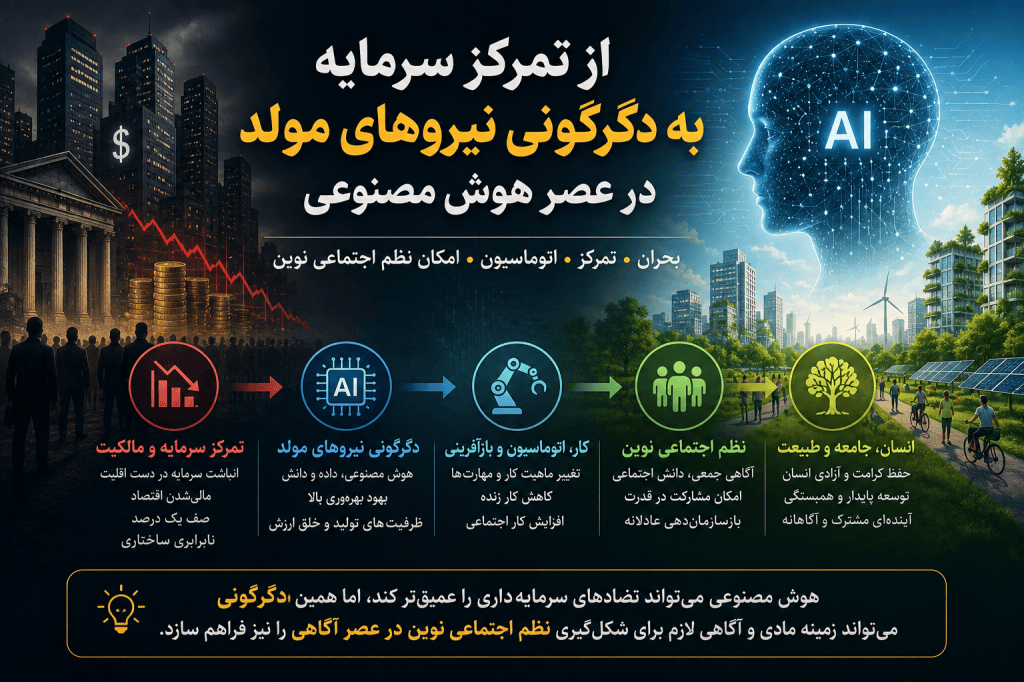
بحران ساختاری سرمایهداری آمریکا در عصر هوش مصنوعی
تمرکز ثروت، دگرگونی نیروهای مولد و امکان نظم اجتماعی نوین در عصر آگاهی
حمید اخوی
مقدمه
بحث درباره بحران سرمایهداری آمریکا را نباید با این ادعا آغاز کرد که اقتصاد ایالات متحده در آستانه فروپاشی فوری قرار گرفته است. چنین ادعایی نه با واقعیتهای اقتصادی سازگار است و نه برای یک نقد مارکسیستی جدی ضرورت دارد. ایالات متحده همچنان یکی از بزرگترین و پویاترین اقتصادهای جهان، مرکز بخش مهمی از سرمایه مالی جهانی و مهمترین قطب سرمایهگذاری خصوصی در فناوریهای پیشرفته و هوش مصنوعی است. برآورد نهایی اداره تحلیل اقتصادی آمریکا نشان میدهد تولید ناخالص داخلی واقعی این کشور در سهماهه نخست ۲۰۲۶ با نرخ سالانه ۲.۱ درصد رشد کرده و سرمایهگذاری، صادرات، هزینههای دولتی و مصرف خانوار در این رشد سهم داشتهاند. بنابراین مسئله مورد بحث در این مقاله بحران به معنای توقف ساده تولید یا فروپاشی قریبالوقوع بازارها نیست؛ مسئله، تضادهای ساختاری شیوه تولید سرمایهداری در مرحلهای است که نیروهای مولد به سطحی از اجتماعیشدن، دانشبنیانی و وابستگی متقابل رسیدهاند که با شکل خصوصی مالکیت و تصاحب محصول اجتماعی تنش فزایندهای پیدا میکند.
در این معنا، رشد اقتصادی نه نفیکننده بحران، بلکه خود میتواند حامل تضاد باشد: جامعه ثروت بیشتری تولید میکند، بهرهوری افزایش مییابد و فناوری امکان تولید با کار انسانی کمتر را فراهم میسازد، اما همزمان مالکیت ثروت و سرمایه در بخش کوچکی از جامعه متمرکز میشود و دسترسی اکثریت به محصول اجتماعی همچنان عمدتاً از طریق فروش نیروی کار صورت میگیرد. این مقاله میکوشد بحران کنونی سرمایهداری آمریکا را در همین چارچوب بررسی کند. نقطه عزیمت آن اقتصاد سیاسی مارکس و مفاهیمی چون انباشت، تمرکز سرمایه، ارزش اضافی، مالیشدن، سرمایه موهوم، اجتماعیشدن تولید و تضاد میان نیروهای مولد و روابط تولید است. هدف، تکرار مکانیکی مفاهیم قرن نوزدهم نیست، بلکه بررسی معنای تازه آنها در شرایطی است که دانش، داده، الگوریتم، شبکه و هوش مصنوعی به نیروهای مستقیم تولید تبدیل شدهاند و این پرسش را پیش میکشند که آیا همین تحول میتواند شرایط مادی و معرفتی پیدایش نظمی متفاوت را فراهم کند؛ نظمی که در اینجا از آن با عنوان «نظم اجتماعی نوین در عصر آگاهی» یاد میشود.
از بحران ادواری تا تضاد ساختاری انباشت سرمایه
در اقتصاد متعارف، بحران اغلب بهعنوان انحراف از وضعیت تعادل بررسی میشود. افزایش قیمت انرژی، اختلال زنجیره تأمین، سیاست پولی نامناسب، همهگیری، جنگ یا سقوط یک بازار مالی میتواند اقتصاد را از مسیر عادی خارج کند و سیاستگذار وظیفه دارد آن را دوباره به تعادل بازگرداند. اقتصاد سیاسی مارکس پرسش متفاوتی مطرح میکند: اگر بحرانها در تاریخ سرمایهداری بارها و در اشکال گوناگون بازمیگردند، آیا نمیتوان سرچشمه آنها را در خود منطق انباشت جستوجو کرد؟ سرمایه در تحلیل مارکس صرفاً مجموعهای از ماشینآلات یا پول نیست؛ یک رابطه اجتماعی است که در آن پول وارد فرایند تولید میشود تا در پایان به پول بیشتری تبدیل شود. سرمایهدار نیروی کار و وسایل تولید را خریداری میکند، کالا تولید میشود و تحقق ارزش کالا باید سرمایه اولیه را همراه با ارزش اضافی بازگرداند. از این رو هدف نهایی تولید سرمایهداری نه تأمین مستقیم نیاز اجتماعی، بلکه بازتولید سرمایه در مقیاسی گستردهتر است.
رقابت هر سرمایه را وادار میکند هزینه را کاهش دهد، فناوری جدید به کار گیرد، بهرهوری را افزایش دهد و سهم بازار خود را حفظ یا گسترش دهد. همین فرایند تناقضی ایجاد میکند که برای فهم بحرانهای سرمایهداری اهمیت بنیادی دارد. هر بنگاه میکوشد هزینه نیروی کار را نسبت به محصول کاهش دهد، اما مجموعه سرمایه برای فروش محصول خود به قدرت خرید اجتماعی نیاز دارد. هر بنگاه از جایگزینی نیروی انسانی با فناوری سود میبرد، اما اکثریت جامعه همچنان درآمد خود را از فروش نیروی کار به دست میآورند. بنابراین آنچه از دید سرمایه منفرد عقلانی است، میتواند در سطح کل نظام به عدم تعادل منجر شود. سرمایهداری ظرفیت تولید را دائماً افزایش میدهد، اما هیچ مکانیسم خودکاری وجود ندارد که تضمین کند قدرت خرید اکثریت جامعه با همان آهنگ افزایش یابد.
از اینجاست که مسئله اضافهانباشت اهمیت پیدا میکند. سرمایه انباشتهشده باید دوباره با نرخ سود قابل قبول سرمایهگذاری شود. هنگامی که فرصتهای سرمایهگذاری مولد به اندازه حجم سرمایه گسترش نمییابند، بخشی از سرمایه به بازارهای مالی، املاک، اوراق بدهی و اشکال مختلف دارایی منتقل میشود. اعتبار برای مدتی میتواند فاصله میان تولید و قدرت خرید را پر کند و ارزش داراییها میتواند بسیار سریعتر از تولید واقعی افزایش یابد، اما این فرایند تضاد را از میان نمیبرد؛ آن را به آینده منتقل میکند. مفهوم «سرمایه موهوم» در مارکس برای فهم همین وضع اهمیت دارد: مطالبات مالی بر درآمد و ارزش آینده میتوانند خود به موضوع خرید و فروش تبدیل شوند و ظاهراً مستقل از فرایند تولید رشد کنند، در حالی که در نهایت تحقق آنها به تولید اجتماعی ارزش وابسته باقی میماند.
مالیشدن، بدهی و اجتماعیشدن ریسک سرمایه
اقتصاد آمریکا در چند دهه گذشته نمونه برجستهای از گسترش این منطق بوده است. مالیشدن به این معنا نیست که تولید مادی اهمیت خود را از دست داده است، بلکه نشان میدهد روابط مالی و مالکیت داراییها نقش فزایندهای در سازماندهی اقتصاد پیدا کردهاند. خانوادهای که درآمدش برای خرید خانه کافی نیست از وام مسکن استفاده میکند؛ دانشجو برای تحصیل بدهکار میشود؛ خانوار برای مصرف از کارت اعتباری استفاده میکند؛ شرکت برای سرمایهگذاری، خرید سهام خود یا ادغام با رقیب اوراق بدهی منتشر میکند و دولت نیز برای تأمین مخارج خود استقراض میکند. اعتبار به جامعه امکان میدهد محدودیت امروز را با تعهدی نسبت به درآمد فردا جایگزین کند، اما در همان حال بخشی از درآمد آینده را پیشاپیش به بازپرداخت اصل و بهره اختصاص میدهد.
بحران مالی ۲۰۰۸ و همهگیری ۲۰۲۰ ماهیت متناقض این ساختار را آشکار کردند. هنگامی که بازتولید عادی سرمایه، اعتبار یا درآمد خانوارها مختل شد، دولت و بانک مرکزی توانستند منابع عظیمی را برای جلوگیری از فروپاشی زنجیرههای پرداخت، اعتبار و تولید بسیج کنند. این تجربهها افسانه اقتصاد سرمایهداری بهعنوان حوزهای مستقل از دولت را تضعیف میکنند. سرمایهداری پیشرفته بدون زیرساخت حقوقی، پولی، مالی، علمی و فیزیکی دولت قابل تصور نیست و هنگامی که بقای کل نظام در معرض خطر قرار میگیرد، دولت به نهادی برای اجتماعیکردن بخشی از ریسکهای خصوصی تبدیل میشود. خصوصیبودن مالکیت در اینجا با اجتماعیبودن پیامدهای آن روبهرو میشود: زیان یک نهاد بزرگ مالی یا تولیدی میتواند آنقدر آثار عمومی داشته باشد که جامعه ناگزیر از تحمل بخشی از هزینه حفظ شرایط بازتولید کل نظام شود.
تمرکز ثروت و ساختار طبقاتی آمریکا
برای فهم اینکه محصول این نظام در اختیار چه کسانی قرار میگیرد، باید از شاخصهای کلان به ساختار مالکیت حرکت کرد. یکی از محدودیتهای بحث عمومی درباره نابرابری این است که اغلب بر تفاوت درآمد تمرکز میکند. درآمد و ثروت یکسان نیستند. درآمد جریانی است که فرد در یک دوره دریافت میکند، در حالی که ثروت انباشتی از داراییهاست که میتواند خود درآمد، بهره، سود، اجاره و افزایش ارزش ایجاد کند. به همین دلیل، برای تحلیل طبقاتی، توزیع ثروت و بهویژه نوع داراییهای تحت مالکیت اهمیت بیشتری از مقایسه ساده حقوق سالانه دارد.
دادههای Distributional Financial Accounts فدرال رزرو برای سهماهه نخست ۲۰۲۶ تصویری روشن از تمرکز داراییها ارائه میکنند. فقط در بخش سهام شرکتها و واحدهای صندوقهای سرمایهگذاری، ۰.۱ درصد بالای خانوارها حدود ۱۳.۳۳ تریلیون دلار، ۰.۹ درصد بعدی حدود ۱۴.۳۱ تریلیون دلار و ۹ درصد بعدی حدود ۲۰.۵۱ تریلیون دلار در اختیار داشتند؛ در مقابل، کل ۵۰ درصد پایین خانوارها فقط حدود ۵۹۰ میلیارد دلار از این نوع داراییها را مالک بودند. این تفاوت فقط تفاوت در سطح مصرف نیست. مالکیت سهام، حقی بر بخشی از سود و افزایش ارزش سرمایه ایجاد میکند و به همین دلیل تمرکز این داراییها بیانگر تمرکز امکان تصاحب درآمد ناشی از مالکیت است.
در تحلیل مارکسیستی، طبقه را نمیتوان به گروههای درآمدی پایین، متوسط و بالا فروکاست. یک پزشک، استاد دانشگاه یا مهندس ممکن است درآمد بالایی داشته باشد، اما اگر درآمد اصلی او همچنان از فروش نیروی کار تخصصیاش حاصل شود، رابطه او با تولید با مالک یک مجموعه عظیم سرمایه یکسان نیست. ثروت علاوه بر ایجاد درآمد، خود را نیز بازتولید میکند. صاحب سهام از سود و افزایش قیمت دارایی برخوردار میشود؛ مالک ملک میتواند اجاره دریافت کند؛ دارنده اوراق بهره میگیرد و سرمایهگذار میتواند بازده دارایی موجود را برای خرید دارایی جدید به کار گیرد. در مقابل، خانوار فاقد ثروت ممکن است برای خرید خانه، تحصیل یا حتی مصرف ضروری بدهکار شود و به جای دریافت بهره، بهره بپردازد. به این ترتیب ثروت نه فقط نتیجه نابرابری گذشته، بلکه یکی از سازوکارهای تولید نابرابری آینده است.
از این رو، تمرکز ثروت را باید تمرکز قدرت نیز دانست. مالکیت سرمایه به صاحبان آن امکان میدهد درباره محل سرمایهگذاری، فناوری مورد استفاده، تعداد کارکنان، جابهجایی تولید، تخصیص بودجه تحقیقاتی و جهت توسعه بنگاه تصمیم بگیرند. دموکراسی سیاسی بر اصل رسمی یک نفر، یک رأی استوار است، اما تخصیص منابع اقتصادی بر چنین اصلی عمل نمیکند. فرد یا نهادی که میلیاردها دلار سرمایه در اختیار دارد، قدرت تصمیمگیری اقتصادی بسیار بیشتری از میلیونها شهروندی دارد که دارایی اصلی آنها نیروی کارشان است. قدرت اقتصادی نیز میتواند از طریق تأمین مالی سیاسی، لابیگری، مالکیت رسانه، حمایت از اندیشکدهها و دانشگاهها و دسترسی مستقیمتر به سیاستگذاران به نفوذ اجتماعی و سیاسی تبدیل شود. این بدان معنا نیست که هر تصمیم سیاسی مستقیماً توسط ثروتمندان دیکته میشود، اما نابرابری عظیم منابع، ظرفیت اثرگذاری بر تصمیمات جمعی را نیز بهشدت نامتقارن میکند.
از تمرکز سرمایه به دگرگونی نیروهای مولد در عصر هوش مصنوعی
این ساختار مالکیت اکنون با تحولی تاریخی در نیروهای مولد تلاقی میکند. هوش مصنوعی، یادگیری ماشین، مراکز داده، رایانش ابری، تراشههای پیشرفته و اتوماسیون در حال تبدیلشدن به بخش مهمی از زیرساخت تولید هستند. گزارش AI Index 2026 دانشگاه استنفورد نشان میدهد سرمایهگذاری خصوصی در هوش مصنوعی در ایالات متحده طی سال ۲۰۲۵ به ۲۸۵.۹ میلیارد دلار رسید؛ بیش از ۲۳ برابر ۱۲.۴ میلیارد دلار سرمایهگذاری خصوصی ثبتشده در چین. در همان سال ۱٬۹۵۳ شرکت تازه AI در آمریکا تأمین مالی شدند. این ارقام را نباید صرفاً نشانه رونق یک صنعت جدید تلقی کرد. سرمایه با چنین مقیاسی به سوی حوزهای حرکت میکند که امکان افزایش بهرهوری، کاهش هزینه، ایجاد بازارهای تازه و کسب درآمد و رانت ناشی از مالکیت فکری و کنترل زیرساخت را فراهم میکند.
در انقلاب صنعتی، سرمایهگذاری در ماشینآلات مکانیکی توان جسمانی انسان را چند برابر کرد؛ انقلاب دیجیتال امکان پردازش و انتقال اطلاعات را گسترش داد؛ هوش مصنوعی اکنون بخشی از فعالیت شناختی انسان ــ تحلیل، ترجمه، برنامهنویسی، طراحی، تولید متن و تصویر، تشخیص الگو و تصمیمسازی ــ را وارد حوزه اتوماسیون میکند. اما AI از یک جهت با ماشین صنعتی کلاسیک تفاوت مهمی دارد. ماده اولیه شناختی آن تا حد زیادی محصول اجتماعی انباشتهشده بشر است. زبان، کتاب، مقاله علمی، تصویر، کد نرمافزاری، تحقیقات دانشگاهی، دادههای اجتماعی و دانش نسلهای گذشته در شکلگیری محیطی نقش داشتهاند که مدلهای هوش مصنوعی از آن تغذیه میکنند. اینجاست که بحث مارکس در گروندریسه درباره رشد «دانش عمومی اجتماعی» یا آنچه بعدها General Intellect نامیده شد، اهمیت تازهای پیدا میکند. هوش مصنوعی را نمیتوان تحقق ساده و مکانیکی پیشبینی مارکس دانست، اما شباهت ساختاری چشمگیر است: دانش اجتماعی اکنون واقعاً میتواند در ماشین، شبکه و الگوریتم تثبیت شود و مستقیماً در تولید نقش ایفا کند.
در همین نقطه، نقش پلتفرمها و شیوه تبدیل فعالیت اجتماعی به درآمد سرمایهای اهمیت پیدا میکند. پلتفرمهایی مانند Facebook و Instagram در مجموعه Meta، و YouTube و خدمات Google در مجموعه Alphabet، تنها ابزارهای ارتباطی خنثی نیستند؛ آنها زیرساختهایی خصوصیاند که بر بستر فعالیت گسترده کاربران، تولید محتوا، جستوجو، مشاهده، تعامل و توجه اجتماعی، بازارهای عظیم تبلیغاتی و خدماتی ایجاد کردهاند. Alphabet در گزارش سالانه ۲۰۲۵ خود ۲۹۴.۷ میلیارد دلار درآمد تبلیغاتی گزارش کرد که ۴۰.۴ میلیارد دلار آن مستقیماً از تبلیغات YouTube بود؛ در عین حال درآمد YouTube از مجموع تبلیغات و اشتراکها در همان سال از ۶۰ میلیارد دلار فراتر رفت. شرکت همچنین از اشتراکهایی مانند YouTube Premium و Google One، که دسترسی به مدلهای پیشرفته Gemini را نیز عرضه میکند، و از Google Cloud از طریق هزینههای مصرفی و اشتراک برای زیرساخت، پلتفرم و خدمات AI درآمد کسب میکند. بنابراین سودآوری اقتصاد دیجیتال و هوش مصنوعی فقط از فروش یک «محصول AI» حاصل نمیشود؛ تبلیغات، اشتراک، خدمات ابری، دسترسی به زیرساخت محاسباتی و تبدیل توجه و فعالیت کاربران به فرصت تجاری، لایههای مختلف یک نظام واحد انباشت را تشکیل میدهند.
اهمیت طبقاتی این سازوکار در آن است که فعالیت اجتماعی میلیونها و میلیاردها انسان در یک سوی رابطه قرار میگیرد، در حالی که مالکیت زیرساختی که این فعالیت را سازمان میدهد و به درآمد تبدیل میکند در سوی دیگر متمرکز است. البته از این واقعیت نباید نتیجه گرفت که تمام ارزش تولیدشده در اقتصاد AI مستقیماً به صاحبان چند پلتفرم منتقل میشود؛ زنجیره ارزش شامل تولید تراشه، انرژی، مراکز داده، شبکه، رایانش ابری، مدلهای بنیادین، نرمافزار، تبلیغات و خدمات مصرفی است و سرمایه و سود در لایههای گوناگون آن توزیع میشود. با این همه، شرکتهایی که گلوگاههای اصلی این زنجیره ــ پلتفرم، زیرساخت محاسباتی، شبکه توزیع، مدل یا دسترسی به کاربران ــ را کنترل میکنند، از موقعیتی ممتاز برای تصاحب بخشی از ارزش اجتماعی برخوردارند. در نتیجه، اجتماعیشدن روزافزون تولید دانش و داده الزاماً به اجتماعیشدن مالکیت یا محصول اقتصادی آن نمیانجامد؛ برعکس، در چارچوب روابط موجود میتواند شکل تازهای از تمرکز سرمایه ایجاد کند.
تناقض دقیقاً در همین نقطه آشکار میشود. دانش مورد استفاده در این فرایند ماهیتی بسیار اجتماعی دارد، اما زیرساختی که آن را به قدرت اقتصادی تبدیل میکند ــ مراکز داده، تراشهها، مدلهای بنیادین، شبکههای ابری و حقوق مالکیت فکری ــ میتواند در مالکیت خصوصی تعداد محدودی از شرکتها و صاحبان سرمایه قرار گیرد. دادههای فدرال رزرو نیز نشان میدهند که مالکیت سهام شرکتها از پیش بهشدت در بخش بالای توزیع ثروت متمرکز است. بنابراین اگر ارزش اقتصادی حاصل از AI عمدتاً از طریق سود شرکتها و افزایش ارزش سهام تحقق یابد، بدون تغییر در روابط مالکیت، بخش بزرگی از ثمره این دگرگونی تکنولوژیک میتواند به همان گروههایی منتقل شود که از پیش بخش اصلی سرمایه مالی را در اختیار دارند.
در اینجا تضاد کلاسیک میان تولید اجتماعی و تصاحب خصوصی شکل تازهای پیدا میکند. میلیونها و در واقع میلیاردها انسان در طول نسلها در تولید دانش و دادهای مشارکت کردهاند که اکنون به یکی از مهمترین مواد اولیه اقتصاد هوش مصنوعی تبدیل شده است، اما حق تصمیمگیری درباره نحوه استفاده از این ظرفیت و تصاحب بخش بزرگی از ارزش اقتصادی حاصل از آن میتواند در اختیار گروه بسیار کوچکتری باقی بماند. در چنین شرایطی، هوش مصنوعی نه تنها یک فناوری، بلکه یک مسئله مالکیت و بنابراین یک مسئله طبقاتی است.
اتوماسیون و تناقض میان رهایی از کار و ناامنی اقتصادی
این تحول یک تناقض عمیقتر نیز ایجاد میکند. از دیدگاه انسانی، افزایش بهرهوری و کاهش نیاز به کار باید دستاوردی مثبت باشد. اگر جامعه بتواند محصول مورد نیاز خود را با نصف زمان کار گذشته تولید کند، نتیجه عقلانی میتواند کاهش ساعات کار، افزایش زمان آزاد و فراهمشدن فرصت بیشتر برای آموزش، هنر، خانواده، فعالیت اجتماعی و رشد فردی باشد. فناوری در این معنا ظرفیت رهاییبخش دارد. اما در جامعهای که دسترسی اکثریت مردم به درآمد همچنان عمدتاً از طریق فروش نیروی کار سازمان یافته است، کاهش نیاز به نیروی کار میتواند نتیجهای کاملاً متفاوت ایجاد کند. اگر شرکت بتواند با استفاده از AI همان محصول را با تعداد کمتری کارگر تولید کند، این افزایش بهرهوری از دید بنگاه میتواند به کاهش هزینه و افزایش سود منجر شود؛ اما برای کارگری که شغل خود را از دست میدهد، همان پیشرفت فناوری به ناامنی اقتصادی تبدیل میشود.
این تناقض ناشی از هوش مصنوعی نیست. سرچشمه آن در رابطه اجتماعیای است که حق دسترسی به محصول اجتماعی را به اشتغال مزدی پیوند میدهد. اگر اتوماسیون به مرحلهای برسد که بخش فزایندهای از کار ضروری را ماشین انجام دهد، جامعه با پرسشی روبهرو خواهد شد که دیگر صرفاً تکنولوژیک نیست: اگر برای تولید ثروت به ساعات کار انسانی کمتری نیاز داریم، چرا امنیت زندگی انسان باید همچنان به فروش هرچه بیشتر ساعت کار وابسته باشد؟ در این نقطه میتوان از امکان تاریخی گذار از «بحران کمبود» به نوعی «بحران فراوانی بالقوه» سخن گفت. اگر ماشین بتواند کالا، خدمات و دانش بیشتری با کار انسانی کمتر تولید کند، پرسش اساسی دیگر فقط این نیست که چگونه تولید را افزایش دهیم؛ پرسش این است که چه کسی مالک ظرفیت تولید است، چه کسی درباره کاربرد آن تصمیم میگیرد و محصول افزایش بهرهوری چگونه میان اعضای جامعه تقسیم میشود.
بحران ساختاری و حدود اصلاحات درون سرمایهداری
از این تحلیل نباید نتیجه گرفت که اصلاحات اقتصادی بیاهمیتاند. مالیات تصاعدی، تقویت اتحادیهها، افزایش دستمزد، خدمات عمومی، آموزش و درمان همگانی، حمایت از بیکاران و تنظیم انحصارات میتوانند زندگی میلیونها انسان را بهبود دهند و توازن قدرت میان کار و سرمایه را تغییر دهند. نقد مارکسیستی زمانی به جزمگرایی تبدیل میشود که تفاوت میان شرایط واقعی زندگی انسانها را به این دلیل که یک اصلاح سرمایهداری را فوراً از میان نمیبرد، بیاهمیت تلقی کند. اما در عین حال، اصلاح توزیع درآمد با تحول روابط مالکیت یکسان نیست. اگر ساختار بنیادی مالکیت سرمایه تغییر نکند، همان مکانیسمهایی که ثروت را متمرکز کردهاند میتوانند پس از دورهای از اصلاحات دوباره عمل کنند. سرمایه از طریق سود، بهره، افزایش ارزش دارایی و انتقال بیننسلی خود را بازتولید میکند. بنابراین پرسش مارکسیستی فقط این نیست که محصول اجتماعی پس از تولید چگونه عادلانهتر توزیع شود؛ پرسش بنیادیتر این است که چه کسی وسایل تولید را مالک است، چه کسی درباره سرمایهگذاری تصمیم میگیرد و چه کسانی در تعیین اولویتهای اقتصادی جامعه مشارکت دارند.
این تمایز برای فهم مرحله کنونی اهمیت ویژهای دارد، زیرا AI میتواند مقیاس تمرکز را افزایش دهد. توسعه مدلهای پیشرفته به تراشه، انرژی، مراکز داده، شبکه و سرمایه عظیم نیاز دارد. این هزینههای ثابت بالا میتوانند ورود رقبای جدید را دشوار کنند و مزیت شرکتهایی را که از پیش سرمایه، داده و زیرساخت دارند تقویت کنند. از این رو ممکن است اجتماعیترین شکل تولید دانش با یکی از متمرکزترین اشکال مالکیت زیرساخت همراه شود.
از تضاد سرمایهداری تا امکان نظم اجتماعی نوین در عصر آگاهی
وجود تضاد ساختاری به معنای فروپاشی خودکار سرمایهداری نیست. تاریخ سرمایهداری نشان داده است که این نظام ظرفیت قابل توجهی برای انطباق دارد. سیاست کینزی، دولت رفاه، اعتبار، جهانیشدن، مالیشدن، سیاست پولی، خصوصیسازی و فناوری در دورههای مختلف به بازسازی شرایط انباشت کمک کردهاند. بحران نیز الزاماً نتیجه مترقی ندارد؛ میتواند به تمرکز بیشتر سرمایه، اقتدارگرایی، ملیگرایی، جنگ، نظارت دیجیتال و اشکال تازهای از سلطه منجر شود. بنابراین هیچ قانون اقتصادی وجود ندارد که از دل افزایش تضادهای سرمایهداری به صورت خودکار یک نظم اجتماعی بهتر بیرون بیاورد. همین نکته مرز مهمی میان جبرگرایی تاریخی و مفهوم نظم اجتماعی نوین در عصر آگاهی ایجاد میکند. نیروهای مولد میتوانند امکان تحول را ایجاد کنند، اما امکان با ضرورت یکسان نیست. آنچه میان این دو قرار دارد، آگاهی و کنش اجتماعی انسان است.
در اینجا مفهوم آگاهی معنایی فراتر از آگاهی فردی یا اخلاقی پیدا میکند. برای نخستین بار در تاریخ، فناوریهایی در حال شکلگیریاند که بالقوه میتوانند حجم عظیمی از اطلاعات مربوط به تولید، مصرف، منابع، نیازها و پیامدهای تصمیمات اقتصادی را تقریباً در زمان واقعی پردازش کنند. همان هوش مصنوعی که میتواند برای افزایش سود شرکت خصوصی به کار رود، از نظر فنی میتواند برای برنامهریزی منابع، سنجش نیازهای اجتماعی، شفافیت تصمیمات، مشارکت شهروندان و هماهنگی شبکههای پیچیده تولید نیز مورد استفاده قرار گیرد. فناوری شکل اجتماعی کاربرد خود را تعیین نمیکند؛ روابط قدرت و مالکیت تعیین میکنند که این ظرفیت در خدمت چه هدفی قرار گیرد.
از این منظر، نظم اجتماعی نوین در عصر آگاهی را نباید صرفاً نسخهای جدید از ملیکردن مالکیت یا انتقال کنترل از شرکت خصوصی به دستگاه دولت تصور کرد. اگر قدرت اقتصادی از گروه کوچکی از صاحبان سرمایه به گروه کوچکی از مدیران دولتی منتقل شود، مسئله مشارکت انسان در قدرت لزوماً حل نشده است. مسئله بنیادیتر آن است که چگونه میتوان مالکیت، تصمیمگیری و مدیریت منابع اجتماعی را به شکلی سازمان داد که انسانها نه فقط دریافتکنندگان محصول تصمیمات اقتصادی، بلکه مشارکتکنندگان آگاه در شکلگیری آنها باشند.
این امر مستلزم بازاندیشی در رابطه میان مالکیت، کار، درآمد و قدرت است. اگر افزایش بهرهوری امکان کاهش زمان کار را فراهم میکند، ثمره آن میتواند به جای بیکاری گسترده به کاهش ساعت کار اجتماعی تبدیل شود. اگر دانش محصول همکاری تاریخی بشر است، میتوان درباره اشکال اجتماعیتر دسترسی و مالکیت آن اندیشید. اگر فناوری امکان مشارکت و پردازش اطلاعات در مقیاس بزرگ را فراهم میکند، میتوان درباره ساختارهایی فراتر از انتخاب دورهای نمایندگان و مدیریت متمرکز بوروکراتیک فکر کرد. و اگر تولید واقعاً اجتماعی است، مسئله مشارکت در قدرت اقتصادی دیگر یک آرمان انتزاعی نیست؛ به پرسشی درباره انطباق روابط اجتماعی با ماهیت واقعی نیروهای مولد تبدیل میشود.
جمعبندی
اقتصاد آمریکا در سال ۲۰۲۶ تصویری متناقض اما از نظر تاریخی بسیار معنادار ارائه میکند. اقتصاد همچنان رشد میکند و در همان حال مالکیت داراییهای مولد بهشدت متمرکز است. در بخش سهام و صندوقهای سرمایهگذاری، گروههای بالای توزیع ثروت بخش قاطع مالکیت را در اختیار دارند، در حالی که سهم نیمه پایین جامعه بسیار ناچیز است. همزمان، آمریکا با ۲۸۵.۹ میلیارد دلار سرمایهگذاری خصوصی AI در سال ۲۰۲۵ با فاصله بسیار زیاد بزرگترین مرکز سرمایهگذاری خصوصی در هوش مصنوعی جهان بوده است. این ارقام به خودی خود نظریه مارکس را «اثبات» نمیکنند و نباید از آمار نتیجهای بیش از ظرفیت آن استخراج کرد، اما در کنار یکدیگر پدیدهای را آشکار میکنند که تحلیل مارکسیستی برای فهم آن همچنان قدرت توضیحی دارد: تولید هرچه اجتماعیتر میشود، دانش بیش از گذشته به نیروی مستقیم تولید تبدیل میشود و سرمایه به مقیاسهای عظیمتری از هماهنگی اجتماعی وابسته میشود، در حالی که مالکیت و حق تصاحب محصول این فرایند میتواند در بخش کوچکی از جامعه متمرکز باقی بماند.
هوش مصنوعی این تضاد را به مرحلهای تازه میرساند. دانش اجتماعی انباشتهشده بشر میتواند در قالب مدل، الگوریتم و ماشین به نیروی تولید تبدیل شود؛ اما زیرساختی که این دانش را به قدرت اقتصادی تبدیل میکند میتواند خصوصی باشد. فناوری میتواند نیاز به کار انسانی را کاهش دهد؛ اما اگر درآمد همچنان به اشتغال مزدی وابسته بماند، همان پیشرفت میتواند ناامنی اقتصادی ایجاد کند. بهرهوری میتواند امکان فراوانی بیشتر را فراهم سازد؛ اما اگر حق دسترسی به محصول اجتماعی تابع مالکیت باقی بماند، فراوانی بالقوه میتواند در کنار محرومیت واقعی وجود داشته باشد.
در چنین شرایطی، بحرانهای سرمایهداری ممکن است به تدریج از بحرانهای ادواری بازار فراتر روند و به بحران انطباق روابط تولید با نیروهای مولدی تبدیل شوند که خود سرمایهداری ایجاد کرده است. با این حال، هیچ تضمینی وجود ندارد که این تضادها به نظمی آزادتر، عادلانهتر یا انسانیتر منجر شوند. همان فناوریها میتوانند برای تمرکز قدرت، نظارت و کنترل نیز به کار روند. تفاوت میان این مسیرها را نه فناوری به تنهایی، بلکه سطح آگاهی اجتماعی، سازمانیابی، نهادهای دموکراتیک و توانایی انسانها برای مشارکت آگاهانه در تعیین آینده خود رقم خواهد زد.
از همین جاست که امکان نظم اجتماعی نوین در عصر آگاهی پدیدار میشود؛ نه بهعنوان مرحلهای محتوم که تاریخ خودبهخود به آن خواهد رسید، بلکه بهعنوان امکانی که توسعه نیروهای مولد شرایط مادی آن را فراهم میکند و تحققش به کنش آگاهانه جامعه وابسته است. تفاوت این نگرش با جبرگرایی تاریخی دقیقاً در همین نکته است: نظم نوین قرار نیست از ویرانههای سرمایهداری به صورت خودکار سر برآورد؛ باید آگاهانه اندیشیده، طراحی و از طریق مشارکت اجتماعی ساخته شود.
در چنین افقی، اقتصاد دیگر هدف جامعه نیست، بلکه وسیله شکوفایی انسان است؛ فناوری نه ابزاری برای حذف انسان به منظور افزایش سود، بلکه وسیلهای برای کاهش کار غیرضروری و گسترش آزادی اوست؛ دانش نه صرفاً کالایی برای انحصار، بلکه میراثی اجتماعی است؛ و قدرت اقتصادی نه حق طبیعی ناشی از مقدار مالکیت، بلکه حوزهای است که باید در آن امکان مشارکت آگاهانه جامعه وجود داشته باشد. سرمایهداری با اجتماعیکردن تولید، جهانیکردن تقسیم کار، تبدیل دانش به نیروی تولید و اکنون با دگرگونی نیروهای مولد در عصر هوش مصنوعی، خود شرایط مادی طرح پرسشی را فراهم کرده است که شاید در قرن بیستویکم اهمیت فزایندهای پیدا کند: اگر دانش، تولید و ثروت بیش از هر زمان دیگری محصول فعالیت اجتماعی انسانها هستند، چرا مالکیت و قدرت تصمیمگیری درباره آنها باید همچنان تا این اندازه خصوصی و متمرکز باقی بماند؟
پاسخ به این پرسش از پیش تعیین نشده است. بحران سرمایهداری تضمینکننده نظم بعدی نیست. اما هرچه فاصله میان ماهیت اجتماعی نیروهای مولد و تمرکز خصوصی مالکیت بیشتر شود، امکان طرح یک بدیل تاریخی نیز واقعیتر میشود. نظم اجتماعی نوین در عصر آگاهی یکی از نامهایی است که میتوان به این امکان داد: امکانی برای آنکه جامعه به جای انتظار برای نظمی که تاریخ بر آن تحمیل میکند، آگاهانه درباره نظمی که میخواهد بسازد تصمیم بگیرد.
منابع اصلی
- Marx, Karl. Capital: A Critique of Political Economy, Vols. I–III.
- Marx, Karl. Grundrisse: Foundations of the Critique of Political Economy، بهویژه Fragment on Machines.
- Federal Reserve Board. Distributional Financial Accounts, 2026 Q1.
- U.S. Bureau of Economic Analysis. GDP (Third Estimate), Industries, Corporate Profits, State GDP, and State Personal Income, First Quarter 2026.
- Stanford Institute for Human-Centered Artificial Intelligence. Artificial Intelligence Index Report 2026.
- Alphabet Inc. Annual Report / Form 10-K for fiscal year 2025.
The Structural Crisis of American Capitalism in the Age of Artificial Intelligence
Concentration of Wealth, Transformation of the Productive Forces, and the Possibility of a New Social Order in the Age of Awareness
Hamid Akhavi
Introduction
A discussion of the crisis of American capitalism should not begin with the claim that the United States economy is on the verge of immediate collapse. Such a claim is neither consistent with economic realities nor necessary for a serious Marxist critique. The United States remains one of the world’s largest and most dynamic economies, a center of global financial capital, and the leading hub of private investment in advanced technologies and artificial intelligence. The U.S. Bureau of Economic Analysis’s final estimate shows that real gross domestic product grew at an annual rate of 2.1 percent in the first quarter of 2026, with investment, exports, government spending, and household consumption all contributing. The issue examined here, therefore, is not crisis as a simple halt in production or an imminent market collapse. It is the structural contradictions of the capitalist mode of production at a stage when the productive forces have become so socialized, knowledge-based, and interdependent that they increasingly conflict with private ownership and private appropriation of the social product.
In this sense, economic growth does not negate crisis; growth itself can carry contradiction. Society produces more wealth, productivity rises, and technology makes it possible to produce with less human labor, while ownership of wealth and capital becomes concentrated in a small part of society and the majority still gain access to the social product mainly by selling their labor power. This article examines the present crisis of American capitalism within that framework. Its point of departure is Marx’s political economy and concepts such as accumulation, concentration of capital, surplus value, financialization, fictitious capital, socialization of production, and the contradiction between productive forces and relations of production. The goal is not to repeat nineteenth-century concepts mechanically, but to examine their renewed meaning under conditions in which knowledge, data, algorithms, networks, and artificial intelligence have become direct productive forces—and to ask whether this transformation may also create the material and cognitive conditions for a different order, referred to here as “a new social order in the age of awareness.”
From Cyclical Crisis to the Structural Contradiction of Capital Accumulation
In mainstream economics, crisis is often treated as a departure from equilibrium. Higher energy prices, supply-chain disruption, unsuitable monetary policy, a pandemic, war, or a financial-market collapse may push the economy off its normal path, and policymakers are expected to restore balance. Marx’s political economy asks a different question: if crises recur throughout capitalist history in many forms, should their source be sought in the logic of accumulation itself? In Marx’s analysis, capital is not merely machinery or money; it is a social relation in which money enters production in order to return as more money. The capitalist purchases labor power and means of production, commodities are produced, and the realization of their value must return the original capital together with surplus value. The ultimate purpose of capitalist production is therefore not the direct satisfaction of social need, but the reproduction of capital on an expanded scale.
Competition compels each capital to cut costs, introduce new technology, raise productivity, and preserve or expand market share. This process creates a contradiction fundamental to understanding capitalist crises. Every firm seeks to reduce labor costs relative to output, yet capital as a whole needs social purchasing power to sell its products. Each firm benefits from replacing human labor with technology, while most people still obtain income by selling their labor power. What is rational from the standpoint of an individual capital can therefore generate imbalance at the level of the system. Capitalism continually expands productive capacity, but no automatic mechanism guarantees that the purchasing power of the majority will rise at the same rate.
This is where overaccumulation becomes important. Accumulated capital must be reinvested at an acceptable rate of profit. When productive investment opportunities do not expand as rapidly as the mass of capital, part of that capital moves into financial markets, real estate, debt securities, and other assets. Credit can temporarily bridge the gap between production and purchasing power, and asset values can rise much faster than real output, but this does not eliminate the contradiction; it postpones it. Marx’s concept of “fictitious capital” is important here: financial claims on future income and value can themselves be bought and sold and appear to grow independently of production, even though their ultimate realization remains dependent on the social production of value.
Financialization, Debt, and the Socialization of Capital Risk
The American economy over recent decades is a leading example of this logic. Financialization does not mean that material production has lost importance; it means that financial relations and asset ownership play a growing role in organizing the economy. A family whose income is insufficient to buy a house takes a mortgage; a student incurs debt for education; households use credit cards for consumption; corporations issue debt to invest, buy back shares, or merge with competitors; and the government borrows to finance expenditures. Credit allows society to replace today’s limitation with a claim on tomorrow’s income, while committing part of that future income in advance to principal and interest payments.
The 2008 financial crisis and the 2020 pandemic exposed the contradictory nature of this structure. When the normal reproduction of capital, credit, or household income was disrupted, the government and central bank mobilized enormous resources to prevent the collapse of payment, credit, and production chains. These experiences weaken the myth of capitalism as a sphere independent of the state. Advanced capitalism is inconceivable without the state’s legal, monetary, financial, scientific, and physical infrastructure. When the survival of the system is threatened, the state becomes an institution for socializing part of the risks created privately. Private ownership confronts the social character of its consequences: the losses of a major financial or productive institution can have such broad effects that society is compelled to bear part of the cost of preserving the conditions for the reproduction of the system as a whole.
Concentration of Wealth and the American Class Structure
To understand who controls the product of this system, analysis must move from aggregate indicators to the structure of ownership. A limitation of public debate about inequality is its frequent focus on income differences. Income and wealth are not the same. Income is a flow received during a period; wealth is a stock of assets that can itself generate income, interest, profit, rent, and capital gains. For class analysis, the distribution of wealth—and especially the kinds of assets owned—is therefore more important than a simple comparison of annual salaries.
Federal Reserve Distributional Financial Accounts for the first quarter of 2026 provide a clear picture of asset concentration. In corporate equities and mutual-fund shares alone, the top 0.1 percent of households owned about $13.33 trillion, the next 0.9 percent about $14.31 trillion, and the next 9 percent about $20.51 trillion. By contrast, the entire bottom 50 percent owned only about $590 billion of these assets. This is not merely a difference in consumption. Stock ownership creates a claim on profit and capital appreciation; concentration of these assets therefore represents concentration of the capacity to appropriate ownership income.
In Marxist analysis, class cannot be reduced to low-, middle-, and high-income groups. A physician, professor, or engineer may earn a high income, but if that income still comes mainly from selling specialized labor power, that person’s relation to production is not the same as that of the owner of a vast concentration of capital. Wealth not only generates income; it reproduces itself. Shareholders receive profit and capital gains, landlords collect rent, bondholders receive interest, and investors can use returns on existing assets to acquire new ones. Households without wealth may instead incur debt for housing, education, or even essential consumption and pay interest rather than receive it. Wealth is thus not only a result of past inequality; it is a mechanism for producing future inequality.
The concentration of wealth must therefore also be understood as a concentration of power. Capital ownership enables its holders to decide where to invest, what technology to use, how many workers to employ, where production will be located, how research budgets are allocated, and in what direction firms develop. Political democracy rests formally on one person, one vote, but economic resources are not allocated on that principle. A person or institution controlling billions of dollars has far greater economic decision-making power than millions of citizens whose principal asset is their labor power. Economic power can also become social and political influence through campaign finance, lobbying, media ownership, support for think tanks and universities, and more direct access to policymakers. This does not mean every political decision is directly dictated by the wealthy; it means that enormous resource inequality also makes the capacity to influence collective decisions profoundly unequal.
From the Concentration of Capital to the Transformation of Productive Forces in the Age of AI
This ownership structure now intersects with a historic transformation of the productive forces. Artificial intelligence, machine learning, data centers, cloud computing, advanced chips, and automation are becoming central components of productive infrastructure. Stanford University’s AI Index 2026 reports that private AI investment in the United States reached $285.9 billion in 2025—more than twenty-three times the $12.4 billion recorded in China. In the same year, 1,953 newly funded AI companies emerged in the United States. These figures should not be treated merely as evidence of a booming new industry. Capital on this scale is moving toward a field that promises greater productivity, lower costs, new markets, and revenue and rent derived from intellectual property and control over infrastructure.
During the Industrial Revolution, investment in mechanical machinery multiplied human physical power; the digital revolution expanded the processing and transmission of information; artificial intelligence now brings parts of human cognitive activity—analysis, translation, programming, design, text and image production, pattern recognition, and decision support—into the sphere of automation. Yet AI differs importantly from the classical industrial machine. Its cognitive raw material is largely humanity’s accumulated social product. Language, books, scientific articles, images, software code, university research, social data, and the knowledge of past generations have created the environment from which AI models draw. Marx’s discussion in the Grundrisse of the growth of “general social knowledge,” later called the General Intellect, therefore acquires renewed significance. AI should not be regarded as a simple mechanical fulfillment of Marx’s prediction, but the structural resemblance is striking: social knowledge can now be fixed in machines, networks, and algorithms and participate directly in production.
At this point, the role of platforms and the conversion of social activity into capital income becomes crucial. Facebook and Instagram within Meta, and YouTube and Google services within Alphabet, are not neutral communication tools; they are privately owned infrastructures that build vast advertising and service markets on user activity, content production, search, viewing, interaction, and social attention. Alphabet reported $294.7 billion in advertising revenue for 2025, including $40.4 billion directly from YouTube advertising; total YouTube revenue from advertising and subscriptions exceeded $60 billion. The company also earns from subscriptions such as YouTube Premium and Google One, which can include access to advanced Gemini models, and from Google Cloud through usage fees and subscriptions for infrastructure, platform, and AI services. Profitability in the digital and AI economy therefore does not arise solely from selling an “AI product.” Advertising, subscriptions, cloud services, access to computing infrastructure, and the conversion of user attention and activity into commercial opportunity form layers of a single system of accumulation.
The class significance of this mechanism lies in the separation between the social activity of millions and billions of people and the concentrated ownership of the infrastructure that organizes and monetizes it. This does not mean that all value generated in the AI economy flows directly to a few platform owners. The value chain includes chips, energy, data centers, networks, cloud computing, foundation models, software, advertising, and consumer services, and capital and profit are distributed across its layers. Nevertheless, firms controlling key bottlenecks—platforms, computing infrastructure, distribution networks, models, or access to users—occupy a privileged position for appropriating part of socially generated value. The increasing socialization of knowledge and data production does not necessarily socialize ownership or its economic product; within existing relations, it can instead create a new form of capital concentration.
The contradiction becomes clearest here. The knowledge used in this process is profoundly social, but the infrastructure that converts it into economic power—data centers, chips, foundation models, cloud networks, and intellectual-property rights—can be privately owned by a small number of companies and investors. Federal Reserve data also show that corporate equity ownership is already concentrated at the top of the wealth distribution. If AI’s economic value is realized mainly through corporate profit and higher share prices, then without a change in ownership relations, much of the benefit of this technological transformation may flow to the same groups that already hold most financial capital.
The classical contradiction between social production and private appropriation thus assumes a new form. Millions—and over generations, billions—of people have contributed to the knowledge and data that now constitute a major raw material of the AI economy. Yet decisions about using this capacity and the appropriation of much of the resulting economic value may remain in the hands of a far smaller group. Under these conditions, artificial intelligence is not merely a technology; it is a question of ownership and therefore a class question.
Automation and the Contradiction Between Liberation from Labor and Economic Insecurity
This transformation produces a deeper contradiction. From a human standpoint, higher productivity and a reduced need for labor should be positive achievements. If society can produce what it needs in half the former working time, the rational outcome could be shorter working hours, more free time, and greater opportunity for education, art, family, social activity, and personal development. Technology has emancipatory potential in this sense. But in a society where most people obtain income mainly by selling their labor power, a reduced need for labor may have an entirely different result. If a company uses AI to produce the same output with fewer workers, higher productivity can mean lower costs and higher profit for the firm, while the same technological advance becomes economic insecurity for a worker who loses a job.
This contradiction is not created by AI. Its source is the social relation that ties access to the social product to wage employment. If automation reaches a point where machines perform a growing share of necessary labor, society confronts a question that is no longer merely technological: if fewer human working hours are needed to produce wealth, why should human security remain dependent on selling ever more hours of labor? Here one may speak of a historical possibility of moving from a “crisis of scarcity” toward a “crisis of potential abundance.” If machines can produce more goods, services, and knowledge with less human labor, the central question is no longer only how to increase production, but who owns productive capacity, who decides its use, and how the gains from productivity are distributed.
Structural Crisis and the Limits of Reform Within Capitalism
This analysis should not imply that economic reforms are unimportant. Progressive taxation, stronger unions, higher wages, public services, universal education and health care, support for the unemployed, and regulation of monopolies can improve millions of lives and alter the balance of power between labor and capital. Marxist critique becomes dogmatic when it dismisses real differences in human living conditions merely because a reform does not immediately abolish capitalism. Yet reforming income distribution is not the same as transforming ownership relations. If the basic structure of capital ownership remains intact, the mechanisms that concentrate wealth can resume operation after a period of reform. Capital reproduces itself through profit, interest, asset appreciation, and intergenerational transfer. The Marxist question is therefore not only how the social product should be distributed more fairly after production, but who owns the means of production, who decides investment, and who participates in setting society’s economic priorities.
This distinction is especially important now because AI can increase the scale of concentration. Advanced models require chips, energy, data centers, networks, and enormous amounts of capital. High fixed costs can make entry difficult and reinforce the advantage of firms that already possess capital, data, and infrastructure. The most socialized form of knowledge production may therefore coexist with one of the most concentrated forms of infrastructure ownership.
From Capitalist Contradiction to the Possibility of a New Social Order in the Age of Awareness
The existence of structural contradiction does not mean that capitalism will collapse automatically. The history of capitalism demonstrates a considerable capacity for adaptation. Keynesian policy, the welfare state, credit, globalization, financialization, monetary policy, privatization, and technology have at different times helped reconstruct the conditions of accumulation. Crisis does not necessarily produce progressive outcomes; it can lead to greater concentration of capital, authoritarianism, nationalism, war, digital surveillance, and new forms of domination. No economic law automatically produces a better social order from capitalism’s intensifying contradictions. This marks an important boundary between historical determinism and the concept of a new social order in the age of awareness. Productive forces can create the possibility of transformation, but possibility is not necessity. Social awareness and human action stand between the two.
Here awareness takes on a meaning beyond individual or moral consciousness. For the first time in history, emerging technologies can potentially process vast quantities of information about production, consumption, resources, needs, and the consequences of economic decisions in near real time. The same AI used to increase private corporate profit could technically be used for resource planning, assessing social needs, making decisions transparent, enabling citizen participation, and coordinating complex production networks. Technology does not determine the social form of its use; relations of power and ownership determine the ends this capacity serves.
From this perspective, a new social order in the age of awareness should not be imagined merely as a new version of nationalization or the transfer of control from private companies to the state apparatus. If economic power passes from a small group of capital owners to a small group of state managers, the problem of human participation in power is not necessarily resolved. The deeper issue is how ownership, decision-making, and the management of social resources can be organized so that people are not merely recipients of economic decisions but conscious participants in shaping them.
This requires rethinking the relationship among ownership, labor, income, and power. If higher productivity makes shorter working time possible, its benefit could be expressed as a reduction in society’s working hours rather than mass unemployment. If knowledge is the product of humanity’s historical cooperation, more social forms of access and ownership can be considered. If technology enables participation and large-scale information processing, structures beyond periodic elections and centralized bureaucratic administration become conceivable. And if production is truly social, participation in economic power is no longer an abstract ideal; it becomes a question of bringing social relations into alignment with the actual character of the productive forces.
Conclusion
The American economy in 2026 presents a contradictory but historically significant picture. The economy continues to grow while ownership of productive assets remains intensely concentrated. In corporate equities and mutual-fund shares, groups at the top of the wealth distribution hold the overwhelming share, while the bottom half of society owns very little. At the same time, with $285.9 billion in private AI investment during 2025, the United States was by far the world’s leading center of private AI investment. These figures do not by themselves “prove” Marx’s theory, and statistics should not be asked to establish more than they can. Taken together, however, they reveal a phenomenon that Marxist analysis still helps explain: production becomes increasingly social, knowledge becomes a direct productive force, and capital depends on ever larger scales of social coordination, while ownership and the right to appropriate the product can remain concentrated in a small part of society.
Artificial intelligence takes this contradiction to a new stage. Humanity’s accumulated social knowledge can become a productive force embodied in models, algorithms, and machines, while the infrastructure that converts that knowledge into economic power remains private. Technology can reduce the need for human labor, but if income remains tied to wage employment, the same advance can create insecurity. Productivity can make greater abundance possible, but if access to the social product remains governed by ownership, potential abundance can coexist with real deprivation.
Under these conditions, capitalist crises may gradually move beyond cyclical market crises and become crises of adaptation between relations of production and the productive forces capitalism itself has created. Yet there is no guarantee that these contradictions will lead to a freer, more just, or more humane order. The same technologies can be used to concentrate power, surveil, and control. The difference between these paths will be determined not by technology alone but by the level of social awareness, organization, democratic institutions, and people’s capacity to participate consciously in shaping their future.
The possibility of a new social order in the age of awareness emerges from this point—not as an inevitable stage toward which history will move on its own, but as a possibility whose material conditions are created by the development of the productive forces and whose realization depends on conscious social action. The difference between this view and historical determinism lies precisely here: the new order will not rise automatically from capitalism’s ruins; it must be consciously conceived, designed, and built through social participation.
In such a horizon, the economy is no longer society’s end but a means to human flourishing; technology is not a means of removing people to raise profit, but a means of reducing unnecessary labor and expanding freedom; knowledge is not merely a commodity to be monopolized, but a social inheritance; and economic power is not a natural right derived from the amount of property one owns, but a sphere in which society must be able to participate consciously. By socializing production, globalizing the division of labor, transforming knowledge into a productive force, and now reshaping the productive forces through AI, capitalism itself has created the material conditions for a question of growing importance in the twenty-first century: if knowledge, production, and wealth are more than ever the products of human social activity, why should ownership and decision-making power over them remain so private and concentrated?
The answer is not predetermined. Capitalist crisis does not guarantee the next order. But as the distance widens between the social character of the productive forces and the private concentration of ownership, the possibility of a historical alternative becomes more real. “A new social order in the age of awareness” is one name for this possibility: a society that, instead of waiting for history to impose an order upon it, consciously decides what order it wants to build.
Principal Sources
- Marx, Karl. Capital: A Critique of Political Economy, Vols. I–III.
- Marx, Karl. Grundrisse: Foundations of the Critique of Political Economy, especially “Fragment on Machines.”
- Federal Reserve Board. Distributional Financial Accounts, 2026 Q1.
- U.S. Bureau of Economic Analysis. GDP (Third Estimate), Industries, Corporate Profits, State GDP, and State Personal Income, First Quarter 2026.
- Stanford Institute for Human-Centered Artificial Intelligence. Artificial Intelligence Index Report 2026.
- Alphabet Inc. Annual Report / Form 10-K for fiscal year 2025.


Leave a comment