Combined report: September 4–8, 2026
People’s Resistance to Opaque AI and Data-Center Expansion
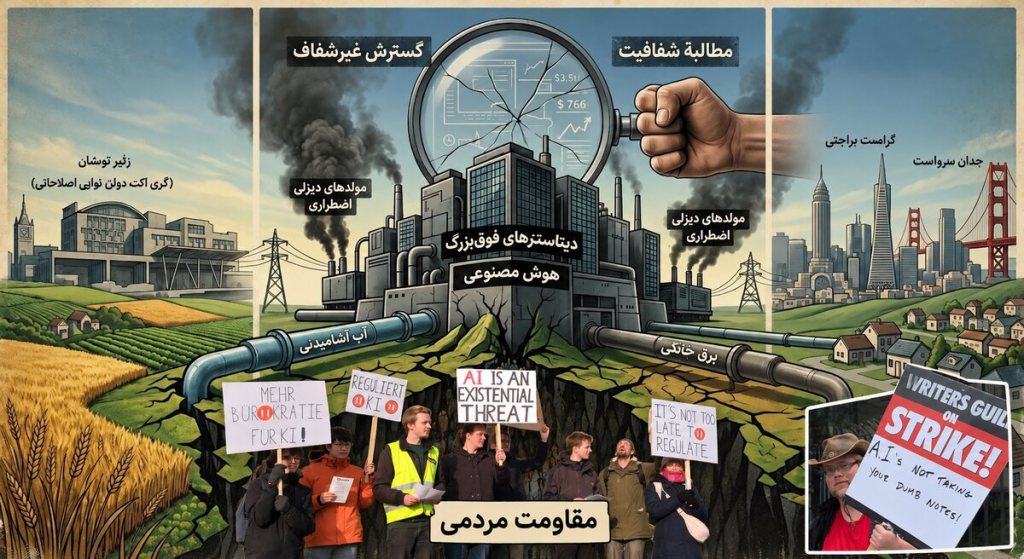
This report consolidates documented developments since the website’s last published edition and removes duplicates. Event dates are separated from publication dates, and claims made by companies, governments, and campaign groups are attributed to them. Most of these actions are not opposition to technology itself; they challenge ownership, surveillance, working conditions, resource use, and the exclusion of communities from decisions.
1. Community resistance and local data-center decisions
Edinburgh, Scotland — demand for a nationwide pause
Event date: September 3 | Publication date: September 3. Hundreds of people representing fourteen local groups rallied outside the Scottish Parliament, calling for a pause on hyperscale data-center permits until the cumulative effects on electricity, water, land, climate, and communities are assessed. Organizers say more than twenty projects are in the planning pipeline and could require more than 7,000 MW. That is the campaign’s estimate, not a final government assessment.
One contested proposal is a reported £2 billion investment in the Lammermuir Hills. This is proposed investment—not realized revenue or profit. The principal demands are a binding definition of a “green data center,” environmental review, and public participation before approval. The government has promised a strategic approach but has not accepted a nationwide pause. The Guardian; Global Justice Now.
Hopkinton, Rhode Island, United States — emergency 60-day moratorium
Decision date: September 1 | Detailed report published: September 3. The town council paused the acceptance and approval of new data-center applications for sixty days while permanent rules are considered. Concerns include water use, grid pressure, noise, light and air pollution, and possible electricity-price increases. Most residents rely on wells. No specific company or project was named, and wages are not at issue. Uprise RI.
Port Angeles, Washington, United States — move toward a six-month moratorium
Preliminary vote: September 1 | Publication date: September 3. The city council directed staff to draft a six-month pause on new applications. Future review is expected to address electricity rates, water, industrial land, noise, and environmental effects. No formal data-center application existed at the time, so this was a preventive step rather than a final moratorium. My Clallam County.
Wesley Vale, Tasmania, Australia — request for state-level review of Firmus
Development reported: September 7; the council vote date was not publicly specified. Latrobe Council unanimously asked that Firmus Technologies’ proposed 52 MW data center be declared a “major project” and assessed at the state level. The company cites more than twenty permanent jobs, but no pay rates or independently enforceable employment guarantees have been published.
Firmus says cooling will rely on rainwater and trucked water. Project documents identify forty emergency diesel generators. Critics say assessing Firmus’s three projects separately obscures their cumulative impact on the grid. State-level review does not itself reject or halt the project; public comments were due September 9. ABC; Firmus.
Victoria, Australia — moratorium and compensation demands
Demands announced: September 7. The Victorian Greens called for an immediate pause on new approvals and construction, a ban on data centers in Melbourne’s green wedge and significant agricultural land, and a levy to compensate residents for noise, pollution, and lost property value. Jemena was reported to have paused new connections because of grid constraints, but the start date and affected projects were not publicly clear. The Greens’ statement that technology companies earn “billions in profit” is a political claim; no audited profit figure was provided for the projects at issue. Guardian Australia; Victorian Greens.
2. Labor resistance, union action, and algorithmic surveillance
United States — Wikimedia Foundation workers form a union
Ballots counted: September 3 | Published: September 4. Direct employees voted 158–14 to unionize. The bargaining unit covers more than 200 staff and seeks greater worker power in decision-making, management transparency, and protection against unfair dismissal. No hourly or daily wage was published.
This was not a direct protest against AI. It occurred, however, as AI companies depend heavily on Wikipedia content and workers face questions about human labor and the stewardship of free-knowledge infrastructure. Wired; Wikimedia Foundation.
San Francisco, United States — unions rally against algorithmic dismissal and surveillance
Rally date: September 4. California unions, including the Teamsters and health-sector workers, urged Governor Gavin Newsom to sign nine worker-protection bills. Demands include human review of firing and discipline, advance notice of automation-related layoffs, and limits on emotion inference and collection of workers’ neural data. No specific wage rate was at issue.
A hospital call-center worker said emotion-recognition software evaluates her tone in real time. This is the worker’s account; no independent system assessment was published. The protest targets unilateral surveillance and automated decision-making without consent or collective bargaining—not all applications of AI. CBS San Francisco; OnLabor.
Brisbane and Gatton, Australia — University of Queensland staff strike
Strike date: September 8 | Call published: September 7. Direct university employees took action at the St Lucia and Gatton campuses. The NTEU seeks a 20 percent pay rise over three years; management’s offer was recorded as 12 percent over four years. No hourly or daily rate was published.
The AI dispute centers on enforceable human oversight and a human decision-maker in employment and disciplinary matters. The university has also acknowledged underpaying 16,382 people by about A$11 million between 2017 and 2026. That amount covers wages, interest, and retirement contributions; it is not university revenue or profit. Courier Mail; NTEU UQ.
Warsaw, Poland — symbolic robot demonstration in defense of jobs
Event date: September 7 | Reports published: September 7–8. The civic initiative Democratism deployed about thirty humanoid and quadruped robots outside the Ministry of Digital Affairs to provoke debate about job displacement and AI regulation. This was a human-organized symbolic demonstration—not a worker strike or autonomous robot protest. No wage figure was given, and no specific regulatory commitment was reported. Straits Times; Dawn.
3. Electricity, water, pollution, and public-cost shifting
New South Wales, Australia — data centers should pay grid-expansion costs
Development reported: September 7. Transgrid said proposed data-center connections around Sydney now exceed 20 GW—about twice the entire state’s peak demand—while only about 1.5 GW of capacity remains on the existing grid. Developers would have to fund additional infrastructure and pay for reserved capacity even when they do not fully use it. This is not a grassroots protest, but it responds to a central public demand: private infrastructure costs should not be shifted onto household bills. Transgrid; Renew Economy.
Thane, India — continuing resistance to an AWS data center
Main protest: July 18 | Detailed report published: September 6. Wakeup Thanekar and residents of Balkum, Majiwada, and Dhokali oppose a project spanning 53 hectares, with 422 MW of electricity demand, reported use of 125,000 liters of treated water per day, and 193 emergency diesel generators. This is not an employment dispute, and no wage rate was published.
Amazon says the facility will not use water for cooling, will employ a closed-loop system, and will draw power through a dedicated substation. These are company claims. Residents respond that a dedicated substation does not eliminate regional grid demand and cite heat, noise, emissions, and the siting of the project among homes and at least eight schools and hospitals. Activists say they do not oppose technology itself. Maharashtra memoranda valued above $300 billion concern proposed investment—not realized revenue or profit. Indian Express.
Cheyenne, Wyoming, United States — dispute over Meta-project wastewater
New investigation published: September 8 | Main events occurred earlier; wastewater acceptance stopped in July. A city test found the rare bacterium Cupriavidus gilardii in roughly 801,000 gallons discharged while a data-center system was flushed. The water did not enter the drinking-water system, but reuse stopped because of possible public contact. Goat Systems is Meta’s contractor and has challenged the notice and penalty.
Meta and its contractor dispute the city’s result and say their independent testing did not confirm the bacterium. The source and level of risk remain contested. The reported $800 million is proposed project investment—not revenue or profit. The Guardian; Cheyenne Board of Public Utilities.
Virginia, United States — Microsoft appeals an advance-payment rule
Appeal filed: August 28 | Details reported: September 3. Microsoft challenged a State Corporation Commission order requiring very large electricity users to pay in advance for dedicated transmission infrastructure. Microsoft says it accepts the cost-causation principle but objects to implementation. This is not popular resistance; it is the industry’s legal response to a consumer-protection decision designed to prevent the costs and risks of canceled or downsized projects from falling on the public. Financial Times; Virginia governor’s office.
4. Concentrated power and a human-rights response
United Nations, Geneva — call for binding safeguards
Speech and publication date: September 7. UN High Commissioner for Human Rights Volker Türk called for firm AI safeguards and warned that development and decision-making power are concentrated among a small number of companies. He cited risks to public services, communications, democracy, and autonomous weapons. This was not an executive decision or ban; its significance lies in placing ownership concentration and corporate power on the formal Human Rights Council agenda. OHCHR; Reuters.
5. The hidden AI labor chain
No independently documented new development involving non-payment, psychological harm, pay, or legal action by data annotators, model evaluators, or content moderators in Kenya, Uganda, Ghana, the Philippines, India, or Latin America emerged during this period. No date had yet been announced for the strike authorized by contracted security guards at OpenAI, Anthropic, Google, and other technology offices in California.
For accuracy, the documented historical OpenAI–Sama rate in Kenya was $1.32–$2 per hour, not $2 per day. Sama directly hired and managed the workers, while OpenAI commissioned and economically benefited from the work. Contractual separation does not erase the chain’s economic connection or shared ethical responsibility. Because no new development occurred, the case is not presented as a new daily event.
Analytical conclusion
Resistance is moving from scattered protest toward three more organized forms: preventive moratoriums and review; shifting infrastructure costs to the companies that create demand; and transforming “AI ethics” from a voluntary management policy into an enforceable collective-bargaining right.
The common thread is the contradiction between social production and private ownership. Data, knowledge, electricity, water, land, and human labor are socially produced or supplied, while control of infrastructure and financial returns remains concentrated among a small number of companies. Low pay, algorithmic dismissal, surveillance, pollution, and grid-expansion costs are shifted onto workers and communities. This is the capitalist accumulation pattern of the AI economy: private power and gain alongside socialized costs and risk.
Most of these movements do not reject technology itself. They demand genuine public and worker power over where, how, why, and by whom technology is built and used; public disclosure of resource commitments and contracts; and human and social oversight of decisions affecting work and life. From the perspective of a new social order, progress should be measured not by the speed of capital accumulation but by democratic participation, social transparency, protection of shared resources, and the community’s power to decide.
Major advances: coordinated action by fourteen Scottish communities; the decisive Wikimedia union vote; enforceable AI protections entering university strikes and bargaining; and moves by councils and grid operators to prevent projects from locking in costs for households.
Open outcomes: Scotland has not accepted a nationwide pause; the Firmus project has not been rejected; Australian labor demands and California bills have not yet become final protections; and Microsoft’s appeal could weaken the principle that large users pay the costs they cause.
Watch list: the outcome of the Wesley Vale consultation; DuPont’s public meeting on a data-center pause; Victoria’s response to moratorium and compensation demands; University of Queensland bargaining; and a strike date for contracted technology-office guards.


Leave a comment