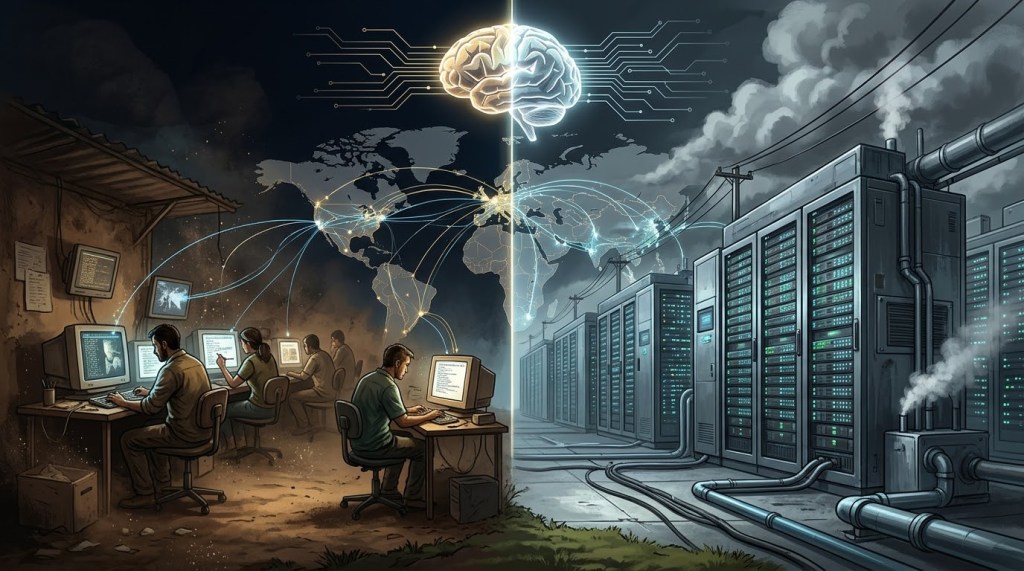

🆕 New Report: Global Protests and Resistance, September 9–13, 2026
The latest report documents popular protests, local resistance, and labor struggles against opaque AI and data-center expansion, focusing on water and electricity use, public costs, environmental impacts, transparency, and hidden labor.
Popular Resistance to the Opaque Expansion of Artificial Intelligence, Data Centers, and the Exploitation of Hidden Labor
From wages of $1.32–$2 an hour to valuations in the hundreds of billions: one chain linking client and contractor
Introduction
Artificial intelligence is often presented as an automated, clean product that needs little human labor. Behind that image, however, lies a vast network of energy-intensive data centers, mineral extraction, publicly supplied electricity and water, and thousands of low-paid workers who label data, evaluate model responses, and filter the internet’s most disturbing material. The social and psychological costs of this chain fall largely on local communities and workers in the Global South, while control of the technology and most of the income and value it creates remain with large corporations.
Two-dollar wages: the hidden reality behind ChatGPT
A TIME investigation found that OpenAI contracted Sama to filter and label texts containing violence, hatred, sexual abuse, and other harmful content in order to make ChatGPT safer. Kenya-based workers received only about $1.32 to $2 per hour. Under the same contract, according to reported documents, OpenAI paid Sama $12.50 for each hour of a worker’s labor. Even before comparing these payments with OpenAI’s revenue or valuation, the gulf between what was paid at the top of the chain and what reached the worker is evident.
These workers were not “direct OpenAI employees,” but that legal separation should not become a separation of social responsibility. OpenAI commissioned the work, defined the need, and used the resulting data; Sama hired, organized, and managed the workers. Structurally, they were links in one economic process: lowering production costs by transferring difficult and harmful work to cheap labor. We cannot assert the private intentions of the two companies’ executives without conclusive evidence, but the observable outcome is clear: product and value accumulated at the top while meager wages and psychological harm remained at the bottom.
What did the daily wage amount to?
With an eight-hour workday, $1.32 per hour equals $10.56 a day, while $2 per hour equals $16 a day. Thus, “two dollars a day” is not accurate for the documented Kenyan case; the reported figure was less than two dollars per hour. Yet the correction does not diminish the issue: a worker confronting traumatic material throughout the day received, even at the highest reported rate, only $16 for eight hours of work.
Comparison with OpenAI’s revenue, profit, and valuation
Three concepts must be distinguished. Revenue is money from sales; profit is revenue after expenses; valuation is investors’ estimate of a company’s worth. Reuters reported in 2025 that OpenAI’s annualized revenue was on a path toward $20 billion by year-end. In April 2026, Reuters also reported a $122 billion funding round and an $852 billion valuation. These figures are not “profit.” Nevertheless, their contrast with wages of $1.32–$2 an hour reveals the enormous concentration of resources at the top of the chain and the minute share received by the product’s hidden makers.
Even at the highest reported wage, $2 an hour, a worker employed 40 hours a week for 52 weeks would earn about $4,160 annually—before accounting for gaps between assignments, unpaid work, lack of benefits, and contract insecurity. The comparison does not claim that a corporation’s valuation should simply be divided among workers. It shows that wage-setting bears little relation to the true importance of their contribution.
Psychological harm and responsibility that cannot be outsourced
Kenyan workers reported spending hours with descriptions of murder, torture, rape, and child abuse. Some described severe psychological harm and inadequate therapeutic support. When a company transfers harmful content to a contractor, the danger does not disappear; it is shifted to workers with less bargaining power and fewer avenues for redress. Outsourcing must not become a way to conceal the source of labor, fragment the employment relationship, and disperse responsibility.
A global pattern, not a Kenyan exception
A 2026 SOMO study reported that Amazon, Google, Meta, Microsoft, and Nvidia use at least 30 intermediary firms for data work. Field reporting has described networks of labelers, evaluators, and content moderators in Kenya, Uganda, Ghana, the Philippines, India, and Latin America. Wages and employment relations are not identical everywhere, and the Kenyan figure should not be generalized without evidence. The recurring pattern, however, is precarious platform labor, multilayered contracting, intensive surveillance, task-based pay, and obstacles to organizing.
In Kenya, workers have formed a data labelers’ association and content moderators’ unions. Lawsuits against Meta and its contractors are especially important because Kenyan courts have accepted that a principal company cannot escape accountability merely by pointing to a contractor. These struggles seek more than higher wages: workers demand recognition of the real employment relationship, psychological support, job security, organizing rights, and access to cross-border justice.
Data centers: the physical face of artificial intelligence
AI depends on intensely material infrastructure. Data centers occupy land, consume vast amounts of electricity, require water for cooling, and sometimes necessitate new power plants and transmission lines. Network expansion costs or tax incentives may be passed on to the public, while a completed data center usually creates relatively few permanent jobs. Local opposition is therefore often not opposition to technology itself, but to secrecy, public subsidies, resource consumption, and decision-making without community participation.
In South Africa, Housing Assembly and Foxglove filed formal objections to two proposed Equinix data centers in Cape Town. Concerns included undisclosed water consumption, potential demand of up to 160 megawatts of electricity, pollution, and the absence of public consultation in a city that remembers the “Day Zero” water crisis. In Britain, whether large data centers should be halted or restricted during drought has also become a national dispute.
In the United States, Data Center Watch estimated that over two years, $18 billion in projects were blocked and $46 billion were delayed, with at least 142 groups active in 24 states. These figures require caution because not every cancellation can be attributed solely to public protest. Still, more recent reports indicate rapidly expanding resistance and the delay or cancellation of many additional projects. Central concerns include higher electricity bills, water use, noise, destruction of green space, declining property values, and tax exemptions for wealthy corporations.
Concrete examples of victories, moratoria, and continuing struggles
Fayetteville, Georgia: In early 2026, after roughly 100 residents spoke against a proposed second data center at a public meeting, the planning commission denied Crow Holdings’ application. The company initially appealed but withdrew the appeal before the next hearing. The city then imposed a moratorium on new applications and changed its zoning rules to prohibit new data centers. The case shows how organized participation in local institutions can directly alter a project’s course.
Coweta County, Georgia: County commissioners unanimously rejected Project Oak. The struggle over the much larger Project Sail—an approximately 800-acre proposed complex—continues. Residents and groups including Citizens for Rural Coweta have collected signatures seeking a referendum that could overturn the county ordinance permitting the project. Project Oak is therefore a documented rejection, while Project Sail must accurately be described as an unresolved, continuing fight.
Camden County, Georgia: In 2026, Camden became the first county in coastal Georgia to adopt a moratorium on new data-center consideration and construction. A data-center plan was also suspended. The action followed public concerns about water, electricity, opaque development procedures, and effects on local communities.
Gross-Gerau, Hesse, Germany: In February 2026, the city council rejected Vantage Data Centers’ €2.5 billion project by a vote of 18–14. Enormous electricity demand, waste heat, infrastructure pressure, and safety concerns were central to the public and political debate. This is a clear example of a major project being formally rejected after public scrutiny and controversy.
Maintal, Germany: EdgeConneX abandoned its planned project. Resistance by a citizens’ initiative to the gas-fired power plant intended to supply the data center, together with local controversy over energy consumption and fossil-fuel dependence, contributed to the retreat.
Babenhausen, Hesse, Germany: Stack Infrastructure abandoned its proposed data center. Reports emphasize uncertainty and the absence of clear local-government support. It is therefore more accurate to describe this as a cancellation amid local opposition and uncertain political support, rather than attribute it solely to street protest without sufficient evidence.
These cases demonstrate that resistance produces different outcomes: a permit may be formally denied, a company may withdraw, a moratorium may pause development while rules are written, or the struggle may remain unresolved. Recording these distinctions is essential for evaluating the real power of popular participation without exaggeration.
Resistance in workplaces and culture
Resistance to the capitalist deployment of AI is not limited to data centers. The 2023 strike by 11,500 Hollywood writers, the strike by roughly 160,000 actors, and the prolonged struggle of video-game performers all demanded limits on AI, informed consent, and compensation. Port workers have likewise resisted automation imposed without job guarantees or union participation. These movements generally do not demand an absolute ban on technology; they ask who owns it, who decides, and who receives the gains from productivity.
Shared demands of a global movement
These struggles point toward common demands: disclosure of all contractors and subcontractors; joint responsibility of client and intermediary for wages, safety, and mental health; a living wage rather than rates based on the cheapest labor market; the right to organize and bargain collectively; protection against retaliatory dismissal; independent assessment of data centers’ water, power, carbon, and environmental effects; publication of subsidy and tax-exemption agreements; consent and compensation for the use of voice, image, and creative work; and binding worker and community participation before AI systems are deployed.
Conclusion
The wage of $1.32–$2 per hour is not an accidental footnote in ChatGPT’s history. It is a compressed sign of the capitalist pattern of accumulation in the AI economy and the existing social order. Production is becoming more social and global: thousands of workers, users, researchers, content creators, and local communities help produce data, knowledge, infrastructure, and value. Yet ownership of the primary tools, control over decisions, and most of the created wealth remain concentrated in a few corporations and investors.
The OpenAI–Sama case makes this contradiction especially clear. Sama directly organized the work; OpenAI commissioned it and used its results. The contractual distinction between them should not obscure the unity of the economic chain or their shared responsibility. At one end, Kenyan workers faced wages of $1.32–$2 per hour and the risk of psychological injury; at the other, the resulting product contributed to revenue growth, investment, and a valuation in the hundreds of billions. Costs and risks were socialized, while ownership, decision-making power, and benefits remained private.
This is capitalism’s fundamental contradiction: the contradiction between social production and private ownership; between technology’s capacity to reduce working time and improve general welfare, and its use to cut labor costs, intensify surveillance, eliminate jobs, and further concentrate wealth and power. AI did not create this contradiction, but it accelerates it, globalizes it, and makes it more visible. Data centers reproduce the same pattern: water, electricity, land, tax exemptions, and network costs come from public resources, while primary decisions and benefits remain under private control.
A new social order would not make ever-greater capital accumulation its purpose. Its measure of progress would be the expansion of human capabilities, popular participation in power, social transparency, and the accountability of economic and technological institutions. AI should reduce exhausting work, shorten working time, expand education and health, protect the environment, and strengthen collective decision-making. Workers and communities that produce the data, knowledge, and infrastructure must participate meaningfully in ownership, policy, and the distribution of benefits.
Resistance by workers, unions, and local communities is therefore not merely a collection of isolated protests. It signals emerging social consciousness against an order that makes production collective while keeping wealth and power private. The issue is not opposition to knowledge and technology. The decisive question is whether AI will expand under the command of private profit and shift its costs onto the disadvantaged, or serve an order grounded in popular participation, accountable ownership, social transparency, dignity at work, and universal empowerment.
Sources
- TIME — OpenAI Used Kenyan Workers on Less Than $2 Per Hour to Make ChatGPT Less Toxic
- The Guardian — Kenyan moderators and the toll of training AI models
- Reuters — OpenAI valuation and annualized revenue reporting
- SOMO — Big Tech and AI data workers globally
- Reuters — Equinix and environmental concerns in Cape Town
- Data Center Watch — Blocked and delayed data-center projects
- Brookings — Reimagining data and AI labor in the Global South
- Foxglove — Campaigns and litigation for African content moderators
- Protect Coweta County — local documentation and Project Oak
- The Guardian — Coweta County residents’ campaign against Project Sail
- The Current GA — Camden moratorium and coastal Georgia opposition
- Hessenschau — Gross-Gerau rejects a €2.5 billion project
- Data Center Dynamics — Stack project in Babenhausen canceled

