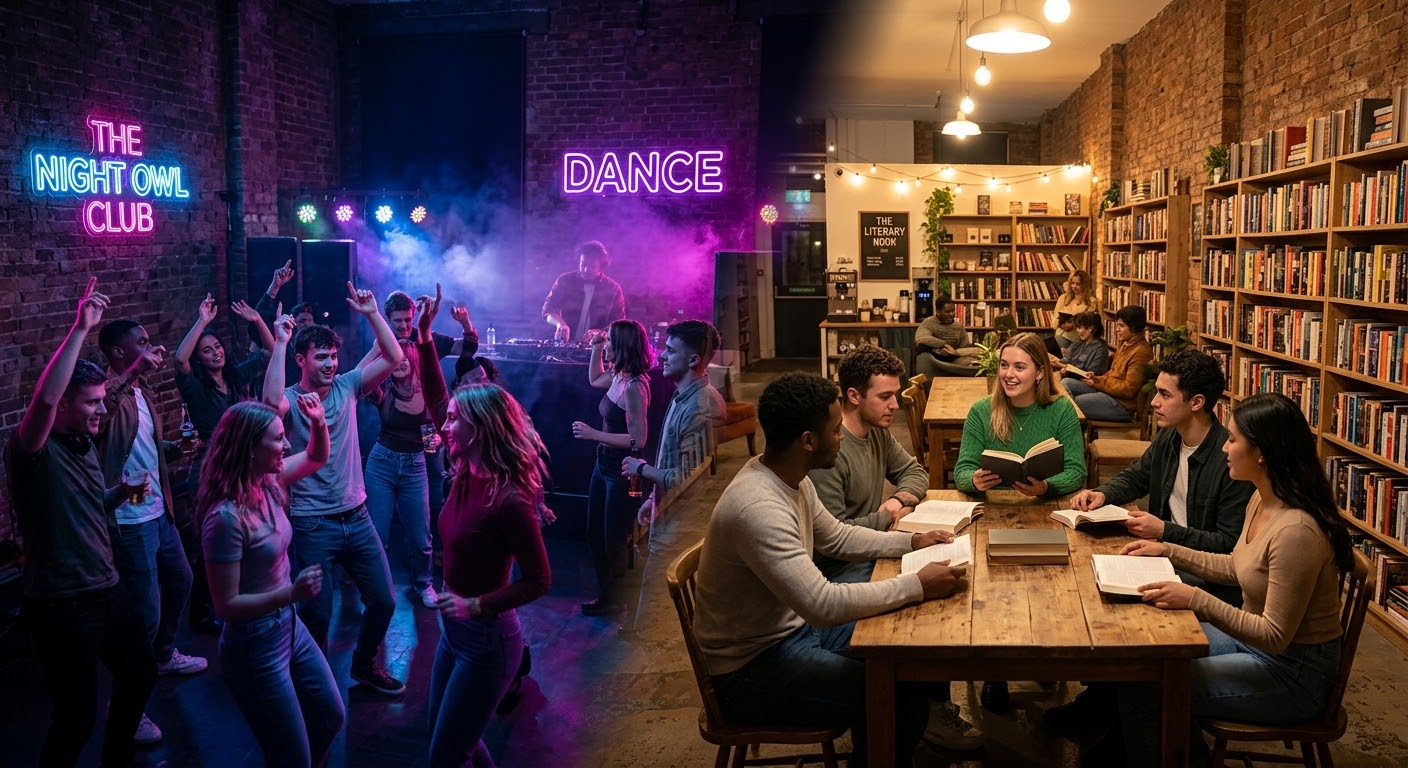
Gen Z, urban transformation, political consciousness, the nightlife recession, and the return of literary “third places”
Hamid Akhavi
Abstract
Contemporary urban sociology points to a significant, though uneven, cultural shift among many members of Generation Z. In numerous cities, younger adults appear less attached than previous generations to alcohol-centered nightlife and more interested in wellness, reading, small gatherings, cultural events, and lower-intensity forms of social interaction. At the same time, housing insecurity, precarious employment, digital surveillance, and the commercialization of public life are changing both the possibilities and meanings of urban sociality.
This transformation should not be reduced to a lifestyle trend. It may also reflect an emerging political consciousness: an awareness that exhaustion, loneliness, insecurity, environmental anxiety, and loss of privacy are not merely individual problems but consequences of systems of ownership, production, urban planning, and technological control.
Drawing on A New Social Order in the Age of Consciousness, this article argues that political consciousness develops when scattered personal experiences are connected to their structural causes. Yet withdrawal from commercial nightlife, individual sobriety, or the purchase of books does not automatically become resistance. Political consciousness becomes transformative only when private dissatisfaction develops into collective understanding, democratic organization, and participation in power.
1. The Eclipse of the Neon Metropolis
For decades, the nighttime economy was treated as a central expression of urban vitality. Bars, clubs, restaurants, and late-night districts generated employment and provided spaces where young adults experimented with identity, relationships, music, and belonging. This model is now under pressure. Many younger adults report drinking less, visiting clubs less frequently, and preferring smaller gatherings, cafés, bookstores, parks, fitness spaces, and online or hybrid communities.
The change is neither universal nor socially uniform. Class, race, gender, disability, geography, sexuality, and local culture all shape how young people use the city. Nightlife also remains important for artistic experimentation and for communities historically excluded from conventional public life. The decline of some forms of nightlife should therefore not be described as a rejection of pleasure. It is better understood as part of a wider reorganization of urban life under conditions of high costs, unstable work, climate anxiety, surveillance, and the commercialization of social interaction.
2. Macroeconomic Pressure and the Privatization of Social Life
High housing costs, debt, insecure employment, transportation expenses, and rising prices have narrowed the income available to many young adults. A single night out may require entrance fees, drinks, food, and transportation. What looks like a cultural preference for staying home may therefore be partly an adaptation to material constraint.
The deeper issue is that urban social life has increasingly been organized around commercial transactions. People are expected to purchase access to places where they can meet, talk, rest, dance, or simply remain in the presence of others. As genuinely public and noncommercial spaces disappear, participation becomes dependent on purchasing power.
This development illustrates a central contradiction discussed in A New Social Order in the Age of Consciousness: social life is collectively produced, but access to its institutions and resources is frequently controlled through private ownership. A vibrant city is created by workers, artists, residents, public infrastructure, collective knowledge, and generations of cultural activity, while much of the resulting value is privately appropriated.
Reading groups, walking clubs, public lectures, libraries, and community gatherings offer lower-cost alternatives. Yet affordability alone does not guarantee equality. Literary and wellness spaces can also become exclusive consumer markets. The decisive question is whether new third places function as branded lifestyle environments or as inclusive civic institutions.
3. The Digital Panopticon: Surveillance, Data, and Behavioral Control
Generation Z is the first cohort to have grown up with smartphones, social media, location tracking, facial recognition, and permanent digital records woven into everyday life. In a nightlife environment, a moment of spontaneity can be recorded, decontextualized, and permanently connected to an individual. The possibility of constant recording creates anticipatory self-discipline: people modify their behavior because they know they may be watched, classified, or publicly judged.
The digital panopticon extends beyond cameras. Searches, purchases, movements, preferences, relationships, and interactions generate data. Users are not merely consumers of technological platforms; through their behavior, attention, and personal information, they participate in production.
This is central to the book’s analysis. Digital platforms depend on socially generated data, collective knowledge, public research, global labor, communication networks, and the continuous activity of billions of people. Production is increasingly socialized, but ownership and control remain concentrated. Society generates the raw material of the digital economy, while private institutions decide how it will be collected, monetized, and used to influence behavior.
Moving from a club to a bookstore does not by itself eliminate surveillance. Payments, cameras, Wi-Fi systems, applications, and social-media promotion may continue to track participants. The demand for lower-surveillance spaces must therefore become part of a wider political struggle for privacy, democratic control of data, algorithmic transparency, and limits on corporate and governmental monitoring.
4. Sobriety, Wellness, and the Politics of Care
Many younger adults increasingly associate heavy drinking with anxiety, disrupted sleep, financial cost, and loss of control. Sobriety and moderation can challenge the assumption that celebration and adulthood must be organized around alcohol. They can also create more accessible social environments.
Wellness, however, contains a contradiction. It can resist unhealthy social conditions, but it can also become another individualized market. The wellness industry often tells people to purchase products, subscriptions, and optimization programs while leaving the causes of exhaustion untouched.
A politically conscious approach asks why so many people are chronically exhausted; why workers lack time for rest, family, creativity, and civic participation; and why mental-health resources remain unequal. Care then becomes more than private self-maintenance. Health, rest, leisure, and access to culture become social conditions of human development and democratic participation. An exhausted population has little time to study political questions, organize at work, participate in neighborhood decisions, or hold institutions accountable.
5. Redesigning the Post-Nightlife City
Vacant bars, clubs, offices, and retail spaces are being converted into cafés, bookstores, housing, studios, wellness facilities, and community venues. Adaptive reuse can reduce waste and respond to changing needs, but conversion alone does not determine social value. A former nightclub transformed into an expensive private club reproduces exclusion in a new form. A public cultural center, cooperative bookstore, or neighborhood assembly space may widen participation.
The central question is not only what a building becomes, but who owns it, who governs it, who can afford to enter it, and whose needs determine its use. The same principle applies to the “15-minute city.” Local access to essential services, libraries, green spaces, and public transportation can strengthen neighborhood life, but without housing justice, improved areas may displace the communities whose activity made them desirable.
Conventional planning often invites residents to comment only after decisions have been shaped by developers, investors, consultants, and agencies. The framework of a new social order proposes something deeper: not merely a distribution of power from above, but continuous participation in power. Residents, workers, neighborhood councils, and marginalized communities should participate in decisions about land use, housing, transportation, technology, and public investment.
6. From Social Awareness to Political Consciousness
Dissatisfaction is not yet political consciousness. Political consciousness emerges when people connect their personal experiences with social structures, historical forces, and relations of power. Rent, burnout, debt, loneliness, surveillance, or unemployment may first appear as individual failures. Consciousness develops when recurring patterns become visible: housing insecurity is linked to ownership and speculation; workplace anxiety to labor relations and automation; digital exhaustion to business models based on attention and data extraction; and the decline of public space to privatization and unequal investment.
This movement from “my problem” to “our condition” is decisive. But information alone is insufficient. A person may encounter thousands of political posts without developing a coherent analysis. Algorithmic systems reward speed, outrage, and polarization. Political consciousness requires time, dialogue, history, memory, comparison, and collective interpretation. It asks not only what is happening, but why, who holds decision-making power, what alternatives exist, and how people can act together.
Beyond Ethical Consumption
It is tempting to interpret every lifestyle choice as resistance. Choosing a sober venue, supporting an independent bookstore, or leaving a social platform may carry ethical value, but consumer decisions remain limited without organization. Markets can absorb dissent: sobriety becomes a premium brand, anti-surveillance becomes an expensive product, reading becomes an aesthetic commodity, and community becomes a subscription service.
Political consciousness moves from “What should I buy?” to larger questions: What should society produce? Who owns and governs digital infrastructure? Who decides how automation is introduced? How can communities participate directly in decisions that shape their lives? What institutions can transform shared knowledge into democratic power?
Social Production and Private Ownership
Modern productive forces—artificial intelligence, machine learning, cloud computing, automation, and global communication networks—depend on highly socialized systems of knowledge and cooperation. They emerge from public education, publicly supported research, global labor, shared science, infrastructure, user activity, and accumulated human culture. Yet ownership remains concentrated.
This contradiction affects city life directly. Automated systems influence employment, policing, housing, credit, transportation, education, public benefits, and access to information. Political consciousness in the age of AI must therefore include technological consciousness: an understanding of how data is produced, how algorithms distribute risks and opportunities, and how ownership determines the purposes technology serves.
7. Third Places as Schools of Democracy
Ray Oldenburg used the term “third place” for social environments beyond home and work. Libraries, cafés, parks, bookstores, and community centers can strengthen civil society through repeated informal encounters. Literary third places can transform reading from a private act into collective interpretation. Participants compare perspectives, question assumptions, connect history with current problems, and encounter ideas outside their usual information networks.
Libraries are particularly important because they offer access without requiring a purchase. They embody the principle that knowledge is a social resource rather than merely a commodity. Physical meetings can also create forms of trust and accountability that are difficult to reproduce through algorithmic platforms.
Offline space is not automatically democratic. Exclusion and hierarchy can exist there as well. Democratic third places require freedom of expression, accessibility, minority protection, transparency, and shared responsibility. They become politically consequential when discussion develops into durable practice and connects with neighborhood councils, tenant organizations, unions, environmental groups, and mutual-aid networks.
8. Participation in Power and the Conscious Citizen
Voting remains important, but periodic elections are not sufficient for democratic control over complex societies. Decisions affecting daily life are made continuously in workplaces, corporations, financial institutions, municipal agencies, and technological platforms.
A New Social Order in the Age of Consciousness proposes participation in power: institutions through which people take part directly and continuously in decisions affecting their communities and workplaces. Neighborhood councils can shape housing, environmental protection, cultural investment, and public-space design. Workplace councils can give workers a voice in automation, scheduling, safety, production, and the use of workplace data.
Digital systems may support real-time consultation, transparent budgeting, and access to public information, but technology cannot substitute for democracy. If platforms and data remain privately controlled or institutionally opaque, digitization may centralize authority rather than democratize it.
Participation also requires freedom of speech, press, association, assembly, political organization, unionization, and strike, together with protection of ethnic, religious, gender, sexual, and other minorities. The conscious and responsible citizen is neither a passive voter nor merely a consumer, but a participant in producing knowledge, evaluating decisions, holding institutions accountable, and shaping collective priorities.
9. Limits and Possibilities
The post-party metropolis contains democratic possibilities but also risks. Nightlife should not be dismissed as politically empty: clubs and music venues have historically sheltered artistic experimentation, queer communities, migrant cultures, and political networks. The objective is not to replace one legitimate social form with another, but to widen the range of safe, affordable, and non-extractive spaces.
Literary culture can also reproduce privilege. Bookstores and discussion groups may exclude people with limited time, income, mobility, or formal education. A democratic culture must include multiple languages, traditions, and forms of knowledge. Nor does private reading automatically change the institutions producing insecurity. Without collective organization, the individual may become a better-informed observer of the same unequal system.
Third places cannot survive through cultural enthusiasm alone. They require affordable land, public investment, accessible transportation, stable housing, fair wages, and time outside work. Their future is inseparable from political economy.
Conclusion
The decline of some forms of nightlife and the appeal of bookstores, libraries, cafés, parks, and reading circles are part of a wider transformation. Economic insecurity, health concerns, surveillance, data extraction, and dissatisfaction with commercialized social relations are encouraging many young people to search for different ways of living together.
The meaning of this transformation depends on whether it remains a collection of individualized lifestyle choices or develops into collective political consciousness. Consciousness matures when people connect private experience to social structure, recognize the relationship between technology and ownership, and move from awareness to democratic organization.
The post-party metropolis should not be imagined as a silent city in which bookstores simply replace nightclubs. A democratic city must make room for reading and dancing, contemplation and celebration, privacy and public assembly, individual development and collective action. Its defining characteristic would be the expansion of human agency: a city in which knowledge, technology, culture, and public space are organized around social needs, and conscious citizens possess the institutions necessary to shape their common future.

