Coverage: October 2–7, 2026
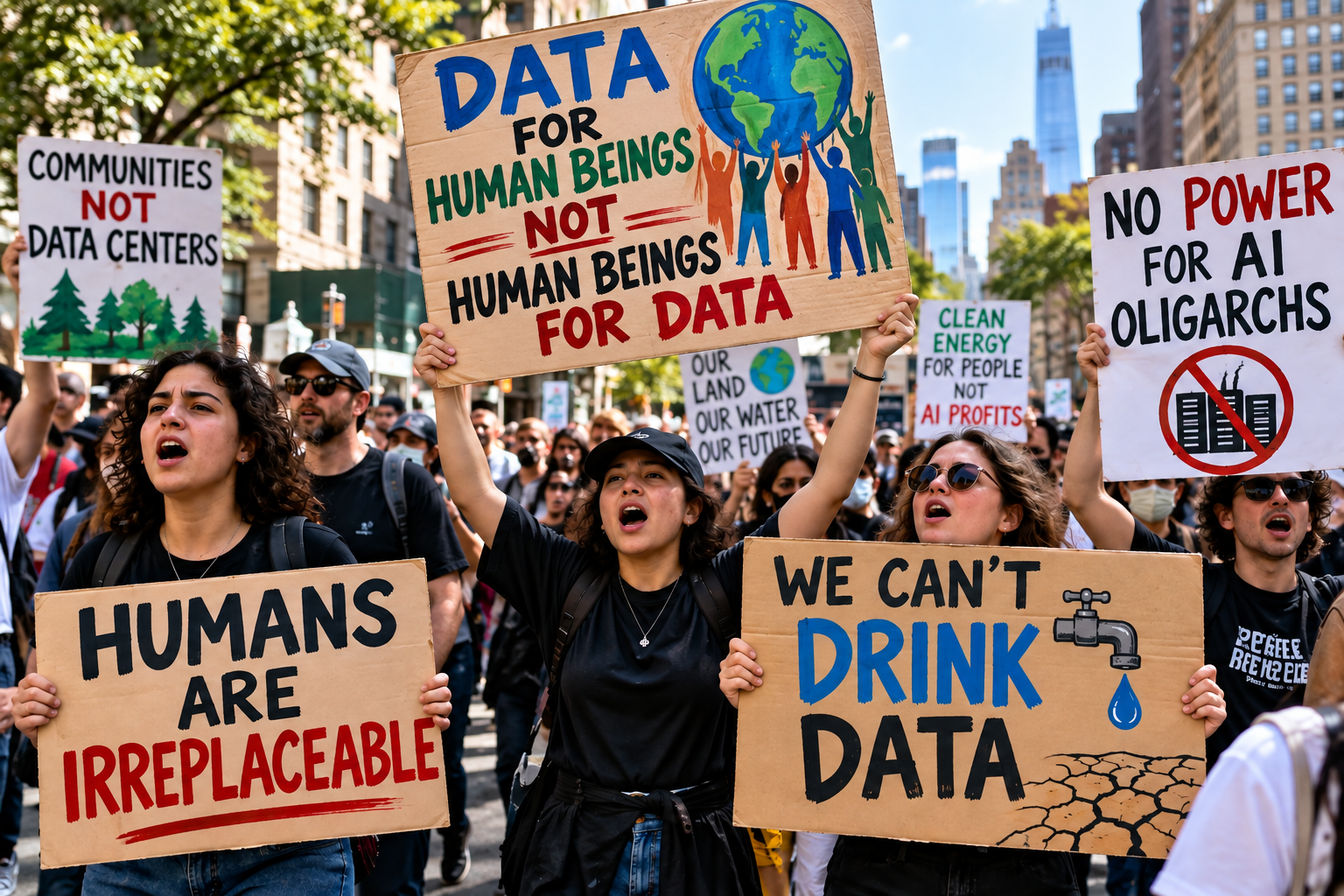
This report continues the website’s previous coverage through October 1 and focuses on protests, community organizing, and labor and civic resistance to the consequences of expanding artificial intelligence, data centers, data surveillance, and automation. These are documented examples; they should not be treated as one unified or centrally coordinated global movement.
Milan, Italy: Protest against data-center expansion
On October 3, residents and activists in the Milan area protested planned data-center developments. Demands included a freeze on new approvals, scrutiny of projects already under way, and stronger assessment of environmental and infrastructure impacts. The protest illustrates how data centers are becoming not merely a technical issue but a conflict over land, energy, public resources, and democratic participation in development decisions.
United Kingdom: Health workers oppose Palantir’s role in the NHS
In early October, health workers, patients, and campaigners took action at numerous locations across England against Palantir’s role in public-health data infrastructure. The concern was not technology alone, but ownership and control of health data, surveillance, and the transfer of decision-making power to private corporations.
San Francisco: Nurses and unions challenge Palantir
As part of broader action against Palantir, nurses and union activists in San Francisco raised concerns about patient data, artificial intelligence in health care, and links between data technologies and surveillance and immigration-enforcement systems. The action highlights the intersection of labor rights, privacy, and social control through technology.
Vancouver: Dockworkers challenge job-displacing automation
Dockworker union delegates from several countries rallied in Vancouver against the use of automation and AI to eliminate jobs, outsource work, surveil workers, weaken unions, or reduce safety. Their position was not a rejection of technology itself. The dispute centered on who determines how technology is deployed and who receives the benefits of higher productivity.
London: Parts of the movement turn toward direct action
Reporting from Britain in early October indicates that some groups critical of uncontrolled AI expansion, including Pull The Plug and Pause AI, are adopting more direct forms of protest. Their actions have targeted major technology firms and data contractors while emphasizing concentrated power, weak public accountability, and the social consequences of accelerated AI development.
United States: Local networks organize against data centers
In states including Illinois and New Hampshire, opposition to data centers is developing from isolated disputes into organized local networks. Concerns include electricity and water consumption, pressure on public grids, land use, costs imposed on communities, and the influence of large corporations over local decision-making.
Japan: Organized resistance in Tsukuba
In Tsukuba, opposition to a data-center project has included the collection of hundreds of signatures and demands for a public meeting. Residents have warned that they may escalate to public protest if meaningful dialogue does not occur. At the time of this report, this is more accurately described as organized resistance and a threatened protest than as a completed demonstration.
Conclusion: The issue is not simply “AI”; it is power
The evidence does not yet justify describing these actions as one unified global movement. What is visible instead is a convergence of different forms of social resistance: workers challenging job displacement and surveillance; residents challenging data centers’ demands on water, electricity, and land; health workers challenging data concentration and surveillance; and citizens challenging the transfer of public decision-making power to private corporations.
A common set of questions is becoming clearer: Who determines the direction of AI development? Who owns the infrastructure and the data? Who bears the social and environmental costs, and who captures the economic benefits? Seen in this way, resistance around AI increasingly intersects with labor, ownership, natural resources, surveillance, and democratic participation in power.


دیدگاهها | Comments
One response to “Social Resistance to AI and Its Infrastructure — Protest Report, October 2–7, 2026”
[…] English […]