Review period: the 24 hours ending August 31, 2026
Only two new, directly relevant developments were identified during this period: a solidarity meeting in India and confirmation of an upcoming strike by University of Sydney staff. Several newly published reports also followed up on earlier developments. No new, reliable event within the past 24 hours was identified in Africa, Latin America, or continental Europe.
New developments
Visakhapatnam, India: solidarity with the struggle against hyperscale data centers
Event date: August 30, 2026, 4–6 p.m.
Groups and companies involved: Friends of the Earth India, local activists, and Google–Adani projects.
A national webinar, “The Rise of AI at the Cost of Shrinking Commons,” was held in solidarity with the struggle of the people of Visakhapatnam. Its announced topics included land acquisition, water and electricity consumption, development in environmentally sensitive areas, the absence of public hearings, and expedited permits. The organizer’s official page confirms the meeting and its title; a detailed independent account of the discussion has not yet been published. Friends of the Earth India announcement
Sydney, Australia: a 24-hour strike over job security and AI rules
Scheduled date: September 2, 2026.
New publication: August 31, 2026.
Employment relationship: direct university employees, not contractors for an AI company.
The University of Sydney branch of the National Tertiary Education Union (NTEU) has confirmed a strike over job security, the expansion of temporary contracts, workload, and management’s refusal to include binding AI safeguards in the collective agreement. Demands include prohibiting the use of AI to cut jobs, preventing fully automated decisions about staff, banning the capture of voices and images without consent, ensuring transparency, and establishing an ethical oversight body. The published sources do not state the wage amount in dispute. Official NTEU strike page | University announcement
Important follow-ups
Thane, India: resistance to Amazon’s 422-megawatt data center
A field report updated on August 30 brought renewed national attention to opposition by residents of Balkum, Kolshet, and Dhokali to an Amazon Web Services hyperscale data center. The protests have been underway since July and therefore do not count as a new event within the 24-hour review period.
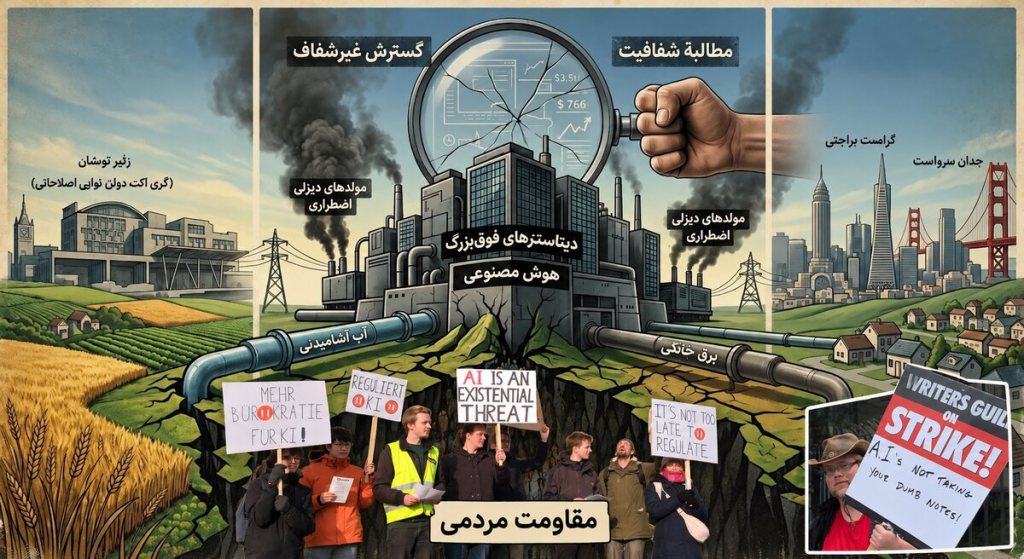
Residents say the issue is not opposition to technology itself, but the location of the facility in a densely populated area, its proximity to schools, hospitals, and residential buildings, and the absence of public participation. Their principal concerns include:
- Heat generated by the facility;
- Continuous noise;
- Approximately 190 emergency diesel generators and their emissions;
- Electricity consumption and potential pressure on the grid;
- Fire risks, traffic, and long-term effects on quality of life.
Amazon has said the center will not use the community’s drinking water for cooling. This is a company claim and does not resolve concerns about electricity, diesel, noise, or the construction site. The state government must decide on objections referred by the Thane municipal authorities. August 30 field report | Amazon’s response and residents’ objections
New York, United States: the statewide resistance tour concludes
The “New York Fights AI Data Centers” tour ended on August 29. Senator Kristen Gonzalez, Food & Water Watch, and local groups are calling for the Responsible Data Center Development Act to be signed into law. The legislation subjects projects above 20 megawatts to restrictions and assessment, requires public hearings before permits are issued, establishes separate water and electricity rates for data centers, and requires assessment of impacts on the grid, water, climate, and Indigenous communities.
The bill has passed both houses of the state legislature but still awaits the governor’s decision. The existing executive order pauses only facilities of 50 megawatts or more and does not cover smaller projects. Official New York Senate report
United States: $50 million mobilized to counter local resistance
On August 31, Build American AI announced that it would launch a campaign in Kansas, Ohio, and Wisconsin to support data-center development, with approximately $50 million in cash on hand. The announced funds are intended for advertising, local organizing, research, and electoral support.
This is not popular resistance; it is the industry’s political and financial response to growing local opposition. The launch of a new super PAC shows the dispute moving from local meetings into electoral contests. The $50 million is the group’s announced budget, not technology companies’ revenue or profit. Axios report
A copyright lawsuit over the appropriation of creative works
On August 28, Sony Music Publishing and Warner Chappell Music sued Anthropic and two of its founders in federal court in Northern California. The publishers allege that Anthropic unlawfully downloaded thousands of musical works to train Claude and that the model can reproduce passages resembling the originals. They seek up to $150,000 per work. Anthropic has denied the allegations.
This case should not be described as a labor or popular protest; it is a legal dispute between large companies over ownership of creative works. Nevertheless, it forms part of broader resistance to opaque data collection for model training. The $150,000 figure is damages sought, not a court award or an amount paid. Account of the case
The hidden AI labor chain
No newly documented development concerning data labelers and content moderators in Kenya, Uganda, Ghana, the Philippines, India, or Latin America was published during the past 24 hours. Older cases are therefore not repeated merely to fill the report.
In the OpenAI–Sama case in Kenya, the documented figure is $1.32 to $2 per hour, not $2 per day. OpenAI commissioned the work and was its ultimate beneficiary, while Sama directly hired and managed the workers. Contractual separation does not eliminate the unity of the economic chain or the responsibilities of both parties. No new judicial development in this case was identified during the review period.
Global assessment
The most important development today is the movement of resistance from scattered protests into three organized arenas: collective labor agreements, binding local regulation, and cross-border solidarity networks. The University of Sydney strike shows that staff want a role in decisions about AI, rather than merely training to adapt to management decisions. In India, the central issues are the ownership and use of shared resources and the exclusion of people from decision-making.
At the same time, the arrival of $50 million in political funding to support data centers shows that the industry is also organizing to counter local resistance. This contradiction reflects the divide between socialized production and costs, on one side, and privatized ownership and benefits, on the other.
Development to follow: the NTEU’s 24-hour strike at the University of Sydney on September 2, 2026—especially participation levels, the situation on picket lines, and whether management will agree to binding safeguards in the collective agreement concerning job cuts, surveillance, and the use of employees’ voices and images.