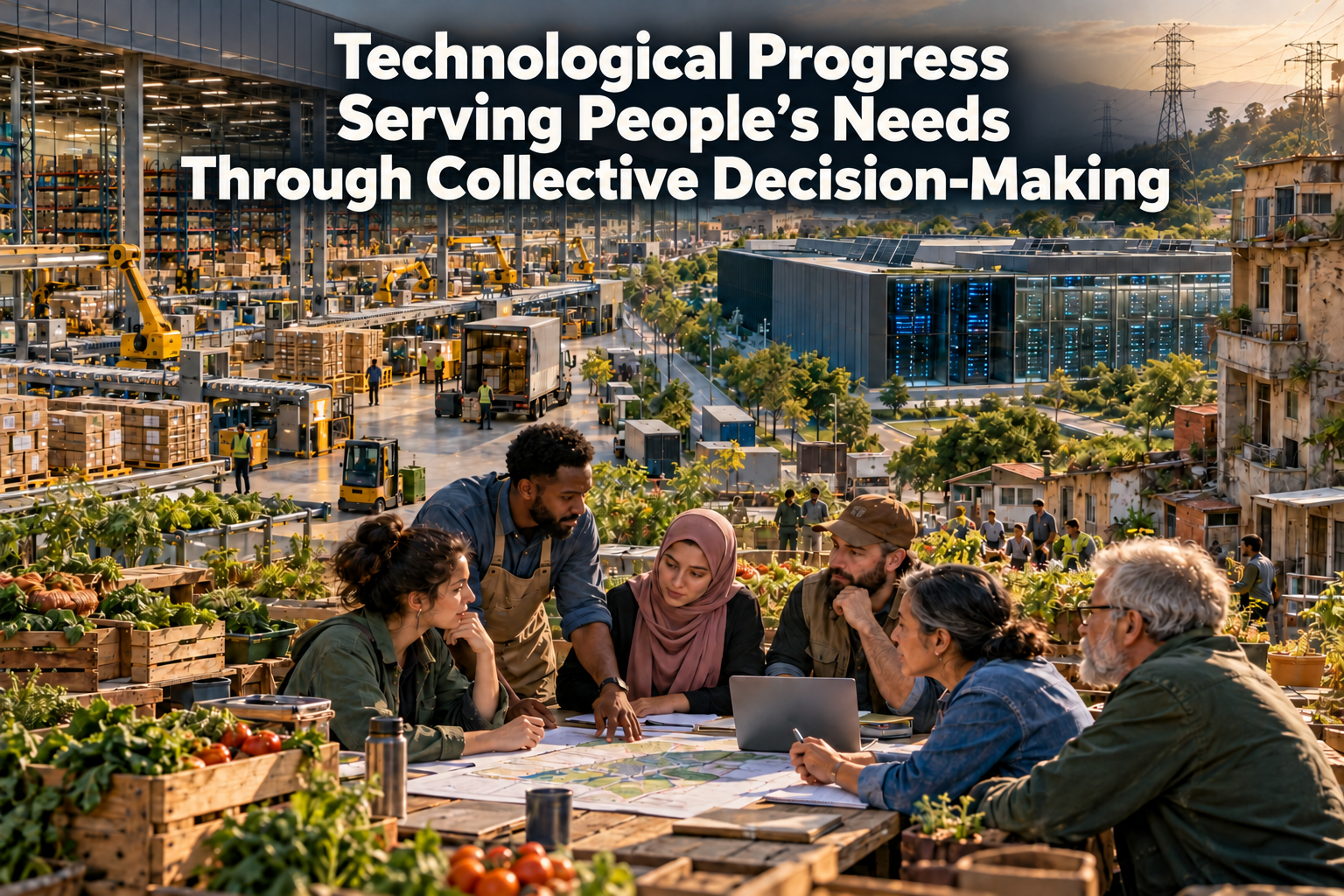
Marx’s theoretical framework and contemporary structural crises in light of A New Social Order in the Age of Consciousness
By Hamid Akhavi
Introduction: The Puzzle of Simultaneous Abundance and Deprivation
One of capitalism’s most striking features is the paradoxical coexistence of surplus production and the extensive waste of wealth with acute shortages and deprivation of basic necessities. While supermarkets and restaurants discard millions of tonnes of untouched food annually, millions of people in disadvantaged neighborhoods face food poverty and economic insecurity. At the same time, billions of dollars flow into servers, speculative data-center projects, and luxury property, while essential energy infrastructure, affordable housing, and basic life-saving medicines face structural investment shortfalls.
Some simplified accounts of conventional economics interpret these mismatches primarily as temporary market failures or disruptions in supply and demand. In Karl Marx’s critique of political economy, however, they are recurring structural expressions of capitalism’s internal organization: the phenomenon described as the anarchy of production.
This structural blindness must be examined through the relationship between ownership, power, and the social organization of consciousness. Capitalism’s problem is not confined to distributing wealth; it also concerns how human beings become visible within its calculations. In its prevailing logic, a person appears less as a conscious being with complex material and cultural needs than as a data point: a consumer in a demand model, labor in a production function, or risk in a credit model. Reducing people to data can push qualitative, local, and living needs out of the planning frame. This is a starting point of A New Social Order in the Age of Consciousness: alongside its dimensions of production and distribution, capitalism’s crisis has cognitive and political dimensions. Human needs may be recognized, but they acquire weight in economic decisions insofar as they fit profitability and purchasing power.
A Guiding Distinction: Data, Knowledge, and Consciousness
To remain consistent with the book, we must distinguish recording data, identifying patterns, and developing social consciousness. Data records what has happened; a model attempts to extract relationships and probabilities. Deciding which needs take priority, which risks are acceptable, and who should bear the costs requires social and political judgment. A society may possess abundant information while denying people the power to use it. Capitalist blindness therefore does not always mean ignorance; it may mean recognizing a need while preferring financial returns to meeting it.
The book’s first chapter presents technology neither as a savior nor as a destiny independent of human action. Its discussion of data ownership likewise distinguishes the social production of knowledge from participation in power. This article follows that connection: changing consciousness without changing institutions and ownership relations is insufficient; changing ownership without freedom, criticism, and participation can reproduce domination in a new form.
1. Marx’s Framework: Organization Within the Workplace and Anarchy Across Society
In Volume One of Capital, particularly the discussion of the division of labor and manufacturing and industrial production, and in Engels’s Anti-Dühring, Marx and Engels formulate a profound structural contradiction of capitalism: the conflict between order, discipline, and systematic planning within individual enterprises at the micro level and anarchy, inadequate coordination, and blind competition across the economy at the macro level.
A. Planned Authority Within the Workplace
Individual enterprises, factories, and modern corporations tend toward managerial discipline and detailed planning. Labor is organized closely; time-and-motion measurement associated with Taylorism, just-in-time supply chains, algorithmic forecasting, and continuous monitoring are deployed to reduce wasted time and materials within the enterprise. Within its private domain, corporate management acts largely through planning.
B. Unrestrained Anarchy Across Society
Outside the factory gates, these highly organized enterprises operate as independent owners in a competitive and unequal market. Contracts, governments, banks, and supply networks coordinate their activities to some extent, but this does not amount to democratically determining society’s needs. The quantities of shoes, cars, housing, or wheat produced are guided primarily by expected sales and profit rather than everyone’s equal right to have their needs met. The connection between independent units is ultimately tested through market exchange after production. When goods fail to sell or markets become saturated, that connection breaks down and crisis emerges.
Marx exposes a structural hypocrisy in the bourgeois ideological defense of this arrangement: capitalists condemn democratic planning for society’s collective needs as an infringement of individual freedom while imposing highly authoritarian planning and hierarchical discipline on workers within the workplace.
C. Anarchy Does Not Mean the Absence of All Coordination
In the discussion of the division of labor in Volume One of Capital and the theoretical chapter on socialism in Anti-Dühring, the central issue is the relationship between the organization of production and the appropriation of its social product. [12, 13] Actual economies contain contracts, standards, government plans, and complex supply networks. An accurate critique should therefore ask what existing coordination serves and who has power over its purposes, rather than claim that no order exists beyond the factory.
A firm may manage its inventory precisely without fully accounting for worker exhaustion, urban traffic, or pollution. Several firms may each have carefully calculated plans while collectively competing for a limited resource. Effective private coordination and social miscoordination can consequently coexist. Information transfer alone cannot resolve this conflict; decision rules and responsibility for costs must also change.
2. Understanding Overproduction and Production Below Social Need
In Marx’s account, capitalist production is driven by exchange value and the accumulation of surplus value, expressed through profit, rather than directly by use value or the satisfaction of human needs. This fundamental separation produces two sides of the same contradiction.
1. The Mechanism of Overproduction
Overproduction under capitalism does not mean that more goods exist than human beings could physically consume. It means that production exceeds effective monetary demand.
To survive competition, capitalists must raise productivity and expand production to reduce unit costs. At the same time, the drive to protect profit margins creates structural pressure on wages. Society’s productive capacity expands while the purchasing power of wage earners, who constitute most final consumers, remains constrained. When a sector appears highly profitable, capital may flow into it simultaneously and without adequate coordination, producing saturation and blocked investment.
2. The Mechanism of Production Below Need
Conversely, a need essential to human life may receive insufficient production or be neglected when its expected return does not compare favorably with its risks and alternative investments. Public housing, treatments for rare diseases, soil and ecosystem protection, and basic medicines may attract insufficient private capital. Public intervention and social financing become important in addressing this gap.
Distinguishing Three Problems: Surplus Goods, Excess Investment, and Deprivation
Unsold goods are not the same as investment that exceeds its expected returns. Server capacity might be fully leased while customers’ eventual revenues remain insufficient to repay the overall investment. Alternatively, infrastructure may be profitable while schools and clinics have limited access to it. The first concerns economic sustainability; the second concerns the distribution of power and benefit.
Inadequate access is also not always inadequate production. A medicine may exist but be unaffordable; housing may have been built but not offered in an appropriate location or at an affordable rent. Each industry must be examined for constraints in capacity, location, quality, price, distribution, and rights of use. These distinctions clarify possible remedies and prevent every problem from being answered with a call for more production.
3. Concrete Evidence and Recent Crises Across Industries
1. Food and Restaurants: Structural Waste Alongside Hunger
Surplus production and structural waste: surplus in supermarket and restaurant distribution is not simply an accidental forecasting error. Presentation, sales forecasts, and pricing policies also matter. Keeping shelves full until closing and offering extensive menus can increase waste. UNEP’s Food Waste Index Report 2024 estimates approximately 1.05 billion tonnes of food waste in 2022, including inedible parts. This cannot all be described as edible food destroyed by retailers. Households accounted for roughly 60%, food services for 28%, and retail for 12%. A critique of waste must therefore consider production, distribution, and consumption together. Claims that discarded food is deliberately contaminated with bleach require evidence identifying particular stores and periods; they should not be generalized to the entire industry. [1]
Distribution gaps and food deserts: alongside food waste in major cities, millions of people in disadvantaged and low-income neighborhoods lack access to fresh fruit and protein. Commercial returns can discourage large retailers from providing high-quality food in poorer areas.
An Applied Example: AI in the Food Supply Chain
A sales-forecasting system can align orders with seasonality, weather, and purchasing patterns, reducing waste. Its objectives are decisive, however. If it measures only profit margins, waste reduction might accompany reduced service in low-income neighborhoods. If food access, freshness, and a minimum local supply are also criteria, the same tool can support different decisions. This is an analytical comparison, not a report of a particular company’s conduct.
A socially directed arrangement could identify stocks approaching the end of their shelf life for redistribution, with consent and food-safety safeguards, shorten transport routes, and help local cooperatives place joint orders. An app cannot make spoiled food, a missing cold chain, or income poverty disappear. Technology must form part of an access and infrastructure policy.
2. Pharmaceuticals and Public Health: Investment Priorities Versus Health Needs
Uneven pharmaceutical investment: capital is attracted to markets with higher expected revenues, intellectual-property protection, and customers with purchasing power. This can marginalize health needs among lower-income populations. Nevertheless, medicines for hypertension, diabetes, or obesity should not simply be labeled luxuries or devices for keeping people ill; they may be necessary and effective treatments. Political-economic criticism concerns prices, access, and investment priorities. Attributing an intention to prevent cures to a particular company requires specific evidence.
Underinvestment in antibiotics: inadequate innovation and access illustrate the gap between social value and commercial return. In June 2024, WHO reported that only 12 of the 32 antibiotics under development against infections caused by priority bacteria were considered innovative. Short treatment courses, the need to restrict use to preserve effectiveness, research costs and risks, and low prices for some older medicines all affect commercial attractiveness. Rapid recovery is not the sole explanation. Shortages of children’s medicines also require country-specific and time-specific investigation: manufacturing disruption, quality problems, ingredient availability, and demand surges may contribute. [2, 3]
AI in Health: Discovering a Drug Is Not the Same as Access to Treatment
Even if a model accelerates the search for drug compounds, safety and effectiveness must still be assessed clinically, quality manufacturing organized, and medicines delivered to patients. Faster computation does not automatically produce fair prices, insurance coverage, or supply in low-income areas. The gap between a technical possibility of treatment and an effective right to treatment is where ownership, financing, and public policy enter.
This perspective supports public research, university collaboration, and access conditions, alongside antibiotic financing that does not depend exclusively on increasing sales volumes. Such an approach better fits responsible use. WHO’s report on G7 measures explicitly addresses market failure and instruments for supporting research and supply. [3]
3. Technology, Artificial Intelligence, and Computing Infrastructure
Rapid server expansion and the risk of overinvestment: hundreds of billions of dollars are being committed to computing infrastructure and AI processors. Expansion can respond to real demand while also running ahead of sustainable demand in particular projects. Demonstrating excess capacity or a bubble requires examining actual utilization, revenues, debt, purchasing contracts, equipment’s economic life, and energy costs. Investment scale alone is insufficient. Social consequences also matter independently of financial profitability: a profitable data center can still raise contested questions about water, the electricity grid, and local public benefits.
Insufficient public network and electricity infrastructure: amid digital expansion, transmission lines, distribution substations, and foundational open-source software may face aging assets and inadequate resources. Explanations include investment and tariff rules, permitting delays, equipment shortages, implementation capacity, and uneven resource allocation. The profitability of some electricity companies does not establish that investment is adequate everywhere.
AI should be understood as an exceptionally socialized productive force: it draws on civilization’s accumulated knowledge, everyday human activity—including some texts, images, and digital traces, depending on each service’s contracts and data policies—and shared electricity and internet infrastructure. Yet ownership and command remain concentrated in important layers of the technology chain. Here the anarchy of production becomes especially acute: a technology capable of reducing some shortages and waste can instead drive manufactured demand, behavioral manipulation, and intensified consumption because the question of who decides is answered in corporate boardrooms rather than by society.
A. Data Centers: Where Private Plans Meet Shared Resources
A data center is not an abstract building in the cloud. It requires land, grid connections, reliable electricity, equipment, labor, and sometimes cooling water. The IEA’s 2025 Energy and AI report estimates global data-center electricity consumption at approximately 415 TWh in 2024 and projects about 945 TWh in its base case for 2030. The second figure is a forecast. Both figures cover all data centers and must not be described entirely as AI electricity consumption. [4]
This scale establishes the importance of social scrutiny, rather than automatically proving projects useless. We must ask what services consume the capacity, what benefits they generate, and what constraints expansion imposes on other uses. The cost of each useful service, water consumption relative to local water stress, and grid-connection costs reveal more than counts of buildings or processors.
To illustrate the conflict, consider three hypothetical projects in one region, each requesting a 100 MW connection while the grid has only 150 MW of spare capacity. Each project may individually have a sound plan and profitable contracts, but their combined request is 300 MW. These numbers are an illustration, not regional statistics. The collective questions are which project takes priority, who pays to reinforce the grid, and whether essential urban services need the same capacity.
A democratic response requires publishing contracts, assessing cumulative impacts, assigning responsibility for connection and expansion costs, and enabling residents to participate. Local councils’ consent, workers’ rights, and environmental limits must enter decisions before irreversible commitments are made. Socializing power means people have a say in resource priorities, rather than merely receiving promises of jobs or tax revenues.
B. Greater Efficiency Does Not Necessarily Mean Lower Total Consumption
In a 2016 corporate report, DeepMind stated that machine learning had reduced the energy used for the cooling operations examined at Google data centers by up to 40%. This concerns the cooling component under the reported conditions, not a 40% reduction in electricity across all data centers worldwide. [5] It demonstrates a real technical opportunity for improvement.
If computation becomes more efficient per unit while total use expands much faster, aggregate consumption can still rise. We must therefore ask separately how much more efficient a service has become and what purposes drive growth in overall demand. This distinction separates criticism of directionless expansion from opposition to technical progress. Social evaluation should consider actual benefit and resource budgets, alongside speed and operation counts.
C. AI Agents: From Generating Answers to Executing Workflows
Here, an agent means a system capable of planning multiple steps toward an assigned objective, using tools, checking results, and choosing its next action. The degree of delegated authority varies. Automation does not establish human-like will, consciousness, or moral responsibility. Assigned goals, available data, permitted tools, and access limits shape the agent’s scope.
A concrete software-industry example is GitHub Copilot’s coding agent. Official documentation describes repository investigation, change planning, code editing, and test execution in a cloud development environment. It also warns that output may be incorrect or vulnerable and requires review. [6] The change is therefore more than faster text generation: part of the execution workflow is delegated to the system.
Social analysis must ask who defines the problem, who accepts the changes, and who receives the saved time. Workers may benefit from eliminating repetitive tasks; the same capability may instead raise work quotas, weaken learning opportunities, or enable layoffs. Technical capability alone does not determine the outcome. Contracts and bargaining power matter.
D. Agents’ Private Optimization and Social Miscoordination
Suppose a company’s purchasing agent pursues only the lowest price and fastest delivery. It might redirect orders to a supplier with lower wages or weaker environmental standards. If those costs are excluded from its objective and binding rules, a reduction in corporate costs can become a transfer of costs to workers and society. This is an analytical scenario, not a claim about a particular transaction.
In another scenario, agents at several companies observe similar signals and simultaneously order computing capacity—or cancel orders after forecasts change. Rapid responses can amplify volatility, but whether this happens and on what scale depends on market and system design. The presence of several agents does not prove collusion. Shared data, similar rules, and feedback among systems require separate investigation.
The central contradiction is clear: each agent may serve its owner’s objective in a highly orderly way while their combined activity fails to benefit society. Faster decisions do not replace the collective determination of objectives. Intelligent tools can strengthen social coordination or accelerate competition over shared resources.
E. Limits on Authority and Responsibility in Agentic Systems
Anthropic’s June 2025 research examined 16 models in simulated corporate environments and found, under some conditions, behaviors such as threats to disclose information and data leakage. The researchers emphasized that these were fictional, controlled scenarios and did not present evidence of this behavior in real deployments in that report. The experiment should therefore not be described as blackmail of an actual person or proof of a biological survival drive. [7]
Its relevance here lies in the need to constrain delegated authority. A system with information access and action tools requires independent evaluation, activity logs, human approval for sensitive decisions, and a means of stopping it. Public or cooperative ownership does not remove these requirements. Technical safety and democratic oversight complement each other.
In socially directed administration, an agent may report shortages, compare options, or draft plans. It has no unilateral right to determine people’s rights, conduct unlimited surveillance, or consume public resources. Cost-reduction goals must operate within non-negotiable legal boundaries: privacy, safety, nondiscrimination, the right to challenge decisions, and clear responsibility for the deploying institution.
4. Housing and Construction
Empty luxury buildings alongside homelessness: in parts of major-city property markets, developers concentrate on luxury apartments and penthouses as stores of capital value. Where expensive units remain vacant, working people may still lack safe, affordable housing.
A Concrete Example of Algorithmic Rent Decisions
In August 2024, the U.S. Department of Justice and several states filed an antitrust lawsuit against RealPage, alleging that nonpublic information from competing landlords was used in rent-recommendation software in ways that weakened competition. This reference describes allegations when the complaint was filed; it is neither a final judgment nor an account of the case’s current status. [8]
The analytical significance is the difference between coordination to increase landlords’ revenues and coordination to improve access to housing. An algorithm may pursue the former without making the latter its principal criterion. Nor should this software automatically be equated with an autonomous agent: a price-recommendation algorithm and an agent authorized to act are different levels of delegation.
Solutions require appropriate supply, location, transport, tenants’ rights, and public financing as well as pricing transparency. A vacant unit does not by itself establish that its location, size, or price meets the needs of everyone without housing.
5. Logistics and Aviation: Ghost Flights
Commercial airlines may be encouraged to operate nearly empty or empty flights to retain airport slots. The extent depends on the airport, period, and regulatory exemptions. Fossil fuel and other resources can then be consumed to protect a commercial asset, while inadequate public-transport investment elsewhere leaves everyday mobility needs unmet.
6. Warehousing and Logistics: Advanced Coordination and the Distribution of Gains
When introducing its Sequoia robotics system in October 2023, Amazon said it could identify and store inventory up to 75% faster and reduce order-processing time within a fulfillment center by up to 25%. These are corporate claims about operational performance. They do not independently establish outcomes for pay, work intensity, or aggregate social benefit. [9]
The theoretical problem is not a lack of planning capacity. It is what planning optimizes and how its gains are distributed. Greater speed can reduce exhausting work and shorten hours without reducing income; it can also increase the amount expected in each shift. Workers’ rights to assess safety, determine sustainable work rates, and share benefits are part of participation in power.
7. Precision Agriculture: Lower Input Use and the Risk of Technological Dependence
In September 2024, John Deere reported average savings of 59% in herbicide mix among customers using See & Spray. Cameras and image processing enable targeted spraying. This figure is the manufacturer’s report for users under that season’s conditions, not a guaranteed result for every crop or farm. [10]
The example makes waste reduction tangible. Social evaluation must also examine equipment costs, repair rights, farm-data ownership, and access for small farmers. Cooperative purchasing, public training, and portable data access are possibilities for institutional design. Lower chemical volume alone is not a complete assessment of soil health or environmental effects.
4. How Anarchy Becomes Crisis—and Its Social Costs
Capitalist crises are not caused solely by external shocks or natural disasters. Internal mechanisms can also create conditions in which accumulated contradictions can no longer be contained. When surplus production intensifies:
Markets freeze and goods remain unsold.
Profit rates fall and credit contracts.
Factories close production lines and dismiss workers.
Layoffs further reduce purchasing power and deepen recession.
The system then often seeks adjustment through capital devaluation, idle capacity, and unemployment. This can also involve physical destruction of productive forces: discarded inventories, destroyed crops, factory closures, and the displacement of millions into poverty and joblessness.
Distinguishing Crisis, Destruction, and Lost Capacity
Falling asset prices or bankruptcy involve the destruction of capital value. Broken machinery or destroyed products involve physical destruction. Shutting usable capacity and idling skilled workers represent lost social opportunities. These can coincide, but they are different processes. A fall in an AI company’s share price does not itself destroy a chip: ownership may change, capacity may be repurposed, or equipment may remain unused.
Crisis also does not begin only with insufficient consumption. Debt, interest rates, disproportionate capacity expansion, supply disruptions, and financial fragility may combine with limited purchasing power. Explanation must identify the mechanisms operating in each case. Social policy can prioritize preserving useful capacity, protecting workers, and transferring authority with accountability rather than rescuing owners unconditionally.
5. Interim Conclusion: The Need for Democratic, Socially Directed Production
Historical and contemporary evidence indicates that capitalism lacks a sufficiently democratic mechanism for guaranteeing alignment between production and human needs. The conflict between advanced organization within enterprises and anarchy across society shows that some technical coordination capacity already exists, but its purposes and scope are shaped by ownership and power. Turning it into democratic planning still requires institutional design, local knowledge, experimentation, and error correction.
The substantive alternative to recurring destruction and waste is to overcome the market’s blind rule and organize production around collective needs through transparent, democratic planning directed by society itself. Wealth would then serve human flourishing and the satisfaction of needs, rather than sale and abstract accumulation.
6. Further Theory: The Tendency of the Rate of Profit to Fall and Its Connection to Production Anarchy
In Volume Three of Capital, Marx examines the tendency of the rate of profit to fall as a structural tendency of accumulation. As competition and automation raise the organic composition of capital—the value relationship of constant to variable capital, connected to production’s technical composition—the overall profit rate tends to face downward pressure.
Marx’s account also includes counteracting tendencies, including greater exploitation, cheaper elements of constant capital, and changing conditions of exchange. [19] Automation must therefore not be translated into a certain, uniform decline in every firm’s profit rate. A company with market power may become more profitable while other sectors face pressure.
AI analysis must likewise distinguish value creation, enterprise revenue, and rent appropriation. Infrastructure owners may earn income from others’ dependence; that income is not necessarily a measure of their contribution to social wealth. Nor can every click or data item be treated as an equivalent unit of labor producing surplus value without examining production and labor relations. The social character of knowledge is a different argument from an accounting explanation of profit or a precise theory of value.
Faced with pressure on profitability, capitalists may turn to two mechanisms that intensify production anarchy:
Speculation and capital flows into unproductive bubbles: funds leave socially necessary productive activities such as sustainable agriculture, housing, and health, moving into abstract financial assets, cryptocurrencies, land speculation, and inflated technology projects.
Intensified exploitation and a lower wage share: firms attempt to sustain profits through lower real wages or layoffs, weakening effective demand and aggravating overproduction.
7. Contemporary Mechanisms for Deferring Crisis and Their Consequences
Contemporary capitalism has developed mechanisms that divert or postpone the immediate consequences of production anarchy and surplus:
Credit and debt: when wages cannot purchase accumulated goods, mass lending, credit cards, and mortgages can sustain demand. Expanding debt may postpone a crisis while increasing its eventual severity, as illustrated by the global financial crisis of 2008 and debt burdens associated with housing and education.
Planned obsolescence: some design and supply practices limit products’ useful life or repairability—from smartphones and laptops to appliances and clothing—encouraging replacement purchases in saturated markets. This can increase resource waste, but a breakdown or upgrade is not automatically evidence of intentional lifespan reduction. The Global E-waste Monitor 2024 estimates approximately 62 million tonnes of electronic waste in 2022. That is total e-waste, not a measure of waste caused specifically by planned obsolescence. [11]
Militarism and the war economy: military budgets can create substantial demand for steel, energy, technology, and chemicals while diverting resources from civilian needs. Individual wars cannot, however, be reduced to a means of absorbing excess production. Geopolitical competition, state structures, military interests, and historical conflicts require specific investigation.
8. Practical Steps and Transitional Horizons: How Can Coordination Be Returned to Society?
The alternative involves neither returning to the past nor accepting the myth of an invisible hand that automatically resolves social needs. Practical elements of renewed coordination include:
Social accounting based on use value: replace abstract measures of expansion—such as shareholder profit and financially inflated aggregate growth—with measures of human needs: food security, universal housing access, environmental sustainability, and public health.
Public and social ownership of natural monopolies and strategic sectors: remove basic energy, health, pharmaceutical, water, and digital infrastructure from private speculation and place essential services under transparent collective administration.
Technology and AI for participatory planning: algorithms and logistics networks within companies such as Amazon and Walmart already achieve advanced operational coordination. Freeing these capabilities from exclusive private control can allow them to support democratic planning, distribution according to local need, and reduced structural waste.
The Practical Architecture of an Intelligent Economy
To translate this direction into institutions, decision flows must be clear. Workplace councils report capacity, maintenance needs, and safety conditions; neighborhood councils express service needs and priorities; specialist institutions assess options and constraints; and regional and national bodies coordinate issues extending beyond localities. Decision rights must come with responsibilities, budgets, public reporting, and recall mechanisms. Calling a body a council does not guarantee participation without actual authority.
Suppose a region faces summer electricity shortages. A public system could compare grid repairs, shifting deferrable loads, improving cooling efficiency, and expanding capacity. Agents could gather information and calculate consequences. Choosing among essential services, costs, and environmental limits must follow approved rules and public participation. This is an institutional proposal, not a claim that a complete, tested system already exists.
Limited, reversible tasks can receive defined automatic execution authority, but sensitive decisions require human approval and a route of appeal. Independent audits, inspectable activity records, least-privilege access, predeployment testing, and rollback capacity are conditions of trust. The institution operating the system cannot escape responsibility by saying that the algorithm decided.
Public data does not mean making private lives public. Medical information, communications, and personal behavior require consent, a defined purpose, minimized collection, and independent protection. Aggregate statistics and local data are sufficient for coordinating many needs. Privacy, freedom of association, and the right to strike belong within planning’s architecture; they are not expendable costs of efficiency.
The decisive question for every transition program is who decides. Twentieth-century experience demonstrated that replacing market anarchy with centralized bureaucratic planning without democratizing decision-making does not resolve domination and miscoordination. The Age of Consciousness framework answers with participation in power rather than allocation from above. Planning must take place where life unfolds—in neighborhoods, workplaces, and associations of producers and consumers. AI now used to forecast behavior and sell more can instead simulate consequences of collective choices and strengthen councils, provided ownership is social and administration democratic.
9. Transition to A New Social Order in the Age of Consciousness: Beyond Blind Markets and Centralized Command
In the framework developed by the book and related articles, capitalism’s present crisis and structural production anarchy are more than a conventional economic impasse. They indicate a possible civilizational transition. The character of productive forces is changing: knowledge, data, and collective consciousness have become central drivers of wealth, yet are constrained by capitalist ownership and extractive platform models.
A. The Fundamental Contradiction: Social Knowledge Production and Private Infrastructure Monopolies
As the book explains, everyday data production, behavioral patterns, and cognitive interaction contribute to some of the data and social foundations underlying AI and automation. Major technology monopolies nevertheless appropriate this social wealth for behavioral prediction and manipulation and the creation of manufactured needs. Production anarchy deepens when technology capable of reducing poverty and waste instead reinforces cycles of excess production, environmental destruction, and alienation.
B. Redefining the Transitional Period
In this framework, transition means neither blind collapse nor a return to past totalitarian models. It is a process of developing social consciousness and organization through:
A shift from institutional extraction to human agency: end the treatment of people and ecosystems as fuel for profit-making and capital accumulation, placing personal autonomy and human dignity at the center of economic activity.
A shift from concentrated networks toward democratic, peer-to-peer coordination: use data and intelligent systems to create transparent distribution arrangements aligned with communities’ actual needs, rather than for police surveillance or destructive competition.
A connection between consciousness and life-centered planning: move from abstract exchange value toward survival and human flourishing, aligning production with ecological resilience and quality of life.
A New Social Order in the Age of Consciousness thus offers a theoretical and practical foundation for overcoming capitalist anarchy. By breaking exclusive private control over knowledge and technology, production can be reorganized around society’s needs.
C. Transition Is a Question of Institutions and Conflicting Interests
Public ownership on paper is not the same as social control of power. If managers who cannot be recalled determine data use, budgets, and production priorities, people may remain subordinate. Accountability, freedom of the press and political parties, judicial independence, minority rights, and workers’ independent organization must be standards for assessing change. No AI model has authority to determine everyone’s true needs without their ability to criticize and choose.
Limited markets, contracts, public reserves, and different ownership forms may coexist during transition. The questions are how far basic needs have been detached from purchasing power and obedience to employers, where exclusive control has diminished, and what authority has passed to people. Industries also differ: an electricity grid, an agricultural cooperative, a hospital, and a software workshop do not require identical operating rules.
D. Productivity, Free Time, and the Possibility of Participation
The ILO and NASK’s 2025 study estimates that one-quarter of workers globally are in occupations with some degree of exposure to generative AI. This is not a forecast that one-quarter of jobs will disappear. The study considers task transformation more likely than complete replacement. [14] Discussion must therefore include changing tasks, job quality, and workers’ decision-making power, rather than only counts of eliminated jobs.
Suppose a ten-person team uses intelligent tools to deliver the same service with equal quality in 20% less time. The time dividend could support shorter hours with secure livelihoods, training, and better service; management could instead choose layoffs or higher output expectations. This is a hypothetical calculation. The difference between the paths is how the gains are distributed, not an intrinsic property of the model.
Free time is itself infrastructure for democracy. A person exhausted by earning a living and providing care lacks an equal opportunity to scrutinize budgets or participate in councils. Economic security, reduced necessary working time, and participation in power therefore belong in one program—the relationship emphasized in the book and in Redefining Work, Time, and Value.
E. Connections With the Website’s Discussions
AI Infrastructure: From Chips and Software to Ownership and Power explains that technological control operates through several layers. Open software alone does not remove dependence on clouds, chips, or energy. Ownership, Wealth and Power distinguishes widespread use from the right to determine a service’s rules. The discussion of work and time similarly insists that progress must increase security, free time, and effective agency as well as output. [15–17]
These connections turn production anarchy into concrete, assessable questions: who owns each layer? Who sets an agent’s objectives? Who pays for the grid and environmental costs? What share of productivity gains reaches workers? How can a citizen inspect, amend, or stop a decision? The answers distinguish technology serving accumulation from technology serving life.
10. The Horizon of the Age of Consciousness: From Blind Anarchy to Collective Awareness
What extends this argument beyond classical criticism of capitalism is its connection to a civilizational horizon. A New Social Order in the Age of Consciousness argues that humanity faces a possible paradigm transition: productive forces, particularly AI and knowledge networks, have become so socialized that continued exclusive private ownership confronts growing economic, social, and political contradictions and can intensify anarchy, waste, and crisis.
Transition does not happen automatically. What can turn anarchy into conscious organization is consciousness understood not as accumulated information but as the collective capacity to connect lived experience with larger structures and the collective will to change them. Each neighborhood housing council, cooperative organizing production around needs, and movement challenging technological monopoly is a living element of a different order—a practice through which a collective capacity can grow.
Production anarchy is not humanity’s inevitable fate. It is a historical condition that can be changed as the real producers of wealth—the great majority who build the world without determining its direction—develop consciousness and organization. A future joining social production with social ownership is possible and can be built; it is not guaranteed. Its material conditions are already taking shape within today’s crises.
Sources and Further Reading
Statistics are presented with their reference years. Forecasts, corporate performance reports, legal allegations, and hypothetical scenarios are distinguished throughout.
1. UNEP, Food Waste Index Report 2024; data for 2022.
2. WHO, State of Development of Antibacterials, June 14, 2024.
3. WHO, G7 Progress in Addressing the Antibiotic Pipeline Crisis, October 14, 2024.
4. IEA, Energy and AI, Executive Summary, April 2025.
5. Google DeepMind, Data-Center Cooling Energy Report, July 20, 2016; corporate report.
6. GitHub official documentation, Copilot agent capabilities and limitations; current documentation.
7. Anthropic, Agentic Misalignment in Simulated Environments, June 20, 2025.
9. Amazon, Introducing Sequoia and Digit, October 18, 2023; corporate performance claims.
10. John Deere, See & Spray Herbicide Savings, September 18, 2024; corporate report.
11. ITU and UNITAR, Global E-waste Monitor 2024; data for 2022.
13. Friedrich Engels, Anti-Dühring, Socialism: Theoretical.
14. ILO and NASK, Generative AI and Jobs: A Refined Global Index of Occupational Exposure, 2025.
15. Hamid Akhavi, AI Infrastructure: From Chips and Software to Ownership and Power.
16. Hamid Akhavi, Ownership, Wealth and Power in the Age of AI.
17. Hamid Akhavi, Redefining Work, Time, and Value in a New Social Order.
18. Hamid Akhavi, A New Social Order in the Age of Consciousness, Volume One, Persian interview edition, 147 pages, especially pp. 4–9 and 114–116 on technology, consciousness, data ownership, free time, and participation in power.
19. Karl Marx, Capital, Volume Three, Chapter 14: Counteracting Influences.

