Period reviewed: September 18–27, 2026. Prepared on September 27, through the morning in Washington, D.C.
The last report published on this site covered September 14–17. This report gathers developments after that edition. It separates event dates from publication dates and distinguishes public protest, legal challenges, adopted decisions, and proposals that have not yet been voted on. Previous report
Overview
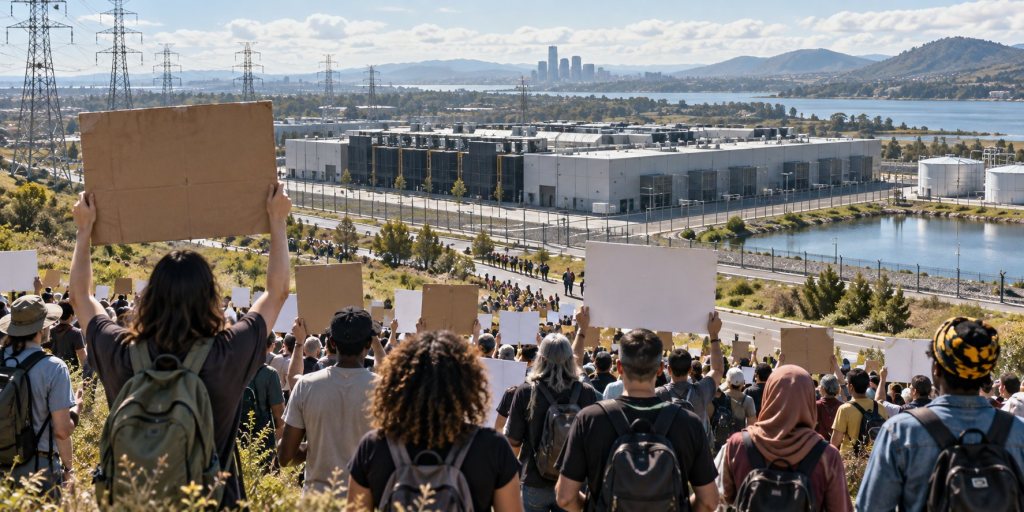
Resistance took several forms during these ten days. Residents called for pauses or limits at public meetings; local and legal groups challenged environmental permits; Indian campaigners reported restrictions on their ability to express opposition; and European debate about water and electricity disclosure reached the level of EU regulation. These actions do not constitute one movement with a single demand. They do, however, ask a common question: who decides how AI infrastructure is built, and who bears its costs?
Europe
United Kingdom: Demanding answers from Microsoft in Leeds
Development dates: September 22–25. No Leeds Datacentre said that its second meeting with Microsoft, scheduled for September 23, was cancelled the preceding evening. In correspondence published by the campaign, Microsoft said it needed more time to provide complete answers to technical questions. The campaign published questions about water consumption, local heat, air and noise pollution, lighting, electricity, jobs, and the project’s claimed benefits. The cancelled meeting does not mean the project was cancelled, nor does it establish every concern as fact. The new development is the continuing demand for specific information and corporate accountability. Campaign account, published September 25
The large Leeds demonstration took place on September 12 and is not counted as a new protest in this period. Published estimates of attendance differ.
European Union: Public consultation on data center standards
Action and publication date: September 21. The European Commission opened a twelve-week public consultation on minimum performance standards for data centers and released a package intended to make energy and water performance more transparent through a common rating scheme and label. Comments on the standards are due December 14, 2026; a legislative proposal is planned for the second quarter of 2027. This is neither a protest nor an immediate binding limit on water and electricity use. It does open a route for labor, environmental, and community groups to place their demands in the decision process. European Commission
Africa
South Africa: The Cape Town data center dispute continues
The proposed Equinix data center at King Air Industria in Cape Town remains an important African example of organized resistance. Housing Assembly and Foxglove challenged its land-use approval over gaps in information needed to assess water and electricity demand, emissions, generators, and effects on the surrounding community. Their appeal was filed before September 18, so it is not presented as a new action during these ten days. The sources reviewed did not establish a new final decision on that appeal between September 18 and 27. Account from the challenging organization
For other African countries, this review did not verify a fresh demonstration, strike, or legal action in the period with both a reliable source and a clear date. That does not mean concerns or opposition are absent.
Asia
India: Access restricted to the Vizag data center campaign account
Event date: September 19; statement date: September 22. Human Rights Forum reported that access in India to the Instagram account of the citizen campaign Stop Vizag Data Centers had been restricted. According to the organization, nine posts had already been restricted. The campaign has questioned the land, water, power, and environmental costs of proposed data centers in and around Visakhapatnam. The rights group demanded restoration of access and a precise explanation of the legal basis. The account relies on the campaign and the rights organization’s statements; it does not establish which particular authority requested the restriction. Human Rights Forum statement
When resource use and land allocations are disputed, the ability to organize and publish criticism matters for meaningful public participation. This is the report’s interpretation of the event, not a proven claim about the motive behind the restriction.
North America
Texas: State permit halt pending audits
Decision date: September 21. The Texas governor directed the state’s environmental agency to stop issuing permits sought by data center projects until reviews of grid and water impacts are completed. His directive also calls for reporting resource use and for projects to pay their own electrical infrastructure costs. It comes amid public concern about the grid, water, and electricity bills. The current pause is not a permanent ban on data centers in Texas, and the audits’ conclusions are not yet known. Office of the Texas Governor
Arizona: Pima County approves a local moratorium
Decision date: September 22. The Pima County Board of Supervisors’ official record marks Resolution 2026–56, implementing a moratorium on data center development, as approved that day. Public correspondence is attached to the record. The accessible summary does not specify the pause’s duration or exceptions, so this report does not claim a more precise legal scope without the full resolution. Official county record
Denton, Texas: Residents favor a pause; no vote yet
Hearing date: September 22; report date: September 23. At the first Denton City Council public hearing on a proposed pause in accepting and approving new data center applications, all twenty speakers supported the moratorium; some sought stronger restrictions. No vote was taken. A second hearing is scheduled for October 27. The city has cited tax receipts from existing facilities while warning about electrical transmission capacity. The local dispute therefore concerns both claimed benefits and infrastructure costs. Local report
New Hampshire: Protest before Bow town meeting
Protest and meeting date: September 22; report date: September 23. Opponents of the possibility that a former power plant site could become a data center protested before a Bow selectboard meeting, then residents expressed their concerns inside. The board chair said the town had received no formal project application at that time. This was early opposition to a possibility under discussion, rather than to a permitted project. One resident also spoke in favor of considering the proposal; the town did not have a unanimous position. New Hampshire Public Radio
North Carolina: Legal challenge over 649 diesel generators
Legal challenge filed: September 25. The Southern Environmental Law Center, representing the Richmond County Coalition for Justice and Black Empowerment, challenged two air permits associated with Amazon’s data center in Hamlet. The permits cover 649 diesel generators in total: 592 backup generators for Amazon and 57 associated with Duke Energy. Petitioners argue that separately permitting the two groups avoids stricter review of emissions from the combined site. This is the petitioners’ allegation, not a court finding. The relationship between industrial pollution and local inequality also makes this an environmental justice dispute. Legal group’s statement and petitions
Workers’ rights: New Jersey labor campaign
Announcement date: September 21; scheduled campaign launch: September 24. The New Jersey State AFL-CIO called for a campaign to pass the FAIR Act, a bill addressing AI use at work. The union source gives a time and place for its press conference but, by itself, does not independently establish attendance or enactment of the law. The effort seeks to bring workers affected by automated workplace decisions into the political process. Union announcement
Conclusion and connection to A New Social Order in the Age of Consciousness
The demand is moving beyond a simple judgment about whether AI is good or bad. In Denton and Bow, residents want to be heard before projects are approved. In Texas and Pima County, public authorities have linked development to further review. In North Carolina, a local coalition is challenging how pollution from a single site is counted. In India, critics’ ability to speak has become part of the dispute over who gets to decide. In Leeds, technical questions have become a means of demanding public accountability.
From the perspective of A New Social Order in the Age of Consciousness, these cases reveal a concrete tension between social production and concentrated private ownership and decision-making. Data, knowledge, labor, water, and electricity come from society, while authority over an infrastructure project’s location, scale, and purpose often remains with a few companies and officials. This interpretation does not make all protesters’ aims identical. Some want a project stopped, some seek independent assessment, and others demand bargaining rights or a real share in decisions. Their common ground is public information, accountability, and effective participation by communities and workers in decision-making power.


Comments
One response to “Global Protests and Resistance to AI and Data Center Expansion — September 18–27, 2026”
[…] English بازگشت به صفحهٔ اصلی […]