Why the Coming Future Is Not a Wish but Highly Likely
A few days ago I watched a short video on Instagram: Dr. Ulcca Hansen, writer and futurist, was talking about an idea Trevor Noah raised: hope is a muscle. Hansen says Noah recently said that the left has lost its imagination and severed its connection to faith; and she agrees with this diagnosis, having seen the same in institutions and movements.
Hansen’s core point is this: those who endured history’s hardest periods understood hope not as a feeling but as a discipline — a muscle built through practice; through community, through imagination, and through naming a possible future again and again and moving toward it, even when no evidence is yet at hand. Her example is Martin Luther King Jr.: King had no proof that the beloved community was coming, but he had a trained imagination and acted as if that community were real — and that changed the world.
This Week, in Four Corners of the World
But let us not start from imagination; let us start from the street. Just this past week, in four corners of the world, hundreds of thousands took to the streets — not with one shared slogan, but with one shared pain:
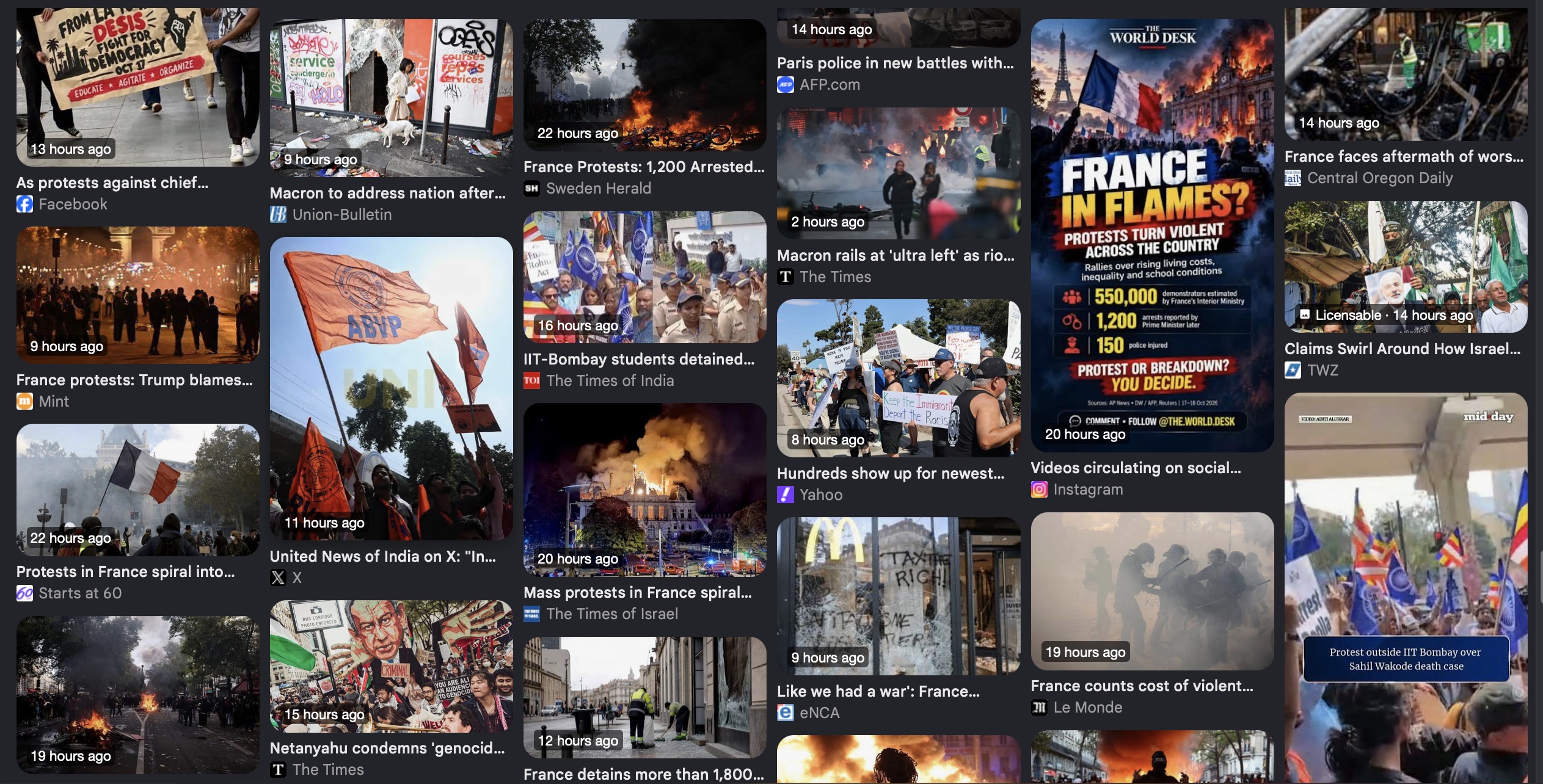
In France, on Saturday October 17, between 550,000 people (the government’s count) and 800,000 (the unions’ count) marched in more than 140 cities; a protest that began with striking students in crumbling schools and grew into public fury over rising prices, inequality, and decaying public services. One protester told CNN: “There’s an accumulation of wealth and power that’s completely out of control.”
In Spain, the housing protest wave continues: after September’s march of hundreds of thousands in Madrid, more than fifty cities saw demonstrations in October, and a general strike has been called for November 11. Rents have nearly doubled in a decade while wages have stood still.
In Albania, students have been demonstrating for five days in Tirana and other cities, demanding the prime minister’s resignation; fury over corruption, unemployment, and inequality. One protester said: “Albania needs a revolution, a change, a complete overthrow of the system, because it can’t go on like this.” Five hundred people have been detained.
In Argentina, students occupied the University of Buenos Aires and thousands marched against Javier Milei’s austerity; the fifth major protest wave since 2023. A judge has fined the government for failing to fund the universities.
Four countries — four patterns of one crisis: a generation that sees wealth built by its labor flow into others’ pockets; that sees its schools crumbling while data centers devour the city’s electricity; that sees housing turned from a right into a commodity. These are not “scattered protests”; they are the signs of a system cracking from within.
The Crises of Capitalism: Accumulation, Poverty, and War
Marx described the mechanism a century and a half ago: capital must accumulate to survive; accumulation means concentration; concentration means growing relative poverty at the opposite pole. Today this mechanism is visible to the naked eye. In the United States, investors bought more than a third of single-family homes sold in the third quarter of 2025; meanwhile 22.6 million renter households pay more than a third of their income just for rent. Wealth accumulates, poverty spreads, and the majority’s livelihood grows tighter every day.
And when accumulation hits a wall at home, capital takes the old road: war. The history of capitalism is the history of turning overproduction crises into organized destruction — from colonial wars to today’s proxy wars. Every missile is demand; every reconstruction is a market. Warmongering is not a deviation from capital’s logic but its continuation by other means: when profit from peaceful production no longer suffices, destruction itself becomes a commodity.
These are not separate crises; they are faces of one crisis: a system that once unleashed the productive forces has become their chain.
Intensified Alienation in the Age of AI
Marx described alienation thus: the worker is estranged from the product of her labor, from the process of labor, from her fellow human beings, and from herself. Artificial intelligence has taken this alienation to an unprecedented level. Today billions of humans — with every click, every text, every image — produce the data that is AI’s engine; but they own none of it, share in none of the decisions over its fate, and do not even know what has been built from them. The data labeler in Kenya, the driver whose routes train the algorithm, the physician whose diagnoses build the model: all are producers, none are owners.
This is history’s deepest form of alienation: the human estranged not only from the product of her hands but from the reflection of humanity’s collective mind. AI is the mirror of human knowledge — which, in the hands of a few, has become an instrument of domination over that same humanity.
The Central Contradiction: Social Production, Private Ownership
And here we reach the heart of the matter; the contradiction Marx saw as history’s engine, brought to its peak by AI: production grows more social every day, ownership grows more private.
Look at AI: trained on the accumulated knowledge of all humanity, built by the collective labor of millions, running on the public infrastructure of the internet and electricity, and its product — from translation to medical diagnosis — serves all of society. History has never seen more social production than this. But its ownership? In the hands of a few corporations. Its profit? Private. The decisions over its fate? In boardrooms.
This contradiction sharpens daily, because technology makes production more social every day without shaking ownership. And contradictions this fundamental get resolved in history; the question is not whether but how. Either this contradiction gets “resolved” through deepening poverty, repression, and war — the road of barbarism; or through the socialization of ownership — the road of the new order.
The Answer: Social and Democratic Ownership
The answer to this contradiction lies within the contradiction itself: if production is social and collective, ownership must be social and democratic too. This is not a slogan; it is a logical necessity. You cannot run history’s most social productive force with history’s most private form of ownership without driving society to explosion — and we see the explosions today in Paris, Tirana, Madrid, and Buenos Aires.
What does social ownership mean? It means the fate of AI — built with everyone’s knowledge — decided by everyone, not by a few. It means data centers as public infrastructure, not private profit machines. It means consciousness as everyone’s right, not a commodity in the attention market. And democratic means what? Not distribution from above, but participation in power: councils, neighborhoods, workplaces — where people live their daily lives, there they decide.
The majority who contribute most to the production and accumulation of capital must have a greater share of the wealth produced. This is not abstract justice; it is the very logic capitalism itself shouts with an open mouth: you produce, we own. Our answer is simple: we produce, we decide too.
Why Is This Future Highly Likely?
Hansen says don’t lean on “existing evidence” for hope. She is right — if by evidence you mean the statistics of the existing order. But there is another kind of evidence: structural evidence. When in a single week, in four countries, hundreds of thousands take to the streets with one pain; when the contradiction of social production and private ownership sharpens daily; when the existing order resorts to war and repression to survive — these are the signs of an order collapsing, not an order stable.
History tells us that orders unable to resolve their fundamental contradictions give way to orders that can. Feudalism could not accommodate the rising bourgeoisie; it gave way. Today’s capitalism cannot accommodate the socialized production it has itself created; and the resolution is the socialization of ownership. This is not mystical prophecy but the material reading of history. That is why we say the future of the new order is not a wish but highly likely.
Trained Hope, Trained Consciousness
And here we return to Hansen. She says we don’t need more information; we need to rebuild our capacity to believe in what we cannot yet see. This sentence should be framed. For decades we have been told salvation lies in more data. But consciousness is not the accumulation of information; consciousness is the capacity to see the link between experience and structure — and like any muscle, this capacity is built through practice: each time you say “the structure is designed this way” instead of “I was unlucky,” one rep; each time you say “what can we do together” instead of “nothing can be done,” one rep; each time you name the future and take one step toward it, one rep.
And this practice is collective. No one alone can believe in a future that hasn’t come and move toward it; that is the work of councils, neighborhoods, workplaces — the participation in power that is the heart of the new social order. Individual hope is a feeling and passes; trained collective hope is a discipline and endures.
Act As If It Were Real
Hansen’s most beautiful line about King is this: he acted as if that community were real — and that changed the world. When a neighborhood’s residents build a council for their housing, when teachers make collective decisions for their school, when programmers open AI tools to everyone, they are acting as if the new order were real. And each time they act this way, they make it a little more real.
So our practice today is clear: let us name the future — an order in which social production has social ownership too; in which AI is not an instrument of power concentration but the infrastructure of collective participation; in which the producing majority takes its share of the wealth produced. Let us name it, name it loudly, and take one step toward it every day. The muscle is built with these very reps.
Hope is a muscle. And the future we train for is not a wish but highly likely — because capitalism’s crises bring it closer every day, and because we are building its material conditions today, with our own hands.
Hamid Akhavi / October 2026

