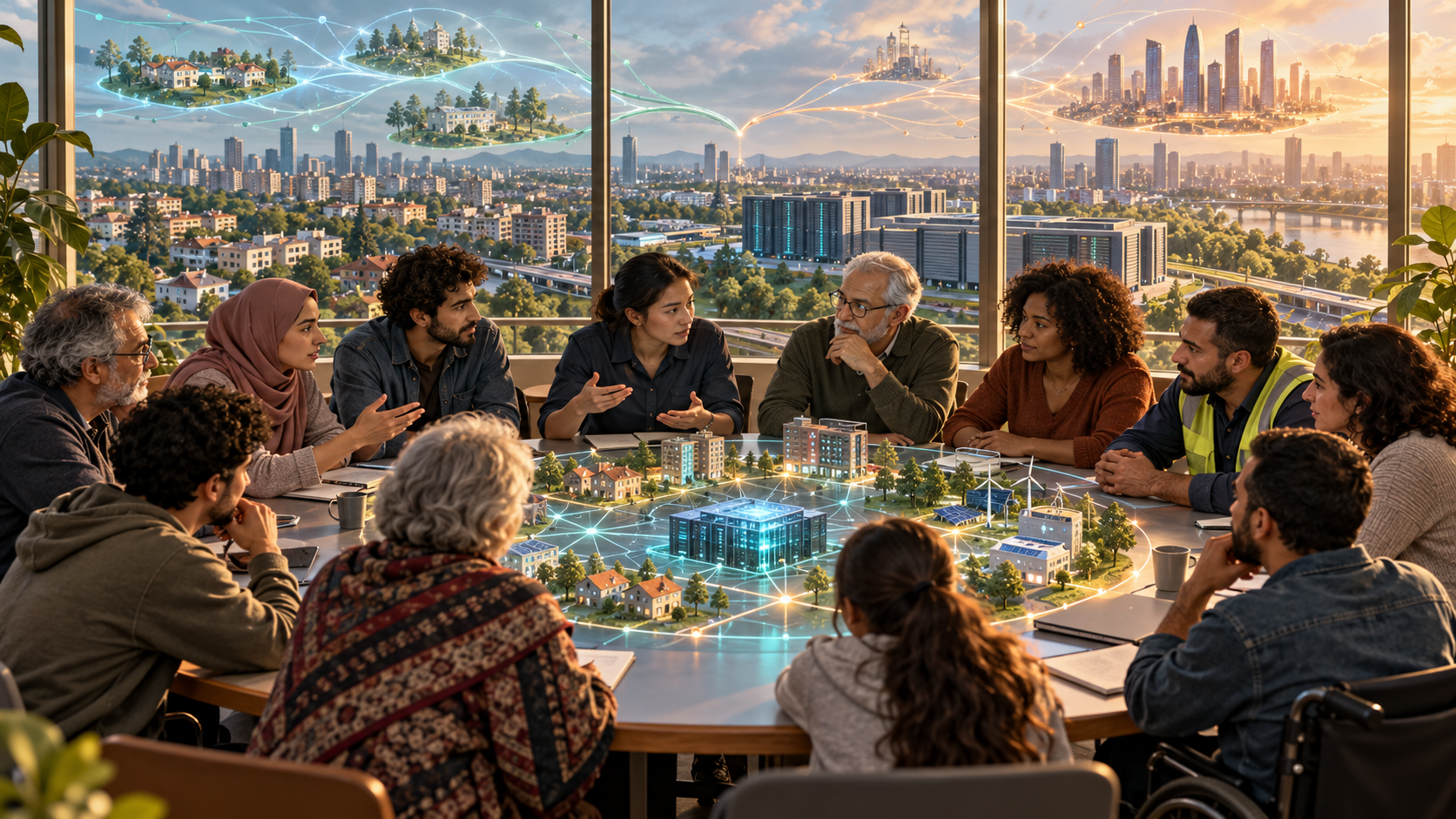
Different Perspectives and the Prospect of a New Social Order in the Age of Consciousness
Hamid Akhavi — October 14, 2026
The future begins in everyday life
Imagine a worker whose pace of work, rest periods, or performance assessment is determined by a system; a tenant who wants to know who benefits from the city’s housing budget; or a resident facing the construction of a data center near their home. For these people, the future of AI is not a remote debate about superintelligent machines. It concerns income, time, water, electricity, and the ability to influence decisions that shape their lives.
There are different views of AI’s future: some warn of major risks, some anticipate scientific progress and abundance, and others emphasize labor, ownership, environmental costs, and the concentration of power. To clarify our own position, we must first understand these perspectives and then show how the question of people’s participation in power connects with them.
The future of AI: different perspectives and shared questions
There is no single view of AI’s future. Disagreements concern the capabilities and risks of machines, as well as the pace of development, oversight, ownership, and the distribution of benefits. The following classification is a map for understanding the debate, rather than a division of individuals into fixed camps. A researcher may support the technology’s potential while also warning of its dangers. Historical examples should not be treated as a complete account of anyone’s current position.
1. Those warning of extinction risk
In his March 2023 TIME article, Eliezer Yudkowsky described the continued development of AI beyond human capabilities as an extremely serious threat and called for a worldwide halt to the training of very powerful systems. This position emphasizes the possibility of losing control. [5] Its significance lies in raising the prospect of irreversible consequences; the intensity of a warning, however, is not scientific proof of its certainty. From our perspective, alongside technical control, we must ask who will have the authority to define risk, set limits on development, and enforce restrictions.
2. Researchers who are both builders and concerned critics
Geoffrey Hinton exemplifies researchers who, despite their foundational role in developing neural networks, warn about social consequences and the possibility of losing control. His warnings also appear in conversations published by the Nobel organization. [6] This perspective shows that helping to build a technology does not imply unconditional confidence in its future. Its connection with our framework is the need for accountability among developers and the institutions deploying their systems: responsibility must accompany decision-making authority.
3. Conditional optimists about progress
In “Machines of Loving Grace,” published in October 2024, Dario Amodei explored the possibility of accelerating progress in health, science, and human wellbeing. These are conditional scenarios, not guaranteed achievements. His subsequent essay, “The Adolescence of Technology,” also addresses risks. [7] Optimism and concern can therefore coexist within one perspective. Our additional question is this: even if the capacity to treat disease and produce goods grows, what mechanisms will ensure that low-income people and disadvantaged communities also benefit?
4. Accelerationists and market-oriented optimists
In “The Techno-Optimist Manifesto,” published in October 2023, Marc Andreessen presented technology, growth, and markets as engines of progress. [8] This view centers on expanding innovation and production. Our criticism is not that increased productive capacity is unimportant, but that productive capacity and equitable distribution are different questions. Potential abundance can coexist with actual deprivation if relations of ownership and power remain unchanged. We must ask: growth of what, for whose benefit, and at what cost?
5. Advocates of pausing or slowing development
The Future of Life Institute’s March 2023 letter called for a pause of at least six months in the training of models more powerful than GPT-4, allowing time to develop and implement safety measures. [9] This proposal is not the same as an indefinite halt to all research. The social question is who gains a voice during that pause: will only governments and companies negotiate, or will workers, citizens, and independent institutions also participate in setting the rules?
6. Advocates of safety, alignment, and oversight
Part of the debate focuses on aligning system behavior with human objectives, safety testing, and oversight. The May 2023 US Senate hearing involving Sam Altman was one public example of calls for oversight; that hearing should not be equated with the entire field of alignment research. [10] Our question here is straightforward: alignment with which people’s wishes? The objectives of owners and governments may conflict with the needs of workers, users, or minorities. Technical safety must be accompanied by rights and social accountability.
7. The geopolitical perspective: competition and cooperation
AI can become part of economic and security competition between states, but international cooperation also belongs to this arena. The November 2023 Bletchley Declaration emphasized cooperation on safety, human rights, and accountability; it should not be described as an official declaration of an arms race. [11] Our argument asks how cooperation among governments and companies can connect with public participation. A country’s security, by itself, is not a sufficient measure of justice for workers, citizens, or people in other countries.
8. Critics of claims of understanding and the harms of language models
In their 2021 paper “On the Dangers of Stochastic Parrots,” Emily Bender, Timnit Gebru, and their coauthors warned against equating fluent output with understanding, and also discussed environmental costs, bias, and social harms. [12] This critique should not be reduced to skepticism about machine capabilities; relations of power are also present in it. Our framework overlaps with this critique and seeks to move from identifying harms toward establishing rights, responsibilities, and institutions for participation in decisions.
9. Critics of AI’s political economy
In her 2021 book “Atlas of AI,” Kate Crawford examines technology in relation to labor, resource extraction, infrastructure, and power. [13] This perspective directly connects with the social character of production. It is therefore incorrect to say that earlier critics ignored power. Our proposed emphasis is to connect this critique with a constructive vision of social ownership and people’s institutionalized participation in setting objectives, exercising oversight, and reviewing decisions.
10. Advocates of open models and broader access
Yann LeCun is a prominent advocate of open models and a critic of some catastrophic scenarios. [14] Broader access can increase opportunities for use, research, and independent scrutiny. But access to a model does not guarantee equal access to computing resources or the right to determine the direction of development. Our question is how freedom of access can connect with the practical ability to use these tools and participate in their governance. An open model can be part of the solution, but it cannot substitute for a democratic decision-making structure.
From differing perspectives to our own position
These perspectives should not be reduced to two simple camps for or against technology. Their disagreements concern several dimensions: which capabilities can be expected, which risks matter most, how quickly development should proceed, who should oversee it, and how benefits should be distributed. Each dimension requires evidence and its own discussion.
Critiques of political economy, warnings about bias, and advocacy for open access each raise aspects of the question of power. “A New Social Order in the Age of Consciousness” learns from these critiques and seeks to connect them with an institutional question: how can people move from bearing the consequences of decisions to having effective authority in shaping them? This is a theoretical and political proposal, not a claim that no one has previously discussed power.
In dialogue with those warning of risks, we emphasize safety and people’s right to determine limits on use. In dialogue with optimists, we distinguish the potential for progress from justice in sharing its benefits. We connect critiques of political economy, ownership, and labor with decision-making institutions. And in dialogue with advocates of open models, we ask what infrastructure and rights are needed to turn access into genuine participation.
We can then take the argument a step further: if production is social, the authority to set objectives and oversee results should also be made social through democratic arrangements. This principle does not mean eliminating expertise, disregarding technical risks, or subjecting minority rights to majority votes. It requires institutions that can make decisions while remaining open to criticism and correction.
Social production and limited authority
AI relies on a combination of social and material resources: accumulated knowledge, language, research, infrastructure, energy, the labor of programmers and data center employees, and the work of people who prepare and evaluate data. Some data also comes from users’ activities and creative works. These contributions are not identical, and contributing data should not be equated with every form of labor. Yet the final product cannot be understood simply as the genius of a few owners or managers.
Against this social foundation, decision-making authority can be concentrated among a limited number of owners, managers, and state institutions. The central issue is not only who owns the product, but who determines its uses and how its benefits are distributed. Here, the contradiction between social production and private ownership also takes the form of a contradiction between widespread participation in production and restricted participation in decision-making power.
This critique does not mean that every technical question can be reduced to ownership. Model errors, security, bias, and reliability require examination under any form of ownership. Changing ownership can change the direction of use, but it does not automatically create an accurate or safe system. A sound social critique must examine both power relations and the tool’s actual limitations.
Machines can choose; people determine legitimacy
AI systems can choose among options within a defined scope, make recommendations, and, when connected to tools, carry out actions. These capabilities should not be equated with human consciousness, moral responsibility, or a right to govern. Choosing an option according to an assigned objective differs from a social decision about which objective is just.
If a system’s sole criterion is reducing costs, it may recommend a solution that shifts the burden onto a group with little power. More precise calculation does not eliminate disagreements over values and interests. The question “efficient for whom?” remains. Human beings are more than collections of measurable characteristics: they possess rights, experience, and the ability to object.
In decisions affecting people’s lives, it must therefore be clear which institution is responsible, what data was used, what limitations exist, and how a decision can be challenged. Delegating part of the work to a system must not break the chain of responsibility. Understandable explanations, human review, and independent evaluation are elements of accountability.
Changing ownership must accompany changing governance
State ownership alone does not equal popular control. A state may own infrastructure while excluding workers and citizens from decision-making. In that situation, concentrated power may continue. Bringing resources into public ownership must therefore be accompanied by guaranteed freedoms and genuine participation in power.
Public, social, and cooperative forms of ownership should be assessed against clear criteria: how much authority do people have in setting objectives? Is the necessary information accessible? Can independent media and unions criticize decisions? Can representatives be recalled? Are conflicts of interest disclosed, and can decisions be reviewed? The label attached to ownership does not answer these questions.
Open models can also expand access and opportunities for evaluation, but access to a model is not the same as access to computing capacity or the right to determine the direction of development. Opening part of the technology, without addressing resources and decision-making structures, does not guarantee equal participation.
Participation does not eliminate expertise
Workplace and neighborhood councils can provide a foundation for participation, provided they have real authority and mechanisms of accountability. Participation must not become a ceremonial meeting to endorse a decision already made. People should be able to define the problem, propose new options, and help oversee implementation.
This process needs experts. Specialists should explain options, costs, evidence, and uncertainty; citizens and accountable representatives should decide social objectives and priorities. Expertise alone cannot determine how much inequality is acceptable or whose needs should come first.
Equal participation also requires resources: time, education, understandable information, independent experts, and support for disadvantaged groups to participate. If only people with more time and resources can take part, a council may reproduce existing inequalities. Coordination at city, regional, and national levels is needed so that one locality’s decisions do not transfer costs to others.
Participatory budgeting in Porto Alegre, Brazil, which began in 1989, provides an example of citizens helping set priorities for part of a public budget. Its significance is in demonstrating a practical mechanism, not proving that a single model resolves every problem of democracy. [1]
Housing: an example of a conscious economy
Suppose a city has a limited housing budget. This is a proposed example to explain the mechanism. Tenants, neighborhood councils, workers, and experts first identify needs and criteria: reducing homelessness, affordability, construction quality, and access to public transportation. They then consider options such as repairing existing homes, building public housing, or supporting cooperatives.
AI can compare costs and scenarios, show possible effects, and make scattered information usable in public discussion. But weighing needs and choosing priorities remain the responsibility of an accountable human institution. Assumptions, gaps in data, and uncertainty must be disclosed; options should receive independent evaluation, and there must be opportunities to challenge and revise decisions.
In a conscious economy, receiving new information should support learning and correction, rather than continuous surveillance of private lives. Transparency about budgets and contracts differs from revealing tenants’ personal information. Necessary data should be collected with privacy protections, and implementation should be periodically assessed against the stated objectives.
Higher productivity: more free time or greater insecurity?
AI’s effect on employment is not predetermined. The type of activity, pace of change, demand, public policy, and workers’ bargaining power all influence it. We therefore cannot equate every productivity gain with inevitable job losses, nor assume that markets will automatically distribute its benefits fairly.
Increased productivity may lead to fewer employees and more concentrated profits. But people can organize to direct part of those gains toward shorter working hours without reduced pay, training with income support, and better public services. These are social choices and political demands, not guaranteed consequences of technology.
Workers and unions should therefore have an effective role in decisions about automation, algorithmic assessment, and the distribution of gains. The issue is not simply adapting people to machines; it is the possibility of collectively shaping the organization of work.
AI infrastructure is also a matter for public decision-making
AI needs infrastructure whose resource consumption is real. In its 2026 report, the International Energy Agency estimates total data center electricity consumption at around 485 terawatt-hours in 2025 and around 950 terawatt-hours in 2030 under its central projection. This forecast is not certain, and it covers all data centers, not only AI systems. [2]
Lawrence Berkeley National Laboratory’s 2024 report also estimates that US data centers used approximately 66 billion liters of water directly in 2023, with an indirect water footprint of nearly 800 billion liters associated with electricity generation. These figures alone do not prove the absence of participation or concentrated ownership, but they demonstrate the importance of public assessment of costs and benefits. [3]
Before a project is approved, its water and electricity use, effects on the grid, land conditions, and costs that may be passed on to the public should be assessed and disclosed. Residents should be able to influence its location, conditions, and necessity. Local decisions must also acknowledge responsibilities toward shared resources and other regions.
Different types of temperature measurement must be distinguished. A preprint published in March 2026 and revised in April reports an average increase of around 2°C in land surface temperature near the data centers studied. That figure is not the air temperature in every neighborhood and should not be generalized to every data center. Publication on arXiv does not itself constitute confirmation through scientific peer review. Each location needs data and independent assessment. [4]
Freedoms are a condition of lasting participation
No council is immune to concentrated power. Representatives, managers, or experts may become a group that monopolizes access to information and decisions. Preventing this requires enduring institutions: rotation of responsibilities, the ability to recall representatives, independent oversight, disclosure of conflicts of interest, and the right to challenge decisions.
A majority vote does not authorize violations of basic rights. Freedom of expression, the press, political parties, organization, assembly, and strike action must be guaranteed, alongside privacy and the rights of religious and sexual minorities. Public decisions must be open to challenge before an independent body. Without the right to dissent, participation can turn into organized obedience.
At the technological level, independent scrutiny and the ability to stop or correct harmful systems must also exist. Auditing and the right to challenge decisions must not remain merely on paper: the responsible institution needs the resources and authority to enforce them.
The age of consciousness: a social possibility and a responsibility
In the framework of “A New Social Order in the Age of Consciousness,” consciousness does not mean machine sentience. It means people’s capacity to connect everyday experience with social structures, discuss shared objectives, and turn understanding into responsible collective action. This process develops through education, freedom to criticize, and the experience of participation.
Consciousness alone does not guarantee social transformation. Technology does not automatically bring freedom either. Building a new order requires organization, rights, accountable institutions, and struggle over ownership and decision-making. A conscious society can make mistakes; the value of democratic institutions lies in their capacity to learn and correct them.
Starting today, we can work for workers’ effective participation in decisions about their jobs; residents’ participation in infrastructure projects; protection of personal data; explanations and human review of algorithmic decisions; and the development of public and cooperative infrastructure. These demands can connect a social vision with tangible experiences.
Our argument therefore neither promises automatic salvation through technology nor predicts inevitable destruction. We learn from safety warnings, critiques of political economy, and advocacy for open access, and emphasize one connection: the social character of production must be accompanied by democratic forms of ownership and participation in power. AI’s future emerges from the interaction of technical capabilities, social relations, and collective action. Consciousness becomes social power when people can set objectives, distribute benefits fairly, and challenge and correct decisions.
Sources
[1] World Bank, Participatory Budgeting in Brazil — the Porto Alegre experience
[2] International Energy Agency, Key Questions on Energy and AI, 2026
https://www.iea.org/reports/key-questions-on-energy-and-ai/executive-summary
[3] Lawrence Berkeley National Laboratory, 2024 United States Data Center Energy Usage Report
[4] Marinoni et al., The data heat island effect, preprint; version 3, April 2026
https://arxiv.org/abs/2603.20897v3
[5] Eliezer Yudkowsky, TIME article, March 29, 2023
https://time.com/6266923/ai-eliezer-yudkowsky-open-letter-not-enough/
[6] Geoffrey Hinton, conversations published by the Nobel organization
https://www.nobelprize.org/prizes/physics/2024/hinton/podcast/
[7] Dario Amodei, Machines of Loving Grace and The Adolescence of Technology
https://darioamodei.com/essay/machines-of-loving-grace
https://darioamodei.com/essay/the-adolescence-of-technology
[8] Marc Andreessen, The Techno-Optimist Manifesto, October 2023
https://a16z.com/the-techno-optimist-manifesto/
[9] Future of Life Institute, Pause Giant AI Experiments: An Open Letter, March 2023
https://futureoflife.org/open-letter/pause-giant-ai-experiments/
[10] US Senate Judiciary Committee, Oversight of AI hearing, May 16, 2023
[11] The Bletchley Declaration, November 2023
[12] Bender, Gebru, and coauthors, On the Dangers of Stochastic Parrots, 2021
https://dl.acm.org/doi/10.1145/3442188.3445922
[13] Kate Crawford, introduction to Atlas of AI
https://katecrawford.net/atlas
[14] Yann LeCun, personal website and links to discussions of open models and AI risk
Theoretical framework: Hamid Akhavi, A New Social Order in the Age of Consciousness

