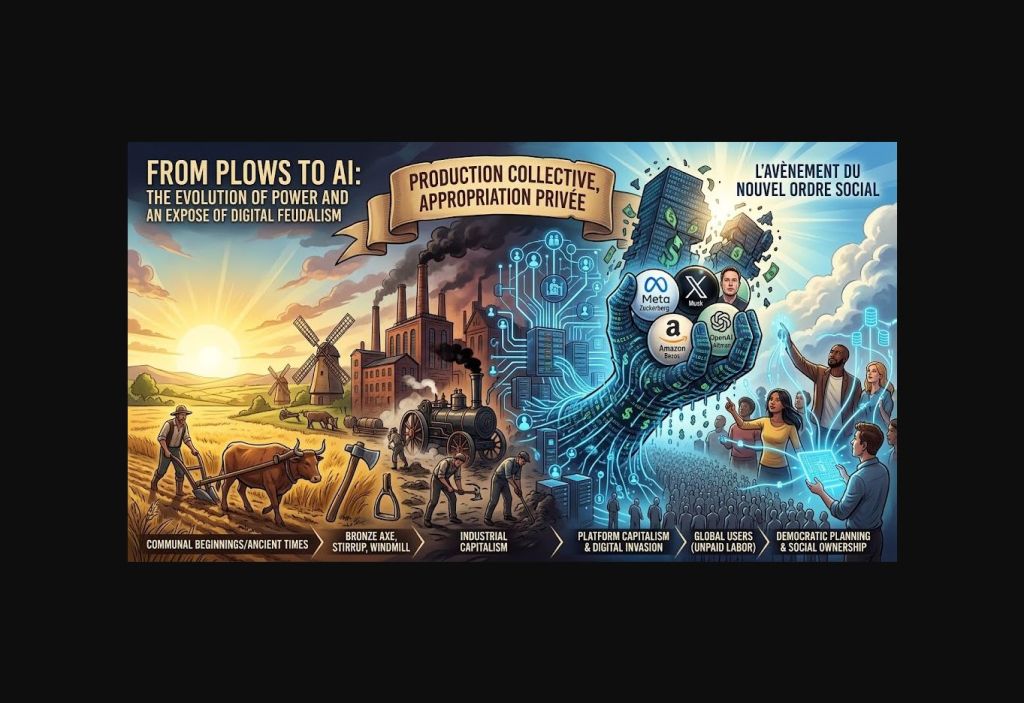
Conceptual image: collective production, private appropriation, and the transition toward a new social order through artificial intelligence.
Introduction: The Means of Production as a Motor of History
The history of human societies shows that different social forms have been shaped directly by the means of production and the economic relations of their time. The iron plow and bronze axe helped dissolve early communal societies and consolidate city-states and slavery. The steam engine transformed a land-centered feudal society into industrial capitalism. Today, new technologies are again redefining social organization.
Technology does not operate in a social vacuum. It functions within the prevailing relations of production. Artificial intelligence and digital platforms are among the most advanced productive tools in human history, yet a fundamental contradiction has emerged between the concentrated private ownership of these tools and the collective, public character of the data that powers them.
Part One: Technological Change and Social Structure
To understand our present historical moment, we should follow the path from earlier tools to the age of AI:
- Iron tools and slavery: Metalworking made large-scale clearing, irrigation, and agricultural expansion possible. Surpluses grew to the point that enslaving prisoners of war became economically profitable, accelerating the transition away from early communal forms.
- The stirrup, mills, and feudalism: The stirrup strengthened the armored mounted warrior, while water and windmills substituted natural energy for human labor. Serfs became tied to the land and surrendered part of their product to feudal lords.
- Printing and the Renaissance: Gutenberg’s press broke the church’s monopoly over knowledge. The translation of religious texts and circulation of newspapers helped form an intellectual middle class and modern nation-states.
- The compass and mercantilism: Oceanic navigation opened global trade and shifted wealth from landed elites toward merchants and owners of trading fleets.
- The steam engine and industrial capitalism: Production was concentrated in factories, turning millions of peasants into an urban proletariat and factory owners into an industrial bourgeoisie.
- Electricity and the assembly line: Mass production created consumer society and a new middle class of managers and technicians.
Part Two: Platform Capitalism and the Technology Oligarchy
We have entered a phase often described as algorithmic capitalism or digital feudalism. A small group of owners controls crucial technological infrastructure and accumulates wealth on an unprecedented scale.
- Mark Zuckerberg (Meta): Instagram, Facebook, and WhatsApp depend on the unpaid activity of billions of people. Every post, comment, and video generates data that improves Meta’s algorithms. The value created through countless hours of social activity becomes corporate profit and private wealth.
- Elon Musk (X and xAI): The use of text produced by millions of X users to train Grok illustrates how publicly generated expression can be privately appropriated as fuel for a concentrated AI system.
- Jeff Bezos (Amazon): Amazon is not merely a retailer. AWS supports a major part of the internet, while purchasing behavior, reviews, and ratings improve systems used to manage labor, shape consumption, and overpower competitors.
- Sam Altman and OpenAI: A project launched with a nonprofit mission evolved into a closed commercial enterprise. Decades of human writing, programming, art, and knowledge published online became training material for proprietary systems valued in the billions.
The Structural Contradiction: Collective Production, Private Appropriation
Exploitation has taken on a new form. The industrial worker was exploited during working hours; today, people also perform unpaid labor in their leisure time by producing data and attention on digital platforms. These contributions help build AI systems, while the surplus created from collective intelligence flows mainly to large technology corporations.
To preserve this arrangement, platform capitalism benefits from a kind of algorithmic de-consciousness: users are kept inside addictive, distracting, and superficial cycles that inhibit sustained critical awareness.
Part Three: The Dialectic of AI and the Possibility of Emancipation
Despite its present concentration, artificial intelligence contains a contradiction that can turn it into a tool against the system that owns it. Just as printing weakened the church’s monopoly over knowledge, AI can weaken monopolies over knowledge, analysis, and management.
1. Democratizing Knowledge
AI sharply reduces the cost of accessing advanced knowledge, processing complex economic information, programming, and legal analysis. Capacities once confined to expensive universities, corporations, or financial institutions can increasingly be used by ordinary people to examine and expose relations of power.
2. Democratic Economic Planning Beyond the “Invisible Hand”
Capitalism has long claimed that only markets and competition for profit can allocate resources efficiently. AI and large-scale data analysis now make it possible to estimate social needs, coordinate production, and optimize distribution without making private profit the organizing purpose. An economy can be planned around meeting human needs rather than maximizing returns for a handful of billionaires.
3. Socializing Infrastructure and Redistributing the Surplus
AI systems and essential data platforms should cease to be the exclusive property of a few owners and become public or shared commons. Under democratic social ownership:
- Productivity gains could shorten the working week instead of producing mass layoffs and insecurity.
- The surplus generated through social knowledge and data could return to the population through universal services, social dividends, or a universal basic income, creating time for intellectual, artistic, and human development.
Analytical Matrix of Historical Transitions
| Historical period | Main technology | Form of exploitation/value | Dominant owners | Emancipatory horizon |
|---|---|---|---|---|
| Slavery | Iron axe and plow | Forced labor and direct captivity | Aristocrats and slaveholders | Revolts and the breakdown of ancient city-states |
| Feudalism | Stirrup and watermill | A share of the peasant product | Feudal lords and knights | Trade, urbanization, and the Renaissance |
| Industrial capitalism | Steam power and assembly line | Surplus value from wage labor | Bourgeoisie and factory owners | Worker organization and socialist movements |
| Algorithmic capitalism | Digital platforms and data | Unpaid user labor plus worker exploitation | Technology oligarchs | Public data infrastructure and democratic AI planning |
Conclusion: Toward a New Social Order
Capitalism in the age of AI intensifies a central contradiction: extraordinary wealth and productive infrastructure are concentrated in a few hands, while billions of people provide the knowledge, data, and social activity on which the system depends.
Just as the plow helped prepare the conditions for feudalism and the steam engine helped give birth to industrial capitalism, AI can become a means of transition toward the next social era. If democratic society gains control over this technology, the logic of endless private accumulation can be displaced. AI can help end the exploitation of human beings by other human beings—an era in which machines perform more necessary labor, the social surplus belongs to society, and people gain the time and freedom to live consciously and fully.


Leave a comment