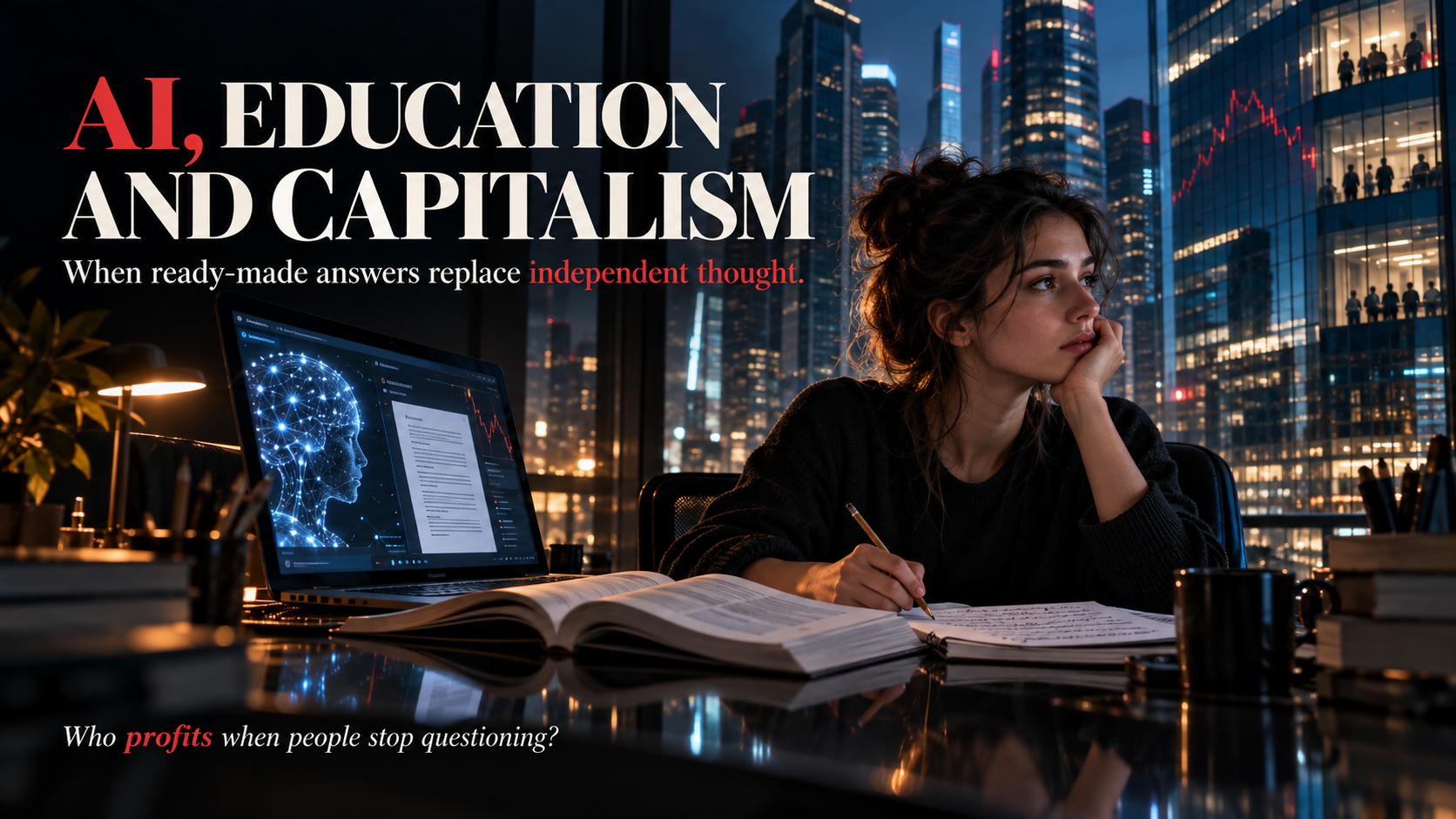
How intellectual dependence can weaken learning and serve concentrated economic power
Education is a struggle over who has the power to understand the world and change it. When universities become credential factories and access to knowledge and learning tools becomes a commodity dependent on people’s ability to pay, artificial intelligence can accelerate a dangerous substitution: finished answers for developed judgment, marketable output for understanding, and obedience to systems for the capacity to challenge them. The question is not simply whether AI makes homework faster. It is whether education produces autonomous people or increasingly dependent users.
Capitalism benefits from an uncritical public. In the political-economic argument advanced here, the enduring drive of capital is to organize social life around accumulation: people skilled enough to produce, willing enough to consume, and insufficiently empowered to question ownership and exploitation. “Dumb citizens” is therefore a misleading insult if it blames people’s intelligence. The real issue is the social production of unawareness and political powerlessness.
Capital needs intelligence, but intelligence placed at its disposal. It needs engineers who can build an automated workplace; it is less comfortable with workers who ask who owns it, who loses their livelihood, and who controls the surplus. This contradiction runs through capitalist education: develop productive abilities, but contain the collective power that could redirect production toward human need. This is a structural critique, not a claim that every teacher, company, or historical institution acts with a single intention.
When AI is introduced across schools, universities, and vocational training mainly to cut labor costs, sell access, and maximize throughput, that contradiction gains a powerful technical instrument. Repeatedly outsourcing reading, reasoning, and judgment can leave learners less practiced in making sound decisions. This outcome is a risk shaped by design and power, not a destiny written into the technology. Resisting it means confronting the commercial organization of education as well as changing classroom practice.
The alternative is education for emancipation: the time, material security, knowledge, and collective confidence to question authority. The research findings below identify specific educational risks; the wider argument about capitalism is a political interpretation of those risks. Classroom scenarios are illustrative unless identified as documented cases. A radical critique must be more rigorous about evidence, not less.
1. Completing an assignment does not necessarily mean learning
A randomized field experiment involving nearly 1,000 high school mathematics students in Turkey illustrates the distinction. Students with a general GPT-based assistant performed better during practice. When assistance was removed, that group scored approximately 17 percent lower than students who had practiced without it. A tutor designed with learning safeguards largely avoided this harm. The result concerns specific tools and conditions; it does not establish that all AI use damages learning. [1]
- Mathematics: A student submits correct algebra solutions but cannot explain why an operation preserves equality.
- Programming: A student produces a working application but cannot diagnose an error after a small requirement changes.
- Science: A student repeats an explanation of an experiment but cannot predict what happens when one variable changes.
- Language learning: A learner submits fluent translations but cannot construct comparable sentences in conversation.
In each example, the product conceals a gap in understanding. An institution judged mainly on completion rates and credentials may have weak incentives to expose that gap. Education should measure what the learner can explain and do after assistance is removed.
2. Outsourcing reasoning can weaken the practice of judgment
AI can choose a question, organize evidence, propose an argument, and write a conclusion. When students delegate every stage, they lose opportunities to practice making and defending intellectual choices.
A 2025 survey of 319 knowledge workers found that greater confidence in generative AI was associated with less reported critical thinking. This was a study of adults’ self-reported work practices, not an experiment proving that students lose intelligence. It nevertheless identifies a relevant concern: confidence in a system may reduce scrutiny. [2]
- Literature: A student accepts an interpretation of a novel without checking whether passages support it.
- History: A student requests the “main cause” of a revolution and never examines competing explanations.
- Statistics: A student repeats a survey conclusion without considering selection bias or uncertainty.
- Debate: A student generates both sides of an argument without deciding which evidence deserves greater weight.
The civic implication is significant. A person practiced in accepting confident answers may also accept an employer’s or political leader’s explanation without examining its assumptions. This is a plausible connection, not proof that classroom AI use causes political compliance.
3. Fluent misinformation can acquire the appearance of authority
An answer can sound authoritative while being wrong. References can appear authentic without corresponding to real publications. Walters and Wilder’s 2023 study documented fabricated references and bibliographic errors in reviews generated by versions of ChatGPT available at that time. Those results are not an error rate for every current system, but they demonstrate why plausible citations require independent verification. [3]
- A history paper attributes a statement to someone who never made it.
- A literature review cites a journal article that does not exist.
- A biology presentation confidently confuses two related processes.
- An economics assignment uses a real statistic with the wrong year, country, or denominator.
A reader who equates polished language with reliable knowledge is vulnerable to advertising, corporate public relations, and political messaging as well as chatbot errors. Students should locate sources, read the relevant material, and check whether it supports the claim. Asking the same system to confirm its answer is insufficient verification.
4. Shortcuts can remove the practice that builds understanding
Reading difficult material, drafting an argument, recalling a concept, and working through an unfamiliar problem can be valuable precisely because they demand sustained attention. The risk is greatest when a shortcut repeatedly replaces the skill an assignment is intended to develop.
- Reading: A student substitutes summaries for full texts and avoids following a complex argument.
- Writing: A student edits the wording of a generated essay without deciding how its argument should develop.
- Research: A student accepts a synthesis without comparing the underlying sources.
- Problem-solving: A student requests the solution immediately instead of attempting an approach and examining an error.
These examples describe possible mechanisms, not proof that every summary or writing aid causes harm. Accessibility tools and explanations can enable engagement. The question is whether assistance helps learners participate in intellectual work or repeatedly eliminates that work.
5. AI can hide learning difficulties from teachers
Teachers use assignments to understand students’ reasoning. If submitted work largely reflects generated output, that information becomes less reliable. A student unable to distinguish correlation from causation may submit an essay that uses both correctly, concealing a misunderstanding that needs attention.
- A language learner submits accurate grammar while persistent misunderstandings remain unaddressed.
- A student receives strong essay grades but cannot organize an argument during an independent examination.
- A group submits a sophisticated presentation even though only one member understands its claims.
Schools need evidence of the student’s reasoning through oral explanations, annotated drafts, classroom work, and application to new problems. A credential should represent developed competence, not merely access to a capable system.
6. Skilled for production, disarmed against exploitation
A worker who can complete a task is useful to an employer. Workers who can also understand exploitation, organize collectively, and contest ownership pose a challenge to managerial power. The distinction is not between intelligence and ignorance in the abstract. It is between abilities mobilized for profit and knowledge connected to the power to refuse unjust conditions.
Consider an economics assignment asking why a company’s profits increased. An answer may emphasize innovation, productivity, and management while omitting wage restraint, subcontracting, market concentration, or public subsidies. The problem is not that every AI answer favors business. It is that accepting the first explanation prevents investigation of competing explanations and the distribution of gains.
A critical education asks: Who produced the additional wealth? Who received it? What bargaining power did each group have? Technical proficiency alone does not guarantee the ability or willingness to pursue those questions.
- A business student produces a restructuring proposal without considering consequences for workers.
- A technology student designs automated workplace monitoring without asking who can contest its decisions.
- A management student proposes replacing staff with AI without evaluating service quality, displaced expertise, or the distribution of savings.
Technical competence can coexist with political passivity. A university that teaches how to optimize layoffs but not how workers can contest them has made a political choice, even when it calls that choice neutrality. Education for liberation must ask not only whether a system works, but for whom it works and who has the power to change it.
7. From autonomous citizen to predictable consumer
From a seller’s perspective, a person who continually questions advertising, financing arrangements, planned obsolescence, and unnecessary consumption can be inconvenient. Education can teach people to choose efficiently among products while leaving the organization of consumption itself unquestioned.
Imagine a student using AI to select a phone. Comparing price and features is useful. A more searching exercise also asks whether replacement is necessary, whether repair is possible, whether commercial relationships affect recommendations, and what labor and environmental costs production involves.
The market rewards purchasing decisions; democracy requires the power to question the choices on offer. A person may become highly efficient at selecting products while losing sight of why needs are defined commercially in the first place. Education should cultivate the ability to refuse manufactured needs, expose concealed costs, and place human well-being above the imperative to sell.
8. The cheap university and the expensive loss of judgment
AI offers institutions a tempting promise: provide more instruction with fewer paid educators. In an illustrative school, automated tutoring reduces spending and raises assignment completion. Administrators advertise modernization. Yet those measures alone cannot establish whether students reason independently, recognize errors, or apply knowledge without help.
Teachers provide more than answers. They notice confusion, invite disagreement, interpret context, and help students develop confidence in their own judgment. When savings become the dominant measure of success, a school may become more efficient at processing students while becoming less effective at educating them.
If a vendor captures the revenue and an institution captures the savings while students absorb the loss of teaching, efficiency becomes a transfer of costs downward. A society should reject the idea that personal instruction is a luxury for the wealthy while everyone else must make do with automated answers. Public education is a social right, not a captive market for technology companies.
9. Unequal support can produce unequal benefits
Access to AI does not guarantee equal educational benefit. Learners also need guidance, subject knowledge, accessible interfaces, and opportunities to question outputs. UNESCO emphasizes human agency, equity, privacy, and educational validation in adopting generative AI. These are implementation principles, not evidence that every deployment increases inequality. [4]
- One student receives teacher-guided tutoring requiring explanations; another receives ready-made answers.
- One school uses AI alongside small-group teaching; another uses it to reduce access to teachers.
- One learner recognizes errors through strong prior knowledge; another accepts the same output uncritically.
The inequality may concern the quality of instruction surrounding AI as much as access to the tool. An especially troubling possibility is a divided system in which privileged students retain human mentorship while others receive predominantly automated instruction. That is a risk to evaluate, not an inevitable outcome.
10. Institutional surveillance can create additional unfairness
Schools can misuse AI when they treat automated judgments as conclusive. Research by Liang and colleagues found that AI-writing detectors frequently misclassified non-native English writing in the samples tested. The finding raises fairness concerns about treating detector scores as proof of misconduct. [5]
An illustrative consequence is an English-language learner being accused of cheating because their writing uses relatively predictable vocabulary and sentence structures. The system then becomes an institutional barrier rather than a reliable assessment of authorship.
Fair procedures should examine the assignment, the student’s explanation, available drafts, and other relevant evidence. Students need clear rules distinguishing permitted assistance from prohibited substitution. Privacy also requires attention: educational convenience should not automatically justify transferring identifiable student work or sensitive information to an external service.
11. Human interaction is part of education
Education develops the ability to listen, disagree, collaborate, and explain ideas to other people. If students generate separate sections of a group project and combine them without discussion, the assignment may be finished while its intended practice in collective reasoning disappears.
Replacing every peer discussion with a private chatbot exchange could similarly reduce encounters with people whose experiences challenge a learner’s assumptions. These are plausible risks whose magnitude depends on implementation. UNESCO recommends preserving opportunities for independent reasoning, real-world observation, and human social interaction. [4]
Collective reasoning is indispensable to organizing a workplace, defending public services, and building democratic power. An education reduced to private exchanges between an isolated user and a proprietary system leaves these capacities underdeveloped. Emancipation requires people learning with one another, recognizing shared conditions, and discovering their capacity to act together.
12. Platform dependence can become dependence on private framing
When students approach knowledge mainly through commercial systems, they encounter it through privately designed interfaces and rules. Accuracy is essential, but it is not the only question.
Who determines which sources receive attention? Which languages and experiences are poorly represented? What commercial relationships affect the service? Can users examine or challenge its decisions? Are students learning how to investigate a question, or only how to request a generated answer?
A student who never asks these questions may treat a commercial interface as a neutral authority. Dependence then becomes intellectual as well as technological: people become practiced at requesting answers while losing practice in deciding how questions should be framed.
13. The democratic stakes: who benefits from an uncritical public?
The connection to citizenship is an argument about possible consequences, not an established finding that AI causes democratic decline. Citizens need to evaluate sources, recognize misleading comparisons, understand uncertainty, and question authority. If education rewards accepting fluent answers without examination, those habits may carry into public life.
- Elections: A voter accepts an AI comparison of candidates without checking sources, dates, campaign financing, or omissions.
- Wages: A reader repeats a claim about rising pay without asking whether the figures account for inflation.
- Public spending: A resident accepts a budget summary without checking what services its categories include or who bears proposed cuts.
- Human rights: A reader treats a generated account of political imprisonment as complete without checking testimony or independent documentation.
- Journalism: A student produces a compelling article without investigating the interests behind its sources.
- Political debate: A person circulates an impressive argument containing unsupported factual claims.
Consider the statement, “There is no alternative to cutting public services.” A critical education asks students to investigate taxation, spending priorities, ownership, and the distribution of costs. An education centered on reproducing approved answers may leave the premise unexamined.
The political conclusion is direct: capital is strengthened when people can operate its systems but cannot effectively question their terms. AI-mediated education can deepen that dependence when it trains users to accept answers while denying them the resources to investigate. Resistance must therefore connect intellectual independence with material independence: time to study, secure livelihoods, strong public institutions, and collective power over technology.
14. Universities are defending space for independent thought
The response is already visible in parts of American higher education: supervised writing, oral defense, restricted devices, and explicit limits on AI-generated work. These measures can reduce opportunities to substitute automated output for a student’s own knowledge. They are not all university-wide bans, and they cannot guarantee that every form of unauthorized assistance is eliminated.
Cornell: paper-and-pencil assessment and face-to-face questioning
Cornell’s October 2025 account describes instructor Liz Karns replacing some assessment with in-class paper-and-pencil work and adding individual 15-minute conversations about course content. It also reports Silvia Amigo-Silvestre returning to written and oral examinations. These are documented course practices, not a ban throughout Cornell. [7]
Harvard Social Studies: a broad default prohibition
Harvard’s Social Studies program prohibits generative and agentic AI across submitted work, including analysis, research, drafting, editing, examinations, and thesis work. Instructors may specify an alternative policy; some thesis uses require approved exceptions. This is a strong restriction within that program, not a claim that all of Harvard bans AI. [8]
Columbia General Studies: permission must be explicit
The School of General Studies bulletin prohibits generative AI for assignments or exams unless the instructor clearly grants permission. Unauthorized use is treated similarly to unauthorized assistance or plagiarism. The scope matters: this is the school’s published academic-integrity rule, not evidence of a blanket ban on research or every AI application at Columbia. [9]
Harvard’s Bok Center: assessment with the student present
The Bok Center recommends options such as writing on paper in class with devices put away, oral discussion before or after submission, and supervised tests of comprehension. These are teaching recommendations instructors can adopt, not a compulsory rule across Harvard. Their purpose is to make the student’s own reasoning visible. [10]
Cornell Communication doctorates: authorship and oral defense
Cornell’s Communication doctoral policy bars using generative AI to draft or write A-exam papers or the dissertation. It requires disclosure and discussion of other uses, and students must explain sources and arguments orally in their A and B examinations. This combines a writing restriction with direct intellectual accountability. [11]
An oral examination asks a question a generated essay can evade: can the student explain why an answer is justified, respond to an objection, and revise a conclusion when the evidence changes? An in-person written assessment with unauthorized devices excluded tests what the learner can do without outsourcing the task. These approaches should include disability accommodations and fair conditions; protecting learning must not become a pretext for intrusive surveillance or arbitrary punishment.
These protections are necessary but insufficient. A university cannot defend independent thought merely by confiscating phones while treating teachers as disposable labor and students as paying customers. The deeper struggle is to reclaim education from the rule of profit and give educators, learners, and the public democratic power over its purposes.
15. Reclaiming technology instead of surrendering to it
A responsible critique must include evidence of benefits. A randomized study in college physics found greater learning gains with a carefully designed AI tutor than in the comparison active-learning classroom condition. The result concerns a specific design and setting; it does not establish that AI can replace teachers across subjects or ages. [6]
Together with the mathematics experiment, this suggests that design matters. A system that asks questions, provides appropriate hints, and checks understanding performs a different educational function from one that simply supplies completed answers. AI can also help students compare economic arguments, investigate corporate claims, explore labor history, and identify questions for further research.
The dividing line is control: whether teachers, learners, and the public determine educational purposes, or whether vendors and cost-cutting administrators dictate them. A useful tool does not justify corporate ownership of the learning process. We can defend beneficial applications while opposing dependence, privatization, and the replacement of human teaching.
16. A program for educational emancipation
- Require an initial attempt before requesting assistance when independent problem-solving is the learning goal.
- Prefer hints and questions over complete answers where these better support learning.
- Assess some work without AI to check retention, explanation, and transfer to unfamiliar problems.
- Ask students to defend their conclusions, compare interpretations, and identify uncertainty.
- Require verification of sources, quotations, numerical claims, and commercial recommendations.
- Preserve discussion, collaboration, direct teacher feedback, and opportunities for collective inquiry.
- Explain acceptable use and provide fair procedures for misconduct allegations.
- Evaluate accessibility, privacy, unequal effects, and actual learning before expanding a deployment.
- Teach students to examine ownership, labor, profit, public subsidies, and the distribution of technological benefits.
- Give educators and students a meaningful role in deciding how AI is adopted and evaluated.
A radical educational program must go beyond better prompting and stronger exam rules. It should defend well-funded public institutions, stable teaching jobs, protected study time, student and worker organization, and democratic scrutiny of procurement and data use. Students must have a voice in decisions that shape their intellectual lives. No one should be forced into a commercial AI platform as the price of participating in education.
Education must not manufacture obedient consumers and technically capable subjects who cannot decide the terms of their own lives. Its emancipatory task is to develop people who can identify domination, judge evidence, organize together, and transform unjust institutions. The question is not only “How do I succeed in this economy?” It is “Why should this economy govern our possibilities—and how can we collectively change it?” Education is not a factory for compliance. It is a field of struggle for human freedom.
References
Research findings and university-policy examples are referenced below. Policies were checked on October 28, 2026; departmental restrictions and teaching recommendations are identified as such. The argument about capitalism expresses this article’s political position and should not be confused with a measured causal finding that AI inevitably weakens every learner.
[4] Miao and Holmes (2023). Guidance for generative AI in education and research. UNESCO.
[5] Liang et al. (2023). GPT detectors are biased against non-native English writers. Patterns.
[7] Cornell Chronicle (October 1, 2025). Faculty innovate with, and avoid, AI in the classroom.
[8] Harvard Committee on Degrees in Social Studies. AI Policy.
[9] Columbia University, School of General Studies. Academic Integrity and Community Standards.
[10] Harvard Derek Bok Center for Teaching and Learning. Guidance by Assessment Type.
[11] Cornell CALS, Communication PhD Program Manual. GenAI Policy: Use in A and B Exams.

