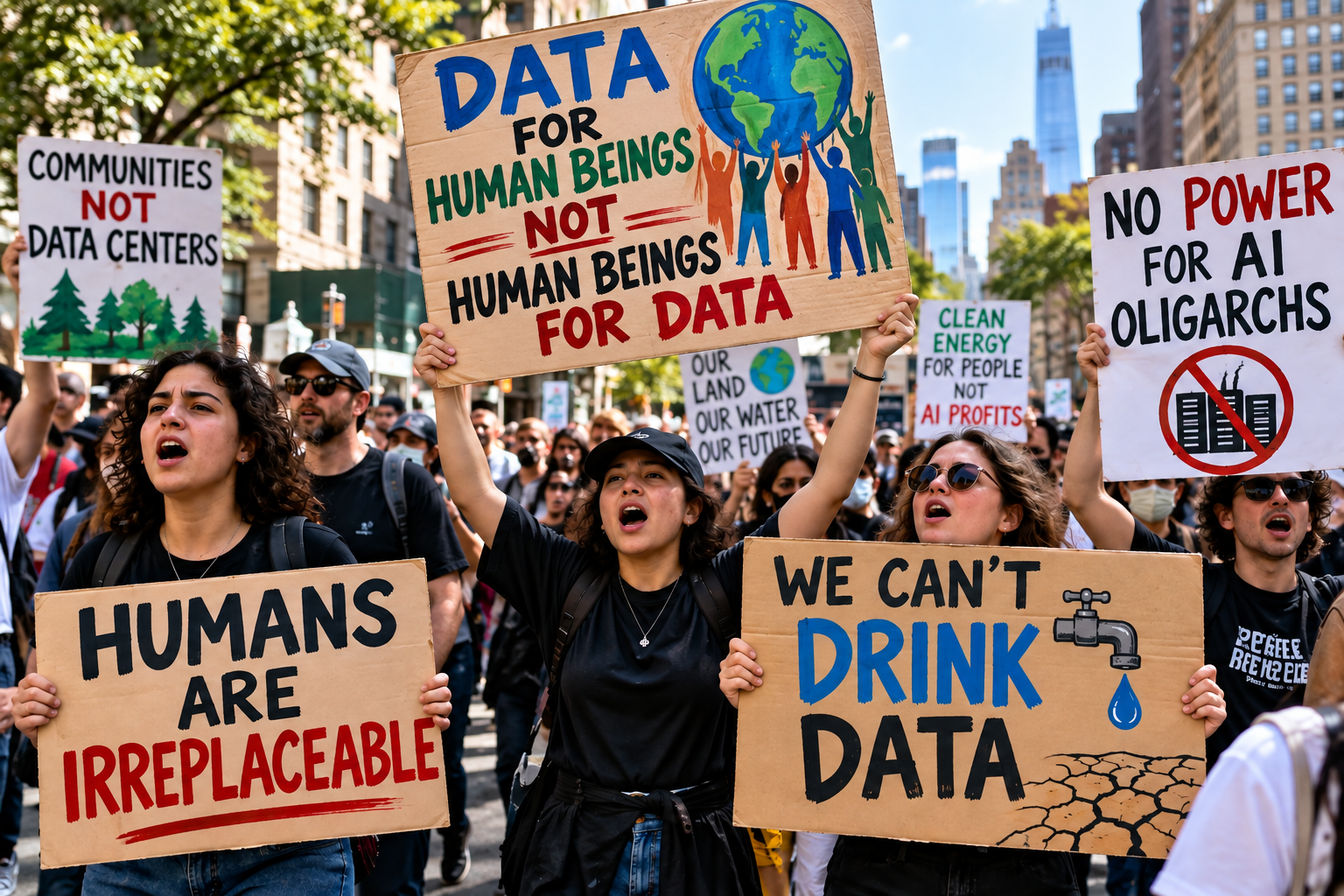
Report and analysis: October 8–14, 2026
AI expansion has opened a social debate over water, electricity, land, data, work and decision-making authority. Continuing this website’s October 2–7 report, this article examines new examples of local resistance, collective bargaining and demands for accountability. The first part reports developments; the second presents the author’s interpretation and policy proposals.
Method: These dates mark the news-monitoring period. Publication dates do not necessarily identify when a protest occurred. Future announcements and unresolved negotiations are distinguished from completed actions and final victories. These examples do not cover every country and do not establish the existence of a single coordinated global movement.
Ireland: resistance to the transformation of village life
RTÉ reported that more than 300 people joined a slow-drive protest in Kilmeaden, County Waterford, on October 10. Residents opposed a proposed data-centre and energy development, citing noise, traffic and changes to their village. A planning decision was expected on October 19; approval or cancellation had not been established. [2]
India: new reporting on resistance that began earlier
Reuters’ October 9 report examined residents’ opposition to Amazon’s project near Mumbai. The reported demonstration took place on September 8. Residents disputed the adequacy of consultation; Amazon defended water-free cooling, dedicated electricity supplies and noise controls. [1]
Illinois: a moratorium demand and the right to speak
On October 14, the Journal-Courier reported that Morgan County officials had promised at the previous day’s meeting to extend a data-centre moratorium by six months, with formal action deferred to the next meeting. Three attendees were ejected. A promise of extension is distinct from final approval. [3]
North Carolina: public organizing and voter education
Clean Water for North Carolina’s calendar listed an October 12 Henderson press conference calling for a statewide data-centre moratorium. It also scheduled an online discussion of data centres, voting and amendments for 7 p.m. on October 14. That evening event was still forthcoming when this report was prepared. The calendar establishes plans, not independent confirmation of turnout or outcomes. [4]
Australia: AI enters collective bargaining
NTEU’s October 8 University of Melbourne update described negotiations over disclosure of AI use in recruitment, promotion, discipline and staff assessment. Wording remained unresolved. Its University of Sydney branch had announced a two-hour October 13 work stoppage over pay, workloads and job security, including AI’s effects. The announcement alone does not establish participation or outcomes. [5] [6]
Canada: recent background on workplace surveillance demands
CUPE’s October 7 statement provides background: it sought prohibitions on continuous surveillance, restrictions on high-risk technologies and automated disciplinary or dismissal decisions, alongside advance notice and union negotiations over AI’s effects. These were union demands, not protections enacted during this reporting week. [7]
New York: pursuing institutional accountability
On October 13, New York City Council announced that SpaceXAI had agreed to testify at an October 16 AI-safety hearing following efforts to enforce a subpoena. This establishes a commitment, not a hearing outcome. Int 1101-2026, concerning civilian complaints about specified AI violations, was introduced and referred to committee on October 8; it was not enacted law. [8] [9]
Protest rights and electoral accountability
The Guardian’s October 14 investigation raised concerns that monitoring anti-tech extremism could extend to peaceful protest. RTÉ’s October 9 reporting described data centres becoming an issue in US midterm campaigns. These developments bring protest rights and representatives’ accountability into the debate. [10] [11]
Analysis: from defending public resources to participation in power
This article’s interpretation is that opposition to a data centre and opposition to algorithmic workplace decisions, despite their differences, raise a common question: who has authority over decisions that change people’s lives? For a village, the issue may be a project’s location and daily living conditions; for a university, recruitment and assessment criteria; for a city, the ability to question a company developing systems that make decisions.
Investment totals alone cannot evaluate a project. The sources of water and electricity, responsibility for grid-upgrade costs, the number and quality of permanent jobs, and verification of corporate commitments must be made clear. Dedicated supplies also require scrutiny of regional resources, infrastructure and public costs. Both companies’ assurances and residents’ concerns should be open to independent assessment.
Within the framework of A New Social Order in the Age of Consciousness, this situation can be understood as an expression of the contradiction between social production and private ownership. Knowledge, data, labour and infrastructure emerge through broad social participation, while ownership of key tools and authority over their use can remain concentrated among a few companies. This is the article’s theoretical interpretation, rather than a conclusion independently proved by each news item.
Social production does not automatically give every user legal ownership of a model. Its political significance is the need to discuss the rights and interests of people who contribute value or bear costs. Where communities fund infrastructure, contracts should specify corporate responsibility, consumption limits, accessible information and effective avenues for challenge. Where systems assess employees, workers should be able to understand criteria, contest errors and obtain human review.
Work, data and the distribution of productivity gains
Higher productivity can reduce exhausting work, shorten working time and improve public services. Those outcomes depend on social and contractual choices: employer-funded training during working hours, income protection during job transitions, bargaining rights and protection against punitive uses of data. An organization introducing AI should explain workers’ share of the gains and their authority over implementation.
The labour chain must also remain visible: data annotators, content moderators, contractors, researchers and maintenance workers. Agreements protecting only a company’s direct employees can shift risks and costs to subcontractors. This article proposes disclosure of contracting chains, clear responsibilities for commissioning companies and contractors, organizing rights and accessible remedies. These are policy proposals, not claims that such protections were enacted during the reporting period.
How can participation in power be measured?
Consultation matters when it precedes a final decision and can change that decision. Announcements after contracts are signed cannot substitute for it. For large projects, this article proposes accessible consumption and subsidy information, cumulative assessment of multiple regional projects, public meetings with written responses and mechanisms to reconsider permits. Residents’ and workers’ representatives should be able to monitor commitments without retaliation for disagreement.
Five questions can test a demand: What is the specific problem? Who has authority to act? How are resources and costs allocated? What enforceable rights do affected people have? What indicators assess the result? For example, controlling water consumption requires a defined limit, verifiable data, responsibility for violations and conditions for review. This approach exposes the distance between a slogan and effective power.
Limits and possibilities for connecting struggles
Opposition groups have different motives and programmes. Environmental protection, job security, privacy and property values may bring people together without creating political unity. Moving a project into a poorer area can also transfer the same burdens to people with less capacity to resist. Justice requires attention beyond one’s own neighbourhood, including regional effects and the rights of all affected communities.
Durable connections could develop around contract transparency, public-resource protection, freedom to organize, corporate accountability and binding participation. A temporary moratorium becomes a concrete programme when conditions for reopening, assessment standards and oversight responsibilities are clear. A moratorium, project cancellation, an official’s promise and enacted legislation are different outcomes and must be recorded separately.
The direction proposed here is technology serving human capabilities: better-informed decisions, improved services, more free time and protection of social life and the environment. Protests can put this goal on the agenda. Realizing it requires independent organization, verifiable evidence and effective participation by communities and workers in decision-making power.
Sources
[2] RTÉ — Waterford, 10 October
[3] Journal-Courier — Morgan County, 14 October
[4] Clean Water for North Carolina — October events
[5] NTEU — Melbourne bargaining, 8 October
[6] NTEU — Sydney stop-work announcement
[7] CUPE — worker protections, 7 October (background)
[8] NYC Council — public accountability, 13 October
[9] NYC Council — proposed civilian enforcement, 8 October
[10] The Guardian — surveillance and peaceful protest, 14 October


Leave a Reply