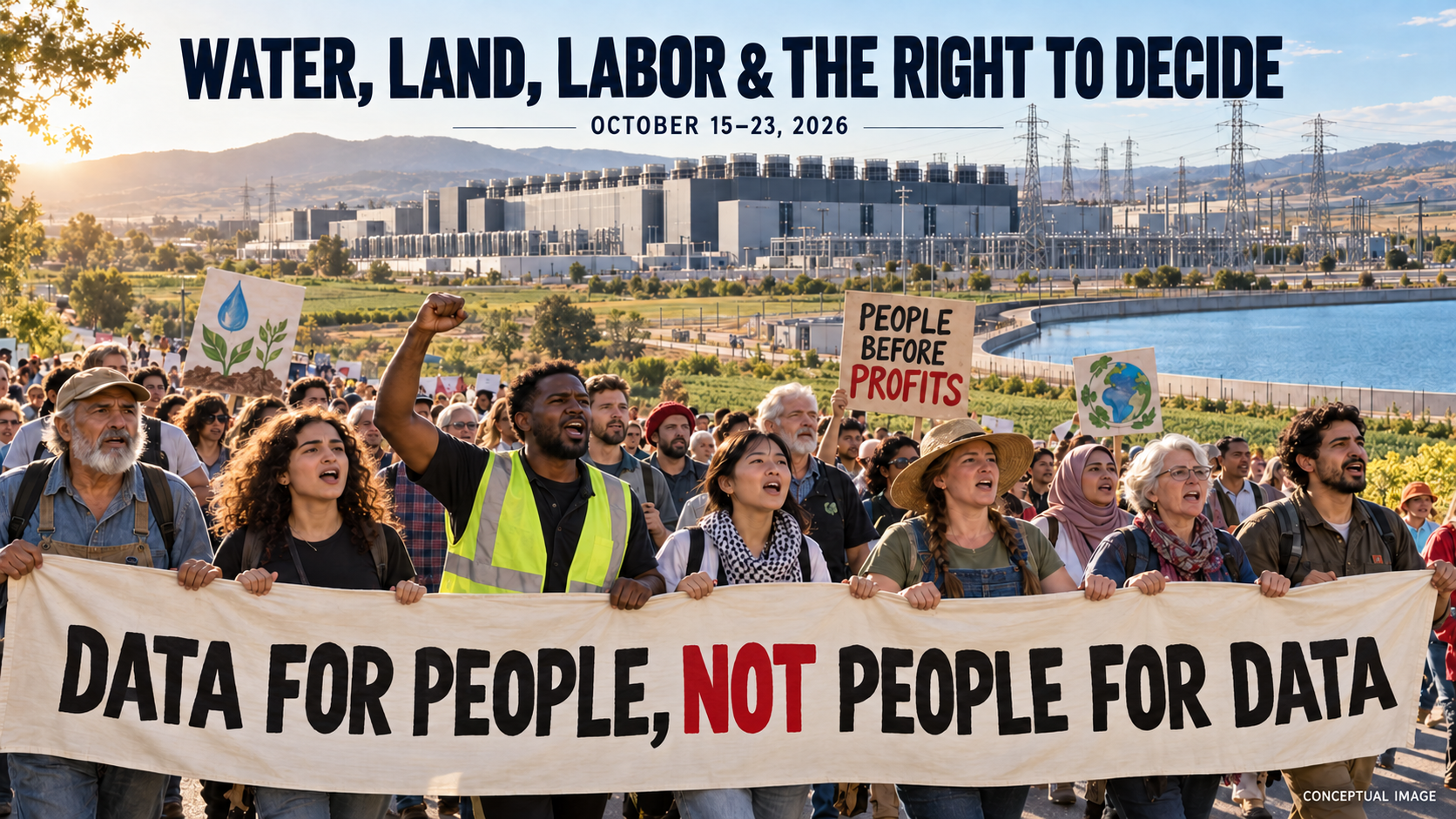
Report and analysis: October 15–23, 2026
This report continues the October 8–14, 2026 report.
In the cases covered during this period, disputes over AI expansion increasingly became questions about everyday life: Who has access to water and electricity? Should land produce food or host digital infrastructure? What share of the industry’s income goes to the workers who make its growth possible? And how much authority do local people have over projects that transform their surroundings?
In France, farmers’ and residents’ opposition to a Google project led to a joint appeal by groups opposing data centers. In Canada, demonstrators rallied against a major AI infrastructure project. In the United States, demands for a pause in development intersected with local politics and elections. In Chile, environmental organizations pursued administrative and legal challenges. In Taiwan, a dispute over workers’ share of semiconductor profits led to a strike. These cases involve different demands; they should not all be treated as one movement or as identical opposition to technology.
Method: New developments are distinguished from relevant background. Organizers’ statements are attributed to them, including their crowd estimates. An announcement alone does not establish that an event took place or succeeded. Analytical sections present the author’s interpretations and proposals.
1. France: defending farmland and building cooperation among local groups
On October 17, opponents of Google’s proposed large data center gathered at Ozans, near Châteauroux. In its October 19 account, the Confédération paysanne of Indre reported more than 1,200 participants. According to that account, the project would develop more than 195 hectares of farmland. Participants also challenged the lack of clear information about its environmental, economic and social consequences. The attendance figure is the estimate of an organization involved in the protest. [1]
A further development followed on October 18, when groups from different parts of France issued a joint appeal to resist data center projects. Published on October 19, the appeal calls for a moratorium and democratic debate. Its signatories bring resource consumption, public costs, employment promises, digital surveillance and military applications into a shared protest framework. These are the coalition’s positions and concerns; the extent of harm from each project requires independent assessment. [2]
Politically, a local dispute over where to build a facility has expanded into a debate about the direction of economic development. Farmers and residents are asking why a company’s demand for computing capacity should take priority over farmland, food production and the host community’s authority.
2. Scotland and Europe: organizing for future collective action
In a statement dated October 15, Friends of the Earth Scotland announced an Edinburgh march for November 14. The organization says more than 20 proposals for hyperscale AI data centers have been submitted in Scotland and local campaigns have formed in response. Its stated demand is a nationwide public conversation before decisions are made. At the time of this report, the march has not taken place; organizers’ expectations of thousands attending are not actual attendance figures. [3]
This organizing connects with European days of action scheduled for November 6–7. Participating organizations reported that 42 groups in ten countries had joined when the appeal was published: France, Spain, Italy, Ireland, Germany, the Netherlands, Belgium, Denmark, Poland and the United Kingdom. That appeal predates this report’s monitoring period and is included as background to current organizing. [4]
This coordination suggests that some local groups are seeking to exchange experience and exert collective pressure. A country’s inclusion in the coalition, however, does not establish that a new demonstration occurred there between October 15 and 23.
3. Virginia: electricity, fossil fuel infrastructure and local accountability
Virginia’s March for a Moratorium campaign included a series of events across several cities. Appalachian Voices’ October 15 announcement for the October 21 Roanoke event called for a pause in new data center approvals and associated energy infrastructure. Organizers cited pressure on water supplies and the expansion of pipelines and fossil fuel facilities. This source documents the announced program and demands; it does not verify attendance. [5]
An official October 20 Loudoun County notice stated that discussion of a proposed pause in consideration of certain data center and substation applications had been deferred to November 17. The proposal concerns applications requiring legislative approval by the Board of Supervisors. It should therefore not be described as a general construction ban or an approved halt to all projects. [6]
This case illustrates the distance between a public demand and an executive decision: a pause can reach the agenda yet remain deferred or narrowly defined. For local communities, being heard is only part of the issue; the question is what effect public participation has on the outcome.
4. United States: data center opposition enters electoral and financial calculations
On October 22, Reuters reported investor concern about data center opposition ahead of elections. Reuters/Ipsos found 69% of registered Democratic voters and 43% of Republicans supported construction limits. This does not establish opposition to every AI application. [7]
The analytical implication is that protest gains economic weight when it can change permitting timelines, energy costs or a project’s feasibility. Under these conditions, local organizing becomes a factor in the exercise of economic power.
5. Canada: Halifax protesters question investment priorities
On October 17, more than 100 people rallied in Halifax against an AI data center project at Point Tupper. The Dalhousie Gazette’s on-the-ground report describes demonstrators marching from the power company’s headquarters to the provincial legislature. According to that report, EverWind’s announced project is intended to be leased to Anthropic. [8]
Citing the developer, the same report gives a planned full capacity of 420 megawatts, more than 2,000 construction jobs and 215 operating jobs. These are project projections. The distinction between temporary construction employment and permanent jobs matters: a public-interest assessment should evaluate them separately alongside energy, infrastructure and public-resource costs. [8]
The social question raised by this protest concerns investment priorities: how should a major digital project be assessed against the host community’s needs for housing, public services, livelihoods and an energy transition?
6. Chile: challenging the exclusion of an environmental assessment
In a report published on October 22, OLCA and MOSACAT announced that they would challenge the decision concerning Google’s Cerrillos data center through public mobilization and administrative and judicial channels. They oppose the determination that the project is not required to enter the environmental impact assessment system. They also say their submissions were not properly incorporated into the record or answered. These claims are attributed to the organizations; announcing legal action is not equivalent to obtaining a favorable ruling. [9]
This case concerns access to an assessment process itself. Communities need verifiable information and an effective route to challenge a project. Without clarity about resource use and the cumulative effects of multiple projects in one area, public decision-making lacks a sufficient basis.
7. Taiwan: semiconductor workers demand a share of profits
On October 22, some employees at Micron’s Taoyuan plant went on strike. AFP confirmed the action but reported limited participation observed at the gathering outside the factory. A previous strike authorization or a plan for a stoppage should not be equated with thousands actually taking part. The dispute centered on workers’ share of profits and bonus arrangements. [10]
This case brings the labor dimension of the AI economy into view. Digital infrastructure is built and operated through the work of semiconductor employees, facilities staff, network workers and maintenance personnel. Rising corporate sales and profits do not automatically guarantee a proportionate benefit for employees; their bargaining power and organization matter.
Micron’s strike should be understood as a dispute over how industry income is shared, rather than evidence that employees oppose technology itself.
8. Asia and Africa: continuing cases, distinguished from this week’s events
Two nearby cases help explain the issue’s geographical reach, but the events described occurred before October 15.
In Batam, Indonesia, The Jakarta Post’s account of the October 5 protest describes residents blocking access to Nongsa Digital Park over interruptions to their water supply. An official promised emergency deliveries and restoration of piped water. This is relevant background and should not be counted as a new demonstration within the current reporting period. [11]
In Cape Town, South Africa, Foxglove and the Housing Assembly had challenged Equinix’s 170-megawatt project before this period. Their October 9 statement raised concerns about access to the hearing and the company’s response. The case is relevant to transparency and participation, but that statement alone does not establish the final outcome or a new development after October 14. [12]
The research for this report did not locate sufficient evidence to add a specific new event from Iran during this period. That is a limitation of the evidence, not proof that dissatisfaction or social consequences are absent.
9. Analysis: water, electricity, employment and surveillance
An analytical reading of these cases identifies several questions around which otherwise different protests can converge:
Water and land: How are industrial demands assessed alongside drinking-water rights, agriculture and ecosystem protection?
Electricity and public costs: Who pays for grid expansion, backup capacity and energy supply?
Employment: How are temporary construction promises distinguished from permanent jobs, wages and employment security?
Data and surveillance: What safeguards prevent computing capacity from supporting unaccountable surveillance, repression or other harmful applications?
Participation: Can people only comment, or can they change the decision?
Water consumption and environmental effects cannot be reduced to one fixed figure for every data center. Each assessment must examine location, scale, cooling technology and energy sources. Data labeling, response evaluation and content moderation should also be visible in the labor chain. No undocumented new event involving those workers has been added to this report.
10. Connecting the report with A New Social Order in the Age of Consciousness
Within the book’s framework, these disputes can be interpreted as concrete manifestations of the contradiction between social production and private ownership. Digital capacity relies on humanity’s accumulated knowledge, collective labor, public networks, natural resources and socially generated data. Yet investment decisions, control over applications and a large share of the benefits can remain concentrated in a small number of companies.
The proposed response is democratic planning based on social needs. A democratic government can coordinate electricity, water and computing capacity, provided that its authority is accompanied by transparency, independent oversight, freedom of association and effective participation by workplace and neighborhood councils.
Within this framework, resource consumption, subsidies, employment commitments and project impacts should be public and auditable. Workers should have bargaining rights over technological change and working conditions, while host communities should be able to demand modification, restriction or rejection of a project. Alongside commercial applications, computing capacity should meet needs in public health, education, research and environmental planning.
The central question is: How can a society that supplies the resources, labor and knowledge required for AI participate in setting its goals and sharing its benefits? Despite their differences, the protests of this period turn that question from a theoretical debate into a practical issue of land, water, wages and decision-making power.
Sources
[1] Confédération paysanne — Mobilisation, 19 October
[2] Terres de Luttes — Appeal of 18 October
[3] Friends of the Earth Scotland — 15 October
[4] APRS — European days of action
[5] Appalachian Voices — Roanoke, 15 October
[6] Loudoun County — Official notice, 20 October
[7] Reuters — Data centers and elections, 22 October
[8] Dalhousie Gazette — Halifax protest, 18 October
[9] OLCA / Interferencia — Chile, 22 October
[10] AFP — Micron strike, 22 October


Leave a Reply