Author: hakhavi

  • New Steps in Turning Social Knowledge into Private Power in the Age of AI

    New Steps in Turning Social Knowledge into Private Power in the Age of AI

    فارسی

    Developments from August 20–24, 2026: the socialization of production and risk versus the concentration of ownership and power

    Discussions of artificial intelligence usually focus on models: Which model is more powerful, and how much human work can it automate? Yet the developments of August 20–24 raise a more important question: Who controls the capacity for intelligent production? AI is no longer merely a software industry. Behind every advanced model stands a vast network of human knowledge, data, chips, electricity, land, water, data centers, financial capital, and labor. AI production is becoming increasingly social, while control over the conditions that turn these social resources into economic power can remain concentrated in the hands of a small number of corporations and owners of capital. This is the contradiction that assumes fundamental importance in the book A New Social Order in the Age of Consciousness.

    From Owning Models to Owning Capacity

    During the first stage of generative AI development, competition was organized largely around models. It is now clearer that possessing an advanced model is not enough. Large-scale operation requires computing capacity, and that capacity is produced through a combination of chips, energy, land, the electrical grid, data centers, and capital. The economic power of AI is therefore shifting from “ownership of the model” toward ownership of the material conditions required to run it. Even when knowledge and model weights are publicly available, openness does not necessarily distribute productive power if only a few companies can secure hundreds of thousands of GPUs, several gigawatts of electricity, and enormous data centers.

    The Financialization of Intelligent-Production Capacity

    The large-scale entry of finance into AI infrastructure is one of the clearest signs of this shift. NVIDIA, together with major financial institutions, has pursued mechanisms designed to mobilize more than $500 billion in third-party capital for AI infrastructure. What matters is not only the amount of capital. Compute is becoming an investable asset class. Computing capacity can be incorporated into long-term contracts, collateral, debt, and financial claims. A new chain is taking shape: infrastructure → computing capacity → future revenue → contracts and collateral → financial assets. This is the financialization of intelligent-production capacity.

    Debt and Ownership Claims on Future Income

    Debt issuance associated with AI development in the United States has reached roughly $220 billion in 2026, compared with about $12.5 billion in the previous year. AI infrastructure is no longer financed only through the retained earnings of technology companies. Bond markets, banks, investment funds, and private credit have entered the structure. An investor may not physically own a GPU or a data center, yet through a contract or financial instrument can acquire a claim on the future income generated by that capacity. Ownership thus expands from physical possession to contractual ownership and financial rights over future revenue.

    From Chips to Land and Energy

    NVIDIA’s expansion from selling chips into infrastructure is another sign of this trend. A GPU producer no longer has to confine itself to selling the means of production; it can participate in chips, financing, land, energy, and data centers. This is vertical concentration of ownership: instead of controlling only one link, a corporation gains a presence across several critical parts of the chain.

    The Price of Compute and the Cost of Entering Production

    Reports on August 22 indicated that the prices of some next-generation servers equipped with AI chips could rise by more than 15 percent, although the increase had not yet been officially confirmed at the time. If compute is becoming one of the essential means of production in the age of consciousness, the cost of accessing it becomes part of the cost of entering advanced production. A university, cooperative, small firm, or independent researcher may have access to papers, open-source code, and even model weights, but without sufficient chips, electricity, and capacity cannot compete on equal terms with owners of multibillion-dollar infrastructure. Knowledge may become more open while the material ability to use it effectively becomes more concentrated.

    The Rise of Full-Stack Ownership

    Developments on August 23 made this trend clearer. Alibaba announced plans to raise approximately $10.2 billion and direct the proceeds toward full-stack AI development, including chips, computing infrastructure, models, and AI deployment. The structural advantage of the future may belong to the company that controls the chain of chip → data center → cloud → model → platform → user → revenue. At this stage, ownership of a model becomes ownership of an intelligent-production ecosystem.

    Data: A Product of Social Activity and Raw Material for AI

    Developments on August 24 again highlighted the question of data ownership. Large organizational datasets—including communications, documents, and operational information—are acquiring economic value for the development of AI products. The fundamental question is who owns data produced through collective human activity and how the new value derived from it is distributed. In their daily activity, workers produce emails, files, solutions, and organizational experience; that activity becomes accumulated knowledge. If this knowledge later serves as raw material for AI, data cannot be treated merely as “fuel for AI.” Data itself is a product of human social activity.

    Automation Is Not Only About Eliminating Jobs

    AI is entering programming, technology services, logistics, and robotics at increasing speed. The drive to produce more with lower costs and fewer workers raises the fundamental question of productivity. If AI can produce the same output with less human labor time, productivity gains could reduce working hours, increase free time, and improve well-being. They could instead lead to workforce reductions, pressure on wages, and higher returns to capital. Technology does not determine the path by itself; ownership relations and power do.

    Private Profits, Socialized Risk

    When hundreds of billions of dollars in debt, investment funds, stock markets, banks, data centers, electrical grids, and real estate become tied to the AI investment cycle, its risks no longer remain private. If investment succeeds, a large share of the profit can remain private. In a crisis, however, the effects can spread to financial markets, pension funds, employment, energy prices, and the broader economy. A new contradiction emerges: the private concentration of profit versus the socialization of risk.

    Two Currents Moving in Opposite Directions

    The developments of these five days can best be understood as two currents. In the first, collective knowledge and research, data and social culture, human labor and software, together with energy, land, water, and public infrastructure, flow toward intelligent production: chips, data centers, computing capacity, and models. In the second, AI products and services are transformed into markets and revenue, contracts and collateral, debt and financial claims, capital accumulation, and concentrated ownership and power. At the same time, electricity and water consumption, grid costs, labor-market disruption, financial risk, and environmental consequences are distributed largely across society.

    From Model Ownership to Ownership of the Conditions of Production

    “Model ownership” is no longer sufficient to explain the political economy of AI. The deeper issue is ownership of the conditions that turn social knowledge into products and economic power. Knowledge, open-source software, and open-weight models may be widely accessible; but if turning them into economic power requires passage through GPUs, cloud systems, energy, data centers, capital, and platforms, those who own these conditions will wield power far beyond their apparent contribution to the production of knowledge. The central question is no longer only who owns artificial intelligence. It is: Who owns the capacity to transform social knowledge into economic power?

    Connection to A New Social Order in the Age of Consciousness

    If cognition, knowledge, and data become the most important productive forces of the new era, the historical contradiction becomes more visible. The intellectual raw materials of this system—language, science, culture, code, experience, and data—have been created across generations by millions and billions of people. Its material infrastructure also depends on human labor, universities, energy, land, water, the power grid, and society’s accumulated capital. Yet the conditions that transform this social whole into an economic product can remain in the hands of a small number of firms. Production, knowledge, data, costs, and risks become increasingly social, while ownership of capacity, income, and decision-making power can become increasingly private, financialized, and concentrated.

    The Defining Question of the Age of Consciousness

    Artificial intelligence creates extraordinary productive possibilities, but technological progress alone does not determine how these possibilities will be distributed. AI could reduce the amount of necessary human labor, expand education and health care, and make access to knowledge nearly universal. The same technology could also concentrate wealth, weaken workers’ bargaining power, and increase economic control. The difference between these paths will not be determined simply by model quality. It will be determined by the structure of ownership and social participation in power. If intelligence and knowledge are more than ever products of society, why should the capacity to turn them into economic power remain under the control of a small number of owners of capital? This is not a question of opposing technology. It is a question of how the immense productive forces unleashed by AI can be placed in the service of human flourishing. This is where the discussion of technology becomes a discussion of A New Social Order in the Age of Consciousness.

  • گام‌های تازه در تبدیل دانش اجتماعی به قدرت خصوصی در عصر هوش مصنوعی

    گام‌های تازه در تبدیل دانش اجتماعی به قدرت خصوصی در عصر هوش مصنوعی

    English

    تحولات ۲۰ تا ۲۴ اوت ۲۰۲۶؛ اجتماعی‌شدن تولید و ریسک، در برابر تمرکز مالکیت و قدرت

    در بحث دربارهٔ هوش مصنوعی معمولاً توجه به مدل‌ها جلب می‌شود: کدام مدل قدرتمندتر است و چه میزان از کار انسان را می‌توان خودکار کرد؟ اما تحولات ۲۰ تا ۲۴ اوت پرسش مهم‌تری را برجسته می‌کنند: چه کسی ظرفیت تولید هوشمند را در اختیار دارد؟ هوش مصنوعی دیگر صرفاً یک صنعت نرم‌افزاری نیست؛ پشت هر مدل پیشرفته شبکهٔ عظیمی از دانش انسانی، داده، تراشه، برق، زمین، آب، مراکز داده، سرمایهٔ مالی و نیروی کار قرار دارد. تولید هوش مصنوعی هرچه اجتماعی‌تر می‌شود، اما کنترل شرایطی که این منابع اجتماعی را به قدرت اقتصادی تبدیل می‌کنند می‌تواند در دست تعداد محدودی از شرکت‌ها و صاحبان سرمایه متمرکز شود. این همان تضادی است که در کتاب «نظم اجتماعی نوین در عصر آگاهی» اهمیت بنیادی پیدا می‌کند.

    از مالکیت مدل به مالکیت ظرفیت

    در مرحلهٔ نخست توسعهٔ هوش مصنوعی مولد، رقابت عمدتاً حول مدل‌ها شکل گرفته بود. اکنون روشن‌تر شده است که داشتن مدل پیشرفته کافی نیست؛ فعالیت در مقیاس بزرگ به ظرفیت محاسباتی نیاز دارد و این ظرفیت حاصل ترکیب تراشه، انرژی، زمین، شبکهٔ برق، مرکز داده و سرمایه است. بنابراین قدرت اقتصادی هوش مصنوعی به‌تدریج از «مالکیت مدل» به مالکیت شرایط مادی اجرای مدل منتقل می‌شود. اگر دانش و حتی وزن‌های یک مدل در اختیار عموم باشد، ولی فقط تعداد محدودی از شرکت‌ها بتوانند صدها هزار پردازندهٔ گرافیکی، چندین گیگاوات برق و مراکز دادهٔ عظیم را تأمین کنند، بازبودن دانش الزاماً به معنای توزیع قدرت تولید نیست.

    مالی‌شدن ظرفیت تولید هوشمند

    ورود گستردهٔ سرمایهٔ مالی به زیرساخت هوش مصنوعی یکی از مهم‌ترین نشانه‌های این تحول است. انویدیا همراه با مؤسسات بزرگ مالی سازوکارهایی برای بسیج بیش از ۵۰۰ میلیارد دلار سرمایهٔ شخص ثالث برای زیرساخت هوش مصنوعی دنبال کرده است. نکتهٔ مهم فقط اندازهٔ سرمایه نیست؛ ظرفیت محاسباتی در حال تبدیل‌شدن به یک طبقهٔ دارایی قابل سرمایه‌گذاری است. این ظرفیت می‌تواند موضوع قراردادهای بلندمدت، وثیقه، بدهی و حقوق مالی قرار گیرد. زنجیرهٔ تازه چنین است: زیرساخت ← ظرفیت محاسباتی ← درآمد آینده ← قرارداد و وثیقه ← دارایی مالی. این همان «مالی‌شدن ظرفیت تولید هوشمند» است.

    بدهی و مالکیت بر درآمد آینده

    انتشار بدهی مرتبط با توسعهٔ هوش مصنوعی در آمریکا در سال ۲۰۲۶ به حدود ۲۲۰ میلیارد دلار رسیده، در حالی که رقم قابل مقایسه در سال قبل حدود ۱۲٫۵ میلیارد دلار بود. ساخت زیرساخت هوش مصنوعی دیگر فقط از سود انباشتهٔ شرکت‌های فناوری تأمین مالی نمی‌شود؛ بازار اوراق قرضه، بانک‌ها، صندوق‌ها و اعتبار خصوصی نیز وارد ساختار شده‌اند. سرمایه‌گذار ممکن است مالک پردازنده یا مرکز داده نباشد، اما از طریق قرارداد یا اوراق مالی صاحب حقی نسبت به درآمد آیندهٔ آن ظرفیت شود. مالکیت از مالکیت فیزیکی به مالکیت قراردادی و حقوق مالی بر درآمد آینده گسترش می‌یابد.

    از تراشه تا زمین و انرژی

    گسترش فعالیت انویدیا از فروش تراشه به زیرساخت نیز نشانهٔ دیگری از این روند است. تولیدکنندهٔ پردازندهٔ گرافیکی دیگر فقط ابزار تولید را نمی‌فروشد و می‌تواند در تراشه، تأمین مالی، زمین، انرژی و مرکز داده نیز حضور داشته باشد. این «تمرکز عمودی مالکیت» است: یک بنگاه به‌جای کنترل یک حلقه، در چند بخش حیاتی زنجیره حضور پیدا می‌کند.

    قیمت ظرفیت محاسباتی و هزینهٔ ورود به تولید

    گزارش‌های ۲۲ اوت نشان دادند قیمت برخی سرورهای نسل جدید مجهز به تراشه‌های هوش مصنوعی ممکن است بیش از ۱۵ درصد افزایش یابد، هرچند در زمان گزارش هنوز رسماً تأیید نشده بود. اگر ظرفیت محاسباتی یکی از ابزارهای اساسی تولید عصر آگاهی باشد، هزینهٔ دسترسی به آن بخشی از هزینهٔ ورود به تولید پیشرفته است. دانشگاه، تعاونی، شرکت کوچک یا پژوهشگر مستقل ممکن است به مقاله، کد متن‌باز و حتی وزن‌های مدل دسترسی داشته باشد، اما بدون تراشه، برق و ظرفیت کافی نمی‌تواند با صاحبان زیرساخت میلیارددلاری در یک سطح رقابت کند. دانش می‌تواند بازتر شود، در حالی که امکان مادی استفادهٔ مؤثر از آن متمرکزتر شود.

    ظهور مالکیت تمام‌زنجیره‌ای

    تحولات ۲۳ اوت این روند را روشن‌تر کرد. علی‌بابا اعلام کرد قصد دارد حدود ۱۰٫۲ میلیارد دلار سرمایه جذب کند و منابع حاصل را به توسعهٔ تمام‌زنجیره‌ای هوش مصنوعی، شامل تراشه، زیرساخت محاسباتی، مدل و استقرار هوش مصنوعی اختصاص دهد. مزیت ساختاری آینده ممکن است متعلق به شرکتی باشد که زنجیرهٔ تراشه ← مرکز داده ← ابر ← مدل ← پلتفرم ← کاربر ← درآمد را کنترل کند. در این مرحله، مالکیت مدل به مالکیت اکوسیستم تولید هوشمند تبدیل می‌شود.

    داده؛ محصول فعالیت اجتماعی و مادهٔ خام هوش مصنوعی

    تحولات ۲۴ اوت مسئلهٔ مالکیت داده را دوباره برجسته کرد. مجموعه‌های بزرگ دادهٔ سازمانی، شامل ارتباطات، اسناد و اطلاعات عملیاتی، برای توسعهٔ محصولات هوش مصنوعی ارزش اقتصادی پیدا می‌کنند. پرسش بنیادی این است که داده‌ای که در نتیجهٔ فعالیت جمعی انسان‌ها تولید شده متعلق به چه کسی است و ارزش جدید حاصل از آن چگونه توزیع می‌شود؟ کارمندان در فعالیت روزانه ایمیل، فایل، راه‌حل و تجربهٔ سازمانی تولید می‌کنند و این فعالیت به دانش انباشته تبدیل می‌شود. اگر این دانش بعداً مادهٔ خام هوش مصنوعی شود، داده را نمی‌توان صرفاً «سوخت هوش مصنوعی» دانست؛ داده خود محصول فعالیت اجتماعی انسان‌هاست.

    خودکارسازی؛ مسئله فقط حذف شغل نیست

    هوش مصنوعی با سرعت بیشتری وارد برنامه‌نویسی، خدمات فناوری، لجستیک و رباتیک می‌شود. فشار برای تولید بیشتر با هزینه و نیروی انسانی کمتر پرسش بنیادی افزایش بهره‌وری را مطرح می‌کند. اگر هوش مصنوعی همان محصول را با زمان کار انسانی کمتر تولید کند، بهره‌وری می‌تواند به کاهش ساعات کار، افزایش اوقات آزاد و رفاه منجر شود یا به کاهش نیروی کار، فشار بر دستمزد و افزایش بازده سرمایه تبدیل شود. فناوری به‌خودی‌خود مسیر را تعیین نمی‌کند؛ مناسبات مالکیت و قدرت تعیین‌کننده‌اند.

    خصوصی‌شدن سود، اجتماعی‌شدن ریسک

    وقتی صدها میلیارد دلار بدهی، صندوق‌های سرمایه‌گذاری، بازار سهام، بانک‌ها، مراکز داده، شبکهٔ برق و املاک به چرخهٔ سرمایه‌گذاری هوش مصنوعی وابسته می‌شوند، ریسک آن نیز دیگر خصوصی باقی نمی‌ماند. اگر سرمایه‌گذاری موفق باشد، بخش بزرگی از سود می‌تواند خصوصی بماند؛ اما در بحران، پیامدها ممکن است به بازار سرمایه، صندوق‌های بازنشستگی، اشتغال، قیمت انرژی و اقتصاد عمومی سرایت کنند. تضاد تازه چنین است: تمرکز خصوصی سود در برابر اجتماعی‌شدن ریسک.

    دو جریان در جهت مخالف

    تحولات این پنج روز را بهتر است به شکل دو جریان دید. در جریان نخست، دانش و پژوهش جمعی، داده و فرهنگ اجتماعی، کار انسانی و نرم‌افزار، و انرژی، زمین، آب و زیرساخت عمومی به مرکز تولید هوشمند می‌رسند: تراشه، مرکز داده، ظرفیت محاسباتی و مدل. در جریان دوم، محصول و خدمات هوش مصنوعی به بازار و درآمد، قرارداد و وثیقه، بدهی و حقوق مالی، انباشت سرمایه و تمرکز مالکیت و قدرت تبدیل می‌شوند. هم‌زمان، مصرف برق و آب، هزینهٔ شبکه، تغییر بازار کار، ریسک مالی و پیامدهای زیست‌محیطی عمدتاً در سطح جامعه توزیع می‌شوند.

    از مالکیت مدل به مالکیت شرایط تولید

    «مالکیت مدل» دیگر برای توضیح اقتصاد سیاسی هوش مصنوعی کافی نیست؛ مسئلهٔ بنیادی‌تر مالکیت شرایطی است که دانش اجتماعی را به محصول و قدرت اقتصادی تبدیل می‌کنند. ممکن است دانش اجتماعی، نرم‌افزار متن‌باز و مدل با وزن‌های باز در دسترس باشد، اما اگر تبدیل این دانش به قدرت اقتصادی نیازمند عبور از پردازنده، ابر، انرژی، مرکز داده، سرمایه و پلتفرم باشد، صاحبان این بخش‌ها قدرتی بسیار بیشتر از سهم ظاهری خود در تولید دانش خواهند داشت. سؤال اساسی دیگر فقط این نیست که چه کسی مالک هوش مصنوعی است، بلکه این است: چه کسی مالک ظرفیت تبدیل دانش اجتماعی به قدرت اقتصادی است؟

    ارتباط با «نظم اجتماعی نوین در عصر آگاهی»

    اگر شناخت، دانش و داده به مهم‌ترین نیروهای مولدهٔ عصر جدید تبدیل شوند، تناقض تاریخی آشکارتر می‌شود. مواد اولیهٔ معرفتی این نظام—زبان، علم، فرهنگ، کد، تجربه و داده—در طول نسل‌ها و توسط میلیون‌ها و میلیاردها انسان تولید شده‌اند. زیرساخت مادی آن نیز به نیروی انسانی، دانشگاه، انرژی، زمین، آب، شبکهٔ برق و سرمایهٔ انباشتهٔ جامعه وابسته است؛ با این حال، شرایط تبدیل این مجموعهٔ اجتماعی به محصول اقتصادی می‌تواند در مالکیت تعداد محدودی از بنگاه‌ها قرار گیرد. تولید، دانش، داده، هزینه و ریسک هرچه اجتماعی‌تر می‌شوند، در حالی که مالکیت ظرفیت، درآمد و قدرت تصمیم‌گیری می‌توانند هرچه خصوصی‌تر، مالی‌تر و متمرکزتر شوند.

    پرسش تعیین‌کنندهٔ عصر آگاهی

    هوش مصنوعی امکانات تولیدی فوق‌العاده‌ای ایجاد می‌کند، اما پیشرفت فناوری به‌خودی‌خود تعیین نمی‌کند این امکانات چگونه توزیع شوند. هوش مصنوعی می‌تواند زمان کار ضروری انسان را کاهش دهد، آموزش و سلامت را گسترش دهد و دسترسی به دانش را تقریباً همگانی کند؛ همان فناوری می‌تواند برای تمرکز ثروت، کاهش قدرت چانه‌زنی نیروی کار و افزایش کنترل اقتصادی نیز به کار رود. تفاوت میان این دو مسیر را صرفاً کیفیت مدل‌ها تعیین نخواهد کرد؛ ساختار مالکیت و مشارکت اجتماعی در قدرت تعیین خواهد کرد. اگر هوش و دانش بیش از هر زمان دیگری محصول جامعه است، چرا ظرفیت تبدیل آن به قدرت اقتصادی باید در اختیار تعداد محدودی از صاحبان سرمایه باقی بماند؟ این پرسش مخالفت با فناوری نیست؛ پرسش این است که چگونه می‌توان نیروهای مولدهٔ عظیمی را که هوش مصنوعی آزاد می‌کند در خدمت شکوفایی انسان قرار داد. این همان نقطه‌ای است که بحث فناوری به بحث دربارهٔ «نظم اجتماعی نوین در عصر آگاهی» تبدیل می‌شود.

  • From Capacity Ownership to the Socialization of Production and the Concentration of Power

    From Capacity Ownership to the Socialization of Production and the Concentration of Power

    فارسی

    Three Interconnected Developments in the Political Economy of Artificial Intelligence, August 17–19, 2026

    The developments of August 17, 18, and 19, 2026 cannot be understood as three separate and unrelated news stories. Taken together, they offer a clear picture of a new stage in the political economy of artificial intelligence: a stage in which the production of knowledge, data, software, and culture becomes increasingly socialized, while the material and computational infrastructure required to convert this social knowledge into economic and political power remains the property of a small number of large corporations. Under these conditions, artificial intelligence is no longer merely a technology or a collection of computational models; it has become the point at which chips, energy, land, power grids, data centers, financial capital, and political power converge.

    Every artificial-intelligence model is the product of an extensive range of social activities. The data used to train these models is formed from writing, images, research, languages, experiences, user behavior, and humanity’s accumulated historical knowledge. Universities, researchers, programmers, writers, artists, social-media users, and millions of direct and indirect workers all contribute to the creation of this capacity. Alongside this flow of knowledge and social activity is a material and infrastructural flow: chips, electricity, water, land, transmission networks, data centers, and financial capital. These two flows come together in AI models and computational capacity; yet the income, ownership, decision-making power, and financial rights resulting from this convergence remain largely in the hands of private corporations and financial institutions.

    August 17, 2026: The Integration of Chips, Capital, and Energy

    On August 17, a collaboration among NVIDIA, SB Energy, and OpenAI was announced to create one of the largest artificial-intelligence infrastructure complexes in the state of Ohio. Under the agreement, SB Energy will provide the necessary land, energy, and buildings at the PORTS-Pike complex in Pike County; OpenAI will be the principal user and tenant of the capacity; and NVIDIA will be the exclusive provider of the AI computing infrastructure.

    The complex is designed for up to eight gigawatts of computing capacity, and its first phase—approximately 800 megawatts—is expected to come online in 2028. NVIDIA also announced that it would invest $1.5 billion in SB Energy and provide up to $105 billion in credit support to guarantee portions of the commitments related to land, electricity, buildings, and long-term leasing. According to the announced plan, supplying electricity to the complex may require the creation of roughly ten gigawatts of new generation capacity and nearly $4.2 billion in investment in the regional power grid. NVIDIA’s official announcement, Reuters report

    The significance of this agreement lies not only in the scale of its figures. Here, chips, capital, land, energy, and the market for computing are joined within a single structure. The company that manufactures the chips also becomes a financial guarantor of the project; the company that builds the data center retains ownership of the land and infrastructure; and the company that develops the AI models becomes dependent on this capacity through a long-term lease. Computational capacity thus becomes not only a means of production, but also a financial asset, collateral, a source of future revenue, and a lever of power.

    This structure demonstrates that in the AI economy, ownership of the means of production no longer refers only to ownership of factories or traditional machinery. Ownership of land, energy, chips, networks, and computational capacity can determine who is able to train large models, who can enter the market, and who can generate revenue from socially produced knowledge and data. Even if models and software become more open, access to the infrastructure required to use them can remain under the control of a small number of corporations.

    August 18, 2026: Under Public Pressure, Society Entered the Equation

    One day later, on August 18, another development occurred in Pennsylvania. Governor Josh Shapiro issued a new executive order concerning data-center development. This policy change did not occur in a vacuum. The rapid expansion of data-center projects had encountered growing protests and pressure from residents, environmental advocates, and local communities. Their concerns were not limited to electricity consumption; the large-scale use of water, rising household energy costs, air and water pollution, strain on the power grid, changes in land use, noise, and the secrecy surrounding agreements between the government and developers were all central issues in these protests.

    Shapiro, who had previously supported the extensive development of data centers and investment by technology companies in Pennsylvania, was compelled, under public pressure and in the face of environmental and social protests, to impose stricter regulations. When announcing the order, he acknowledged that over the preceding year he had heard directly from Pennsylvanians concerned about the impact of data centers on the environment, utility bills, and the lives of local communities. Official statement from the Pennsylvania governor’s office, Executive Order 2026-05

    Under the order, data-center projects must commit to environmental standards, transparency, community participation, and consumer protection. Developers must pay the full cost of generating, transmitting, and distributing the electricity they require so that these costs are not shifted onto households and local businesses. Before receiving state permits, projects must obtain the approval of local authorities and provide clearer information about their consumption of electricity, gas, and water, as well as the measures they will take to prevent pollution.

    All data-center projects were also removed from the state’s Fast Track permitting program, and state agencies were prohibited from signing nondisclosure agreements, or NDAs, with project developers. This decision is highly significant because confidential agreements can keep the people of a region uninformed until the final stages about the nature, scale, and consequences of a project that directly affects their lives.

    This development shows that society does not enter the equation of technological development automatically. Society emerges as an effective force only when people organize, protest, demand transparency, and compel political power to answer to them. If political power had been left to itself, it would have followed capital and wealth, not the needs of the people or the task of addressing social consequences. The Pennsylvania governor’s change of position was not the spontaneous result of government action; it was the product of social pressure and the rising political cost of continuing the previous policy.

    This experience demonstrates that policymaking on artificial intelligence and data centers cannot be confined to negotiations between governments and large corporations. The people who bear the economic and environmental costs of these projects must have a direct role in decisions concerning their location, scale, resource consumption, environmental effects, and social benefits. Technology can serve society only when society participates meaningfully in determining the direction of its development and how it is used.

    August 19, 2026: The Material Costs of the AI Economy Became More Visible

    On August 19, new reports on the expansion of data centers and their supply chains showed how the growth of artificial intelligence has increased demand for electricity, industrial equipment, generators, cooling systems, cables, steel, and grid infrastructure. This development challenges the common image of AI as a purely digital and immaterial phenomenon. Behind every model and every AI-generated response stands an enormous array of physical infrastructure, natural resources, and human labor.

    Data-center industry studies show that pressure on power grids has forced developers to move projects farther away from dense urban centers and saturated networks. In some regions, the distance between data centers and grid connection points has increased sharply, while the share of greenfield projects—facilities built from the ground up on previously undeveloped land—has risen from about eight percent in past years to nearly 39 percent. This shift entails expanded transmission lines, changes in land use, and the transfer of part of the cost of AI development to new communities and environments.

    At the same time, factories and industrial-equipment manufacturers are profiting from this wave of demand. Generac has invested approximately $250 million to expand its production of industrial and commercial generators. Its backlog of data-center-related orders has reached about $1.6 billion, and the company plans to hire nearly one thousand additional workers. Manufacturers of cooling systems, cables, prefabricated walls, construction machinery, and industrial components are likewise experiencing increased orders. Reuters report on the data-center manufacturing supply chain

    This expansion of industrial production can create employment and income; however, the issue is not merely the number of jobs created. The central questions are who decides the direction of these investments, who owns the infrastructure, who receives the profits, and who pays the social and environmental costs. If the costs of expanding the power grid, consuming water, producing pollution, changing land use, and raising energy prices are shifted onto society while income and ownership rights remain in private hands, then we face a pattern in which costs are socialized and benefits are privatized.

    From Social Production to the Concentration of Power

    A common contradiction can be seen in all three developments. Knowledge, data, language, software, and culture are produced socially. Material infrastructure, too, cannot be created without the collective labor of engineers, construction workers, power-grid employees, equipment manufacturers, universities, and public investment. Yet the result of this social process—through the private ownership of data centers, chips, networks, contracts, and financial rights—leads to the concentration of economic and political power.

    Companies that control computational capacity own more than a collection of servers. They can determine who gains access to advanced artificial intelligence, which research receives funding, which models are developed, which data acquires economic value, and which needs receive priority. For this reason, computational capacity is gradually becoming one of the fundamental forms of power in contemporary society.

    This trend also shows that making a model open or publishing its weights does not, by itself, amount to the genuine socialization of artificial intelligence. If running the model still requires scarce chips, abundant energy, enormous data centers, and billions of dollars in capital, the ability to use it effectively remains with the actors who control this infrastructure. Under these conditions, knowledge may appear to become more open, while the means of converting it into economic power remain private and concentrated.

    Conclusion: The Future of Artificial Intelligence Is a Social Choice

    The developments of August 17–19 show that the central issue of artificial intelligence is no longer merely the speed of models or the processing power of chips. The question is what kind of economic and social order will take shape around this technology. Will socially produced knowledge and public resources strengthen monopolies and concentrated power, or will society be able to participate in determining the development, ownership, oversight, and distribution of the benefits of this technology?

    The Pennsylvania experience shows that, in the absence of social pressure, economic and political power does not naturally place people’s needs first. Society’s entry into the equation requires awareness, organization, transparency, protest, and direct participation. The future of artificial intelligence is not predetermined; it will be shaped through the struggle between social production and private ownership, between public needs and the accumulation of wealth, and between social participation and the concentration of power.

    Return to Home

  • از مالکیت ظرفیت تا اجتماعی‌شدن تولید و تمرکز قدرت

    از مالکیت ظرفیت تا اجتماعی‌شدن تولید و تمرکز قدرت

    English

    سه تحول پیوسته در اقتصاد سیاسی هوش مصنوعی؛ ۱۷ تا ۱۹ اوت ۲۰۲۶

    تحولات سه روز ۱۷، ۱۸ و ۱۹ اوت ۲۰۲۶ را نمی‌توان سه خبر جداگانه و بی‌ارتباط دانست. این تحولات، در کنار یکدیگر، تصویری روشن از مرحله‌ای تازه در اقتصاد سیاسی هوش مصنوعی به دست می‌دهند: مرحله‌ای که در آن تولید دانش، داده، نرم‌افزار و فرهنگ هرچه اجتماعی‌تر می‌شود، اما زیرساخت‌های مادی و محاسباتی لازم برای تبدیل این دانش اجتماعی به قدرت اقتصادی و سیاسی، در مالکیت تعداد محدودی از شرکت‌های بزرگ باقی می‌ماند. در چنین شرایطی، هوش مصنوعی دیگر صرفاً یک فناوری یا مجموعه‌ای از مدل‌های محاسباتی نیست؛ بلکه به نقطهٔ اتصال تراشه، انرژی، زمین، شبکه‌های برق، مراکز داده، سرمایهٔ مالی و قدرت سیاسی تبدیل می‌شود.

    هر مدل هوش مصنوعی محصول مجموعه‌ای گسترده از فعالیت‌های اجتماعی است. داده‌های مورد استفاده برای آموزش این مدل‌ها از نوشته‌ها، تصاویر، پژوهش‌ها، زبان‌ها، تجربه‌ها، رفتارهای کاربران و انباشت تاریخی دانش بشری شکل گرفته است. دانشگاه‌ها، پژوهشگران، برنامه‌نویسان، نویسندگان، هنرمندان، کاربران شبکه‌های اجتماعی و میلیون‌ها نیروی کار مستقیم و غیرمستقیم، همگی در تولید این ظرفیت نقش دارند. در کنار این جریان دانش و فعالیت اجتماعی، یک جریان مادی و زیرساختی نیز وجود دارد: تراشه‌ها، برق، آب، زمین، شبکه‌های انتقال، مراکز داده و سرمایهٔ مالی. این دو جریان در مدل‌ها و ظرفیت محاسباتی هوش مصنوعی به یکدیگر متصل می‌شوند؛ اما درآمد، مالکیت، قدرت تصمیم‌گیری و حقوق مالی حاصل از این اتصال، عمدتاً در اختیار شرکت‌ها و نهادهای مالی خصوصی قرار می‌گیرد.

    ۱۷ اوت ۲۰۲۶: ادغام تراشه، سرمایه و انرژی

    در ۱۷ اوت، همکاری NVIDIA، شرکت SB Energy و OpenAI برای ایجاد یکی از بزرگ‌ترین مجتمع‌های زیرساختی هوش مصنوعی در ایالت اوهایو اعلام شد. بر اساس این توافق، SB Energy زمین، انرژی و ساختمان‌های لازم را در مجموعهٔ PORTS-Pike در شهرستان پایک فراهم می‌کند، OpenAI استفاده‌کننده و مستأجر اصلی ظرفیت خواهد بود و NVIDIA تأمین‌کنندهٔ انحصاری زیرساخت محاسباتی هوش مصنوعی است.

    این مجموعه برای ظرفیتی تا هشت گیگاوات محاسباتی طراحی شده است و نخستین مرحلهٔ آن، با ظرفیت حدود ۸۰۰ مگاوات، قرار است در سال ۲۰۲۸ وارد مدار شود. NVIDIA همچنین اعلام کرد ۱٫۵ میلیارد دلار در SB Energy سرمایه‌گذاری می‌کند و برای تضمین بخشی از تعهدات مربوط به زمین، برق، ساختمان و اجارهٔ بلندمدت، تا سقف ۱۰۵ میلیارد دلار پشتیبانی اعتباری فراهم خواهد کرد. بر اساس برنامهٔ اعلام‌شده، تأمین برق این مجموعه ممکن است به ایجاد حدود ده گیگاوات ظرفیت جدید تولید انرژی و نزدیک به ۴٫۲ میلیارد دلار سرمایه‌گذاری در شبکهٔ برق منطقه‌ای نیاز داشته باشد. اعلام رسمی NVIDIA، گزارش رویترز

    اهمیت این قرارداد فقط در بزرگی ارقام آن نیست. در اینجا تراشه، سرمایه، زمین، انرژی و بازار مصرف در یک ساختار واحد به یکدیگر پیوند می‌خورند. شرکتی که تراشه تولید می‌کند، به تضمین‌کنندهٔ مالی پروژه نیز تبدیل می‌شود؛ شرکتی که مرکز داده را می‌سازد، مالک زمین و زیرساخت باقی می‌ماند؛ و شرکتی که مدل‌های هوش مصنوعی را توسعه می‌دهد، از طریق اجاره‌ای بلندمدت به این ظرفیت وابسته می‌شود. به این ترتیب، ظرفیت محاسباتی نه‌فقط یک ابزار تولید، بلکه به دارایی مالی، وثیقه، منبع درآمد آینده و اهرم قدرت تبدیل می‌شود.

    این ساختار نشان می‌دهد که در اقتصاد هوش مصنوعی، مالکیت ابزار تولید دیگر فقط به معنای مالکیت کارخانه یا ماشین‌آلات سنتی نیست. مالکیت زمین، انرژی، تراشه، شبکه و ظرفیت محاسباتی می‌تواند تعیین کند چه کسی قادر است مدل‌های بزرگ را آموزش دهد، چه کسی به بازار وارد شود و چه کسی از دانش و داده‌های اجتماعی درآمد کسب کند. حتی اگر مدل‌ها و نرم‌افزارها بازتر شوند، دسترسی به زیرساخت لازم برای استفاده از آن‌ها همچنان می‌تواند در اختیار تعداد محدودی از شرکت‌ها باقی بماند.

    ۱۸ اوت ۲۰۲۶: تحت فشار مردم، جامعه وارد معادله شد

    یک روز بعد، در ۱۸ اوت، تحول دیگری در پنسیلوانیا رخ داد. جاش شاپیرو، فرماندار این ایالت، فرمان اجرایی تازه‌ای دربارهٔ توسعهٔ مراکز داده صادر کرد. این تغییر سیاست در خلأ اتفاق نیفتاد. گسترش سریع پروژه‌های مراکز داده با اعتراض‌ها و فشار فزایندهٔ مردم، فعالان محیط‌زیست و جوامع محلی روبه‌رو شده بود. نگرانی‌ها تنها به مصرف برق محدود نمی‌شد؛ مصرف گستردهٔ آب، افزایش هزینهٔ انرژی خانوارها، آلودگی هوا و آب، فشار بر شبکهٔ برق، تغییر کاربری زمین، سروصدا و محرمانه نگه‌داشتن توافق‌های میان دولت و شرکت‌های توسعه‌دهنده، از محورهای اصلی این اعتراض‌ها بود.

    شاپیرو که پیش‌تر از توسعهٔ گستردهٔ مراکز داده و سرمایه‌گذاری شرکت‌های فناوری در پنسیلوانیا حمایت می‌کرد، تحت فشار مردم و در مواجهه با اعتراض‌های زیست‌محیطی و اجتماعی، ناچار شد مقررات سخت‌گیرانه‌تری وضع کند. خود او نیز هنگام اعلام فرمان گفت که طی یک سال گذشته نگرانی‌های مستقیم ساکنان پنسیلوانیا دربارهٔ تأثیر مراکز داده بر محیط‌زیست، قبوض خدمات عمومی و زندگی جوامع محلی را شنیده است. بیانیهٔ رسمی فرمانداری پنسیلوانیا، متن فرمان اجرایی ۲۰۲۶-۰۵

    طبق این فرمان، پروژه‌های مراکز داده باید به معیارهای محیط‌زیستی، شفافیت، مشارکت اجتماعی و حفاظت از مصرف‌کنندگان متعهد شوند. توسعه‌دهندگان باید هزینهٔ کامل تولید، انتقال و توزیع برق موردنیاز خود را بپردازند تا این هزینه‌ها به خانوارها و کسب‌وکارهای محلی منتقل نشود. پروژه‌ها پیش از دریافت مجوزهای ایالتی باید موافقت نهادهای محلی را به دست آورند و اطلاعات روشن‌تری دربارهٔ مصرف برق، گاز و آب و همچنین اقدامات مربوط به جلوگیری از آلودگی ارائه کنند.

    همچنین تمام پروژه‌های مراکز داده از برنامهٔ صدور سریع مجوز یا Fast Track خارج شدند و سازمان‌های ایالتی از امضای توافق‌نامه‌های عدم افشا یا NDA با توسعه‌دهندگان این پروژه‌ها منع شدند. این تصمیم اهمیت زیادی دارد، زیرا توافق‌های محرمانه می‌توانند مردم یک منطقه را تا مراحل پایانی از ماهیت، ابعاد و پیامدهای پروژه‌ای که مستقیماً بر زندگی آن‌ها اثر می‌گذارد، بی‌اطلاع نگه دارند.

    این تحول نشان می‌دهد که جامعه به‌طور خودکار وارد معادلهٔ توسعهٔ فناوری نمی‌شود؛ جامعه تنها زمانی به‌عنوان یک نیروی مؤثر ظاهر می‌شود که مردم سازمان پیدا کنند، اعتراض کنند، خواهان شفافیت شوند و قدرت سیاسی را وادار به پاسخ‌گویی کنند. اگر قدرت سیاسی به حال خود رها می‌شد، مسیر سرمایه و ثروت را دنبال می‌کرد، نه نیازهای مردم و رفع پیامدهای اجتماعی. تغییر موضع فرماندار پنسیلوانیا نیز نه نتیجهٔ خودبه‌خودی عملکرد دولت، بلکه حاصل فشار اجتماعی و افزایش هزینهٔ سیاسی ادامهٔ سیاست پیشین بود.

    این تجربه نشان می‌دهد که سیاست‌گذاری در زمینهٔ هوش مصنوعی و مراکز داده نمی‌تواند صرفاً به مذاکرهٔ دولت‌ها و شرکت‌های بزرگ محدود شود. مردمی که هزینه‌های اقتصادی و محیط‌زیستی این پروژه‌ها را می‌پردازند، باید در تصمیم‌گیری دربارهٔ محل، اندازه، مصرف منابع، آثار زیست‌محیطی و منافع اجتماعی آن‌ها نقش مستقیم داشته باشند. فناوری هنگامی می‌تواند در خدمت جامعه قرار گیرد که جامعه در تعیین مسیر توسعه و نحوهٔ استفاده از آن مشارکت واقعی داشته باشد.

    ۱۹ اوت ۲۰۲۶: هزینه‌های مادی اقتصاد هوش مصنوعی آشکارتر شد

    در ۱۹ اوت، گزارش‌های تازه دربارهٔ توسعهٔ مراکز داده و زنجیرهٔ تأمین آن‌ها نشان داد که رشد هوش مصنوعی چگونه تقاضا برای برق، تجهیزات صنعتی، ژنراتورها، سامانه‌های خنک‌کننده، کابل، فولاد و زیرساخت شبکه را افزایش داده است. این تحول، تصور رایج از هوش مصنوعی به‌عنوان پدیده‌ای صرفاً دیجیتال و نامادی را زیر سؤال می‌برد. پشت هر مدل و هر پاسخ تولیدشده توسط هوش مصنوعی، مجموعه‌ای عظیم از زیرساخت‌های فیزیکی، منابع طبیعی و نیروی انسانی قرار دارد.

    بررسی‌های صنعت مراکز داده نشان می‌دهد که فشار بر شبکه‌های برق، توسعه‌دهندگان را ناچار کرده است پروژه‌های خود را از مراکز متراکم شهری و شبکه‌های اشباع‌شده دورتر کنند. فاصلهٔ میان مراکز داده و نقاط اتصال به شبکه، در برخی مناطق به‌شدت افزایش یافته و سهم پروژه‌های Greenfield، یعنی پروژه‌هایی که از ابتدا در زمین‌های توسعه‌نیافته ساخته می‌شوند، از حدود هشت درصد در سال‌های گذشته به نزدیک ۳۹ درصد رسیده است. این انتقال به معنای گسترش خطوط انتقال، تغییر کاربری زمین و انتقال بخشی از هزینه‌های توسعهٔ هوش مصنوعی به جوامع و محیط‌زیست مناطق تازه است.

    هم‌زمان، کارخانه‌ها و تولیدکنندگان تجهیزات صنعتی از این موج تقاضا سود می‌برند. شرکت Generac حدود ۲۵۰ میلیون دلار برای افزایش تولید ژنراتورهای صنعتی و تجاری سرمایه‌گذاری کرده است. حجم سفارش‌های انباشتهٔ مرتبط با مراکز داده در این شرکت به حدود ۱٫۶ میلیارد دلار رسیده و شرکت قصد دارد نزدیک به هزار نیروی جدید استخدام کند. تولیدکنندگان سامانه‌های خنک‌کننده، کابل، دیوارهای پیش‌ساخته، ماشین‌آلات ساختمانی و قطعات صنعتی نیز با افزایش سفارش‌ها روبه‌رو شده‌اند. گزارش رویترز دربارهٔ زنجیرهٔ تولید مراکز داده

    این افزایش تولید صنعتی می‌تواند اشتغال و درآمد ایجاد کند؛ اما مسئله فقط تعداد مشاغل ایجادشده نیست. پرسش اصلی این است که چه کسی دربارهٔ جهت این سرمایه‌گذاری‌ها تصمیم می‌گیرد، چه کسی مالک زیرساخت‌هاست، چه کسی سود می‌برد و چه کسانی هزینه‌های اجتماعی و محیط‌زیستی آن را پرداخت می‌کنند. اگر هزینهٔ توسعهٔ شبکهٔ برق، مصرف آب، آلودگی، تغییر کاربری زمین و افزایش قیمت انرژی به جامعه منتقل شود، درحالی‌که درآمد و حقوق مالکیت در اختیار شرکت‌های خصوصی باقی بماند، با الگویی روبه‌رو خواهیم بود که در آن هزینه‌ها اجتماعی و منافع خصوصی می‌شوند.

    از تولید اجتماعی تا تمرکز قدرت

    در هر سه تحول، یک تضاد مشترک دیده می‌شود. دانش، داده، زبان، نرم‌افزار و فرهنگ به‌صورت اجتماعی تولید می‌شوند. زیرساخت‌های مادی نیز بدون کار جمعی مهندسان، کارگران ساختمانی، کارکنان شبکه‌های برق، تولیدکنندگان تجهیزات، دانشگاه‌ها و سرمایه‌گذاری‌های عمومی شکل نمی‌گیرند. اما نتیجهٔ این فرایند اجتماعی، از طریق مالکیت خصوصی مراکز داده، تراشه‌ها، شبکه‌ها، قراردادها و حقوق مالی، به تمرکز قدرت اقتصادی و سیاسی منجر می‌شود.

    شرکت‌هایی که کنترل ظرفیت محاسباتی را در اختیار دارند، فقط مالک مجموعه‌ای از سرورها نیستند. آن‌ها می‌توانند تعیین کنند چه کسی به هوش مصنوعی پیشرفته دسترسی داشته باشد، کدام پژوهش‌ها تأمین مالی شوند، چه مدل‌هایی توسعه پیدا کنند، چه داده‌هایی ارزش اقتصادی بیابند و چه نیازهایی در اولویت قرار گیرند. به همین دلیل، ظرفیت محاسباتی به‌تدریج به یکی از اشکال بنیادین قدرت در جامعهٔ معاصر تبدیل می‌شود.

    این روند همچنین نشان می‌دهد که باز بودن یک مدل یا انتشار وزن‌های آن، به‌تنهایی به معنای اجتماعی‌شدن واقعی هوش مصنوعی نیست. اگر اجرای مدل همچنان به تراشه‌های کمیاب، انرژی فراوان، مراکز دادهٔ عظیم و سرمایهٔ میلیاردی نیاز داشته باشد، امکان استفادهٔ مؤثر از آن در اختیار بازیگرانی باقی می‌ماند که این زیرساخت‌ها را کنترل می‌کنند. در چنین وضعیتی، دانش ممکن است ظاهراً بازتر شود، اما ابزار تبدیل آن به قدرت اقتصادی همچنان خصوصی و متمرکز باقی می‌ماند.

    نتیجه‌گیری: آیندهٔ هوش مصنوعی یک انتخاب اجتماعی است

    تحولات ۱۷ تا ۱۹ اوت نشان می‌دهد که مسئلهٔ اصلی هوش مصنوعی دیگر فقط سرعت مدل‌ها یا توان پردازشی تراشه‌ها نیست. مسئله این است که چه نوع نظم اقتصادی و اجتماعی پیرامون این فناوری شکل می‌گیرد. آیا دانش اجتماعی و منابع عمومی به تقویت انحصارها و تمرکز قدرت منجر خواهند شد، یا جامعه خواهد توانست در تعیین مسیر توسعه، مالکیت، نظارت و توزیع منافع این فناوری مشارکت کند؟

    تجربهٔ پنسیلوانیا نشان می‌دهد که قدرت اقتصادی و سیاسی، بدون فشار اجتماعی، به‌طور طبیعی نیازهای مردم را در اولویت قرار نمی‌دهد. ورود جامعه به معادله نیازمند آگاهی، سازمان‌یابی، شفافیت، اعتراض و مشارکت مستقیم است. آیندهٔ هوش مصنوعی از پیش تعیین نشده است؛ این آینده در کشمکش میان تولید اجتماعی و مالکیت خصوصی، میان نیازهای عمومی و انباشت ثروت و میان مشارکت جامعه و تمرکز قدرت شکل خواهد گرفت.

    بازگشت به صفحهٔ اصلی

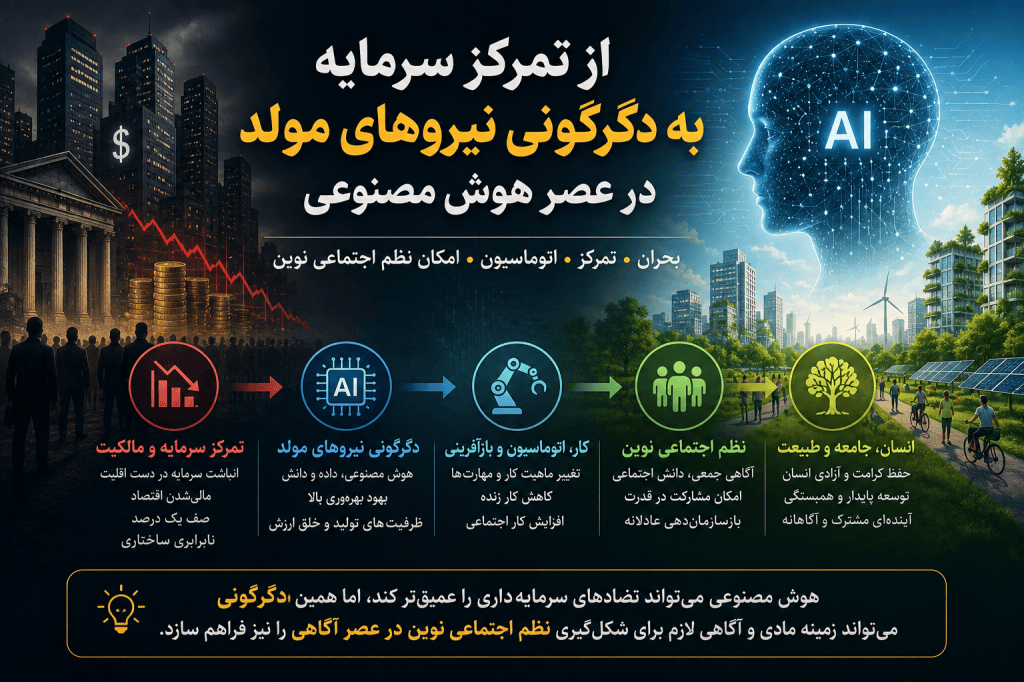
  • بحران ساختاری سرمایه‌داری آمریکا در عصر هوش مصنوعی

    بحران ساختاری سرمایه‌داری آمریکا در عصر هوش مصنوعی

    تازه | NEW

    بحران ساختاری سرمایه‌داری آمریکا در عصر هوش مصنوعی

    تمرکز ثروت، دگرگونی نیروهای مولد و امکان نظم اجتماعی نوین در عصر آگاهی

    حمید اخوی

    مقدمه

    بحث درباره بحران سرمایه‌داری آمریکا را نباید با این ادعا آغاز کرد که اقتصاد ایالات متحده در آستانه فروپاشی فوری قرار گرفته است. چنین ادعایی نه با واقعیت‌های اقتصادی سازگار است و نه برای یک نقد مارکسیستی جدی ضرورت دارد. ایالات متحده همچنان یکی از بزرگ‌ترین و پویاترین اقتصادهای جهان، مرکز بخش مهمی از سرمایه مالی جهانی و مهم‌ترین قطب سرمایه‌گذاری خصوصی در فناوری‌های پیشرفته و هوش مصنوعی است. برآورد نهایی اداره تحلیل اقتصادی آمریکا نشان می‌دهد تولید ناخالص داخلی واقعی این کشور در سه‌ماهه نخست ۲۰۲۶ با نرخ سالانه ۲.۱ درصد رشد کرده و سرمایه‌گذاری، صادرات، هزینه‌های دولتی و مصرف خانوار در این رشد سهم داشته‌اند. بنابراین مسئله مورد بحث در این مقاله بحران به معنای توقف ساده تولید یا فروپاشی قریب‌الوقوع بازارها نیست؛ مسئله، تضادهای ساختاری شیوه تولید سرمایه‌داری در مرحله‌ای است که نیروهای مولد به سطحی از اجتماعی‌شدن، دانش‌بنیانی و وابستگی متقابل رسیده‌اند که با شکل خصوصی مالکیت و تصاحب محصول اجتماعی تنش فزاینده‌ای پیدا می‌کند.

    در این معنا، رشد اقتصادی نه نفی‌کننده بحران، بلکه خود می‌تواند حامل تضاد باشد: جامعه ثروت بیشتری تولید می‌کند، بهره‌وری افزایش می‌یابد و فناوری امکان تولید با کار انسانی کمتر را فراهم می‌سازد، اما همزمان مالکیت ثروت و سرمایه در بخش کوچکی از جامعه متمرکز می‌شود و دسترسی اکثریت به محصول اجتماعی همچنان عمدتاً از طریق فروش نیروی کار صورت می‌گیرد. این مقاله می‌کوشد بحران کنونی سرمایه‌داری آمریکا را در همین چارچوب بررسی کند. نقطه عزیمت آن اقتصاد سیاسی مارکس و مفاهیمی چون انباشت، تمرکز سرمایه، ارزش اضافی، مالی‌شدن، سرمایه موهوم، اجتماعی‌شدن تولید و تضاد میان نیروهای مولد و روابط تولید است. هدف، تکرار مکانیکی مفاهیم قرن نوزدهم نیست، بلکه بررسی معنای تازه آنها در شرایطی است که دانش، داده، الگوریتم، شبکه و هوش مصنوعی به نیروهای مستقیم تولید تبدیل شده‌اند و این پرسش را پیش می‌کشند که آیا همین تحول می‌تواند شرایط مادی و معرفتی پیدایش نظمی متفاوت را فراهم کند؛ نظمی که در اینجا از آن با عنوان «نظم اجتماعی نوین در عصر آگاهی» یاد می‌شود.

    از بحران ادواری تا تضاد ساختاری انباشت سرمایه

    در اقتصاد متعارف، بحران اغلب به‌عنوان انحراف از وضعیت تعادل بررسی می‌شود. افزایش قیمت انرژی، اختلال زنجیره تأمین، سیاست پولی نامناسب، همه‌گیری، جنگ یا سقوط یک بازار مالی می‌تواند اقتصاد را از مسیر عادی خارج کند و سیاست‌گذار وظیفه دارد آن را دوباره به تعادل بازگرداند. اقتصاد سیاسی مارکس پرسش متفاوتی مطرح می‌کند: اگر بحران‌ها در تاریخ سرمایه‌داری بارها و در اشکال گوناگون بازمی‌گردند، آیا نمی‌توان سرچشمه آنها را در خود منطق انباشت جست‌وجو کرد؟ سرمایه در تحلیل مارکس صرفاً مجموعه‌ای از ماشین‌آلات یا پول نیست؛ یک رابطه اجتماعی است که در آن پول وارد فرایند تولید می‌شود تا در پایان به پول بیشتری تبدیل شود. سرمایه‌دار نیروی کار و وسایل تولید را خریداری می‌کند، کالا تولید می‌شود و تحقق ارزش کالا باید سرمایه اولیه را همراه با ارزش اضافی بازگرداند. از این رو هدف نهایی تولید سرمایه‌داری نه تأمین مستقیم نیاز اجتماعی، بلکه بازتولید سرمایه در مقیاسی گسترده‌تر است.

    رقابت هر سرمایه را وادار می‌کند هزینه را کاهش دهد، فناوری جدید به کار گیرد، بهره‌وری را افزایش دهد و سهم بازار خود را حفظ یا گسترش دهد. همین فرایند تناقضی ایجاد می‌کند که برای فهم بحران‌های سرمایه‌داری اهمیت بنیادی دارد. هر بنگاه می‌کوشد هزینه نیروی کار را نسبت به محصول کاهش دهد، اما مجموعه سرمایه برای فروش محصول خود به قدرت خرید اجتماعی نیاز دارد. هر بنگاه از جایگزینی نیروی انسانی با فناوری سود می‌برد، اما اکثریت جامعه همچنان درآمد خود را از فروش نیروی کار به دست می‌آورند. بنابراین آنچه از دید سرمایه منفرد عقلانی است، می‌تواند در سطح کل نظام به عدم تعادل منجر شود. سرمایه‌داری ظرفیت تولید را دائماً افزایش می‌دهد، اما هیچ مکانیسم خودکاری وجود ندارد که تضمین کند قدرت خرید اکثریت جامعه با همان آهنگ افزایش یابد.

    از اینجاست که مسئله اضافه‌انباشت اهمیت پیدا می‌کند. سرمایه انباشته‌شده باید دوباره با نرخ سود قابل قبول سرمایه‌گذاری شود. هنگامی که فرصت‌های سرمایه‌گذاری مولد به اندازه حجم سرمایه گسترش نمی‌یابند، بخشی از سرمایه به بازارهای مالی، املاک، اوراق بدهی و اشکال مختلف دارایی منتقل می‌شود. اعتبار برای مدتی می‌تواند فاصله میان تولید و قدرت خرید را پر کند و ارزش دارایی‌ها می‌تواند بسیار سریع‌تر از تولید واقعی افزایش یابد، اما این فرایند تضاد را از میان نمی‌برد؛ آن را به آینده منتقل می‌کند. مفهوم «سرمایه موهوم» در مارکس برای فهم همین وضع اهمیت دارد: مطالبات مالی بر درآمد و ارزش آینده می‌توانند خود به موضوع خرید و فروش تبدیل شوند و ظاهراً مستقل از فرایند تولید رشد کنند، در حالی که در نهایت تحقق آنها به تولید اجتماعی ارزش وابسته باقی می‌ماند.

    مالی‌شدن، بدهی و اجتماعی‌شدن ریسک سرمایه

    اقتصاد آمریکا در چند دهه گذشته نمونه برجسته‌ای از گسترش این منطق بوده است. مالی‌شدن به این معنا نیست که تولید مادی اهمیت خود را از دست داده است، بلکه نشان می‌دهد روابط مالی و مالکیت دارایی‌ها نقش فزاینده‌ای در سازمان‌دهی اقتصاد پیدا کرده‌اند. خانواده‌ای که درآمدش برای خرید خانه کافی نیست از وام مسکن استفاده می‌کند؛ دانشجو برای تحصیل بدهکار می‌شود؛ خانوار برای مصرف از کارت اعتباری استفاده می‌کند؛ شرکت برای سرمایه‌گذاری، خرید سهام خود یا ادغام با رقیب اوراق بدهی منتشر می‌کند و دولت نیز برای تأمین مخارج خود استقراض می‌کند. اعتبار به جامعه امکان می‌دهد محدودیت امروز را با تعهدی نسبت به درآمد فردا جایگزین کند، اما در همان حال بخشی از درآمد آینده را پیشاپیش به بازپرداخت اصل و بهره اختصاص می‌دهد.

    بحران مالی ۲۰۰۸ و همه‌گیری ۲۰۲۰ ماهیت متناقض این ساختار را آشکار کردند. هنگامی که بازتولید عادی سرمایه، اعتبار یا درآمد خانوارها مختل شد، دولت و بانک مرکزی توانستند منابع عظیمی را برای جلوگیری از فروپاشی زنجیره‌های پرداخت، اعتبار و تولید بسیج کنند. این تجربه‌ها افسانه اقتصاد سرمایه‌داری به‌عنوان حوزه‌ای مستقل از دولت را تضعیف می‌کنند. سرمایه‌داری پیشرفته بدون زیرساخت حقوقی، پولی، مالی، علمی و فیزیکی دولت قابل تصور نیست و هنگامی که بقای کل نظام در معرض خطر قرار می‌گیرد، دولت به نهادی برای اجتماعی‌کردن بخشی از ریسک‌های خصوصی تبدیل می‌شود. خصوصی‌بودن مالکیت در اینجا با اجتماعی‌بودن پیامدهای آن روبه‌رو می‌شود: زیان یک نهاد بزرگ مالی یا تولیدی می‌تواند آن‌قدر آثار عمومی داشته باشد که جامعه ناگزیر از تحمل بخشی از هزینه حفظ شرایط بازتولید کل نظام شود.

    تمرکز ثروت و ساختار طبقاتی آمریکا

    برای فهم اینکه محصول این نظام در اختیار چه کسانی قرار می‌گیرد، باید از شاخص‌های کلان به ساختار مالکیت حرکت کرد. یکی از محدودیت‌های بحث عمومی درباره نابرابری این است که اغلب بر تفاوت درآمد تمرکز می‌کند. درآمد و ثروت یکسان نیستند. درآمد جریانی است که فرد در یک دوره دریافت می‌کند، در حالی که ثروت انباشتی از دارایی‌هاست که می‌تواند خود درآمد، بهره، سود، اجاره و افزایش ارزش ایجاد کند. به همین دلیل، برای تحلیل طبقاتی، توزیع ثروت و به‌ویژه نوع دارایی‌های تحت مالکیت اهمیت بیشتری از مقایسه ساده حقوق سالانه دارد.

    داده‌های Distributional Financial Accounts فدرال رزرو برای سه‌ماهه نخست ۲۰۲۶ تصویری روشن از تمرکز دارایی‌ها ارائه می‌کنند. فقط در بخش سهام شرکت‌ها و واحدهای صندوق‌های سرمایه‌گذاری، ۰.۱ درصد بالای خانوارها حدود ۱۳.۳۳ تریلیون دلار، ۰.۹ درصد بعدی حدود ۱۴.۳۱ تریلیون دلار و ۹ درصد بعدی حدود ۲۰.۵۱ تریلیون دلار در اختیار داشتند؛ در مقابل، کل ۵۰ درصد پایین خانوارها فقط حدود ۵۹۰ میلیارد دلار از این نوع دارایی‌ها را مالک بودند. این تفاوت فقط تفاوت در سطح مصرف نیست. مالکیت سهام، حقی بر بخشی از سود و افزایش ارزش سرمایه ایجاد می‌کند و به همین دلیل تمرکز این دارایی‌ها بیانگر تمرکز امکان تصاحب درآمد ناشی از مالکیت است.

    در تحلیل مارکسیستی، طبقه را نمی‌توان به گروه‌های درآمدی پایین، متوسط و بالا فروکاست. یک پزشک، استاد دانشگاه یا مهندس ممکن است درآمد بالایی داشته باشد، اما اگر درآمد اصلی او همچنان از فروش نیروی کار تخصصی‌اش حاصل شود، رابطه او با تولید با مالک یک مجموعه عظیم سرمایه یکسان نیست. ثروت علاوه بر ایجاد درآمد، خود را نیز بازتولید می‌کند. صاحب سهام از سود و افزایش قیمت دارایی برخوردار می‌شود؛ مالک ملک می‌تواند اجاره دریافت کند؛ دارنده اوراق بهره می‌گیرد و سرمایه‌گذار می‌تواند بازده دارایی موجود را برای خرید دارایی جدید به کار گیرد. در مقابل، خانوار فاقد ثروت ممکن است برای خرید خانه، تحصیل یا حتی مصرف ضروری بدهکار شود و به جای دریافت بهره، بهره بپردازد. به این ترتیب ثروت نه فقط نتیجه نابرابری گذشته، بلکه یکی از سازوکارهای تولید نابرابری آینده است.

    از این رو، تمرکز ثروت را باید تمرکز قدرت نیز دانست. مالکیت سرمایه به صاحبان آن امکان می‌دهد درباره محل سرمایه‌گذاری، فناوری مورد استفاده، تعداد کارکنان، جابه‌جایی تولید، تخصیص بودجه تحقیقاتی و جهت توسعه بنگاه تصمیم بگیرند. دموکراسی سیاسی بر اصل رسمی یک نفر، یک رأی استوار است، اما تخصیص منابع اقتصادی بر چنین اصلی عمل نمی‌کند. فرد یا نهادی که میلیاردها دلار سرمایه در اختیار دارد، قدرت تصمیم‌گیری اقتصادی بسیار بیشتری از میلیون‌ها شهروندی دارد که دارایی اصلی آنها نیروی کارشان است. قدرت اقتصادی نیز می‌تواند از طریق تأمین مالی سیاسی، لابی‌گری، مالکیت رسانه، حمایت از اندیشکده‌ها و دانشگاه‌ها و دسترسی مستقیم‌تر به سیاست‌گذاران به نفوذ اجتماعی و سیاسی تبدیل شود. این بدان معنا نیست که هر تصمیم سیاسی مستقیماً توسط ثروتمندان دیکته می‌شود، اما نابرابری عظیم منابع، ظرفیت اثرگذاری بر تصمیمات جمعی را نیز به‌شدت نامتقارن می‌کند.

    از تمرکز سرمایه به دگرگونی نیروهای مولد در عصر هوش مصنوعی

    این ساختار مالکیت اکنون با تحولی تاریخی در نیروهای مولد تلاقی می‌کند. هوش مصنوعی، یادگیری ماشین، مراکز داده، رایانش ابری، تراشه‌های پیشرفته و اتوماسیون در حال تبدیل‌شدن به بخش مهمی از زیرساخت تولید هستند. گزارش AI Index 2026 دانشگاه استنفورد نشان می‌دهد سرمایه‌گذاری خصوصی در هوش مصنوعی در ایالات متحده طی سال ۲۰۲۵ به ۲۸۵.۹ میلیارد دلار رسید؛ بیش از ۲۳ برابر ۱۲.۴ میلیارد دلار سرمایه‌گذاری خصوصی ثبت‌شده در چین. در همان سال ۱٬۹۵۳ شرکت تازه AI در آمریکا تأمین مالی شدند. این ارقام را نباید صرفاً نشانه رونق یک صنعت جدید تلقی کرد. سرمایه با چنین مقیاسی به سوی حوزه‌ای حرکت می‌کند که امکان افزایش بهره‌وری، کاهش هزینه، ایجاد بازارهای تازه و کسب درآمد و رانت ناشی از مالکیت فکری و کنترل زیرساخت را فراهم می‌کند.

    در انقلاب صنعتی، سرمایه‌گذاری در ماشین‌آلات مکانیکی توان جسمانی انسان را چند برابر کرد؛ انقلاب دیجیتال امکان پردازش و انتقال اطلاعات را گسترش داد؛ هوش مصنوعی اکنون بخشی از فعالیت شناختی انسان ــ تحلیل، ترجمه، برنامه‌نویسی، طراحی، تولید متن و تصویر، تشخیص الگو و تصمیم‌سازی ــ را وارد حوزه اتوماسیون می‌کند. اما AI از یک جهت با ماشین صنعتی کلاسیک تفاوت مهمی دارد. ماده اولیه شناختی آن تا حد زیادی محصول اجتماعی انباشته‌شده بشر است. زبان، کتاب، مقاله علمی، تصویر، کد نرم‌افزاری، تحقیقات دانشگاهی، داده‌های اجتماعی و دانش نسل‌های گذشته در شکل‌گیری محیطی نقش داشته‌اند که مدل‌های هوش مصنوعی از آن تغذیه می‌کنند. اینجاست که بحث مارکس در گروندریسه درباره رشد «دانش عمومی اجتماعی» یا آنچه بعدها General Intellect نامیده شد، اهمیت تازه‌ای پیدا می‌کند. هوش مصنوعی را نمی‌توان تحقق ساده و مکانیکی پیش‌بینی مارکس دانست، اما شباهت ساختاری چشمگیر است: دانش اجتماعی اکنون واقعاً می‌تواند در ماشین، شبکه و الگوریتم تثبیت شود و مستقیماً در تولید نقش ایفا کند.

    در همین نقطه، نقش پلتفرم‌ها و شیوه تبدیل فعالیت اجتماعی به درآمد سرمایه‌ای اهمیت پیدا می‌کند. پلتفرم‌هایی مانند Facebook و Instagram در مجموعه Meta، و YouTube و خدمات Google در مجموعه Alphabet، تنها ابزارهای ارتباطی خنثی نیستند؛ آنها زیرساخت‌هایی خصوصی‌اند که بر بستر فعالیت گسترده کاربران، تولید محتوا، جست‌وجو، مشاهده، تعامل و توجه اجتماعی، بازارهای عظیم تبلیغاتی و خدماتی ایجاد کرده‌اند. Alphabet در گزارش سالانه ۲۰۲۵ خود ۲۹۴.۷ میلیارد دلار درآمد تبلیغاتی گزارش کرد که ۴۰.۴ میلیارد دلار آن مستقیماً از تبلیغات YouTube بود؛ در عین حال درآمد YouTube از مجموع تبلیغات و اشتراک‌ها در همان سال از ۶۰ میلیارد دلار فراتر رفت. شرکت همچنین از اشتراک‌هایی مانند YouTube Premium و Google One، که دسترسی به مدل‌های پیشرفته Gemini را نیز عرضه می‌کند، و از Google Cloud از طریق هزینه‌های مصرفی و اشتراک برای زیرساخت، پلتفرم و خدمات AI درآمد کسب می‌کند. بنابراین سودآوری اقتصاد دیجیتال و هوش مصنوعی فقط از فروش یک «محصول AI» حاصل نمی‌شود؛ تبلیغات، اشتراک، خدمات ابری، دسترسی به زیرساخت محاسباتی و تبدیل توجه و فعالیت کاربران به فرصت تجاری، لایه‌های مختلف یک نظام واحد انباشت را تشکیل می‌دهند.

    اهمیت طبقاتی این سازوکار در آن است که فعالیت اجتماعی میلیون‌ها و میلیاردها انسان در یک سوی رابطه قرار می‌گیرد، در حالی که مالکیت زیرساختی که این فعالیت را سازمان می‌دهد و به درآمد تبدیل می‌کند در سوی دیگر متمرکز است. البته از این واقعیت نباید نتیجه گرفت که تمام ارزش تولیدشده در اقتصاد AI مستقیماً به صاحبان چند پلتفرم منتقل می‌شود؛ زنجیره ارزش شامل تولید تراشه، انرژی، مراکز داده، شبکه، رایانش ابری، مدل‌های بنیادین، نرم‌افزار، تبلیغات و خدمات مصرفی است و سرمایه و سود در لایه‌های گوناگون آن توزیع می‌شود. با این همه، شرکت‌هایی که گلوگاه‌های اصلی این زنجیره ــ پلتفرم، زیرساخت محاسباتی، شبکه توزیع، مدل یا دسترسی به کاربران ــ را کنترل می‌کنند، از موقعیتی ممتاز برای تصاحب بخشی از ارزش اجتماعی برخوردارند. در نتیجه، اجتماعی‌شدن روزافزون تولید دانش و داده الزاماً به اجتماعی‌شدن مالکیت یا محصول اقتصادی آن نمی‌انجامد؛ برعکس، در چارچوب روابط موجود می‌تواند شکل تازه‌ای از تمرکز سرمایه ایجاد کند.

    تناقض دقیقاً در همین نقطه آشکار می‌شود. دانش مورد استفاده در این فرایند ماهیتی بسیار اجتماعی دارد، اما زیرساختی که آن را به قدرت اقتصادی تبدیل می‌کند ــ مراکز داده، تراشه‌ها، مدل‌های بنیادین، شبکه‌های ابری و حقوق مالکیت فکری ــ می‌تواند در مالکیت خصوصی تعداد محدودی از شرکت‌ها و صاحبان سرمایه قرار گیرد. داده‌های فدرال رزرو نیز نشان می‌دهند که مالکیت سهام شرکت‌ها از پیش به‌شدت در بخش بالای توزیع ثروت متمرکز است. بنابراین اگر ارزش اقتصادی حاصل از AI عمدتاً از طریق سود شرکت‌ها و افزایش ارزش سهام تحقق یابد، بدون تغییر در روابط مالکیت، بخش بزرگی از ثمره این دگرگونی تکنولوژیک می‌تواند به همان گروه‌هایی منتقل شود که از پیش بخش اصلی سرمایه مالی را در اختیار دارند.

    در اینجا تضاد کلاسیک میان تولید اجتماعی و تصاحب خصوصی شکل تازه‌ای پیدا می‌کند. میلیون‌ها و در واقع میلیاردها انسان در طول نسل‌ها در تولید دانش و داده‌ای مشارکت کرده‌اند که اکنون به یکی از مهم‌ترین مواد اولیه اقتصاد هوش مصنوعی تبدیل شده است، اما حق تصمیم‌گیری درباره نحوه استفاده از این ظرفیت و تصاحب بخش بزرگی از ارزش اقتصادی حاصل از آن می‌تواند در اختیار گروه بسیار کوچک‌تری باقی بماند. در چنین شرایطی، هوش مصنوعی نه تنها یک فناوری، بلکه یک مسئله مالکیت و بنابراین یک مسئله طبقاتی است.

    اتوماسیون و تناقض میان رهایی از کار و ناامنی اقتصادی

    این تحول یک تناقض عمیق‌تر نیز ایجاد می‌کند. از دیدگاه انسانی، افزایش بهره‌وری و کاهش نیاز به کار باید دستاوردی مثبت باشد. اگر جامعه بتواند محصول مورد نیاز خود را با نصف زمان کار گذشته تولید کند، نتیجه عقلانی می‌تواند کاهش ساعات کار، افزایش زمان آزاد و فراهم‌شدن فرصت بیشتر برای آموزش، هنر، خانواده، فعالیت اجتماعی و رشد فردی باشد. فناوری در این معنا ظرفیت رهایی‌بخش دارد. اما در جامعه‌ای که دسترسی اکثریت مردم به درآمد همچنان عمدتاً از طریق فروش نیروی کار سازمان یافته است، کاهش نیاز به نیروی کار می‌تواند نتیجه‌ای کاملاً متفاوت ایجاد کند. اگر شرکت بتواند با استفاده از AI همان محصول را با تعداد کمتری کارگر تولید کند، این افزایش بهره‌وری از دید بنگاه می‌تواند به کاهش هزینه و افزایش سود منجر شود؛ اما برای کارگری که شغل خود را از دست می‌دهد، همان پیشرفت فناوری به ناامنی اقتصادی تبدیل می‌شود.

    این تناقض ناشی از هوش مصنوعی نیست. سرچشمه آن در رابطه اجتماعی‌ای است که حق دسترسی به محصول اجتماعی را به اشتغال مزدی پیوند می‌دهد. اگر اتوماسیون به مرحله‌ای برسد که بخش فزاینده‌ای از کار ضروری را ماشین انجام دهد، جامعه با پرسشی روبه‌رو خواهد شد که دیگر صرفاً تکنولوژیک نیست: اگر برای تولید ثروت به ساعات کار انسانی کمتری نیاز داریم، چرا امنیت زندگی انسان باید همچنان به فروش هرچه بیشتر ساعت کار وابسته باشد؟ در این نقطه می‌توان از امکان تاریخی گذار از «بحران کمبود» به نوعی «بحران فراوانی بالقوه» سخن گفت. اگر ماشین بتواند کالا، خدمات و دانش بیشتری با کار انسانی کمتر تولید کند، پرسش اساسی دیگر فقط این نیست که چگونه تولید را افزایش دهیم؛ پرسش این است که چه کسی مالک ظرفیت تولید است، چه کسی درباره کاربرد آن تصمیم می‌گیرد و محصول افزایش بهره‌وری چگونه میان اعضای جامعه تقسیم می‌شود.

    بحران ساختاری و حدود اصلاحات درون سرمایه‌داری

    از این تحلیل نباید نتیجه گرفت که اصلاحات اقتصادی بی‌اهمیت‌اند. مالیات تصاعدی، تقویت اتحادیه‌ها، افزایش دستمزد، خدمات عمومی، آموزش و درمان همگانی، حمایت از بیکاران و تنظیم انحصارات می‌توانند زندگی میلیون‌ها انسان را بهبود دهند و توازن قدرت میان کار و سرمایه را تغییر دهند. نقد مارکسیستی زمانی به جزم‌گرایی تبدیل می‌شود که تفاوت میان شرایط واقعی زندگی انسان‌ها را به این دلیل که یک اصلاح سرمایه‌داری را فوراً از میان نمی‌برد، بی‌اهمیت تلقی کند. اما در عین حال، اصلاح توزیع درآمد با تحول روابط مالکیت یکسان نیست. اگر ساختار بنیادی مالکیت سرمایه تغییر نکند، همان مکانیسم‌هایی که ثروت را متمرکز کرده‌اند می‌توانند پس از دوره‌ای از اصلاحات دوباره عمل کنند. سرمایه از طریق سود، بهره، افزایش ارزش دارایی و انتقال بین‌نسلی خود را بازتولید می‌کند. بنابراین پرسش مارکسیستی فقط این نیست که محصول اجتماعی پس از تولید چگونه عادلانه‌تر توزیع شود؛ پرسش بنیادی‌تر این است که چه کسی وسایل تولید را مالک است، چه کسی درباره سرمایه‌گذاری تصمیم می‌گیرد و چه کسانی در تعیین اولویت‌های اقتصادی جامعه مشارکت دارند.

    این تمایز برای فهم مرحله کنونی اهمیت ویژه‌ای دارد، زیرا AI می‌تواند مقیاس تمرکز را افزایش دهد. توسعه مدل‌های پیشرفته به تراشه، انرژی، مراکز داده، شبکه و سرمایه عظیم نیاز دارد. این هزینه‌های ثابت بالا می‌توانند ورود رقبای جدید را دشوار کنند و مزیت شرکت‌هایی را که از پیش سرمایه، داده و زیرساخت دارند تقویت کنند. از این رو ممکن است اجتماعی‌ترین شکل تولید دانش با یکی از متمرکزترین اشکال مالکیت زیرساخت همراه شود.

    از تضاد سرمایه‌داری تا امکان نظم اجتماعی نوین در عصر آگاهی

    وجود تضاد ساختاری به معنای فروپاشی خودکار سرمایه‌داری نیست. تاریخ سرمایه‌داری نشان داده است که این نظام ظرفیت قابل توجهی برای انطباق دارد. سیاست کینزی، دولت رفاه، اعتبار، جهانی‌شدن، مالی‌شدن، سیاست پولی، خصوصی‌سازی و فناوری در دوره‌های مختلف به بازسازی شرایط انباشت کمک کرده‌اند. بحران نیز الزاماً نتیجه مترقی ندارد؛ می‌تواند به تمرکز بیشتر سرمایه، اقتدارگرایی، ملی‌گرایی، جنگ، نظارت دیجیتال و اشکال تازه‌ای از سلطه منجر شود. بنابراین هیچ قانون اقتصادی وجود ندارد که از دل افزایش تضادهای سرمایه‌داری به صورت خودکار یک نظم اجتماعی بهتر بیرون بیاورد. همین نکته مرز مهمی میان جبرگرایی تاریخی و مفهوم نظم اجتماعی نوین در عصر آگاهی ایجاد می‌کند. نیروهای مولد می‌توانند امکان تحول را ایجاد کنند، اما امکان با ضرورت یکسان نیست. آنچه میان این دو قرار دارد، آگاهی و کنش اجتماعی انسان است.

    در اینجا مفهوم آگاهی معنایی فراتر از آگاهی فردی یا اخلاقی پیدا می‌کند. برای نخستین بار در تاریخ، فناوری‌هایی در حال شکل‌گیری‌اند که بالقوه می‌توانند حجم عظیمی از اطلاعات مربوط به تولید، مصرف، منابع، نیازها و پیامدهای تصمیمات اقتصادی را تقریباً در زمان واقعی پردازش کنند. همان هوش مصنوعی که می‌تواند برای افزایش سود شرکت خصوصی به کار رود، از نظر فنی می‌تواند برای برنامه‌ریزی منابع، سنجش نیازهای اجتماعی، شفافیت تصمیمات، مشارکت شهروندان و هماهنگی شبکه‌های پیچیده تولید نیز مورد استفاده قرار گیرد. فناوری شکل اجتماعی کاربرد خود را تعیین نمی‌کند؛ روابط قدرت و مالکیت تعیین می‌کنند که این ظرفیت در خدمت چه هدفی قرار گیرد.

    از این منظر، نظم اجتماعی نوین در عصر آگاهی را نباید صرفاً نسخه‌ای جدید از ملی‌کردن مالکیت یا انتقال کنترل از شرکت خصوصی به دستگاه دولت تصور کرد. اگر قدرت اقتصادی از گروه کوچکی از صاحبان سرمایه به گروه کوچکی از مدیران دولتی منتقل شود، مسئله مشارکت انسان در قدرت لزوماً حل نشده است. مسئله بنیادی‌تر آن است که چگونه می‌توان مالکیت، تصمیم‌گیری و مدیریت منابع اجتماعی را به شکلی سازمان داد که انسان‌ها نه فقط دریافت‌کنندگان محصول تصمیمات اقتصادی، بلکه مشارکت‌کنندگان آگاه در شکل‌گیری آنها باشند.

    این امر مستلزم بازاندیشی در رابطه میان مالکیت، کار، درآمد و قدرت است. اگر افزایش بهره‌وری امکان کاهش زمان کار را فراهم می‌کند، ثمره آن می‌تواند به جای بیکاری گسترده به کاهش ساعت کار اجتماعی تبدیل شود. اگر دانش محصول همکاری تاریخی بشر است، می‌توان درباره اشکال اجتماعی‌تر دسترسی و مالکیت آن اندیشید. اگر فناوری امکان مشارکت و پردازش اطلاعات در مقیاس بزرگ را فراهم می‌کند، می‌توان درباره ساختارهایی فراتر از انتخاب دوره‌ای نمایندگان و مدیریت متمرکز بوروکراتیک فکر کرد. و اگر تولید واقعاً اجتماعی است، مسئله مشارکت در قدرت اقتصادی دیگر یک آرمان انتزاعی نیست؛ به پرسشی درباره انطباق روابط اجتماعی با ماهیت واقعی نیروهای مولد تبدیل می‌شود.

    جمع‌بندی

    اقتصاد آمریکا در سال ۲۰۲۶ تصویری متناقض اما از نظر تاریخی بسیار معنادار ارائه می‌کند. اقتصاد همچنان رشد می‌کند و در همان حال مالکیت دارایی‌های مولد به‌شدت متمرکز است. در بخش سهام و صندوق‌های سرمایه‌گذاری، گروه‌های بالای توزیع ثروت بخش قاطع مالکیت را در اختیار دارند، در حالی که سهم نیمه پایین جامعه بسیار ناچیز است. همزمان، آمریکا با ۲۸۵.۹ میلیارد دلار سرمایه‌گذاری خصوصی AI در سال ۲۰۲۵ با فاصله بسیار زیاد بزرگ‌ترین مرکز سرمایه‌گذاری خصوصی در هوش مصنوعی جهان بوده است. این ارقام به خودی خود نظریه مارکس را «اثبات» نمی‌کنند و نباید از آمار نتیجه‌ای بیش از ظرفیت آن استخراج کرد، اما در کنار یکدیگر پدیده‌ای را آشکار می‌کنند که تحلیل مارکسیستی برای فهم آن همچنان قدرت توضیحی دارد: تولید هرچه اجتماعی‌تر می‌شود، دانش بیش از گذشته به نیروی مستقیم تولید تبدیل می‌شود و سرمایه به مقیاس‌های عظیم‌تری از هماهنگی اجتماعی وابسته می‌شود، در حالی که مالکیت و حق تصاحب محصول این فرایند می‌تواند در بخش کوچکی از جامعه متمرکز باقی بماند.

    هوش مصنوعی این تضاد را به مرحله‌ای تازه می‌رساند. دانش اجتماعی انباشته‌شده بشر می‌تواند در قالب مدل، الگوریتم و ماشین به نیروی تولید تبدیل شود؛ اما زیرساختی که این دانش را به قدرت اقتصادی تبدیل می‌کند می‌تواند خصوصی باشد. فناوری می‌تواند نیاز به کار انسانی را کاهش دهد؛ اما اگر درآمد همچنان به اشتغال مزدی وابسته بماند، همان پیشرفت می‌تواند ناامنی اقتصادی ایجاد کند. بهره‌وری می‌تواند امکان فراوانی بیشتر را فراهم سازد؛ اما اگر حق دسترسی به محصول اجتماعی تابع مالکیت باقی بماند، فراوانی بالقوه می‌تواند در کنار محرومیت واقعی وجود داشته باشد.

    در چنین شرایطی، بحران‌های سرمایه‌داری ممکن است به تدریج از بحران‌های ادواری بازار فراتر روند و به بحران انطباق روابط تولید با نیروهای مولدی تبدیل شوند که خود سرمایه‌داری ایجاد کرده است. با این حال، هیچ تضمینی وجود ندارد که این تضادها به نظمی آزادتر، عادلانه‌تر یا انسانی‌تر منجر شوند. همان فناوری‌ها می‌توانند برای تمرکز قدرت، نظارت و کنترل نیز به کار روند. تفاوت میان این مسیرها را نه فناوری به تنهایی، بلکه سطح آگاهی اجتماعی، سازمان‌یابی، نهادهای دموکراتیک و توانایی انسان‌ها برای مشارکت آگاهانه در تعیین آینده خود رقم خواهد زد.

    از همین جاست که امکان نظم اجتماعی نوین در عصر آگاهی پدیدار می‌شود؛ نه به‌عنوان مرحله‌ای محتوم که تاریخ خودبه‌خود به آن خواهد رسید، بلکه به‌عنوان امکانی که توسعه نیروهای مولد شرایط مادی آن را فراهم می‌کند و تحققش به کنش آگاهانه جامعه وابسته است. تفاوت این نگرش با جبرگرایی تاریخی دقیقاً در همین نکته است: نظم نوین قرار نیست از ویرانه‌های سرمایه‌داری به صورت خودکار سر برآورد؛ باید آگاهانه اندیشیده، طراحی و از طریق مشارکت اجتماعی ساخته شود.

    در چنین افقی، اقتصاد دیگر هدف جامعه نیست، بلکه وسیله شکوفایی انسان است؛ فناوری نه ابزاری برای حذف انسان به منظور افزایش سود، بلکه وسیله‌ای برای کاهش کار غیرضروری و گسترش آزادی اوست؛ دانش نه صرفاً کالایی برای انحصار، بلکه میراثی اجتماعی است؛ و قدرت اقتصادی نه حق طبیعی ناشی از مقدار مالکیت، بلکه حوزه‌ای است که باید در آن امکان مشارکت آگاهانه جامعه وجود داشته باشد. سرمایه‌داری با اجتماعی‌کردن تولید، جهانی‌کردن تقسیم کار، تبدیل دانش به نیروی تولید و اکنون با دگرگونی نیروهای مولد در عصر هوش مصنوعی، خود شرایط مادی طرح پرسشی را فراهم کرده است که شاید در قرن بیست‌ویکم اهمیت فزاینده‌ای پیدا کند: اگر دانش، تولید و ثروت بیش از هر زمان دیگری محصول فعالیت اجتماعی انسان‌ها هستند، چرا مالکیت و قدرت تصمیم‌گیری درباره آنها باید همچنان تا این اندازه خصوصی و متمرکز باقی بماند؟

    پاسخ به این پرسش از پیش تعیین نشده است. بحران سرمایه‌داری تضمین‌کننده نظم بعدی نیست. اما هرچه فاصله میان ماهیت اجتماعی نیروهای مولد و تمرکز خصوصی مالکیت بیشتر شود، امکان طرح یک بدیل تاریخی نیز واقعی‌تر می‌شود. نظم اجتماعی نوین در عصر آگاهی یکی از نام‌هایی است که می‌توان به این امکان داد: امکانی برای آنکه جامعه به جای انتظار برای نظمی که تاریخ بر آن تحمیل می‌کند، آگاهانه درباره نظمی که می‌خواهد بسازد تصمیم بگیرد.

    منابع اصلی

    • Marx, Karl. Capital: A Critique of Political Economy, Vols. I–III.
    • Marx, Karl. Grundrisse: Foundations of the Critique of Political Economy، به‌ویژه Fragment on Machines.
    • Federal Reserve Board. Distributional Financial Accounts, 2026 Q1.
    • U.S. Bureau of Economic Analysis. GDP (Third Estimate), Industries, Corporate Profits, State GDP, and State Personal Income, First Quarter 2026.
    • Stanford Institute for Human-Centered Artificial Intelligence. Artificial Intelligence Index Report 2026.
    • Alphabet Inc. Annual Report / Form 10-K for fiscal year 2025.

    NEW | تازه

    The Structural Crisis of American Capitalism in the Age of Artificial Intelligence

    Concentration of Wealth, Transformation of the Productive Forces, and the Possibility of a New Social Order in the Age of Awareness

    Hamid Akhavi

    Introduction

    A discussion of the crisis of American capitalism should not begin with the claim that the United States economy is on the verge of immediate collapse. Such a claim is neither consistent with economic realities nor necessary for a serious Marxist critique. The United States remains one of the world’s largest and most dynamic economies, a center of global financial capital, and the leading hub of private investment in advanced technologies and artificial intelligence. The U.S. Bureau of Economic Analysis’s final estimate shows that real gross domestic product grew at an annual rate of 2.1 percent in the first quarter of 2026, with investment, exports, government spending, and household consumption all contributing. The issue examined here, therefore, is not crisis as a simple halt in production or an imminent market collapse. It is the structural contradictions of the capitalist mode of production at a stage when the productive forces have become so socialized, knowledge-based, and interdependent that they increasingly conflict with private ownership and private appropriation of the social product.

    In this sense, economic growth does not negate crisis; growth itself can carry contradiction. Society produces more wealth, productivity rises, and technology makes it possible to produce with less human labor, while ownership of wealth and capital becomes concentrated in a small part of society and the majority still gain access to the social product mainly by selling their labor power. This article examines the present crisis of American capitalism within that framework. Its point of departure is Marx’s political economy and concepts such as accumulation, concentration of capital, surplus value, financialization, fictitious capital, socialization of production, and the contradiction between productive forces and relations of production. The goal is not to repeat nineteenth-century concepts mechanically, but to examine their renewed meaning under conditions in which knowledge, data, algorithms, networks, and artificial intelligence have become direct productive forces—and to ask whether this transformation may also create the material and cognitive conditions for a different order, referred to here as “a new social order in the age of awareness.”

    From Cyclical Crisis to the Structural Contradiction of Capital Accumulation

    In mainstream economics, crisis is often treated as a departure from equilibrium. Higher energy prices, supply-chain disruption, unsuitable monetary policy, a pandemic, war, or a financial-market collapse may push the economy off its normal path, and policymakers are expected to restore balance. Marx’s political economy asks a different question: if crises recur throughout capitalist history in many forms, should their source be sought in the logic of accumulation itself? In Marx’s analysis, capital is not merely machinery or money; it is a social relation in which money enters production in order to return as more money. The capitalist purchases labor power and means of production, commodities are produced, and the realization of their value must return the original capital together with surplus value. The ultimate purpose of capitalist production is therefore not the direct satisfaction of social need, but the reproduction of capital on an expanded scale.

    Competition compels each capital to cut costs, introduce new technology, raise productivity, and preserve or expand market share. This process creates a contradiction fundamental to understanding capitalist crises. Every firm seeks to reduce labor costs relative to output, yet capital as a whole needs social purchasing power to sell its products. Each firm benefits from replacing human labor with technology, while most people still obtain income by selling their labor power. What is rational from the standpoint of an individual capital can therefore generate imbalance at the level of the system. Capitalism continually expands productive capacity, but no automatic mechanism guarantees that the purchasing power of the majority will rise at the same rate.

    This is where overaccumulation becomes important. Accumulated capital must be reinvested at an acceptable rate of profit. When productive investment opportunities do not expand as rapidly as the mass of capital, part of that capital moves into financial markets, real estate, debt securities, and other assets. Credit can temporarily bridge the gap between production and purchasing power, and asset values can rise much faster than real output, but this does not eliminate the contradiction; it postpones it. Marx’s concept of “fictitious capital” is important here: financial claims on future income and value can themselves be bought and sold and appear to grow independently of production, even though their ultimate realization remains dependent on the social production of value.

    Financialization, Debt, and the Socialization of Capital Risk

    The American economy over recent decades is a leading example of this logic. Financialization does not mean that material production has lost importance; it means that financial relations and asset ownership play a growing role in organizing the economy. A family whose income is insufficient to buy a house takes a mortgage; a student incurs debt for education; households use credit cards for consumption; corporations issue debt to invest, buy back shares, or merge with competitors; and the government borrows to finance expenditures. Credit allows society to replace today’s limitation with a claim on tomorrow’s income, while committing part of that future income in advance to principal and interest payments.

    The 2008 financial crisis and the 2020 pandemic exposed the contradictory nature of this structure. When the normal reproduction of capital, credit, or household income was disrupted, the government and central bank mobilized enormous resources to prevent the collapse of payment, credit, and production chains. These experiences weaken the myth of capitalism as a sphere independent of the state. Advanced capitalism is inconceivable without the state’s legal, monetary, financial, scientific, and physical infrastructure. When the survival of the system is threatened, the state becomes an institution for socializing part of the risks created privately. Private ownership confronts the social character of its consequences: the losses of a major financial or productive institution can have such broad effects that society is compelled to bear part of the cost of preserving the conditions for the reproduction of the system as a whole.

    Concentration of Wealth and the American Class Structure

    To understand who controls the product of this system, analysis must move from aggregate indicators to the structure of ownership. A limitation of public debate about inequality is its frequent focus on income differences. Income and wealth are not the same. Income is a flow received during a period; wealth is a stock of assets that can itself generate income, interest, profit, rent, and capital gains. For class analysis, the distribution of wealth—and especially the kinds of assets owned—is therefore more important than a simple comparison of annual salaries.

    Federal Reserve Distributional Financial Accounts for the first quarter of 2026 provide a clear picture of asset concentration. In corporate equities and mutual-fund shares alone, the top 0.1 percent of households owned about $13.33 trillion, the next 0.9 percent about $14.31 trillion, and the next 9 percent about $20.51 trillion. By contrast, the entire bottom 50 percent owned only about $590 billion of these assets. This is not merely a difference in consumption. Stock ownership creates a claim on profit and capital appreciation; concentration of these assets therefore represents concentration of the capacity to appropriate ownership income.

    In Marxist analysis, class cannot be reduced to low-, middle-, and high-income groups. A physician, professor, or engineer may earn a high income, but if that income still comes mainly from selling specialized labor power, that person’s relation to production is not the same as that of the owner of a vast concentration of capital. Wealth not only generates income; it reproduces itself. Shareholders receive profit and capital gains, landlords collect rent, bondholders receive interest, and investors can use returns on existing assets to acquire new ones. Households without wealth may instead incur debt for housing, education, or even essential consumption and pay interest rather than receive it. Wealth is thus not only a result of past inequality; it is a mechanism for producing future inequality.

    The concentration of wealth must therefore also be understood as a concentration of power. Capital ownership enables its holders to decide where to invest, what technology to use, how many workers to employ, where production will be located, how research budgets are allocated, and in what direction firms develop. Political democracy rests formally on one person, one vote, but economic resources are not allocated on that principle. A person or institution controlling billions of dollars has far greater economic decision-making power than millions of citizens whose principal asset is their labor power. Economic power can also become social and political influence through campaign finance, lobbying, media ownership, support for think tanks and universities, and more direct access to policymakers. This does not mean every political decision is directly dictated by the wealthy; it means that enormous resource inequality also makes the capacity to influence collective decisions profoundly unequal.

    From the Concentration of Capital to the Transformation of Productive Forces in the Age of AI

    This ownership structure now intersects with a historic transformation of the productive forces. Artificial intelligence, machine learning, data centers, cloud computing, advanced chips, and automation are becoming central components of productive infrastructure. Stanford University’s AI Index 2026 reports that private AI investment in the United States reached $285.9 billion in 2025—more than twenty-three times the $12.4 billion recorded in China. In the same year, 1,953 newly funded AI companies emerged in the United States. These figures should not be treated merely as evidence of a booming new industry. Capital on this scale is moving toward a field that promises greater productivity, lower costs, new markets, and revenue and rent derived from intellectual property and control over infrastructure.

    During the Industrial Revolution, investment in mechanical machinery multiplied human physical power; the digital revolution expanded the processing and transmission of information; artificial intelligence now brings parts of human cognitive activity—analysis, translation, programming, design, text and image production, pattern recognition, and decision support—into the sphere of automation. Yet AI differs importantly from the classical industrial machine. Its cognitive raw material is largely humanity’s accumulated social product. Language, books, scientific articles, images, software code, university research, social data, and the knowledge of past generations have created the environment from which AI models draw. Marx’s discussion in the Grundrisse of the growth of “general social knowledge,” later called the General Intellect, therefore acquires renewed significance. AI should not be regarded as a simple mechanical fulfillment of Marx’s prediction, but the structural resemblance is striking: social knowledge can now be fixed in machines, networks, and algorithms and participate directly in production.

    At this point, the role of platforms and the conversion of social activity into capital income becomes crucial. Facebook and Instagram within Meta, and YouTube and Google services within Alphabet, are not neutral communication tools; they are privately owned infrastructures that build vast advertising and service markets on user activity, content production, search, viewing, interaction, and social attention. Alphabet reported $294.7 billion in advertising revenue for 2025, including $40.4 billion directly from YouTube advertising; total YouTube revenue from advertising and subscriptions exceeded $60 billion. The company also earns from subscriptions such as YouTube Premium and Google One, which can include access to advanced Gemini models, and from Google Cloud through usage fees and subscriptions for infrastructure, platform, and AI services. Profitability in the digital and AI economy therefore does not arise solely from selling an “AI product.” Advertising, subscriptions, cloud services, access to computing infrastructure, and the conversion of user attention and activity into commercial opportunity form layers of a single system of accumulation.

    The class significance of this mechanism lies in the separation between the social activity of millions and billions of people and the concentrated ownership of the infrastructure that organizes and monetizes it. This does not mean that all value generated in the AI economy flows directly to a few platform owners. The value chain includes chips, energy, data centers, networks, cloud computing, foundation models, software, advertising, and consumer services, and capital and profit are distributed across its layers. Nevertheless, firms controlling key bottlenecks—platforms, computing infrastructure, distribution networks, models, or access to users—occupy a privileged position for appropriating part of socially generated value. The increasing socialization of knowledge and data production does not necessarily socialize ownership or its economic product; within existing relations, it can instead create a new form of capital concentration.

    The contradiction becomes clearest here. The knowledge used in this process is profoundly social, but the infrastructure that converts it into economic power—data centers, chips, foundation models, cloud networks, and intellectual-property rights—can be privately owned by a small number of companies and investors. Federal Reserve data also show that corporate equity ownership is already concentrated at the top of the wealth distribution. If AI’s economic value is realized mainly through corporate profit and higher share prices, then without a change in ownership relations, much of the benefit of this technological transformation may flow to the same groups that already hold most financial capital.

    The classical contradiction between social production and private appropriation thus assumes a new form. Millions—and over generations, billions—of people have contributed to the knowledge and data that now constitute a major raw material of the AI economy. Yet decisions about using this capacity and the appropriation of much of the resulting economic value may remain in the hands of a far smaller group. Under these conditions, artificial intelligence is not merely a technology; it is a question of ownership and therefore a class question.

    Automation and the Contradiction Between Liberation from Labor and Economic Insecurity

    This transformation produces a deeper contradiction. From a human standpoint, higher productivity and a reduced need for labor should be positive achievements. If society can produce what it needs in half the former working time, the rational outcome could be shorter working hours, more free time, and greater opportunity for education, art, family, social activity, and personal development. Technology has emancipatory potential in this sense. But in a society where most people obtain income mainly by selling their labor power, a reduced need for labor may have an entirely different result. If a company uses AI to produce the same output with fewer workers, higher productivity can mean lower costs and higher profit for the firm, while the same technological advance becomes economic insecurity for a worker who loses a job.

    This contradiction is not created by AI. Its source is the social relation that ties access to the social product to wage employment. If automation reaches a point where machines perform a growing share of necessary labor, society confronts a question that is no longer merely technological: if fewer human working hours are needed to produce wealth, why should human security remain dependent on selling ever more hours of labor? Here one may speak of a historical possibility of moving from a “crisis of scarcity” toward a “crisis of potential abundance.” If machines can produce more goods, services, and knowledge with less human labor, the central question is no longer only how to increase production, but who owns productive capacity, who decides its use, and how the gains from productivity are distributed.

    Structural Crisis and the Limits of Reform Within Capitalism

    This analysis should not imply that economic reforms are unimportant. Progressive taxation, stronger unions, higher wages, public services, universal education and health care, support for the unemployed, and regulation of monopolies can improve millions of lives and alter the balance of power between labor and capital. Marxist critique becomes dogmatic when it dismisses real differences in human living conditions merely because a reform does not immediately abolish capitalism. Yet reforming income distribution is not the same as transforming ownership relations. If the basic structure of capital ownership remains intact, the mechanisms that concentrate wealth can resume operation after a period of reform. Capital reproduces itself through profit, interest, asset appreciation, and intergenerational transfer. The Marxist question is therefore not only how the social product should be distributed more fairly after production, but who owns the means of production, who decides investment, and who participates in setting society’s economic priorities.

    This distinction is especially important now because AI can increase the scale of concentration. Advanced models require chips, energy, data centers, networks, and enormous amounts of capital. High fixed costs can make entry difficult and reinforce the advantage of firms that already possess capital, data, and infrastructure. The most socialized form of knowledge production may therefore coexist with one of the most concentrated forms of infrastructure ownership.

    From Capitalist Contradiction to the Possibility of a New Social Order in the Age of Awareness

    The existence of structural contradiction does not mean that capitalism will collapse automatically. The history of capitalism demonstrates a considerable capacity for adaptation. Keynesian policy, the welfare state, credit, globalization, financialization, monetary policy, privatization, and technology have at different times helped reconstruct the conditions of accumulation. Crisis does not necessarily produce progressive outcomes; it can lead to greater concentration of capital, authoritarianism, nationalism, war, digital surveillance, and new forms of domination. No economic law automatically produces a better social order from capitalism’s intensifying contradictions. This marks an important boundary between historical determinism and the concept of a new social order in the age of awareness. Productive forces can create the possibility of transformation, but possibility is not necessity. Social awareness and human action stand between the two.

    Here awareness takes on a meaning beyond individual or moral consciousness. For the first time in history, emerging technologies can potentially process vast quantities of information about production, consumption, resources, needs, and the consequences of economic decisions in near real time. The same AI used to increase private corporate profit could technically be used for resource planning, assessing social needs, making decisions transparent, enabling citizen participation, and coordinating complex production networks. Technology does not determine the social form of its use; relations of power and ownership determine the ends this capacity serves.

    From this perspective, a new social order in the age of awareness should not be imagined merely as a new version of nationalization or the transfer of control from private companies to the state apparatus. If economic power passes from a small group of capital owners to a small group of state managers, the problem of human participation in power is not necessarily resolved. The deeper issue is how ownership, decision-making, and the management of social resources can be organized so that people are not merely recipients of economic decisions but conscious participants in shaping them.

    This requires rethinking the relationship among ownership, labor, income, and power. If higher productivity makes shorter working time possible, its benefit could be expressed as a reduction in society’s working hours rather than mass unemployment. If knowledge is the product of humanity’s historical cooperation, more social forms of access and ownership can be considered. If technology enables participation and large-scale information processing, structures beyond periodic elections and centralized bureaucratic administration become conceivable. And if production is truly social, participation in economic power is no longer an abstract ideal; it becomes a question of bringing social relations into alignment with the actual character of the productive forces.

    Conclusion

    The American economy in 2026 presents a contradictory but historically significant picture. The economy continues to grow while ownership of productive assets remains intensely concentrated. In corporate equities and mutual-fund shares, groups at the top of the wealth distribution hold the overwhelming share, while the bottom half of society owns very little. At the same time, with $285.9 billion in private AI investment during 2025, the United States was by far the world’s leading center of private AI investment. These figures do not by themselves “prove” Marx’s theory, and statistics should not be asked to establish more than they can. Taken together, however, they reveal a phenomenon that Marxist analysis still helps explain: production becomes increasingly social, knowledge becomes a direct productive force, and capital depends on ever larger scales of social coordination, while ownership and the right to appropriate the product can remain concentrated in a small part of society.

    Artificial intelligence takes this contradiction to a new stage. Humanity’s accumulated social knowledge can become a productive force embodied in models, algorithms, and machines, while the infrastructure that converts that knowledge into economic power remains private. Technology can reduce the need for human labor, but if income remains tied to wage employment, the same advance can create insecurity. Productivity can make greater abundance possible, but if access to the social product remains governed by ownership, potential abundance can coexist with real deprivation.

    Under these conditions, capitalist crises may gradually move beyond cyclical market crises and become crises of adaptation between relations of production and the productive forces capitalism itself has created. Yet there is no guarantee that these contradictions will lead to a freer, more just, or more humane order. The same technologies can be used to concentrate power, surveil, and control. The difference between these paths will be determined not by technology alone but by the level of social awareness, organization, democratic institutions, and people’s capacity to participate consciously in shaping their future.

    The possibility of a new social order in the age of awareness emerges from this point—not as an inevitable stage toward which history will move on its own, but as a possibility whose material conditions are created by the development of the productive forces and whose realization depends on conscious social action. The difference between this view and historical determinism lies precisely here: the new order will not rise automatically from capitalism’s ruins; it must be consciously conceived, designed, and built through social participation.

    In such a horizon, the economy is no longer society’s end but a means to human flourishing; technology is not a means of removing people to raise profit, but a means of reducing unnecessary labor and expanding freedom; knowledge is not merely a commodity to be monopolized, but a social inheritance; and economic power is not a natural right derived from the amount of property one owns, but a sphere in which society must be able to participate consciously. By socializing production, globalizing the division of labor, transforming knowledge into a productive force, and now reshaping the productive forces through AI, capitalism itself has created the material conditions for a question of growing importance in the twenty-first century: if knowledge, production, and wealth are more than ever the products of human social activity, why should ownership and decision-making power over them remain so private and concentrated?

    The answer is not predetermined. Capitalist crisis does not guarantee the next order. But as the distance widens between the social character of the productive forces and the private concentration of ownership, the possibility of a historical alternative becomes more real. “A new social order in the age of awareness” is one name for this possibility: a society that, instead of waiting for history to impose an order upon it, consciously decides what order it wants to build.

    Principal Sources

    • Marx, Karl. Capital: A Critique of Political Economy, Vols. I–III.
    • Marx, Karl. Grundrisse: Foundations of the Critique of Political Economy, especially “Fragment on Machines.”
    • Federal Reserve Board. Distributional Financial Accounts, 2026 Q1.
    • U.S. Bureau of Economic Analysis. GDP (Third Estimate), Industries, Corporate Profits, State GDP, and State Personal Income, First Quarter 2026.
    • Stanford Institute for Human-Centered Artificial Intelligence. Artificial Intelligence Index Report 2026.
    • Alphabet Inc. Annual Report / Form 10-K for fiscal year 2025.
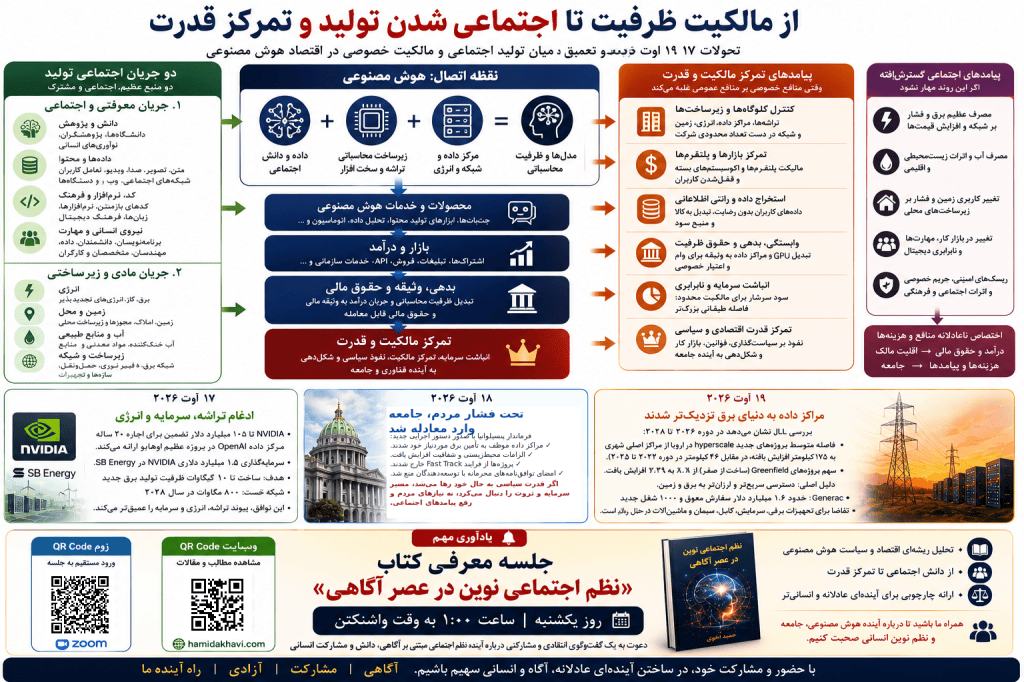
    بازگشت به صفحهٔ اصلی | Return to Home

  • وقتی ظرفیت محاسباتی به وثیقه مالی تبدیل می‌شود

    مقالهٔ تازه • ۱۵ اوت ۲۰۲۶ | NEW ARTICLE • AUGUST 15, 2026

    وقتی ظرفیت محاسباتی به وثیقه مالی تبدیل می‌شود

    When Computing Capacity Becomes Financial Collateral

    وقتی ظرفیت محاسباتی به وثیقه مالی تبدیل می‌شود

    ۱۵ اوت ۲۰۲۶

    مهم‌ترین تحول تازه

    مهم‌ترین تحول تازه در ادامه روند چند روز گذشته، بیش از آنکه معرفی یک مدل جدید باشد، به ساختار مالکیت و تأمین مالی زیرساخت هوش مصنوعی مربوط است. مجموعه اخبار ۱۴ و ۱۵ اوت نشان می‌دهد که تضاد میان تولید اجتماعی و مالکیت خصوصی اکنون از مالکیت داده و مدل فراتر رفته و به مرحله‌ای رسیده است که خودِ ظرفیت محاسباتی به یک دارایی مالی تبدیل می‌شود.

    NVIDIA و وال‌استریت: مالی‌شدن ظرفیت محاسباتی

    NVIDIA با شش مجموعه بزرگ مالی، از جمله BlackRock، Blackstone، Goldman Sachs و KKR، برای ایجاد سازوکارهایی با هدف بسیج بیش از ۵۰۰ میلیارد دلار سرمایه شخص ثالث برای زیرساخت هوش مصنوعی همکاری کرده است. نکته مهم‌تر این است که تجهیزات NVIDIA می‌توانند پشتوانه و وثیقه این تأمین مالی قرار گیرند؛ یعنی GPU و تجهیزات مرکز داده عملاً وارد همان منطق مالی می‌شوند که در آن دارایی‌های فیزیکی مبنای اعتبار و بدهی قابل معامله قرار می‌گیرند.

    از منظر کتاب «نظم اجتماعی نوین در عصر آگاهی»، این تحول اجازه می‌دهد مفهوم «مالکیت ظرفیت» را دقیق‌تر کنیم. سرمایه دیگر فقط کارخانه، داده یا مدل را مالک نیست؛ حق دسترسی به ظرفیت تبدیل دانش اجتماعی به قدرت محاسباتی نیز به دارایی مالی تبدیل می‌شود. بنابراین مالی‌شدن سرمایه از خود ابزار تولید به «توان تولید» گسترش می‌یابد.

    نشانه‌ای از محدودیت همین مدل: کاهش تعهد NVIDIA در پروژه OpenAI

    گزارش‌های تازه نشان می‌دهند NVIDIA میزان ضمانت مورد انتظار برای پروژه مرکز داده OpenAI در اوهایو را از رقم مورد بحث حدود ۲۵۰ میلیارد دلار به کمتر از ۱۲۰ میلیارد دلار کاهش داده است.

    این تغییر مهم است، زیرا نشان می‌دهد حتی در اوج رونق AI، مسئله تأمین سرمایه و ریسک پروژه‌های عظیم مرکز داده جدی شده است. نیاز اجتماعی و اقتصادی به محاسبات در حال افزایش است، اما مقیاس سرمایه مورد نیاز چنان بزرگ شده که حتی بزرگ‌ترین شرکت‌های این صنعت برای تأمین آن به شبکه پیچیده‌ای از بانک‌ها، صندوق‌ها، بیمه‌ها و تضمین‌های مالی نیاز دارند.

    از منظر کتاب، اینجا تضاد دیگری آشکار می‌شود: تولید AI بیش از پیش به فعالیت میلیون‌ها کاربر، توسعه‌دهنده و تولیدکننده دانش وابسته است، اما ورود به سطح بالای تولید مستلزم سرمایه‌ای در مقیاس ده‌ها یا صدها میلیارد دلار است. بنابراین اجتماعی‌شدن تولید هم‌زمان با افزایش مانع مالکیت ابزار تولید پیش می‌رود.

    مدل‌های open-weight گسترش می‌یابند، اما زیرساخت همچنان گلوگاه است

    مدل‌های باز چینی مانند محصولات Moonshot و Z.ai فشار قابل توجهی بر بازار وارد کرده‌اند و Meta و NVIDIA نیز توسعه مدل‌های open-weight را افزایش داده‌اند. داده‌های اخیر نشان می‌دهد استفاده کسب‌وکارها از پلتفرم‌های ارائه‌دهنده مدل‌های open-weight در حال افزایش است.

    اما یک تناقض مهم باقی می‌ماند. Meta می‌تواند در یک سال ده‌ها میلیارد دلار برای زیرساخت AI هزینه کند، در حالی که ظرفیت خوشه‌های محاسباتی جدید حتی پیش از راه‌اندازی ممکن است فروخته شود.

    این داده تقریباً به‌صورت تجربی نشان می‌دهد که بازبودن مدل با بازبودن قدرت تولید یکی نیست. دانش می‌تواند اجتماعی‌تر شود، اما اگر اجرای مؤثر آن نیازمند زیرساختی باشد که تنها تعداد محدودی قادر به تأمین آن هستند، قدرت اقتصادی همچنان متمرکز می‌ماند.

    دولت نیز وارد مناقشه مالکیت مدل‌ها شده است

    بحث مدل‌های open-weight اکنون از یک تصمیم مهندسی به مسئله سیاست صنعتی، امنیت ملی و رقابت ژئوپولیتیکی تبدیل شده است. وقتی دانش و مدل به نیروی تولیدی استراتژیک تبدیل می‌شوند، دولت نیز وارد سازمان‌دهی شرایط مالکیت و دسترسی می‌شود. بنابراین ساختار قدرت AI فقط رابطه سرمایه و کار نیست؛ سرمایه، دولت، فناوری و زیرساخت در یک شبکه قدرت قرار می‌گیرند.

    زیرساخت AI مستقیماً منابع اجتماعی را مصرف می‌کند

    مصرف برق مراکز داده هوش مصنوعی به سرعت رو به افزایش است و برنامه‌ریزی شبکه‌های برق را در برخی مناطق تغییر داده است. نکته مهم این است که توقف یا کاهش توسعه بعضی مراکز داده بلافاصله پیش‌بینی رشد مصرف برق را تغییر می‌دهد.

    این نمونه روشنی از وابستگی مالکیت خصوصی به منابع اجتماعی است. مرکز داده، مدل و درآمد می‌توانند خصوصی باشند، اما برق، آب، زمین، شبکه و آثار زیست‌محیطی در قلمرو جامعه قرار دارند. هوش مصنوعی نشان می‌دهد پیشرفته‌ترین تولید «اطلاعاتی» بشر در واقع به یک زیربنای عظیم مادی و اجتماعی وابسته است.

    خودکارسازی هنوز «پایان کار» نیست، اما وارد بازار کار شده است

    داده‌های اخیر نشان می‌دهند AI در مواردی به‌عنوان یکی از عوامل تعدیل نیرو اعلام شده است، هرچند داده‌های کلان اشتغال هنوز اثر فراگیر و قطعی AI را نشان نمی‌دهند.

    بنابراین پرسش مهم‌تر همچنان مالکیت افزایش بهره‌وری است. اگر AI بتواند همان محصول را با ساعات کار انسانی کمتر تولید کند، جامعه عملاً «زمان» تولید کرده است. در ساختار کنونی این زمان می‌تواند به کاهش اشتغال و افزایش بازده سرمایه تبدیل شود؛ در نظم اجتماعی دیگری می‌تواند به کاهش ساعت کار و افزایش آزادی انسان تبدیل شود.

    جمع‌بندی: وقتی ظرفیت محاسباتی به وثیقه مالی تبدیل می‌شود

    تحولات این هفته اجازه می‌دهد زنجیره‌ای را که در گزارش‌های گذشته شکل گرفته بود کامل‌تر کنیم:

    دانش اجتماعی → داده → مدل → تراشه → انرژی → ظرفیت محاسباتی → دارایی مالی → بازار سرمایه → قدرت اقتصادی

    نکته تعیین‌کننده این است که بخش نخست این زنجیره ــ دانش، داده و بخش مهمی از نوآوری ــ بیش از پیش اجتماعی تولید می‌شود؛ اما هرچه به سمت ظرفیت محاسباتی، سرمایه و بازار حرکت می‌کنیم، تمرکز مالکیت افزایش می‌یابد.

    در مرحله کنونی هوش مصنوعی، تضاد تولید اجتماعی و مالکیت خصوصی از مالکیت محصول فراتر رفته است: ظرفیت تبدیل دانش اجتماعی به قدرت تولیدی، خود به دارایی خصوصی، وثیقه مالی و موضوع انباشت سرمایه تبدیل می‌شود.

    این تحول شاید از معرفی هر مدل تازه‌ای مهم‌تر باشد؛ زیرا نشان می‌دهد مسئله اصلی آینده AI فقط این نیست که «چه کسی هوش مصنوعی بهتری می‌سازد؟» بلکه این است که «چه کسی ظرفیت مادی و مالی تبدیل دانش جمعی بشر به قدرت اقتصادی را در اختیار دارد؟»

    When Computing Capacity Becomes Financial Collateral

    August 15, 2026

    The Most Important New Development

    The most important development of the past several days is not the introduction of a new model, but a deeper transformation in the ownership and financing structure of artificial intelligence infrastructure. The news of August 14 and 15 suggests that the contradiction between social production and private ownership has moved beyond data and models. We are now entering a stage in which computing capacity itself is becoming a financial asset.

    NVIDIA and Wall Street: The Financialization of Computing Capacity

    NVIDIA has been working with six major financial institutions, including BlackRock, Blackstone, Goldman Sachs, and KKR, on mechanisms designed to mobilize more than $500 billion in third-party capital for AI infrastructure. The crucial point is that NVIDIA equipment can serve as collateral for this financing. GPUs and data-center hardware are therefore entering the same financial logic in which physical assets become the basis for credit, leverage, and tradable debt.

    From the perspective of the book “A New Social Order in the Age of Awareness,” this development sharpens the concept of “ownership of capacity.” Capital no longer merely owns the factory, the data, or the model. The right of access to the capacity that converts socially produced knowledge into computational power is itself becoming a financial asset. Financialization is extending from ownership of the means of production to ownership of productive capability itself.

    A Sign of the Limits of This Model: NVIDIA Reduces Its Commitment to the OpenAI Project

    Recent reporting indicates that NVIDIA reduced the expected guarantee associated with an OpenAI data-center project in Ohio from a figure under discussion of roughly $250 billion to less than $120 billion.

    This matters because it shows that even at the height of the AI boom, financing and risk are becoming serious constraints on gigantic data-center projects. Social and economic demand for computing is rising, yet the scale of capital required is so large that even the biggest firms in the sector increasingly depend on complex networks of banks, funds, insurers, and financial guarantees.

    A second contradiction therefore becomes visible. AI production depends more and more on the activity of millions of users, developers, researchers, and knowledge producers, while entry into the upper tier of production requires tens or even hundreds of billions of dollars. The socialization of production is advancing at the same time that the barrier to ownership of the means of production is rising.

    Open-Weight Models Are Expanding, but Infrastructure Remains the Bottleneck

    Open Chinese models from firms such as Moonshot and Z.ai are putting pressure on the market, while Meta and NVIDIA have also accelerated the development of open-weight systems. Business use of platforms that serve open-weight models has been increasing.

    Yet the basic contradiction remains. A company such as Meta can spend tens of billions of dollars in a single year on AI infrastructure, while capacity in newly built compute clusters can be sold out even before they officially launch.

    This is powerful empirical evidence that openness of the model is not the same thing as openness of productive power. Knowledge can become more socially accessible, but if effective deployment depends on infrastructure that only a small number of actors can finance and operate, economic power remains concentrated.

    The State Is Also Entering the Struggle over Model Ownership

    The debate over open-weight models has moved beyond engineering choices. It has become an issue of industrial policy, national security, and geopolitical competition. Once knowledge and models become strategic productive forces, the state begins to organize the conditions of ownership and access. The structure of AI power is therefore not simply a relationship between capital and labor; capital, the state, technology, and infrastructure increasingly form a single power network.

    AI Infrastructure Directly Consumes Social Resources

    Electricity demand from AI data centers is rising rapidly and is already changing power-grid planning in some regions. The suspension or slowing of individual data-center projects can immediately alter forecasts for future electricity demand.

    This is a clear example of the dependence of private ownership on social resources. The data center, the model, and the revenue stream may be privately owned, but electricity, water, land, grid infrastructure, and environmental consequences belong to the social sphere. AI demonstrates that the most advanced form of “informational” production is in fact dependent on a vast material and social foundation.

    Automation Is Not Yet the “End of Work,” but It Is Entering the Labor Market

    Recent labor-market reporting shows that AI is being cited in some cases as a factor in workforce reductions, although economy-wide data still do not show a broad and conclusive employment shock caused by AI.

    The deeper question is therefore the ownership of productivity gains. If AI allows the same output to be produced with fewer human labor hours, society has effectively produced “time.” Under the current ownership structure, that time can appear as layoffs and higher returns to capital. Under a different social order, the same technological gain could appear as shorter working hours and greater human freedom.

    Conclusion: When Computing Capacity Becomes Financial Collateral

    The developments of this week allow us to extend the chain that has emerged in earlier reports:

    Social knowledge → data → models → chips → energy → computing capacity → financial asset → capital markets → economic power

    The decisive point is that the first part of this chain — knowledge, data, and much of innovation — is increasingly socially produced. Yet as we move toward computing capacity, finance, and markets, ownership becomes more concentrated.

    At the present stage of artificial intelligence, the contradiction between social production and private ownership has moved beyond ownership of the final product. The capacity to transform social knowledge into productive power is itself becoming private property, financial collateral, and an object of capital accumulation.

    This development may be more important than the release of any new model. The central question for the future of AI is no longer simply, “Who can build the best artificial intelligence?” It is increasingly, “Who owns the material and financial capacity to transform humanity’s collective knowledge into economic power?”


    این گفتگو را دنبال کنید | Continue the Conversation

    اگر این نوشته برای شما جالب بود، برای دریافت مقالات و پژوهش‌های تازه عضو شوید. | If you found this article useful, subscribe to receive new articles and research directly in your inbox.

  • اجتماعی‌شدن مدل‌ها، مالی‌شدن زیرساخت و تعمیق مالکیت ظرفیت | The Socialization of Models, the Financialization of Infrastructure, and the Deepening of Capacity Ownership

    اجتماعی‌شدن مدل‌ها، مالی‌شدن زیرساخت و تعمیق مالکیت ظرفیت | The Socialization of Models, the Financialization of Infrastructure, and the Deepening of Capacity Ownership

    گزارش تحولات هوش مصنوعی

    موضوع: اجتماعی‌شدن مدل‌ها، مالی‌شدن زیرساخت و تعمیق «مالکیت ظرفیت»

    مهم‌ترین تحول امروز را نباید صرفاً در معرفی یک مدل جدید جست‌وجو کرد. اخبار ۱۴ اوت نشان می‌دهند که دو روند ظاهراً متضاد هم‌زمان در حال تقویت‌شدن‌اند: از یک سو، مدل‌های open-weight قدرتمندتر و ارزان‌تر می‌شوند و امکان استفاده و توسعه هوش مصنوعی را در اختیار گروه بزرگ‌تری از توسعه‌دهندگان و شرکت‌ها قرار می‌دهند؛ از سوی دیگر، مالکیت ظرفیت محاسباتی و نظام مالی لازم برای ایجاد آن بیش از پیش در دست تعداد محدودی از شرکت‌های فناوری و مؤسسات مالی متمرکز می‌شود.

    ۱. مدل باز چینی به مرز مدل‌های بسته پیشرفته رسیده است

    امروز Z.ai اعلام کرد مدل open-source جدید GLM-5.3 در آزمون CyberGym برای شناسایی آسیب‌پذیری نرم‌افزار امتیاز ۸۴.۵٪ گرفته و در این آزمون اندکی بالاتر از مدل محدود Mythos 5 شرکت Anthropic قرار گرفته است. البته در تبدیل آسیب‌پذیری‌ها به exploit عملی، Mythos همچنان فاصله قابل توجهی دارد. Z.ai می‌گوید وزن‌های مدل را پس از ارزیابی‌های ایمنی منتشر خواهد کرد.

    ارتباط با کتاب: این تحول نشان می‌دهد توانایی‌هایی که تا همین اواخر فقط در آزمایشگاه‌های بسته و بسیار سرمایه‌بر وجود داشتند، می‌توانند وارد فضای وسیع‌تر تولید اجتماعی شوند. توسعه‌دهندگان مستقل، دانشگاه‌ها و شرکت‌های کوچک‌تر می‌توانند بر مدل‌های قدرتمند کار کنند و آنها را تغییر دهند.

    اما همین تحول تناقض دیگری ایجاد می‌کند: اجتماعی‌شدن مدل الزاماً به اجتماعی‌شدن قدرت تولیدی منجر نمی‌شود. مدل را می‌توان دانلود کرد، ولی اجرای آن در مقیاس بزرگ همچنان به GPU، برق و مرکز داده نیاز دارد.

    ۲. «بازبودن مدل» اکنون به مسئله سیاست صنعتی و قدرت دولتی تبدیل شده است

    امروز سناتور آمریکایی Jim Banks از دولت آمریکا خواست برای توسعه مدل‌های open-weight آمریکایی مشوق ایجاد کند. دلیل این درخواست، گسترش مدل‌های چینی در بازار آمریکا و نگرانی از وابستگی شرکت‌های آمریکایی به آنهاست. مدل‌های Meta، NVIDIA و Thinking Machines در این رقابت قرار گرفته‌اند.

    این تحول اهمیت نظری زیادی دارد. مدل open-weight دیگر صرفاً یک انتخاب مهندسی نیست؛ به ابزار رقابت اقتصادی و ژئوپولیتیکی تبدیل شده است.

    ارتباط با کتاب: دانش اجتماعی هنگامی که به یک نیروی تولیدی استراتژیک تبدیل می‌شود، دولت و سرمایه برای کنترل مسیر توسعه آن وارد میدان می‌شوند. بنابراین مسئله مالکیت AI را نمی‌توان فقط رابطه شرکت و مصرف‌کننده دانست؛ دولت، سرمایه و زیرساخت نیز بخشی از ساختار مالکیت و قدرت‌اند.

    ۳. تحول مهم‌تر امروز: «ظرفیت محاسباتی» در حال تبدیل‌شدن به یک طبقه دارایی مالی است

    جزئیات تازه‌ای که امروز درباره طرح ۵۰۰ میلیارد دلاری NVIDIA منتشر شد، از نظر اقتصاد سیاسی شاید مهم‌ترین خبر روز باشد.

    Goldman Sachs در حال مذاکره با سرمایه‌گذاران برای مشارکت در این ساختار است. بیمه‌گران، بانک‌ها و مدیران دارایی قرار است بخش عمده سرمایه را فراهم کنند. NVIDIA نیز اختیار دارد تا حدود ۱۲۵ میلیارد دلار، یعنی ۲۵٪ پروژه‌ها، پشتوانه ارائه کند.

    اما نکته مهم‌تر هدف این ساختار است: ایجاد یک بازار asset-backed برای AI compute؛ یعنی تجهیزات محاسباتی و ظرفیت AI بتوانند مانند دیگر دارایی‌های مالی پشتوانه بدهی قرار گیرند و حتی بدهی مبتنی بر آنها قابل معامله شود.

    این یک تحول بسیار مهم برای کتاب است. در مرحله اول، GPU ابزار تولید بود. در مرحله دوم، GPU و مرکز داده به سرمایه ثابت تبدیل شدند. اکنون در مرحله سوم، خود ظرفیت محاسباتی در حال تبدیل‌شدن به دارایی مالی است. بنابراین می‌توانیم شاهد ظهور چیزی شبیه به «مالی‌شدن ظرفیت محاسباتی» باشیم.

    ۴. مقیاس تمرکز سرمایه از آنچه تصور می‌کردیم بزرگ‌تر است

    Goldman Sachs برآورد کرده چهار hyperscaler بزرگ تا سال ۲۰۳۰ بیش از ۵ تریلیون دلار برای فناوری و مراکز داده هزینه خواهند کرد.

    برای مقایسه، تنها در سال جاری Alphabet، Amazon، Meta، Microsoft و Oracle حدود ۷۵۰ میلیارد دلار برای مراکز داده هزینه خواهند کرد.

    ارتباط با کتاب: این ارقام نشان می‌دهند مسئله دیگر صرفاً «شرکت‌های بزرگ فناوری» نیست. یک ساختار جدید سرمایه ثابت در مقیاس تاریخی در حال ساخته‌شدن است.

    ورود به لایه بالای تولید AI نیازمند میلیاردها دلار سرمایه است. بنابراین حتی اگر دانش و مدل‌ها آزادتر شوند، مانع ورود به ظرفیت تولید می‌تواند بالاتر برود.

    ۵. در نتیجه، مفهوم «مالکیت ظرفیت» امروز معنای دقیق‌تری پیدا می‌کند

    در گزارش‌های روزهای گذشته به این مفهوم رسیدیم که باید میان مالکیت مدل و مالکیت ظرفیت اجرای مدل تفاوت گذاشت. اطلاعات امروز این مفهوم را یک مرحله جلوتر می‌برند.

    اکنون زنجیره را می‌توان چنین دید:

    دانش اجتماعی ← داده ← مدل ← تراشه ← مرکز داده ← ظرفیت محاسباتی ← دارایی مالی ← بازار سرمایه

    در انتهای این زنجیره دیگر فقط یک شرکت فناوری قرار ندارد؛ بانک، بیمه، صندوق سرمایه‌گذاری و بازار بدهی نیز وارد شده‌اند. در نتیجه، کنترل AI می‌تواند از ترکیب مالکیت تکنولوژیک + مالکیت زیرساخت + مالکیت مالی شکل بگیرد.

    ۶. هزینه مادی این تمرکز همچنان بر منابع اجتماعی فشار می‌آورد

    طبق تازه‌ترین پیش‌بینی اداره اطلاعات انرژی آمریکا، مصرف برق این کشور از رکورد ۴۱۹۵ میلیارد کیلووات‌ساعت در ۲۰۲۵ به ۴۲۶۸ میلیارد در ۲۰۲۶ و ۴۳۹۱ میلیارد در ۲۰۲۷ خواهد رسید؛ توسعه مراکز داده AI یکی از عوامل اصلی این افزایش است.

    در عین حال، مقاومت اجتماعی در برابر مراکز داده افزایش یافته است. در سه‌ماهه نخست امسال، ۷۵ پروژه به ارزش حدود ۱۳۰ میلیارد دلار با مخالفت جوامع محلی مواجه شده‌اند؛ به‌حدی که بانک‌ها اکنون حمایت یا مخالفت جامعه محلی را جزئی از ارزیابی ریسک اعتباری پروژه محسوب می‌کنند.

    ارتباط با کتاب: اینجا تناقض بسیار ملموس است: سرمایه مالک مرکز داده است، اما برای تولید به برق، آب، زمین، مجوز عمومی و پذیرش جامعه نیاز دارد. تولید خصوصی بدون زیرساخت اجتماعی امکان‌پذیر نیست.

    ۷. خودکارسازی هنوز «پایان کار» نیست، اما وارد محاسبات سیاست اقتصادی شده است

    تحلیل تازه رویترز نشان می‌دهد اثر AI بر آمار کلان اشتغال آمریکا هنوز کوچک و دشوار برای جداسازی از عوامل دیگر است. با این حال، AI در برخی بررسی‌ها به یکی از دلایل مهم تعدیل نیرو، به‌ویژه در فناوری و امور مالی، تبدیل شده و فدرال رزرو اکنون آثار آن بر بهره‌وری و تقاضای نیروی کار را به‌طور رسمی زیر نظر دارد.

    برای کتاب این احتیاط مهم است. هنوز نباید از «پایان کار» سخن گفت. پرسش بنیادی‌تر همان پرسشی است که در گزارش‌های اخیر مطرح کردیم: اگر AI زمان لازم برای تولید یک کالا یا خدمت را کاهش می‌دهد، مالک زمان اجتماعی آزادشده چه کسی است؟

    اگر افزایش بهره‌وری به کاهش اشتغال و افزایش بازده سرمایه تبدیل شود، منفعت فناوری خصوصی می‌شود. اگر به کاهش ساعت کار بدون کاهش سطح زندگی منجر شود، همان فناوری می‌تواند به افزایش آزادی انسان تبدیل شود.

    نتیجه امروز: از «مالکیت ظرفیت» به «مالی‌شدن ظرفیت»

    تحولات ۱۴ اوت اجازه می‌دهند چارچوب نظری چند روز گذشته را یک گام دیگر توسعه دهیم. ما ابتدا از مالکیت مدل صحبت کردیم. سپس به مالکیت گلوگاه رسیدیم. بعد مفهوم مالکیت ظرفیت محاسباتی مطرح شد.

    تحول امروز مرحله بعدی را نشان می‌دهد: ظرفیت محاسباتی نه‌تنها در حال خصوصی‌شدن و تمرکز است، بلکه در حال تبدیل‌شدن به یک دارایی مالی قابل تأمین مالی، وثیقه‌گذاری و معامله است.

    این مسئله برای «نظم اجتماعی نوین در عصر آگاهی» اهمیت بنیادی دارد. دانش مورد استفاده AI حاصل انباشت اجتماعی عظیمی است؛ داده توسط میلیاردها انسان تولید می‌شود؛ پژوهش دانشگاهی و نرم‌افزار متن‌باز پایه‌های آن را ساخته‌اند؛ و زیرساخت انرژی و منابع طبیعی جامعه آن را ممکن می‌کنند.

    اما در انتهای این زنجیره، حق تبدیل دانش اجتماعی به قدرت محاسباتی و سپس تبدیل آن قدرت به درآمد و دارایی مالی می‌تواند در دست شبکه‌ای بسیار محدود از شرکت‌های فناوری و سرمایه مالی قرار گیرد.

    بنابراین شاید بتوان تز مرکزی این مرحله را چنین صورت‌بندی کرد: هرچه دانش و تولید هوش مصنوعی اجتماعی‌تر می‌شوند، مبارزه بر سر مالکیت از خودِ دانش به مالکیت ظرفیت تبدیل دانش به قدرت اقتصادی منتقل می‌شود؛ و اکنون حتی خودِ این ظرفیت نیز در حال مالی‌شدن است.

    این تحول، به‌نظر من، یکی از مهم‌ترین شواهدی است که تاکنون برای توسعه استدلال «تولید اجتماعی / مالکیت خصوصی» در کتاب به دست آورده‌ایم.

    AI Developments Report

    Theme: The Socialization of Models, the Financialization of Infrastructure, and the Deepening of “Capacity Ownership”

    Today’s most important development should not be sought merely in the introduction of a new model. The news of August 14 indicates that two seemingly contradictory trends are strengthening simultaneously. On the one hand, powerful open-weight models are becoming more capable and less expensive, placing the use and development of artificial intelligence within reach of a broader range of developers and companies. On the other hand, ownership of computing capacity—and of the financial system required to create it—is becoming increasingly concentrated in the hands of a small number of technology companies and financial institutions.

    1. A Chinese Open Model Has Reached the Frontier of Advanced Closed Models

    Today, Z.ai announced that its new open-source GLM-5.3 model scored 84.5 percent in the CyberGym benchmark for identifying software vulnerabilities, placing it slightly above Anthropic’s restricted Mythos 5 model in this test. Mythos, however, still maintains a substantial lead in turning vulnerabilities into practical exploits. Z.ai says it will release the model weights after completing safety evaluations.

    Connection to the book: This development shows that capabilities which until recently existed only in closed, highly capital-intensive laboratories can enter a much broader sphere of social production. Independent developers, universities, and smaller companies can work with powerful models and modify them.

    Yet this same development creates another contradiction: the socialization of the model does not necessarily lead to the socialization of productive power. A model can be downloaded, but running it at scale still requires GPUs, electricity, and data centers.

    2. “Model Openness” Has Become a Question of Industrial Policy and State Power

    Today, U.S. Senator Jim Banks called on the American government to create incentives for the development of American open-weight models. The request was prompted by the growing presence of Chinese models in the U.S. market and concerns that American companies could become dependent on them. Models from Meta, NVIDIA, and Thinking Machines are part of this competition.

    This development has major theoretical importance. An open-weight model is no longer merely an engineering choice; it has become an instrument of economic and geopolitical competition.

    Connection to the book: When social knowledge becomes a strategic productive force, both the state and capital enter the field to control the direction of its development. The ownership of AI therefore cannot be understood solely as a relationship between company and consumer. The state, capital, and infrastructure are also parts of the structure of ownership and power.

    3. Today’s More Important Development: “Computing Capacity” Is Becoming a Financial Asset Class

    From the standpoint of political economy, the new details released today about NVIDIA’s 500-billion-dollar initiative may be the most important news of the day.

    Goldman Sachs is negotiating with investors to participate in this structure. Insurers, banks, and asset managers are expected to provide most of the capital. NVIDIA also has the option to provide backing for approximately 125 billion dollars, equal to 25 percent of the projects.

    More important, however, is the purpose of the structure: to create an asset-backed market for AI compute. In other words, computing equipment and AI capacity could serve as collateral for debt, and debt based on that capacity could itself become tradable.

    This is an extremely important development for the book. In the first stage, the GPU was an instrument of production. In the second stage, GPUs and data centers became fixed capital. Now, in the third stage, computing capacity itself is becoming a financial asset. We may therefore be witnessing the emergence of something resembling the “financialization of computing capacity.”

    4. The Scale of Capital Concentration Is Greater Than We Imagined

    Goldman Sachs estimates that the four largest hyperscalers will spend more than 5 trillion dollars on technology and data centers by 2030.

    For comparison, Alphabet, Amazon, Meta, Microsoft, and Oracle will spend approximately 750 billion dollars on data centers this year alone.

    Connection to the book: These figures show that the issue is no longer simply one of “large technology companies.” A new structure of fixed capital is being built on a historic scale.

    Entering the upper tier of AI production requires billions of dollars in capital. Consequently, even as knowledge and models become more open, the barrier to entering productive capacity may rise.

    5. The Concept of “Capacity Ownership” Has Acquired a More Precise Meaning

    In recent reports, we arrived at the idea that ownership of a model must be distinguished from ownership of the capacity required to run it. Today’s information advances this concept by another stage.

    The chain can now be understood as follows:

    Social knowledge → data → model → chip → data center → computing capacity → financial asset → capital market

    At the end of this chain, there is no longer only a technology company. Banks, insurers, investment funds, and debt markets have also entered. Control over AI can therefore emerge through a combination of technological ownership, infrastructure ownership, and financial ownership.

    6. The Material Cost of This Concentration Continues to Place Pressure on Social Resources

    According to the latest forecast by the U.S. Energy Information Administration, electricity consumption in the United States will rise from a record 4,195 billion kilowatt-hours in 2025 to 4,268 billion in 2026 and 4,391 billion in 2027. The expansion of AI data centers is one of the principal drivers of this increase.

    At the same time, social resistance to data centers has grown. During the first quarter of this year, 75 projects worth approximately 130 billion dollars faced opposition from local communities—to such an extent that banks now treat community support or opposition as part of their assessment of a project’s credit risk.

    Connection to the book: The contradiction is tangible here: capital owns the data center, but production requires electricity, water, land, public permits, and social acceptance. Private production is impossible without social infrastructure.

    7. Automation Is Not Yet the “End of Work,” but It Has Entered Economic Policy Calculations

    A new Reuters analysis shows that the effect of AI on aggregate U.S. employment statistics remains small and difficult to separate from other factors. Nevertheless, some surveys identify AI as an important cause of layoffs, especially in technology and finance, and the Federal Reserve is now formally monitoring its effects on productivity and labor demand.

    This caution is important for the book. We should not yet speak of the “end of work.” The more fundamental question is the one posed in recent reports: if AI reduces the time required to produce a good or service, who owns the social time that has been freed?

    If higher productivity is converted into reduced employment and increased returns to capital, the benefit of technology is privatized. If it leads to shorter working hours without a decline in living standards, the same technology can expand human freedom.

    Today’s Conclusion: From “Capacity Ownership” to the “Financialization of Capacity”

    The developments of August 14 allow us to advance the theoretical framework of recent days by another step. We began by discussing ownership of the model. We then moved to ownership of the bottleneck. After that, the concept of ownership of computing capacity emerged.

    Today’s development reveals the next stage: computing capacity is not only being privatized and concentrated; it is also becoming a financial asset that can be financed, pledged as collateral, and traded.

    This question is fundamental to A New Social Order in the Age of Awareness. The knowledge used by AI is the product of an immense process of social accumulation. Data is produced by billions of human beings; academic research and open-source software have built its foundations; and social energy infrastructure and natural resources make it possible.

    Yet at the end of this chain, the right to transform social knowledge into computing power—and then to transform that power into income and financial assets—can remain in the hands of a very limited network of technology companies and financial capital.

    The central thesis of this stage may therefore be formulated as follows: as knowledge and the production of artificial intelligence become more social, the struggle over ownership moves from knowledge itself to ownership of the capacity to convert knowledge into economic power; and now that capacity itself is being financialized.

    In my view, this development is one of the most important pieces of evidence we have yet obtained for advancing the book’s argument concerning “social production/private ownership.”

  • دانشگاه در عصر آگاهی

    University in the Age of Consciousness

    چین، هوش مصنوعی و پرسشی بزرگ‌تر درباره آینده آموزش و «نظم اجتماعی نوین در عصر آگاهی»

    تحولی که امروز در دانشگاه‌های چین در جریان است، صرفاً جابه‌جایی چند رشته دانشگاهی نیست. میان سال‌های ۲۰۲۱ تا ۲۰۲۵، دانشگاه‌های چین حدود ۱۲٬۲۰۰ برنامه کارشناسی را لغو یا متوقف کردند و در همان دوره حدود ۱۰٬۲۰۰ برنامه جدید ایجاد شد. در سال ۲۰۲۴ به تنهایی، وزارت آموزش چین از ایجاد ۱٬۸۳۹ برنامه جدید، توقف پذیرش در ۲٬۲۲۰ برنامه و لغو رسمی ۱٬۴۲۸ برنامه خبر داد. در سال ۲۰۲۶ نیز رشته‌های تازه‌ای مانند «روبات‌های آینده»، «هوش تجسم‌یافته» و «علوم و فناوری مغز–ماشین» وارد فهرست رسمی شدند. این ارقام از یک تغییر اداری فراتر می‌روند: چین در حال بازطراحی بخشی از نظام آموزش عالی خود بر اساس تصویری است که از نیروهای مولد آینده دارد.

    این تحول برای بحثی که در کتاب «نظم اجتماعی نوین در عصر آگاهی» دنبال می‌شود اهمیت ویژه‌ای دارد، زیرا یکی از پرسش‌های بنیادی کتاب این است که وقتی دانش، اطلاعات، هوش مصنوعی و توانایی سازمان‌دهی دانش به عناصر مرکزی تولید تبدیل می‌شوند، جایگاه انسان، آموزش و دانشگاه چه تغییری می‌کند؟ اگر در دوران کشاورزی زمین و در دوران صنعتی ماشین، کارخانه و سرمایه فیزیکی نقش محوری داشتند، در اقتصاد امروز دانش و توانایی تولید، پردازش، ترکیب و به‌کارگیری آن به یکی از مهم‌ترین نیروهای مولد تبدیل شده است. از این منظر، دانشگاه دیگر تنها محل انتقال دانسته‌های گذشته نیست؛ دانشگاه خود بخشی از زیرساخت تولید آینده است.

    دانش به‌مثابه نیروی مولد

    در عصر هوش مصنوعی، ارزش اقتصادی بیش از پیش از ترکیب دانش انسانی، داده، محاسبات، الگوریتم و ماشین ایجاد می‌شود. یک کارخانه روباتیک بدون مهندس، برنامه‌نویس، متخصص مواد، طراح سیستم، تکنسین، پژوهشگر و مجموعه عظیمی از دانش انباشته اجتماعی قادر به فعالیت نیست. حتی پیشرفته‌ترین مدل هوش مصنوعی نیز محصول کار و دانش جمعی است: پژوهش‌های دانشگاهی، داده‌های تولیدشده توسط میلیون‌ها انسان، زیرساخت محاسباتی، مهندسی نرم‌افزار و سخت‌افزار و تجربه تاریخی جامعه در آن متراکم شده است.

    بنابراین نیروی انسانی را نباید فقط «هزینه نیروی کار» یا حتی صرفاً «سرمایه انسانی» دید. انسان آگاه و برخوردار از دانش خود یکی از مهم‌ترین نیروهای مولد جامعه است. آموزش در چنین شرایطی از یک خدمت جانبی به بخشی از ساختار تولید اجتماعی تبدیل می‌شود. پرسش تعیین‌کننده دیگر فقط این نیست که چند دانشگاه یا چند فارغ‌التحصیل داریم؛ پرسش این است که چه نوع دانش، چه نوع توانایی و چه نوع انسانی در این دانشگاه‌ها پرورش می‌یابد.

    اقدام چین از این زاویه قابل فهم است. برنامه رسمی تعدیل و بهینه‌سازی رشته‌ها برای سال‌های ۲۰۲۵ تا ۲۰۲۷ صریحاً بر هماهنگی رشته‌های دانشگاهی با پیشرفت فناوری، نیازهای راهبردی، صنایع نوظهور و تقاضای نیروی انسانی تأکید می‌کند و هم‌زمان خواهان تقویت رشته‌های بنیادی و ادغام میان‌رشته‌ای است. این سیاست نشان می‌دهد که آموزش عالی به عنوان بخشی از برنامه‌ریزی توسعه فناوری و تولید دیده می‌شود، نه نهادی کاملاً جدا از اقتصاد و ساختار اجتماعی.

    اما چه کسی آینده را تعیین می‌کند؟

    در همین نقطه، پرسشی بسیار مهم‌تر آغاز می‌شود. اگر دانشگاه باید نیروی انسانی مورد نیاز آینده را تربیت کند، چه کسی تعیین می‌کند که «نیاز آینده» چیست؟ بازار؟ شرکت‌های بزرگ؟ دولت؟ نهادهای نظامی و صنعتی؟ یا جامعه‌ای که شهروندان آن آگاهانه درباره جهت توسعه خود مشارکت می‌کنند؟

    اگر پاسخ فقط بازار باشد، دانشگاه به مرکز تأمین نیروی کار برای سودآورترین صنایع تبدیل می‌شود. اگر پاسخ فقط دولت باشد، خطر آن وجود دارد که نظام آموزشی در خدمت اولویت‌های قدرت سیاسی و اهداف از بالا تعیین‌شده قرار گیرد. و اگر شرکت‌های بزرگ فناوری تعیین‌کننده اصلی باشند، ممکن است دانشگاه به ضمیمه‌ای برای نیازهای نیروی انسانی و پژوهشی شرکت‌هایی تبدیل شود که مالک زیرساخت‌های داده، محاسبات و هوش مصنوعی‌اند.

    در «نظم اجتماعی نوین در عصر آگاهی»، مسئله باید به شکل دیگری طرح شود. جامعه به دانش تخصصی، برنامه‌ریزی و آینده‌نگری نیاز دارد، اما تعیین جهت عمومی توسعه نمی‌تواند فقط در اختیار بازار، دولت یا گروه کوچکی از صاحبان سرمایه و فناوری باشد. تصمیم درباره اینکه جامعه چه نوع فناوری‌ای را توسعه دهد، منابع آموزشی خود را در چه جهتی به کار گیرد و چه نیازهایی را در اولویت قرار دهد، بخشی از مشارکت آگاهانه شهروندان در قدرت است. تخصص جای مشارکت اجتماعی را نمی‌گیرد؛ همان‌طور که مشارکت اجتماعی نیز جای تخصص را نمی‌گیرد. مسئله، ایجاد رابطه‌ای نوین میان دانش تخصصی، داده‌های واقعی و تصمیم‌گیری دموکراتیک است.

    چرا علوم انسانی را نمی‌توان کنار گذاشت؟

    اینجاست که یک خطر در بازسازی آموزش عالی پدیدار می‌شود. اگر موفقیت دانشگاه صرفاً با سرعت اشتغال فارغ‌التحصیلان یا میزان تقاضای بازار اندازه‌گیری شود، رشته‌هایی مانند فلسفه، تاریخ، جامعه‌شناسی، علوم سیاسی، هنر، ادبیات و حتی برخی زبان‌ها ممکن است کم‌اهمیت جلوه کنند. گزارش‌های اخیر درباره چین نیز نشان می‌دهند که بخشی از کاهش برنامه‌ها در علوم انسانی، هنر، زبان‌های خارجی و مدیریت رخ داده است، هرچند این روند را نباید به معنای حذف کلی علوم انسانی دانست.

    اما درست در عصر هوش مصنوعی، جامعه بیش از گذشته به این رشته‌ها نیاز دارد. مهندسی می‌تواند به ما بگوید چگونه یک سیستم تشخیص چهره بسازیم؛ جامعه‌شناسی و علوم سیاسی باید بپرسند این سیستم چه رابطه‌ای با قدرت اجتماعی ایجاد می‌کند. علوم کامپیوتر می‌تواند الگوریتم تصمیم‌گیری طراحی کند؛ فلسفه و اخلاق باید بپرسند معیار تصمیم عادلانه چیست. هوش مصنوعی می‌تواند میلیون‌ها داده پزشکی را تحلیل کند؛ حقوق و علوم اجتماعی باید بپرسند مالک این داده‌ها چه کسی است، چه کسی اجازه استفاده از آنها را می‌دهد و ارزش اقتصادی حاصل از آنها چگونه توزیع می‌شود.

    بنابراین تقابل «علوم فنی یا علوم انسانی» از اساس نادرست است. دانشگاه عصر آگاهی باید دقیقاً در جهت شکستن این دیوار حرکت کند: هوش مصنوعی و جامعه‌شناسی، روباتیک و فلسفه، داده و حقوق، پزشکی و اخلاق، اقتصاد و علوم کامپیوتر، مهندسی و محیط زیست. خود چین نیز در سیاست‌های رسمی جدید بر توسعه رشته‌های میان‌رشته‌ای تأکید کرده و در سال ۲۰۲۶ یک دسته رسمی «مطالعات میان‌رشته‌ای» را به فهرست رشته‌های کارشناسی افزوده است.

    از کارخانه مدرک‌سازی تا زیرساخت آگاهی

    یکی از مشکلات بسیاری از نظام‌های آموزش عالی این است که دانشگاه به کارخانه مدرک‌سازی تبدیل شده است. دانشجو وارد یک مسیر استاندارد می‌شود، مجموعه‌ای از واحدها را می‌گذراند، امتحان می‌دهد و مدرکی دریافت می‌کند که قرار است مجوز ورود او به بازار کار باشد. در این الگو، ارزش آموزش تا حد زیادی با ارزش مبادله‌ای مدرک سنجیده می‌شود.

    اما در جامعه‌ای که دانش با سرعتی بی‌سابقه تغییر می‌کند، این مدل هر روز ناکارآمدتر می‌شود. مهارتی که دانشجو در سال اول دانشگاه می‌آموزد ممکن است هنگام فارغ‌التحصیلی دگرگون شده باشد. بنابراین دانشگاه آینده نمی‌تواند فقط «دانش موجود» را منتقل کند؛ باید توانایی یادگیری مستمر، تفکر انتقادی، کار میان‌رشته‌ای، تشخیص اطلاعات معتبر، خلاقیت، همکاری و فهم پیامدهای اجتماعی فناوری را پرورش دهد.

    این تمایز ما را از «دانش» به «آگاهی» می‌رساند. دانش به ما امکان می‌دهد جهان را بهتر بفهمیم و تغییر دهیم؛ آگاهی ما را وادار می‌کند درباره جهت، هدف و پیامد این تغییر نیز بیندیشیم. ممکن است جامعه‌ای از نظر فنی بسیار پیشرفته باشد اما اگر شهروندان نتوانند درباره مالکیت فناوری، توزیع قدرت، کرامت انسانی، آزادی و پیامدهای اجتماعی تصمیمات جمعی پرسش کنند، افزایش دانش لزوماً به افزایش آگاهی اجتماعی منجر نمی‌شود.

    به همین دلیل عنوان «دانشگاه در عصر آگاهی» معنایی فراتر از دانشگاه مجهز به هوش مصنوعی دارد. دانشگاه عصر آگاهی نهادی است که هم دانش تولید می‌کند و هم ظرفیت جامعه برای فهم و نقد چگونگی استفاده از دانش را گسترش می‌دهد.

    درس چین؛ نه تقلید، نه انکار

    بازسازی سریع رشته‌های دانشگاهی در چین نشان می‌دهد که یک کشور می‌تواند آموزش عالی را فعالانه با تحول نیروهای مولد هماهنگ کند. این توانایی برنامه‌ریزی مهم است و نباید آن را نادیده گرفت. اما درس اصلی لزوماً این نیست که سایر کشورها نیز هزاران رشته را حذف کنند و همه منابع را به هوش مصنوعی و روباتیک منتقل کنند. مسئله بنیادی‌تر است: دانشگاه باید بتواند تحولات واقعی جامعه و فناوری را تشخیص دهد و خود را با آنها تطبیق دهد، بدون آنکه به یک مرکز آموزش حرفه‌ای کوتاه‌مدت تقلیل پیدا کند.

    جامعه آینده به مهندس هوش مصنوعی نیاز دارد، اما به جامعه‌شناسی که اثر هوش مصنوعی بر روابط قدرت را بررسی کند نیز نیاز دارد؛ به متخصص روباتیک نیاز دارد، اما به اقتصاددانی که اثر اتوماسیون بر توزیع ثروت را تحلیل کند نیز نیاز دارد؛ به دانشمند داده نیاز دارد، اما به حقوقدانی که از حقوق شهروند در برابر تمرکز داده و نظارت دفاع کند نیز نیاز دارد. و بیش از همه، به شهروندانی نیاز دارد که بتوانند در مورد جهت حرکت جامعه آگاهانه مشارکت کنند.

    این همان نقطه‌ای است که بحث دانشگاه به بحث گسترده‌تر «نظم اجتماعی نوین در عصر آگاهی» متصل می‌شود. اگر دانش یکی از مهم‌ترین نیروهای مولد عصر جدید است، دسترسی به دانش، تولید دانش، مالکیت زیرساخت‌های دانش و مشارکت در تعیین جهت استفاده از دانش نیز به مسائل مرکزی نظم اجتماعی نوین تبدیل می‌شوند. پرسش دیگر فقط این نیست که «چه کسی ابزار تولید را در اختیار دارد؟» بلکه باید پرسید: چه کسی داده را در اختیار دارد؟ چه کسی الگوریتم را کنترل می‌کند؟ چه کسی زیرساخت محاسباتی را مالک است؟ چه کسی تعیین می‌کند چه دانشی تولید شود؟ و چه کسی از ارزش حاصل از دانش اجتماعی بهره می‌برد؟

    از این منظر، دانشگاه آینده یکی از میدان‌های اصلی شکل‌گیری نظم اجتماعی نوین خواهد بود. دانشگاه نباید کارخانه تولید مدرک برای بازار کار باشد؛ باید زیرساختی برای تولید دانش، گسترش آگاهی، پرورش شهروند مسئول و افزایش ظرفیت جامعه برای مشارکت در تعیین آینده خود باشد.

    شاید پرسش اساسی عصر ما همین باشد: آیا قرار است انسان را برای خدمت به فناوری آینده تربیت کنیم، یا فناوری و آموزش را چنان سازمان دهیم که در خدمت رشد و شکوفایی انسان باشند؟

    این پرسش یکی از محورهای کتاب «نظم اجتماعی نوین در عصر آگاهی» است.

    منابع فارسی/انگلیسی

    ۱. Ministry of Education of the People’s Republic of China, “MOE releases latest undergraduate program accreditation and approval results,” April 24, 2025.
    ۲. Ministry of Education of the People’s Republic of China, “Action plan for academic discipline adjustment issued,” August 29, 2025.
    ۳. Ministry of Education of the People’s Republic of China, Undergraduate Program Catalogue (2026), April 2026.
    ۴. Le Monde, “In the age of AI, Chinese universities overhaul their curricula,” June 26, 2026.
    ۵. Economic Times, “China is rethinking degrees for industry. Should India do the same for its MSMEs?”, August 8, 2026.

    ────────────────────────


    ‎China, Artificial Intelligence, and a Larger Question About the Future of Education and the New Social Order in the Age of Consciousness

    ‎The transformation now taking place in Chinese universities is more than a reshuffling of academic majors. Between 2021 and 2025, Chinese higher-education institutions revoked or suspended roughly 12,200 undergraduate program offerings while introducing about 10,200 new ones. In 2024 alone, China’s Ministry of Education reported 1,839 new undergraduate programs, 2,220 programs suspending enrollment, and 1,428 programs formally cancelled. In 2026, the official undergraduate catalogue added or elevated fields including Future Robotics, Embodied Intelligence, and Brain-Machine Science and Technology. These figures point to something larger than administrative reform: China is redesigning part of its higher-education system around its understanding of the productive forces of the future.

    ‎This development is particularly relevant to the argument developed in the book “New Social Order in the Age of Consciousness.” One of the book’s central questions is what happens to the role of human beings, education, and the university when knowledge, information, artificial intelligence, and the capacity to organize knowledge become central elements of production. If land was central to agrarian society and machinery, factories, and physical capital became central to industrial capitalism, today the capacity to produce, process, combine, and apply knowledge has become one of society’s most important productive forces. The university, from this perspective, is no longer merely an institution for transmitting the knowledge of the past. It is part of the infrastructure through which the future is produced.

    ‎Knowledge as a Productive Force

    ‎In the age of artificial intelligence, economic value is increasingly produced through combinations of human knowledge, data, computation, algorithms, and machines. A robotic factory cannot function without engineers, programmers, material scientists, system designers, technicians, researchers, and enormous stores of accumulated social knowledge. Even the most advanced AI model is itself a social product, incorporating academic research, data generated by millions of people, computing infrastructure, software and hardware engineering, and accumulated human experience.

    ‎Human beings therefore cannot be understood merely as a “labor cost,” or even simply as “human capital.” A knowledgeable and conscious human being is one of society’s most important productive forces. Education consequently moves from the margins of production toward its center. The decisive question is no longer merely how many universities or graduates a society has, but what kinds of knowledge, capacities, critical abilities, and human beings those institutions cultivate.

    ‎China’s restructuring can be understood in this context. Its official 2025–2027 action plan explicitly calls for academic disciplines to respond to technological progress, strategic national needs, emerging industries, and changing demand for talent, while also strengthening basic disciplines and interdisciplinary integration. Higher education is therefore being treated as an element of technological and productive planning rather than as an institution isolated from economic and social development.

    ‎But Who Determines the Future?

    ‎At precisely this point, a more fundamental question appears. If universities are expected to educate the people needed by the future, who determines what “the needs of the future” actually are? The market? Large corporations? The state? Military and industrial institutions? Or a society whose citizens consciously participate in determining the direction of development?

    ‎If the market alone supplies the answer, universities risk becoming training centers for the most profitable industries. If the state alone supplies the answer, education may become subordinated to priorities defined from above. If large technology corporations become the principal decision-makers, universities can gradually become extensions of the research and labor requirements of firms that already control much of the infrastructure of data, computation, and artificial intelligence.

    ‎The New Social Order in the Age of Consciousness poses the issue differently. Society needs expertise, planning, scientific knowledge, and foresight, but decisions about the general direction of development cannot belong exclusively to the market, the state, or a small group of owners of capital and technology. Decisions about what technologies society should develop, where educational resources should be directed, and which human needs deserve priority are part of conscious citizen participation in power. Expertise cannot substitute for democratic participation, and democratic participation cannot substitute for expertise. The task is to establish a new relationship among specialized knowledge, reliable data, and democratic social decision-making.

    ‎Why the Humanities Cannot Simply Be Discarded

    ‎This is where a serious danger appears. If the success of a university is measured only by immediate employment rates or market demand, philosophy, history, sociology, political science, literature, the arts, and some languages can appear expendable. Recent reporting on China indicates that some of the program reductions have indeed affected the humanities, arts, foreign languages, and management, although this should not be interpreted as a wholesale elimination of the humanities.

    ‎Yet the age of AI may require these disciplines more, not less. Engineering can tell us how to build a facial-recognition system; sociology and political science must ask what kind of relationship that system creates between citizens and power. Computer science can design a decision-making algorithm; philosophy and ethics must ask what constitutes a just decision. Artificial intelligence can analyze millions of medical records; law and the social sciences must ask who owns those data, who may authorize their use, and how the economic value generated from them should be distributed.

    ‎The opposition between technical education and the humanities is therefore false. The university of the Age of Consciousness should break down these boundaries: AI with sociology, robotics with philosophy, data science with law, medicine with ethics, economics with computer science, and engineering with environmental studies. China’s own recent policy also emphasizes interdisciplinary development, and its 2026 catalogue formally established an interdisciplinary category that includes new fields such as Embodied Intelligence and Brain-Machine Science and Technology.

    ‎From a Degree Factory to an Infrastructure of Consciousness

    ‎One of the weaknesses of many higher-education systems is that the university has increasingly become a degree factory. A student enters a standardized sequence, completes required credits, passes examinations, and receives a credential that is expected to function as an entry ticket to the labor market. Education is thereby evaluated largely through the exchange value of the credential.

    ‎But in a society where knowledge changes at unprecedented speed, this model becomes increasingly inadequate. A technical skill learned in a student’s first year may be transformed by the time that student graduates. The university of the future therefore cannot simply transmit existing knowledge. It must cultivate the capacity for continuous learning, critical thinking, interdisciplinary work, evaluation of reliable information, creativity, cooperation, and understanding of the social consequences of technology.

    ‎This distinction takes us from knowledge to consciousness. Knowledge expands our ability to understand and transform the world; consciousness requires us to consider the direction, purpose, and consequences of that transformation. A society may become extraordinarily advanced technologically, yet if its citizens lack the capacity to question the ownership of technology, the distribution of power, human dignity, freedom, and the consequences of collective decisions, an increase in knowledge does not automatically produce an increase in social consciousness.

    ‎The phrase “University in the Age of Consciousness” therefore means more than a university equipped with AI. It describes an institution that produces knowledge while simultaneously expanding society’s capacity to understand, evaluate, and democratically shape the uses of knowledge.

    ‎The Lesson from China: Neither Imitation nor Rejection

    ‎China’s rapid restructuring demonstrates that a society can actively attempt to align higher education with changes in its productive forces. That capacity for planning is significant. But the lesson is not necessarily that other societies should eliminate thousands of programs and transfer their resources wholesale into AI and robotics. The deeper lesson is that universities must be capable of recognizing real technological and social transformations and responding to them without reducing themselves to short-term vocational training centers.

    ‎The society of the future needs AI engineers, but it also needs sociologists who can examine AI’s effects on power relations. It needs robotics specialists, but also economists who can analyze automation’s effects on the distribution of wealth. It needs data scientists, but also lawyers capable of defending citizens against excessive concentration of data and surveillance. Above all, it needs citizens capable of consciously participating in decisions about society’s direction.

    ‎This is where the question of the university joins the broader argument of the New Social Order in the Age of Consciousness. If knowledge has become one of the most important productive forces of the new era, then access to knowledge, the production of knowledge, ownership of knowledge infrastructure, and participation in determining how knowledge is used become central questions of social organization. It is no longer enough to ask, “Who owns the means of production?” We must also ask: Who controls the data? Who controls the algorithms? Who owns the computational infrastructure? Who determines what knowledge is produced? And who receives the value generated from socially produced knowledge?

    ‎From this perspective, the university of the future is one of the principal institutions through which a new social order may take shape. It should not be a factory producing credentials for the labor market. It should become an infrastructure for producing knowledge, expanding consciousness, cultivating responsible citizens, and increasing society’s capacity to participate in determining its own future.

    ‎Perhaps the defining question of our era is this: Are we going to educate human beings to serve the technologies of the future, or will we organize technology and education so that they serve human development and flourishing?

    ‎That question stands at the heart of “New Social Order in the Age of Consciousness.”

    ‎References

    ‎1. Ministry of Education of the People’s Republic of China, “MOE releases latest undergraduate program accreditation and approval results,” April 24, 2025.
    2. Ministry of Education of the People’s Republic of China, “Action plan for academic discipline adjustment issued,” August 29, 2025.
    3. Ministry of Education of the People’s Republic of China, Undergraduate Program Catalogue (2026), April 2026.
    4. Le Monde, “In the age of AI, Chinese universities overhaul their curricula,” June 26, 2026.
    5. Economic Times, “China is rethinking degrees for industry. Should India do the same for its MSMEs?”, August 8, 2026.

    بازگشت به صفحهٔ اصلی | Return to Home

  • مالکیت گلوگاه و تولید اجتماعی

    فارسی English

    موضوع: اجتماعی‌شدن تولید، تمرکز مالکیت و انتقال هزینه‌های هوش مصنوعی به جامعه

    در تحولات چند روز اخیر، خبر اصلی لزوماً معرفی یک مدل تازه نیست. مهم‌تر از آن، تغییر در ساختار اقتصادی هوش مصنوعی است. شواهد تازه نشان می‌دهد که هوش مصنوعی هم‌زمان بهره‌وری را افزایش می‌دهد، نیاز به زیرساخت‌های عظیم انرژی و محاسبات را تشدید می‌کند، شیوه‌های تازه‌ای برای مالکیت مدل‌ها ایجاد می‌کند و دولت‌ها را ناچار می‌سازد درباره پیامدهای اجتماعی خودکارسازی مداخله کنند. از منظر کتاب «نظم اجتماعی در عصر آگاهی»، این مجموعه تحولات را می‌توان مراحل مختلف یک فرایند واحد دانست: تولید هرچه اجتماعی‌تر می‌شود، اما مالکیت گلوگاه‌های تولید و حق تصاحب ارزش همچنان متمرکز باقی می‌ماند.

    ۱. «مدل باز» دیگر الزاماً به معنای ارزش اقتصادی باز نیست

    یکی از مهم‌ترین تحولات تازه مربوط به Alibaba و مدل Qwen3.8-Max است. گزارش‌های تازه حاکی از آن است که Alibaba قصد دارد از کاربران تجاری بزرگ این مدل open-weight سهمی از درآمد مطالبه کند. مدل Kimi K3 شرکت Moonshot نیز سازوکاری مشابه دارد؛ برای برخی کاربران بزرگ تجاری توافق درآمدی لازم است.

    ارتباط با کتاب: این تحول شکل جدیدی از مالکیت را نشان می‌دهد. شرکت دیگر لازم نیست تمام تولید را خودش انجام دهد. هزاران توسعه‌دهنده می‌توانند مدل را دریافت کنند، آن را تغییر دهند، نرم‌افزار بسازند، مشتری پیدا کنند و ارزش جدید تولید کنند؛ اما مالک مدل می‌تواند از این شبکه اجتماعی تولید، حق دریافت بخشی از ارزش پایین‌دست را برای خود محفوظ نگه دارد.

    بنابراین باید میان «دسترسی به ابزار» و «مالکیت اقتصادی ابزار» تمایز قائل شویم. بازبودن کد یا وزن مدل الزاماً به معنای اجتماعی‌شدن مالکیت نیست.

    ۲. هوش مصنوعی اکنون مستقیماً وارد زیرساخت انرژی شده است

    نتایج مالی تازه Siemens Energy نشان می‌دهد تقاضای مراکز داده AI به یکی از محرک‌های مهم بازار توربین‌های گازی و تجهیزات شبکه برق تبدیل شده است. بخش قابل توجهی از سفارش‌های جدید به اپراتورهای مراکز داده و مشتریان مرتبط با توسعه زیرساخت بازمی‌گردد.

    ارتباط با کتاب: این تحول تعریف «ابزار تولید» را گسترده‌تر می‌کند. ابزار تولید هوش مصنوعی فقط GPU یا مدل نیست؛ اکنون شامل نیروگاه، توربین، شبکه انتقال برق، سیستم سرمایش، زمین و آب نیز می‌شود. به عبارت دیگر، کارخانه AI یک ساختمان پر از سرور نیست؛ یک اکوسیستم عظیم مادی است.

    ۳. هزینه زیرساخت خصوصی AI اکنون به مسئله عمومی شبکه برق تبدیل شده است

    نمونه تگزاس از نظر اقتصاد سیاسی بسیار مهم است. توسعه سریع پروژه‌های مراکز داده و تقاضای عظیم برق آنها فشار تازه‌ای بر شبکه و برنامه‌ریزی انرژی ایجاد کرده است.

    ارتباط با کتاب: در اینجا تضاد مالکیت خصوصی و تولید اجتماعی از فضای دیجیتال خارج می‌شود و کاملاً مادی می‌شود. مرکز داده خصوصی است. مدل خصوصی است. درآمد خصوصی است. اما شبکه برق مشترک است؛ منابع طبیعی مشترک‌اند؛ امنیت انرژی مسئله جامعه است؛ و پیامد افزایش مصرف برق نیز بر جامعه اثر می‌گذارد.

    بنابراین یکی از پرسش‌های مهم «نظم اجتماعی در عصر آگاهی» باید این باشد که جامعه تا چه حد باید منابع عمومی را برای زیرساختی اختصاص دهد که مالکیت و سود آن خصوصی است؟

    ۴. خودکارسازی ظاهراً در حال افزایش واقعی بهره‌وری است

    داده‌های جدید بازار کار آمریکا نشانه‌هایی از رشد بهره‌وری نشان می‌دهند و اقتصاددانان در حال بررسی نقش استفاده شرکت‌ها از AI در این افزایش هستند. در عین حال هنوز نباید نتیجه گرفت که AI باعث بیکاری گسترده شده است.

    ارتباط با کتاب: مسئله اساسی فعلاً «بیکاری عمومی ناشی از AI» نیست؛ مسئله مهم‌تر مالکیت افزایش بهره‌وری است.

    اگر یک ساعت کار انسانی بتواند با کمک AI محصولی تولید کند که پیش‌تر دو ساعت زمان می‌برد، یک ساعت زمان اجتماعی آزاد شده است. پرسش سیاسی ـ اقتصادی این است: این ساعت آزادشده متعلق به چه کسی است؟

    اگر نتیجه آن صرفاً کاهش هزینه نیروی کار و افزایش سود باشد، افزایش بهره‌وری به سرمایه منتقل می‌شود. اما اگر نتیجه آن کاهش ساعت کار بدون کاهش سطح زندگی باشد، فناوری به افزایش آزادی انسان تبدیل می‌شود. این تمایز می‌تواند یکی از ستون‌های نظری «نظم اجتماعی در عصر آگاهی» باشد.

    ۵. نخستین نشانه‌های قابل اندازه‌گیری جابه‌جایی نیروی کار نیز ظاهر شده‌اند

    برخی تحلیل‌های بازار کار نشان می‌دهند بیکاری در مشاغلی که بیشتر در معرض AI قرار دارند ممکن است شروع به حرکت سریع‌تر از روند عمومی کرده باشد. اثر فعلی هنوز محدود است و نباید از «بیکاری انبوه AI» سخن گفت، اما جهت تحول قابل توجه است.

    ارتباط با کتاب: اهمیت این داده در اندازه فعلی آن نیست؛ در جهت تحول است. سرمایه اکنون می‌تواند بخشی از کار فکری را همان‌گونه خودکار کند که ماشین صنعتی بخش‌هایی از کار جسمانی را خودکار کرد. در نتیجه تضاد تازه‌ای شکل می‌گیرد: دانش جمعی بشر در ماشین متراکم می‌شود، اما ماشین و محصول اقتصادی حاصل از آن الزاماً متعلق به همان جامعه نیست.

    ۶. دولت‌ها نیز دارند مسئله «جابه‌جایی تکنولوژیک» را به رسمیت می‌شناسند

    در کالیفرنیا پیشنهادهایی برای اصلاح حمایت‌های کارگری در دوران AI مطرح شده است، از جمله الزام به اطلاع‌رسانی پیش از برخی اخراج‌های گسترده مرتبط با فناوری و خودکارسازی.

    ارتباط با کتاب: خود ورود دولت به این حوزه نشان می‌دهد خودکارسازی دیگر صرفاً مسئله داخلی شرکت‌ها نیست. جامعه ناچار می‌شود درباره نحوه توزیع هزینه و منفعت افزایش بهره‌وری تصمیم بگیرد. اما مدیریت پیامد اخراج، پرسش عمیق‌تر را حل نمی‌کند: چرا افزایش بهره‌وری اجتماعی باید ابتدا به حذف درآمد انسان تبدیل شود؟

    ۷. تأمین مالی AI و خطر اجتماعی‌شدن ریسک

    گزارش‌های اخیر درباره ابعاد عظیم تأمین مالی مراکز داده و خرید تراشه نشان می‌دهد روابط میان تأمین‌کنندگان تراشه، شرکت‌های مدل‌ساز و سرمایه‌گذاران پیچیده‌تر و در مواردی حلقوی‌تر شده است.

    ارتباط با کتاب: اگر فروشنده ابزار تولید هم‌زمان به تأمین مالی خریدار آن ابزار کمک کند، مرز میان تقاضای واقعی و تقاضای ایجادشده توسط اکوسیستم سرمایه پیچیده‌تر می‌شود. این موضوع می‌تواند مقدمه مرحله دیگری از تضاد باشد: خصوصی‌بودن بازده سرمایه در دوره رونق، در مقابل احتمال اجتماعی‌شدن پیامدهای بحران در صورت شکست سرمایه‌گذاری‌های عظیم.

    ۸. نتیجه امروز: از «مالکیت خصوصی» به «مالکیت گلوگاه»

    مجموع تحولات این هفته پیشنهاد می‌کند که برای کتاب «نظم اجتماعی در عصر آگاهی» مفهوم «مالکیت گلوگاه» را جدی‌تر کنیم.

    در سرمایه‌داری صنعتی، مالکیت کارخانه اهمیت مرکزی داشت. در اقتصاد هوش مصنوعی ممکن است قدرت حتی بیشتر از مالکیت محصول، از کنترل یکی از گلوگاه‌های ضروری تولید ناشی شود:

    داده ← تراشه ← انرژی ← مرکز داده ← مدل ← ابر ← پلتفرم ← بازار

    لازم نیست یک شرکت همه این زنجیره را در اختیار داشته باشد. کافی است نقطه‌ای را کنترل کند که دیگران بدون عبور از آن قادر به تولید نباشند.

    در سوی دیگر، تولید هرچه اجتماعی‌تر می‌شود: میلیاردها انسان داده تولید می‌کنند؛ دانشگاه‌ها دانش بنیادی می‌سازند؛ توسعه‌دهندگان نرم‌افزار تولید می‌کنند؛ کاربران مدل‌ها را اصلاح می‌کنند؛ و جامعه زیرساخت انرژی و ارتباطات را فراهم می‌کند.

    از این منظر، تضاد اصلی عصر هوش مصنوعی را شاید بتوان دقیق‌تر چنین صورت‌بندی کرد:

    «هرچه فرایند تولید اجتماعی‌تر، شبکه‌ای‌تر و وابسته‌تر به دانش جمعی بشر می‌شود، امکان تصاحب ارزش از طریق مالکیت خصوصی گلوگاه‌های تولید نیز افزایش می‌یابد.»

    این فرمول می‌تواند توسعه مهمی در تز «تولید اجتماعی در برابر مالکیت خصوصی» در کتاب باشد؛ زیرا توضیح می‌دهد چرا مسئله آینده صرفاً این نیست که چه کسی مالک کارخانه است، بلکه چه کسی نقاطی را کنترل می‌کند که جامعه برای تولید دانش، اطلاعات و ثروت ناچار است از آنها عبور کند.

    Gatekeeper Ownership and Social Production

    Topic: The socialization of production, concentration of ownership, and the transfer of AI’s costs to society.

    In the developments of the past several days, the main story is not necessarily the introduction of a new model. More important is the changing economic structure of artificial intelligence. New evidence indicates that AI is simultaneously increasing productivity, intensifying the need for enormous energy and computing infrastructures, creating new forms of model ownership, and compelling governments to intervene in the social consequences of automation. From the perspective of the book New Social Order in the Age of Consciousness, these developments can be understood as different stages of a single process: production is becoming increasingly social, while ownership of the essential production bottlenecks and the right to appropriate value remain concentrated.

    1. An “open model” no longer necessarily means open economic value

    One of the most important recent developments concerns Alibaba and its Qwen3.8-Max model. Recent reports indicate that Alibaba intends to require large commercial users of this open-weight model to share a portion of their revenue. Moonshot’s Kimi K3 model uses a similar mechanism: some large commercial users must enter into revenue-sharing agreements.

    Connection to the book: This development reveals a new form of ownership. A company no longer needs to conduct all production itself. Thousands of developers can obtain the model, modify it, build applications, find customers, and create new value; yet the model owner can reserve the right to claim a portion of the value produced downstream by this social network of production.

    We must therefore distinguish between “access to the instrument” and “economic ownership of the instrument.” Open code or open model weights do not necessarily mean that ownership has become social.

    2. Artificial intelligence has entered the energy infrastructure directly

    Recent financial results from Siemens Energy show that demand from AI data centers has become an important driver of the market for gas turbines and electrical-grid equipment. A significant share of new orders is connected to data-center operators and customers developing related infrastructure.

    Connection to the book: This development expands the definition of the “means of production.” The means of AI production are not limited to GPUs or models; they now include power plants, turbines, transmission grids, cooling systems, land, and water. In other words, an AI factory is not simply a building filled with servers. It is a vast material ecosystem.

    3. The cost of private AI infrastructure has become a public electrical-grid issue

    The example of Texas is particularly important from the standpoint of political economy. The rapid expansion of data-center projects and their enormous electricity requirements are creating new pressure on the grid and on energy planning.

    Connection to the book: Here, the contradiction between private ownership and social production leaves the digital realm and becomes completely material. The data center is private. The model is private. The revenue is private. But the electrical grid is shared; natural resources are shared; energy security is a social concern; and the consequences of increasing electricity consumption affect society as a whole.

    One of the important questions for a New Social Order in the Age of Consciousness must therefore be this: to what extent should society allocate public resources to an infrastructure whose ownership and profits remain private?

    4. Automation appears to be producing real productivity gains

    New U.S. labor-market data show signs of productivity growth, and economists are examining the role of corporate AI use in that increase. At the same time, it is still premature to conclude that AI has caused mass unemployment.

    Connection to the book: For now, the central issue is not “general unemployment caused by AI.” The more important issue is ownership of the productivity increase.

    If one hour of human labor, assisted by AI, can produce what previously required two hours, then one hour of social time has been liberated. The political-economic question is: to whom does this liberated hour belong?

    If the result is merely lower labor costs and higher profits, the productivity gain is transferred to capital. But if the result is shorter working hours without a decline in living standards, technology becomes an expansion of human freedom. This distinction can become one of the theoretical pillars of a new social order in the age of consciousness.

    5. The first measurable signs of labor displacement are appearing

    Some labor-market analyses suggest that unemployment in occupations with greater exposure to AI may be beginning to rise faster than the general trend. The present effect remains limited, and it would be inaccurate to speak of “mass AI unemployment,” but the direction of change is significant.

    Connection to the book: The importance of this evidence lies not in its present magnitude, but in its direction. Capital can now automate portions of intellectual labor just as industrial machinery automated portions of physical labor. A new contradiction therefore emerges: humanity’s collective knowledge becomes concentrated in the machine, but the machine and the economic product it generates do not necessarily belong to the society that created that knowledge.

    6. Governments are recognizing the problem of technological displacement

    Proposals have been introduced in California to reform labor protections in the age of AI, including requirements for advance notice before certain large-scale layoffs connected to technology and automation.

    Connection to the book: The state’s entry into this field demonstrates that automation is no longer merely an internal corporate matter. Society is being compelled to decide how the costs and benefits of productivity growth will be distributed. Yet managing the consequences of layoffs does not answer the deeper question: why should socially produced productivity gains first appear as the destruction of human income?

    7. AI financing and the risk of socializing losses

    Recent reports on the enormous scale of data-center financing and chip purchases show that relationships among chip suppliers, model developers, and investors have become increasingly complex and, in some cases, circular.

    Connection to the book: When the seller of a means of production also helps finance the purchaser of that same instrument, the boundary between genuine demand and demand created inside the capital ecosystem becomes more difficult to identify. This may prepare the ground for another contradiction: private returns during the period of expansion, followed by the possible socialization of losses if these enormous investments fail.

    8. Today’s conclusion: from “private ownership” to “gatekeeper ownership”

    Taken together, this week’s developments suggest that the concept of “gatekeeper ownership” deserves a more central place in the book New Social Order in the Age of Consciousness.

    In industrial capitalism, ownership of the factory was central. In the AI economy, power may derive even more from control over one of the indispensable bottlenecks of production:

    Data → chips → energy → data centers → models → cloud infrastructure → platforms → markets

    A company does not need to own the entire chain. It is enough to control a point through which others must pass in order to produce.

    Meanwhile, production is becoming increasingly social: billions of people generate data; universities create foundational knowledge; developers produce software; users refine models; and society supplies energy and communications infrastructure.

    From this perspective, the central contradiction of the AI era may be stated more precisely as follows:

    “The more social, networked, and dependent upon humanity’s collective knowledge the process of production becomes, the greater the possibility of appropriating value through private ownership of the bottlenecks of production.”

    This formulation can significantly develop the book’s thesis of “social production versus private ownership.” It explains why the question of the future is not simply who owns the factory, but who controls the points through which society must pass in order to produce knowledge, information, and wealth.