فارسی English
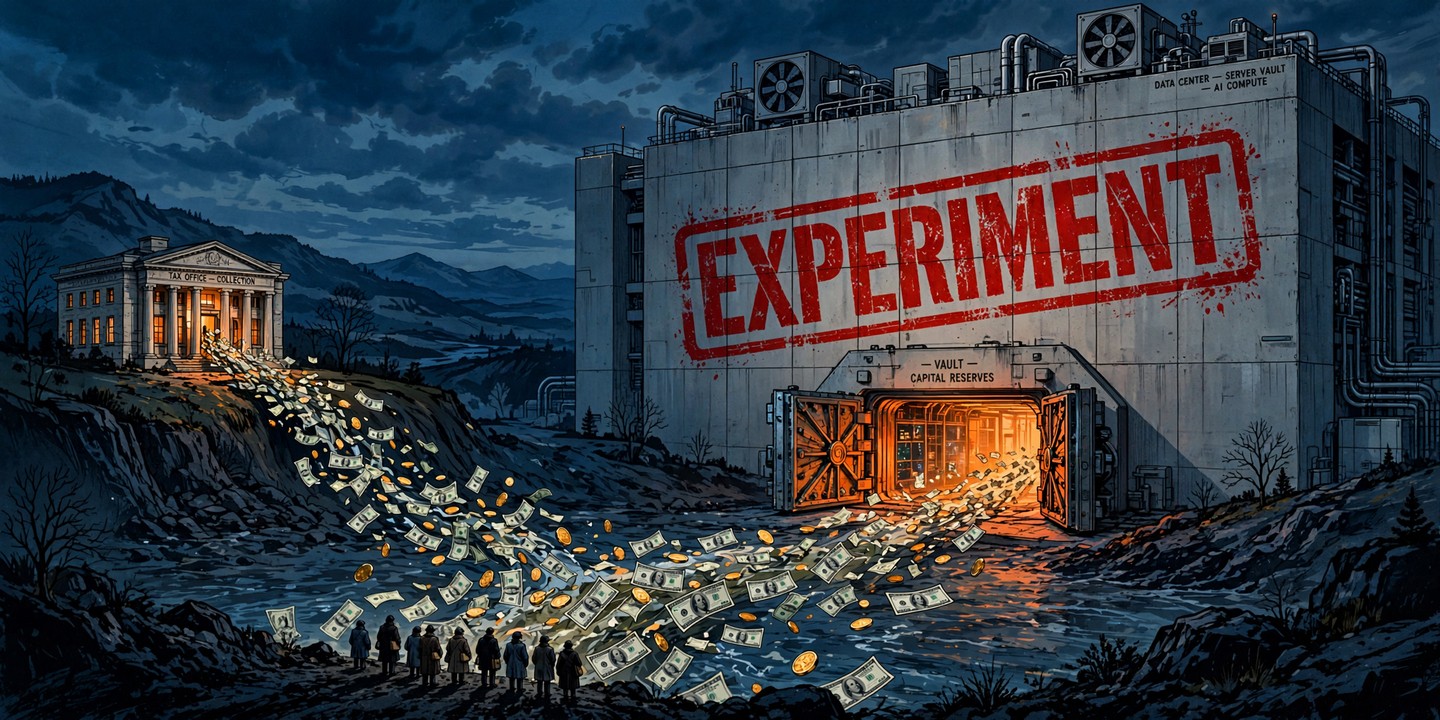
From Meta’s $3.9 billion credit to $83 billion in tax breaks for six companies; society pays the costs, shareholders take the profits
1. An Instagram Post and an Unintentional Confession
A few days ago, an Instagram post making the rounds exposed a tax scandal: Meta told the U.S. tax authority that its giant AI data centers are really “experiments” — and with that single word, shaved billions off its tax bill. The irony is that the post itself was a trick: its publisher is an investment app that ends by inviting readers to buy shares in these very companies, on the grounds that “your taxes are helping pay for Big Tech’s AI buildout, so you might as well own a piece of it.” But the figures in that post are real, and they come from credible sources: a New York Times investigation and reports by the Institute on Taxation and Economic Policy. This article takes those tricks apart, one by one, to show that in the age of AI, organized plunder runs through the tax code.
Read this article through the lens this website has returned to again and again: the contradiction between socialized production and private ownership. What follows — from rebranding a data center as an “experiment” to $83 billion in tax breaks — is not a collection of isolated offenses but the expression of a single logic: socialize the costs, privatize the profits. And every new trick deepens that contradiction.
2. Trick One: The “Experimental” Data Center
On September 30, 2026, the New York Times — reporting by Kashmir Hill, Jesse Drucker, Eli Tan and Mike Isaac — revealed that for two years, Meta has classified its AI data centers in its tax filings as “pilot models,” a technical term in tax law for a prototype of a product still being tested. Under that label, Meta counts the Nvidia chips installed in these data centers as “research supplies,” qualifying for the federal research and experimentation tax credit — a credit dating to a 1981 law that was meant to encourage genuine research.
The numbers are staggering: Meta’s tax savings from this credit were about $700 million in 2023, rose to $2 billion in 2024, and jumped to $3.9 billion in 2025. Meta is now the largest beneficiary of this credit among all publicly traded U.S. companies. The Times reports that even some of Meta’s own finance executives doubted the maneuver would survive IRS scrutiny; but the company’s auditor, Ernst & Young, signed off — and more remarkably, is now pitching the same approach to other companies.
The contradiction becomes clear when you set Meta’s words to investors beside its words to the tax authority. In January 2025, Mark Zuckerberg said these data centers would “accelerate every major part of our core business”; in July 2025 he announced “hundreds of billions of dollars” in computing investment to build “superintelligence,” including a data center so large it could cover a significant part of Manhattan. The Prometheus cluster is already partly online, and Hyperion is slated to reach 5 gigawatts. None of this smells like an “experiment” — but in the world of taxes, words can be bought and sold.
3. An Older Trick: The “Researcher” CEO
This is not the first time Meta has dodged taxes with a word game. According to Bloomberg Tax, years ago Meta counted $4.1 billion of Zuckerberg’s 2012 and 2013 stock option income as “research wages,” on the grounds that Zuckerberg was writing code when he received those options. The result was roughly $355 million in tax credits. The IRS rejected that story, and the case is now before the U.S. Tax Court. The pattern is the same: one label, one definition, and billions of dollars moved from the public’s pocket into private hands.
4. Trick Two: Accelerated Depreciation
Meta’s trick is only the tip of the iceberg. The most common tool is “accelerated depreciation”: the company deducts the cost of buildings and equipment far faster than they actually wear out. Using this method, Microsoft claimed about $18.7 billion in tax breaks in 2025 — a historic record for a single public company in one year. Two-thirds of that figure came straight from depreciating its investments. Amazon pulled $6.5 billion the same way, by “front-loading” the cost of building out its data centers. Put simply: the building is still standing and still working, but on the tax return it has already grown old and worn out this year.
5. Trick Three: Foreign Profits and Intellectual Property
Alphabet obtained $3.9 billion from a lower tax rate on foreign sales of products tied to its own patents and software — the very intellectual property built with publicly funded research, now serving as a shield for global sales. Nvidia took $4.2 billion from a break for selling its own chips abroad. In both cases the logic is the same: profits drawn from global knowledge and global markets return the smallest possible share to the treasury that made that knowledge possible.
6. The Lawmaker as Accomplice: The Tricks Made Permanent
These tricks do not happen in a vacuum; the lawmaker is an accomplice. On July 4, 2025, the “One Big Beautiful Bill Act” was signed, handing these companies two great gifts: 100 percent bonus depreciation was made permanent, so companies can deduct the full cost of equipment in the year of purchase; and domestic research and development expenses became immediately deductible again, repealing the post-2022 rule that forced companies to spread research costs over five years. ITEP warns that restoring this break retroactively is a “pure windfall”: a reward for investments the companies would have made anyway, requiring nothing new from them.
7. The Scale of the Loot: Eighty-Three Billion Dollars
Consider the scale. According to ITEP, just six companies collected about $83 billion in federal tax breaks in 2025 — more than 40 percent of the $204 billion disclosed by all publicly traded U.S. companies. That exceeds the entire annual discretionary budget of the U.S. Department of Education ($82.4 billion). For comparison: the largest single-year break ITEP had recorded before 2025 was JPMorgan’s $5.2 billion in 2024; in 2025, two companies tripled that and four more than doubled it.
Five tech giants — Amazon, Alphabet, Meta, Microsoft and Oracle — together reported $422 billion in profits and paid just 4.5 percent in federal income tax, against a statutory corporate rate of 21 percent. Those same five companies invested about $380 billion in 2025 and are on track for $755 billion in 2026. Tech executives themselves describe demand for data center capacity as “insatiable.” ITEP’s question is simple and devastating: why should taxpayers subsidize investments that would happen anyway and that nobody asked for?
8. Who Pays? The People’s Water and Power Bills
The answer is clear: the people. Data centers devour cities’ electricity and water, and the neighbors pay the bill. In Ohio alone, $1.6 billion in sales tax breaks went to data centers in a single year, and the issue has become the central battleground of the state’s elections. The Ratepayer Protection Act, which would have forced data centers to pay their own power costs, passed the House of Representatives on September 16 by a crushing 417 to 3; but on September 30 it died in the Senate, 57 to 43, short of the 60-vote threshold. In New Jersey, resistance worked: on August 28, 2026, a bipartisan law was signed ending $250 million in AI data center tax credits. James Shannon, the congressman who wrote the research-credit law in 1981, told the Times it was meant for “people power, knowledge, information” — and that Meta’s use of it has gone “way, way beyond what anybody could have imagined.”
9. What Do People Say?
The people, unlike the lobbyists, have not fallen for the word games. A Gallup poll in May 2026 found 71 percent of Americans oppose building an AI data center near where they live (48 percent strongly) — opposition exceeding even that to nuclear plants. A New York Times/Siena poll in September 2026: 61 percent opposed versus only 14 percent strongly in favor; 56 percent of opponents want limits, 38 percent want a total ban. Top reasons: environment and water use (32 percent), impact on local communities (21 percent), and distrust of AI (18 percent). Pew Research found 54 percent of Americans call data centers “mostly bad” for the environment, up from 39 percent in January. In an October 1, 2026 Time interview, Donald Trump, confronted with these polls, said anyone opposing data centers “wants to be poor and live in a crime-infested neighborhood.” That is the official language of power, addressed to the people who pay the bills.
10. The Deepening Contradiction: Socialized Production, Private Ownership
This website’s earlier articles have pointed to this gap again and again, and this case is its clearest illustration. Production grows more social every day: the foundations of AI were built in public universities with public money; tens of thousands of engineers, technicians and workers — from chip designers to data center guards — are the collective labor that keeps this machine running; the water, power and land these facilities swallow are the community’s shared resources; and now, through tax breaks, even the financial cost of construction comes out of taxpayers’ pockets. $83 billion in breaks in one year means $83 billion that never reached schools, hospitals and public infrastructure.
But ownership grows more private every day: the data centers, the chips, the models and the profits belong to a handful of shareholders. The decisions — where to build, what to build, what price to set, who gets access to this power — are made in boardrooms, not in neighborhood councils, not in parliaments, and not by vote of the people who foot the bill.
Every new tax trick deepens this contradiction by one step: society’s share of the cost grows, and its share of decision and profit shrinks. The “research” credit written for “people power, knowledge, information” is today a cover for privatizing the profits of the most social technology in history. This is the gap we have named before; until it is closed, every new “advance” in AI will come at the price of a new retreat for justice.
11. Socialized Costs, Privatized Profits
This story is the mirror image of the truth this website has stated before: socialized production versus private ownership. But it has another face: socialized costs versus privatized profits. Knowledge built with public money in public universities, water drawn from cities’ aquifers, electricity whose bill lands on neighbors’ doorsteps, taxes left unpaid while schools and hospitals go without — these are costs society pays so that profit stays private and is divided among shareholders.
The tricks are not mere “loopholes”; they are mechanisms of upward redistribution. When a single word — “experimental,” “researcher” — can move billions of dollars, the question is no longer technical but political: who has the right to decide about our common wealth?
This is the same deepening contradiction traced throughout this article: the more social production becomes — from public knowledge and collective labor to cities’ water and power to taxpayers’ pockets — the more private and concentrated ownership becomes. This contradiction will not resolve itself; either democratic control by society over this infrastructure will close it, or deeper social crises will.
The democratic answer is clear: end data center tax breaks, make the giants pay the real cost of the water and power they consume, and ultimately bring AI infrastructure — the productive force of our age — under society’s democratic control. Until that day, every new “experiment” they announce is really an experiment in testing our patience.
Editorial Note
This article is based on the New York Times investigation (September 30, 2026), reports by the Institute on Taxation and Economic Policy (ITEP), and polls by Gallup, Pew, NYT/Siena and Fox News. The tax-break figures are drawn from the companies’ own disclosures in their financial statements.
Sources
- New York Times investigation of Meta’s tax credit
- More on Meta’s “pilot models”
- Six companies and $83 billion in tax breaks
- Big Tech and AI development tax breaks
- Democrats’ bill to end data center breaks
- New Jersey ends data center tax credits
- Pew survey on Americans’ views of data centers
- Gallup: seven in ten opposed
- NYT/Siena poll
- Ohio voters oppose data center breaks

