A response to Professor Michael Webber’s 60 Minutes interview: the “insatiable demand for intelligence” is not a law of nature. It is the logic of capital — and the bill is sent to everyone else.
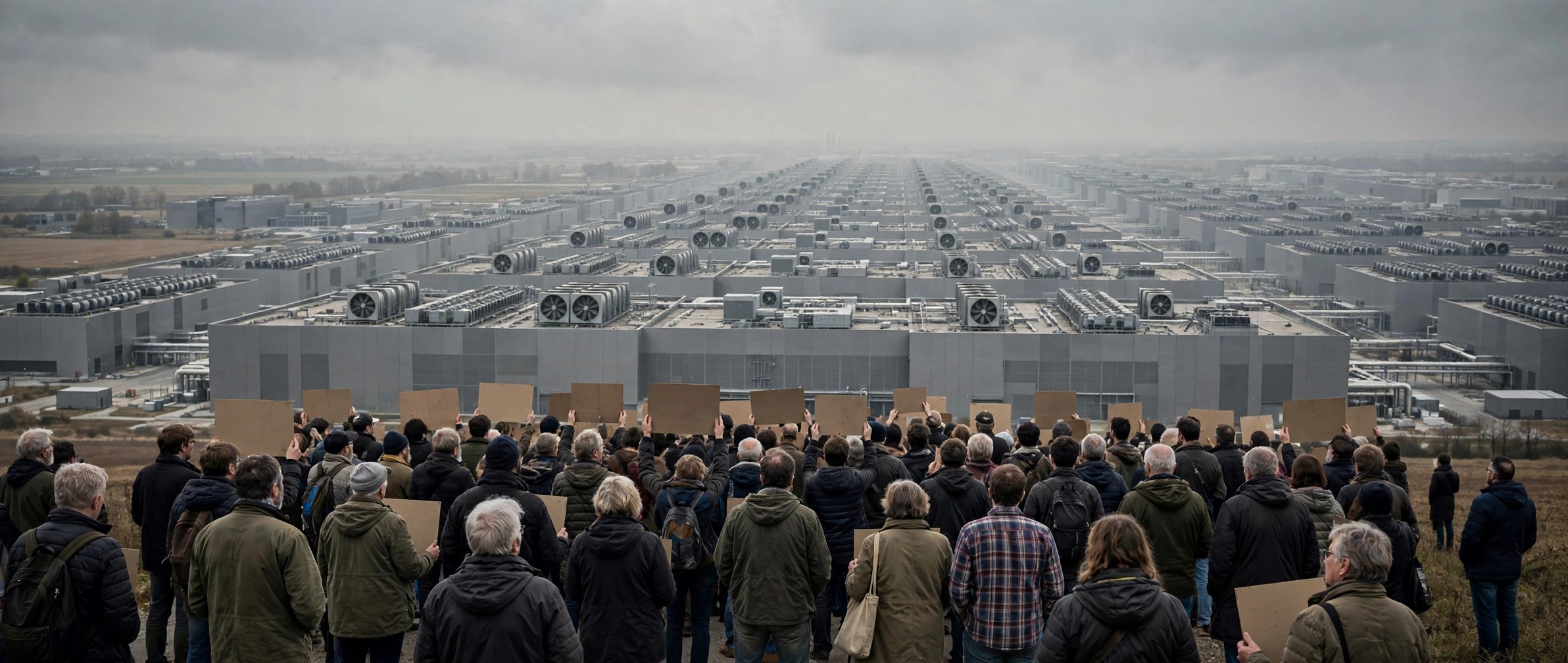
In a recent 60 Minutes segment on the massive spending by tech companies on data centers and AI infrastructure, Professor Michael Webber of the University of Texas put the industry’s dilemma plainly: “I’ve talked to a lot of smart people, and some say this will satiate. But then there are other smart people who say the demand for intelligence will never be sated. So we will always want more data centers. We will always want more intelligence.”
We should thank him for his honesty. He stated the quiet part out loud: the plan is infinite expansion. But his framing deserves a serious response — because everything hinges on three small words: demand, we, and intelligence.
1. Whose demand is “insatiable”?
“Demand for intelligence” sounds like a natural human appetite, like hunger or thirst. It is not. No community ever gathered and voted to surround itself with windowless buildings that drink rivers and strain power grids. The demand Webber describes is the demand of capital in an arms race: each company must out-build the others or perish. If one stops, a rival takes the market.
This is not demand in any human sense. It is compulsion — the compulsion of accumulation, which must expand or die. To call it “demand for intelligence” is to dress a structural imperative in the clothes of human nature, as if the rest of us were clamoring for it. We were never asked.
2. The magic “we”
“We will always want more data centers.” That “we” is doing enormous political work. It manufactures a consensus that does not exist.
Ask the residents living next to these facilities — the ones watching their water tables drop and their electricity bills climb, the ones organizing protests from Virginia to Texas to Brussels. They did not consent to be the “we” in that sentence. Their towns were chosen for cheap land, cheap power, and weak regulation — not for democratic deliberation.
And notice how the interview frames the whole matter: a debate among “smart people.” Experts on television, weighing whether demand will satiate. The rest of us are cast as spectators of a technical question, when it is in fact a political one: who decides what gets built, on whose land, at whose cost, and for whose benefit? The expert framing is itself a way of removing the decision from democratic hands.
3. Satiation is a red herring
Will the spending “satiate”? The question assumes that if only demand leveled off, the problem would resolve itself. It would not.
Even dramatic efficiency gains would not reduce the buildout — this is the oldest lesson of industrial capitalism, the Jevons paradox: making a resource cheaper to use increases its total use. The system does not merely meet demand; it manufactures it, then calls the result natural. Every new capability becomes the justification for the next round of construction. Satiation can never arrive, because the machine is designed to move the horizon.
So the debate Webber reports — satiate or never satiate — is a debate inside the industry’s own frame. Step outside it, and the real question appears: satiation of what, for whom?
4. What kind of “intelligence”?
Suppose we grant the premise and ask: what is this “intelligence” whose demand is infinite?
Look at what the infrastructure actually produces. The most profitable applications of these models are not scientific breakthroughs or medical miracles — they are engagement engines: recommender systems, targeted advertising, synthetic content at infinite scale. The “intelligence” being built is overwhelmingly the kind that keeps users scrolling, clicking, and buying. It is intelligence in the service of profit, not of human flourishing.
More of that intelligence does not mean more wisdom, more truth, or more human capability. It can mean — and increasingly does mean — more noise, more manipulation, more of what we have called the cotton-candy society: infinite pleasant content, zero nourishment. “We will always want more intelligence” turns out to mean: the industry will always want more capacity to monetize attention.
5. The alternative: intelligence as a commons
None of this is an argument against computation, or against AI itself. It is an argument against who decides.
Imagine the same immense technological capacity — the product, after all, of social labor: public research, open science, millions of workers and users — governed democratically. Communities deciding what gets built near them. Public ownership of compute, directed toward human needs: medicine, science, education, climate. Councils, not boardrooms, setting the priorities.
Under such an arrangement, the question “will demand satiate?” would finally be answerable — because demand would mean something real: what people, deliberating together, actually decide they need. Some things would be built; others would not. That is what democratic control looks like.
Professor Webber is right about one thing: under the current system, the demand will never be sated. Where he goes wrong is presenting that as a fact about intelligence, or about “us.” It is a fact about a system — and systems can be changed.
The communities already protesting data centers have understood this better than the experts on television. They are not debating satiation curves. They are asking the only question that matters: who is this for? Until that question is answered democratically, “we will always want more data centers” will remain what it is — the industry speaking, in the first person plural, on behalf of everyone it never consulted.
Intelligence was never the scarce resource. Democracy was.

