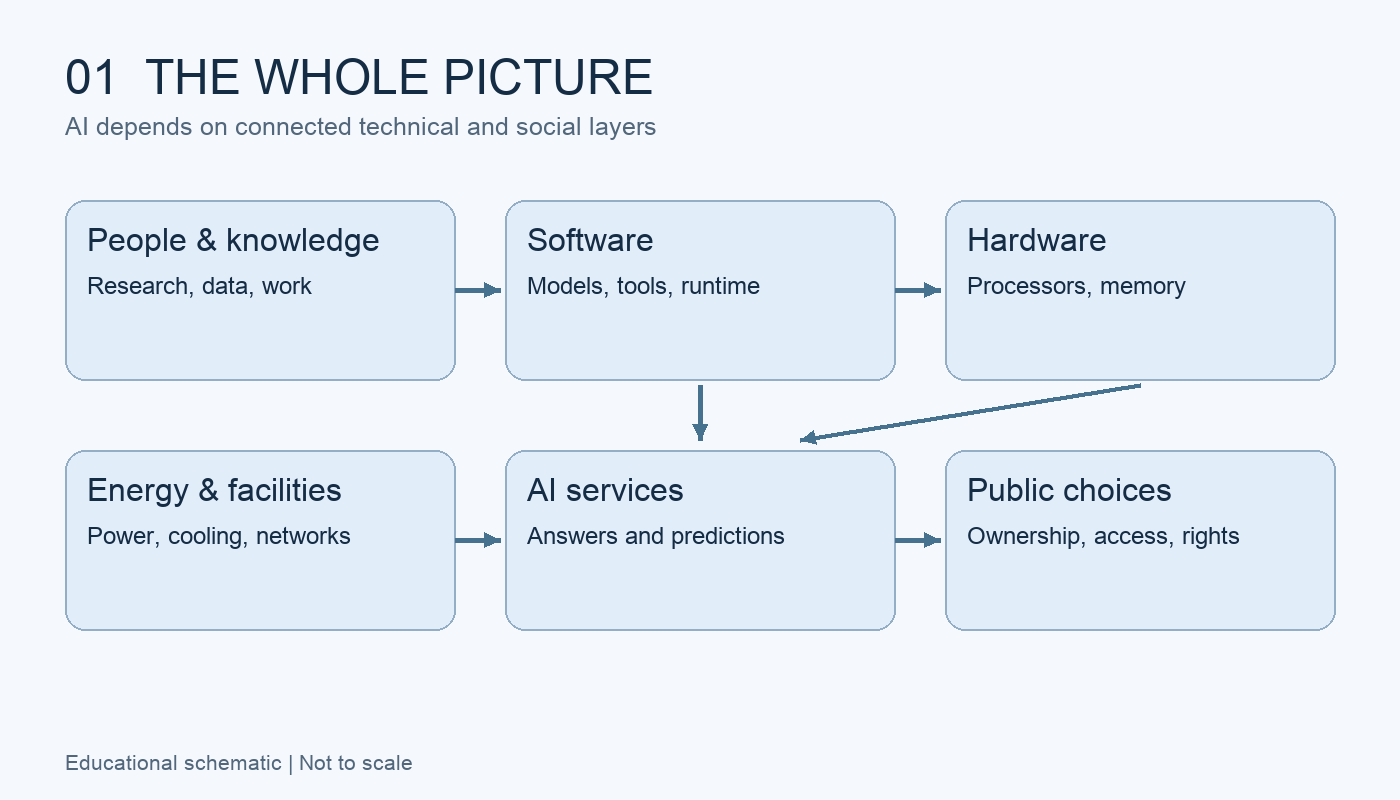
Artificial intelligence is usually recognized by what appears on a screen: an answer to a question, a generated image, or a proposed solution to a problem. Behind that output, however, processors, memory, networks, software, and data centers are at work. Understanding this infrastructure helps explain how AI is built, why developing it is expensive, and how control over its use is distributed among companies, institutions, and the public.
AI is not the product of a single chip or program. Its capabilities emerge from the coordination of components with different roles. This interdependence makes AI more than an engineering issue: the knowledge and labor that create it are widely distributed and social, while ownership and decision-making power can be concentrated.
What does the hardware do?
AI models require numerical calculations for training and for responding to requests. Many of these calculations can be divided into parts that run simultaneously. Processor type, memory capacity, and data transfer speed determine how quickly this work can be done, at what cost, and with how much energy.
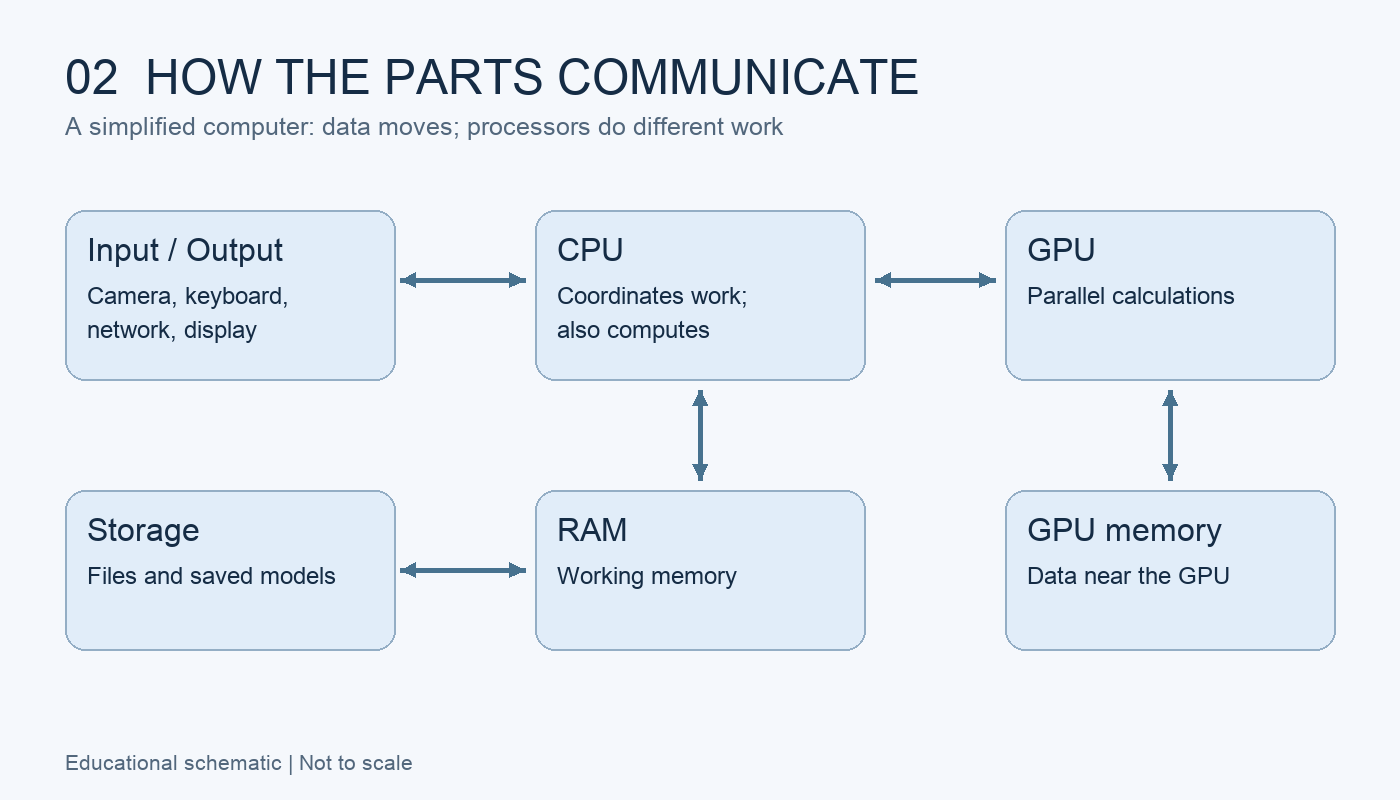
The central processing unit, or CPU, is the system’s general-purpose, flexible component. Common tasks include running programs, preparing data, and coordinating components. Modern CPUs also perform parallel processing: the distinction between CPU and GPU is not simply “sequential versus parallel,” but concerns architecture and suitability for different workloads. Intel documentation
The graphics processing unit, or GPU, is well suited to performing many similar operations in parallel. This is important for the matrix calculations used in neural networks. Computing power alone is not enough, however: if data cannot move from memory to the processor quickly enough, some of the device’s capacity remains unused.
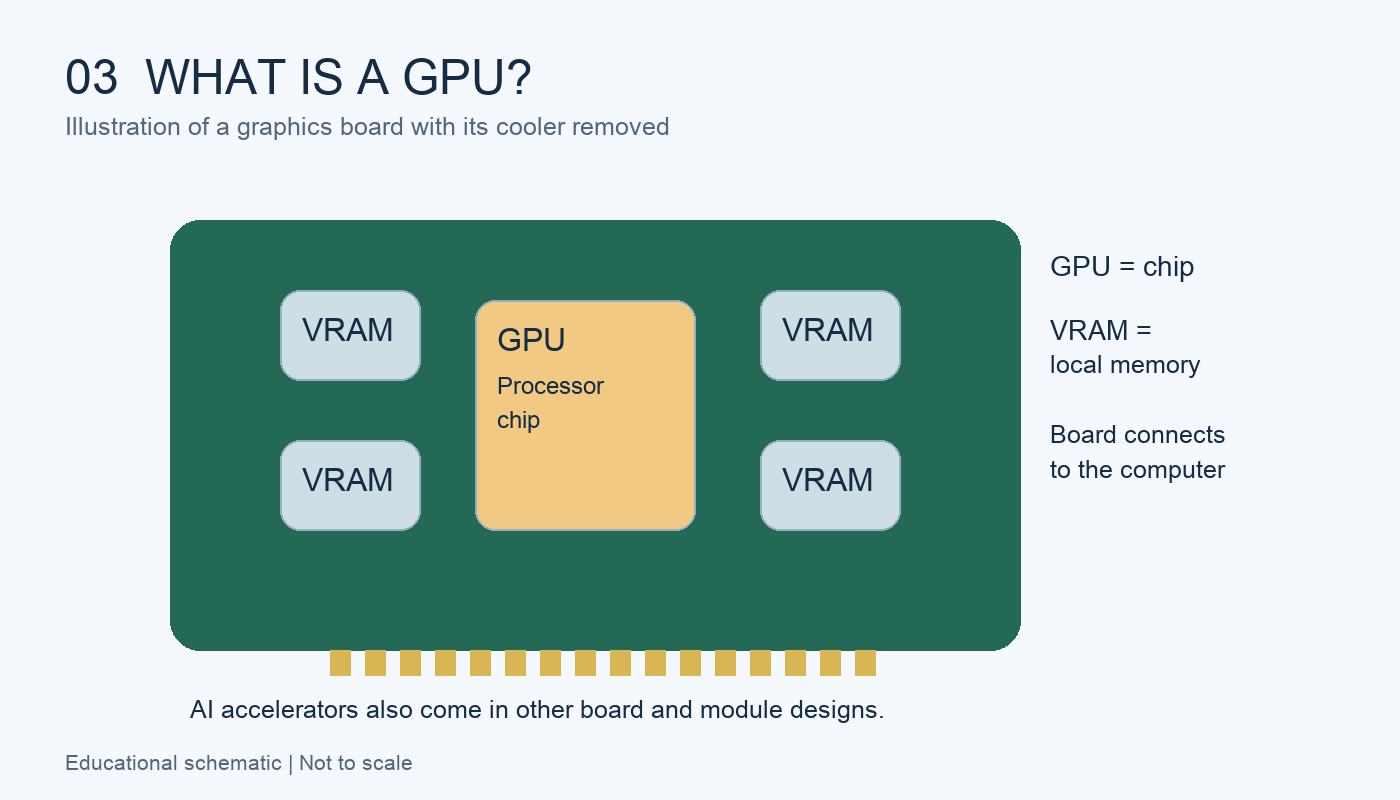
Specialized accelerators are designed for particular classes of computation. TPU is the name of Google’s accelerator family, while NPU generally refers to a unit that speeds up neural-network operations. ASIC is the broader term for an application-specific integrated circuit; these labels therefore do not always represent separate categories at the same level. An FPGA is reconfigurable hardware whose logic can be adapted to an application’s requirements.
A small model on a personal device and a large model in a data center have different needs. On a personal device, battery consumption and response time matter. In a data center, memory capacity, communication between devices, request volume, and operating costs also become important. The right choice is the one suited to the task, not necessarily the most powerful chip.
How does software put this capacity to work?
Without software, hardware does not know which calculations to perform or how to perform them. Several intermediate layers connect the model to the chip.
Frameworks such as PyTorch and TensorFlow provide tools for defining and training models. Developers can specify a network’s structure and training method without writing every detail of hardware execution from scratch. Compilers, libraries, and runtime environments then prepare these calculations for the target device. Drivers provide the interface between software and hardware.
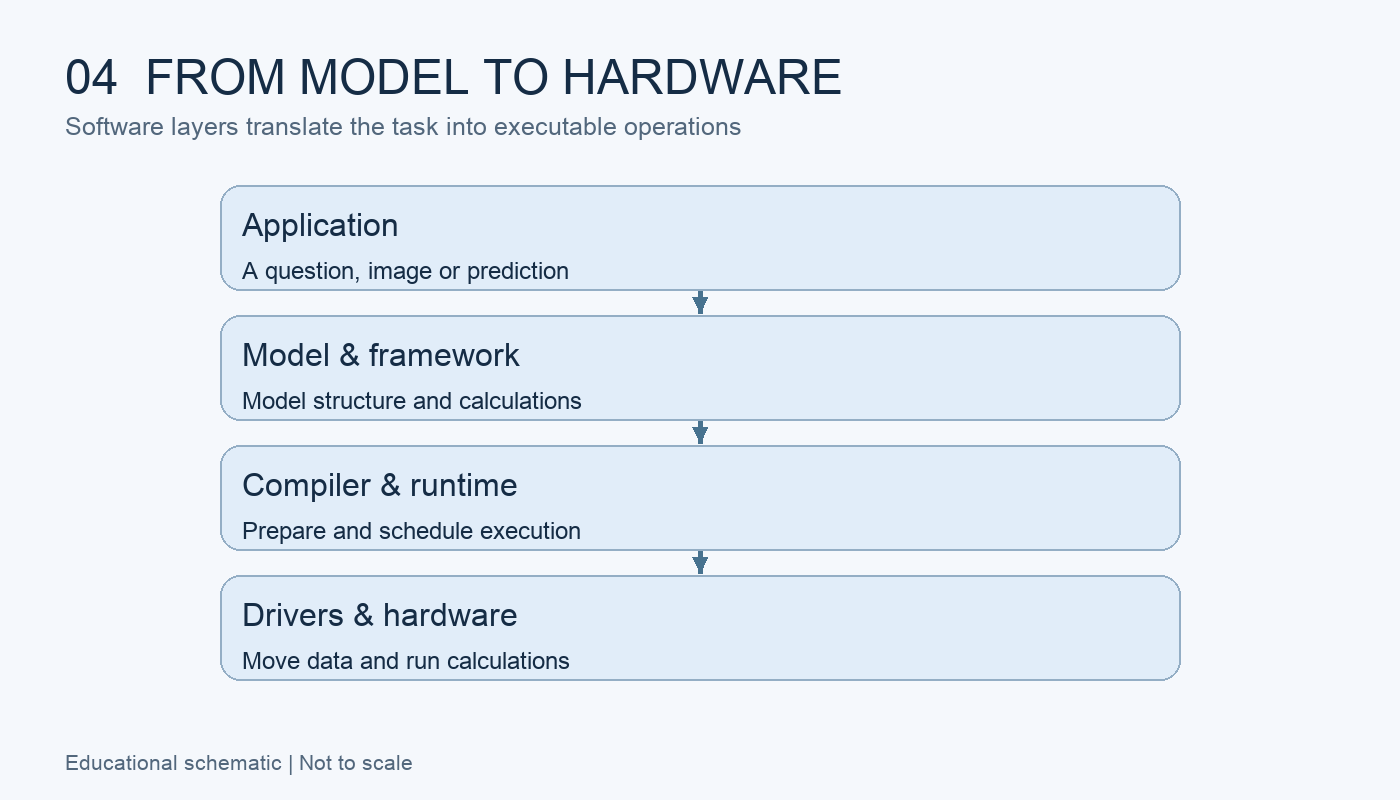
A computational operation, for example, can be implemented in several ways. The choice of method, memory use, and distribution of work across processing units affect speed and resource consumption. Two systems with similar chips may therefore perform differently because their software and settings differ.
Some of this optimization is now itself assisted by AI. In Meta’s KernelEvolve project, a software agent generates different versions of computational code, tests them, and uses feedback to continue searching for better solutions. This shows how AI can help develop its own infrastructure, although the results still need to be evaluated for correctness and performance. Meta technical explanation
Why does moving models between platforms matter?
Suppose a university develops a model using a particular set of tools and hardware. If the model can run only in that environment, changing suppliers or using less expensive equipment becomes difficult. This dependency can create costs for staff training, software rewriting, and long-term maintenance.
ONNX was developed to make exchanging models between tools easier. It provides a common format for representing computational graphs, operators, and data types. ONNX Runtime is a related execution environment that supports different hardware-acceleration pathways. About ONNX ONNX Runtime documentation
A common format does not guarantee trouble-free execution or identical speed on every device. Some operators may be unsupported on a platform, or may require additional conversion and tuning. Portability must be tested in practice.
This is where open standards have social significance: they can reduce switching costs and expand choice. Yet an open model format alone does not equalize access to chips, electricity, capital, or data-center capacity.
Who helps build this infrastructure?
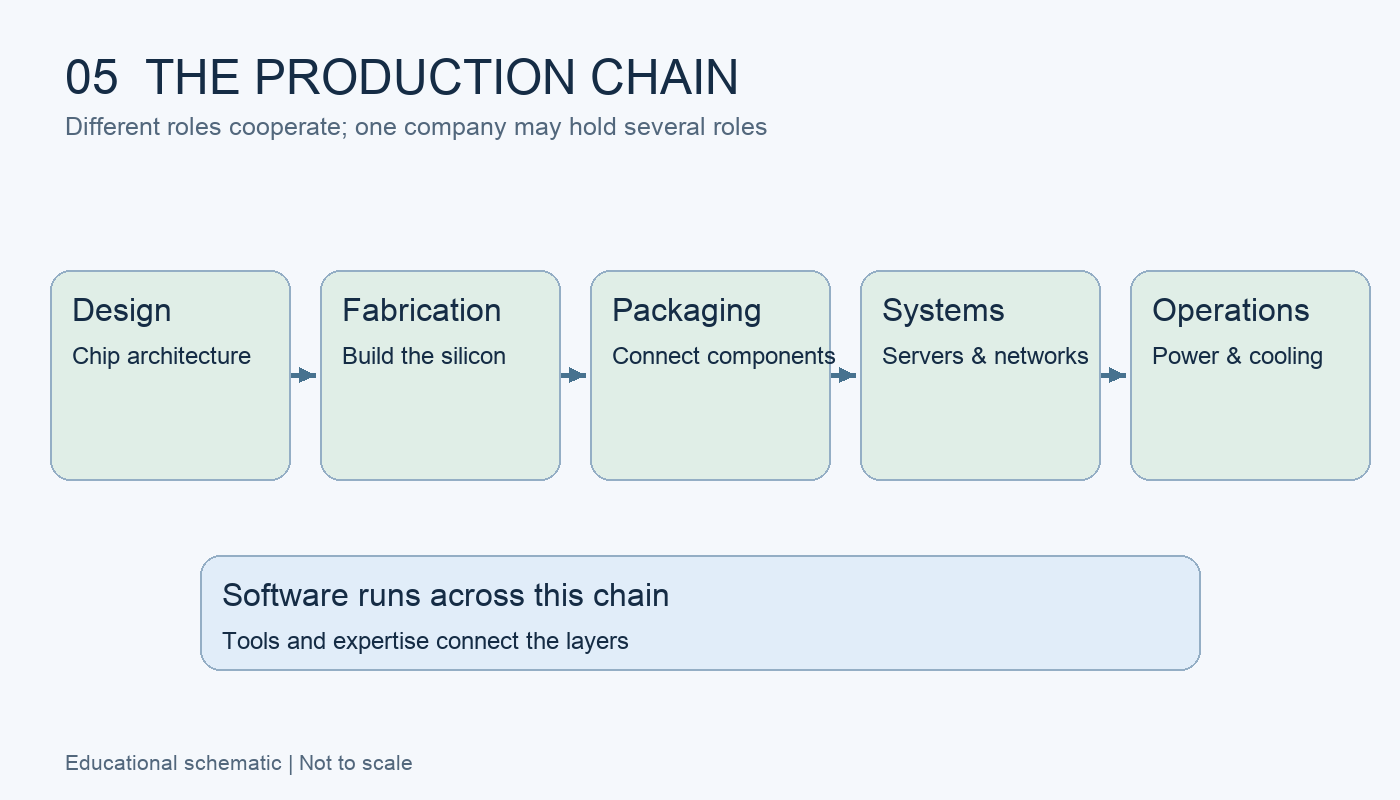
To understand the participants, we must distinguish their roles. Processor design, physical chip fabrication, packaging, equipment production, software development, and cloud services are different activities, even when a company performs several of them.
Processor designers and suppliers include NVIDIA, AMD, Intel, and designers of proprietary accelerators. On the software side, frameworks, libraries, and runtime tools determine how developers use this hardware. Understanding a company’s position requires looking at this combination of roles, not merely its product names.
Fabrication and packaging are also distinct parts of the picture. TSMC, for example, offers advanced packaging services such as CoWoS and technologies in its 3DFabric family, which help bring computing components together and connect them. Moving from a design to a usable system therefore depends on extensive industrial and engineering capacity. TSMC advanced packaging
Data centers, networks, memory, electricity, and cooling must also work in coordination with these components. A shortage or constraint in any link can affect the whole system. Power in the AI economy is therefore not limited to owning a model: control over infrastructure and access to it matters as well.
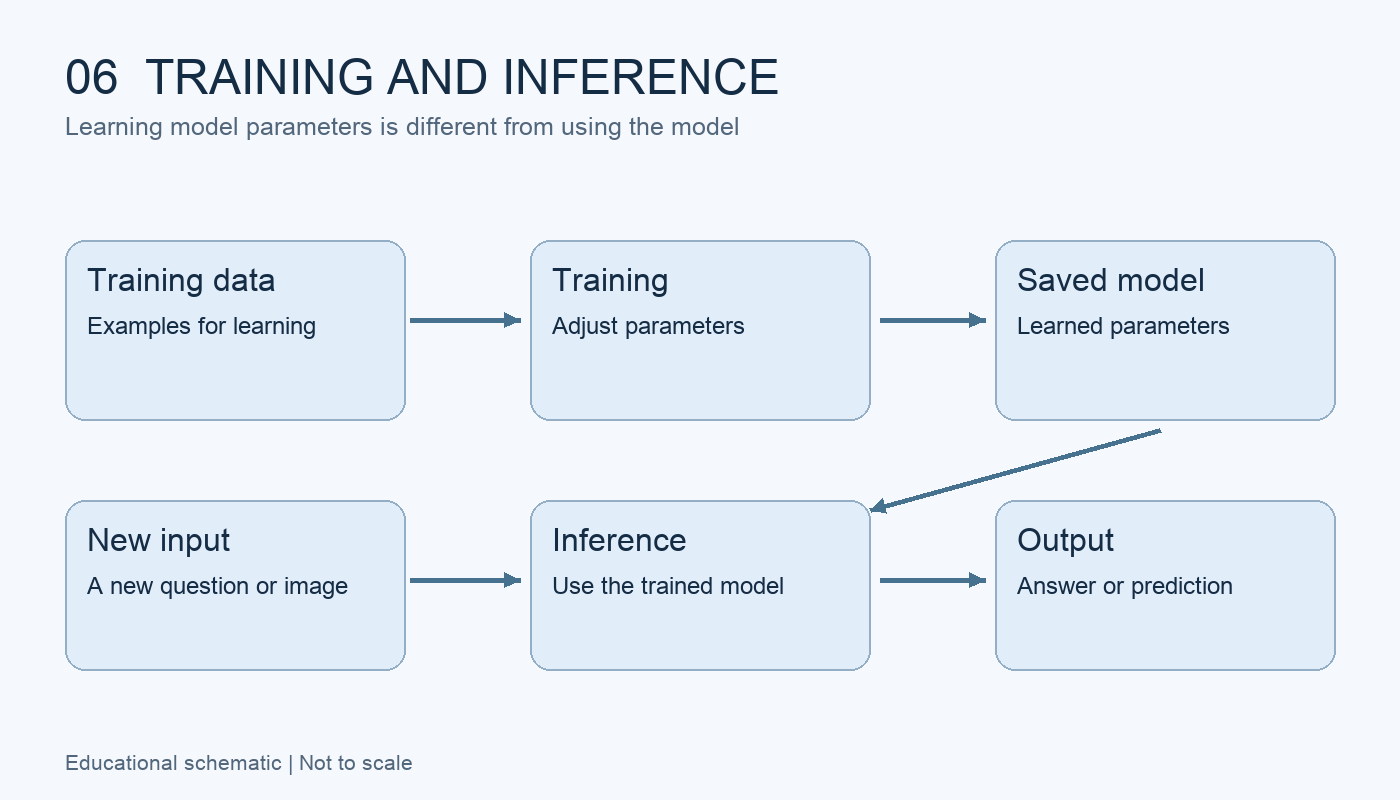
Training and using a model are different stages
During training, a model’s parameters are adjusted using data and a learning method. During inference, the trained model is used to produce a response, prediction, or decision. These stages can have different memory, computing, and timing requirements.
For example, a system that must handle many requests simultaneously cannot be assessed solely by the speed of a single response. Serving capacity, cost, and output quality also matter. In an interactive application, a long delay can make a tool unusable even if its overall throughput is high.
Claims such as “several times faster” are therefore insufficient without specifying the model, hardware, settings, and measurement criteria. A meaningful evaluation must show the conditions under which an improvement occurs and whether output quality or resource consumption also changes.
Greater efficiency does not necessarily mean lower total consumption
Optimizing chips and software can reduce the energy required for a particular task. But if the number of uses or model sizes increase, total consumption may still rise. We must distinguish “energy per computation” from “energy consumed by all activity.”
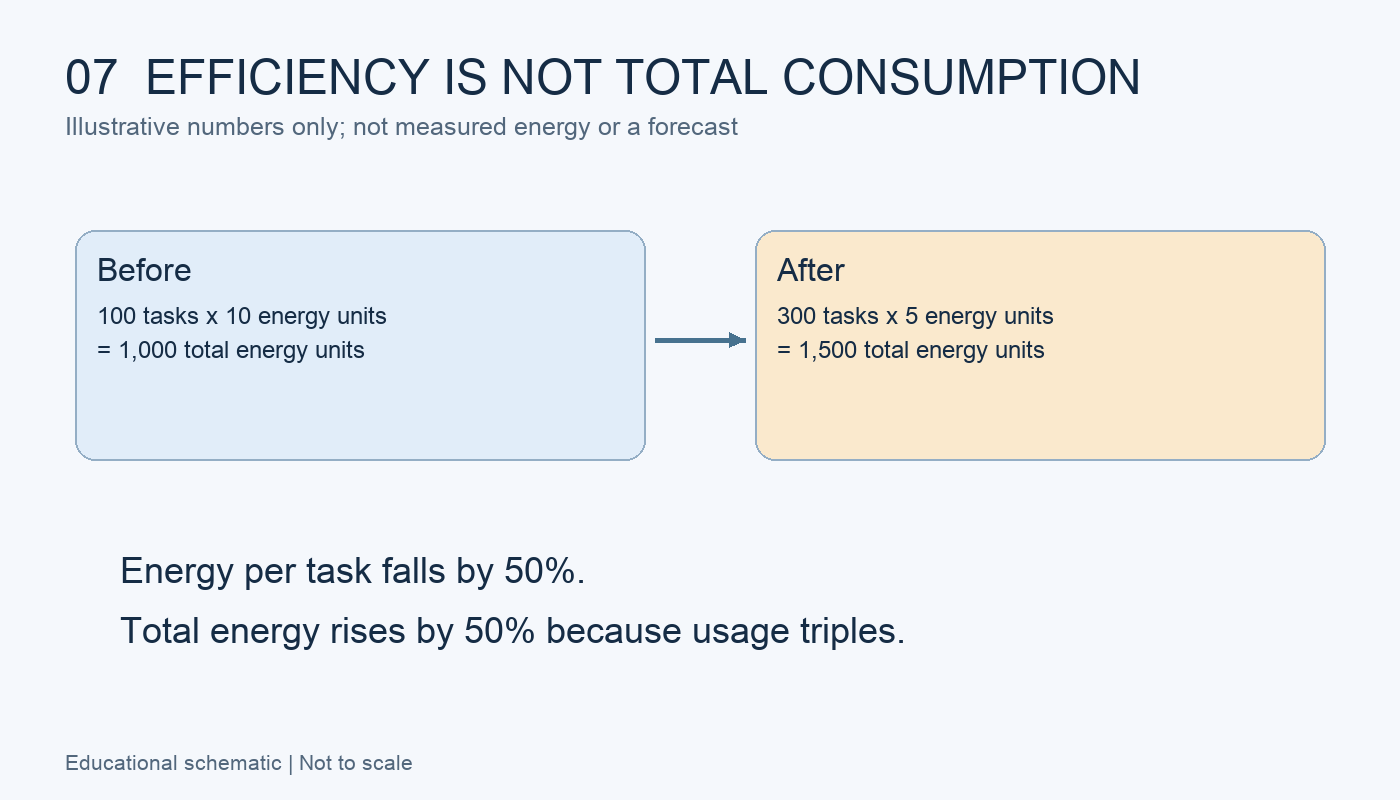
This connects AI to electricity planning and public infrastructure. Data-center development and energy-grid expansion do not always proceed at the same pace. The International Energy Agency’s report shows why assessing AI demand requires considering equipment, infrastructure, and the scale of deployment together. Energy and AI
The social question is not simply how efficient a device is. We must also ask what purposes resources serve, who pays for expansion, and how society participates in these decisions.
From social production to concentrated control
AI infrastructure results from extensive cooperation involving researchers, programmers, engineers, manufacturing workers, network specialists, and many others. Its knowledge and tools also build on earlier achievements. From the perspective of A New Social Order in the Age of Consciousness, this network illustrates the social character of production and knowledge.
Wide participation in production does not automatically distribute power equally. A platform owner can decide access conditions, prices, usage priorities, and service restrictions. When switching platforms is difficult, users’ effective freedom of choice is also reduced. This analysis connects the technical issue of vendor dependency to the social issues of ownership and power.
Similarly, greater computing capacity and automated software development do not by themselves determine who benefits. They may reduce exhausting work, improve public services, and expand opportunities to learn; or they may be used to cut labor costs and concentrate income further. How technology is used and its benefits distributed are matters for social decision-making.
Open source and democratic control
An open-source project can make code inspection, technical participation, and shared use easier. ONNX, for example, has defined roles, specialist groups, and a steering committee. These mechanisms matter for organizing technical collaboration. ONNX governance
Developer participation, however, is not the same as representing everyone affected by a technology. Workers, users of public services, and residents of areas hosting infrastructure also have interests that may not be reflected in technical decisions.
Within the book’s framework, democratic control means society is more than a consumer of outputs: it must have an effective say in purposes, limits of use, costs, and the distribution of benefits. Transparency in public contracts, independent audits, worker participation, and clear channels for challenge and accountability are proposed mechanisms for pursuing this direction.
Understanding chips and software is essential to understanding AI, but it is not the end of the discussion. The decisive question is what forms of ownership and oversight govern this capacity, built from social knowledge and labor, and how it can increase agency, well-being, and awareness for everyone.
فارسیEnglishBack to Home

Leave a comment