When Housing Is a Commodity, the Desert Becomes Home
Communities on wheels in America and the pattern of “A New Social Order in the Age of Consciousness”
Hamid Akhavi — October 15, 2026
The image the reel shows
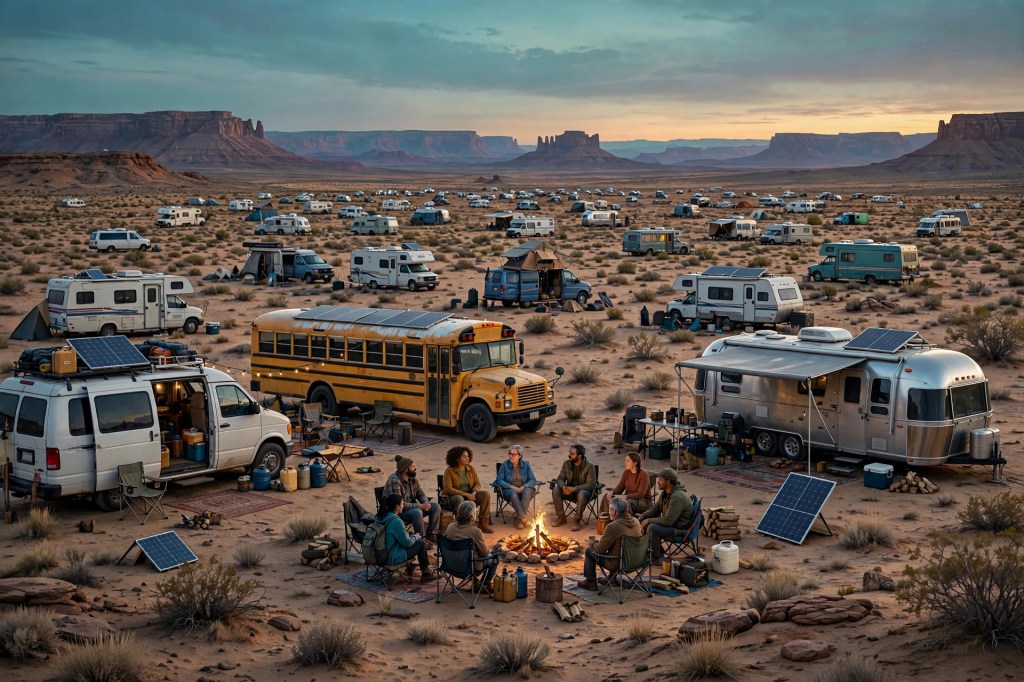
A recent Instagram reel shows thousands of vans, converted school buses, RVs, and trailers camped side by side in the Arizona desert. Its caption reads: “Something is forming outside the system… a parallel society on wheels.” Some were driven into vehicle living by necessity; others looked at the rent, the debt, and the surveillance — and walked away on their own. Then they found each other: van, bus, RV, solar panel, public land, community.
The image is striking. But like every striking image, it shows half the reality and hides the other half. Let’s look at both halves — with numbers.
The reality behind the image
Every January, the desert of Quartzsite, Arizona hosts the “Rubber Tramp Rendezvous” (RTR), the annual gathering of vehicle nomads that Bob Wells started in 2010 with 45 people and that had grown to ten thousand attendees by 2019 — the largest gathering of its kind in the world. Attendees call themselves “the Tribe”; someone dubbed it “Burning Man for retirees.” The program is seminars: installing solar panels, stealth parking in cities, cheap dental care across the Mexican border, finding free secondhand goods. (Drone’s-eye view of the RTR gathering)
Bob Wells is himself the emblem of this story: in 1995, after twenty years working in a store and a difficult divorce, he moved into a van with his last $1,500. In 2005, after seeing a mother with three children sleeping in a car, he built the CheapRVLiving website to teach vehicle living. He later played himself in the film Nomadland (2020), and in 2018 founded the Homes on Wheels Alliance charity, which buys vans for homeless people and makes them habitable. By September 2026 his YouTube channel had passed 1,500 videos and nearly a quarter-billion views.
And beyond RTR: Slab City in California — “the last free place”; BLM public lands that allow dispersed camping; and the streets of Los Angeles, Oakland, Seattle, and Phoenix, lined with parked RVs.
Two populations, one desert
A distinction the reel blurs and we must not: there are two different populations in that desert. One has chosen — remote workers, retirees, and adventurers for whom vanlife is a lifestyle, made possible by technology (remote work, satellite internet, solar panels). The other has been driven — workers, seniors on fixed incomes, and families whose rent has outrun their wages. Jessica Bruder documented exactly this second group in Nomadland (2017): older Americans living in vans and working seasonal jobs, such as Amazon warehouses.
The first group is the shop window; the second is the reality — and the reality is growing.
The numbers: what the last two years brought
NBC News (September 2025, citing RVIA’s demographic report) wrote that about 486,000 people in America now live full-time in RVs — roughly double the 2021 figure. About a third of them have children, and the overwhelming majority earn less than $75,000 a year. This is not Instagram vanlife; this is the last resort.
U.S. Census Bureau data says the same: in 2023 about 342,000 people lived in an RV, boat, or van — 41 percent more than in 2019. The gap between median household income and the income needed to buy a median-priced home reached a near ten-year high in 2024.
On the supply side the market is hot too: the RV Industry Association (RVIA) announced that in 2025 more than 342,000 RVs were shipped and 8.1 million American households now own one. But owning an RV and living in one are different things — many of these rigs are weekend toys, not homes.
And behind it all: the Department of Housing and Urban Development’s 2024 point-in-time count recorded more than 771,000 homeless people on a single night — the largest annual increase ever recorded; about 146,000 of them were over 55. Harvard housing research says 22.7 million renter households spent more than 30 percent of their income on housing in 2024, and 12.1 million spent more than half. This is no longer “lifestyle”; this is a livelihood crisis.
The book’s pattern: when housing is a commodity
This is exactly where the pattern of A New Social Order in the Age of Consciousness enters. Housing in this system is a commodity, not a right. Workers build the city — brick by brick, street by street — but the landowner and the developer capture its value. Rent is the modern form of tribute: a monthly payment for something you helped build, to someone who merely holds the deed. It is the same contradiction of socialized production and private ownership, this time over the roof above one’s head.
When rent rises faster than wages, people have three options: work more, eat less, or exit. Those 486,000 — and hundreds of thousands more in cars and tents — have chosen the third; not out of philosophy, but out of simple household arithmetic.
Poverty brings people together
And this is the point the reel gets right and we must take seriously: shared hardship builds community. The RTR seminars, teaching a neighbor to install a solar panel, finding a cheap dentist for a stranger, a charity that turns a van into a home — these are the embryonic forms of what the book calls “consciousness”: connecting personal experience (“I can’t pay the rent”) to its structural cause (“housing is a commodity”). People whom the system wanted as isolated atoms — each a lonely tenant, each a lonely debtor — found each other in the desert and built a “we” again, in different ways: tribe, gathering, charity, shared knowledge and tools.
Bob Wells understood this twenty years ago: when in 2005 he saw that mother and her three children in the car, he built an educational website instead of preaching. Then he built a charity. That is: first recognizing shared pain, then building shared tools. It is the same path from personal experience to collective action.
The limit of exit
But honesty requires saying: exit is not power. The same system that expelled people still sets the terms of the outside: overnight parking bans, camp clearances by police, fines and towing — and with no fixed address: no vote, no services, no school for the children. A community on wheels can survive, but it cannot decide; it can flee the rent, but it cannot abolish it.
And this is exactly where the book stands: the question is not escape from power but participation in power. The question is not how to flee the expensive city; it is who decides about land, housing, and the city?
Conclusion: not escape — building
Communities on wheels show two things at once. First, the human capacity to rebuild society even in the desert — when poverty brings people together, they find new ways of being together. Second, the necessity of a new social order: one in which housing is a right, not a commodity, public land is truly public, and decisions belong to all, not to owners. Until that day, the desert is a temporary home — not a real one.
Maybe freedom was never supposed to look tidy. Maybe it looks like wheels, dust, solar panels, campfires, and people finding each other. Not running away. Building toward something.
— thedigitalnomadguy Instagram reel, October 14, 2026

