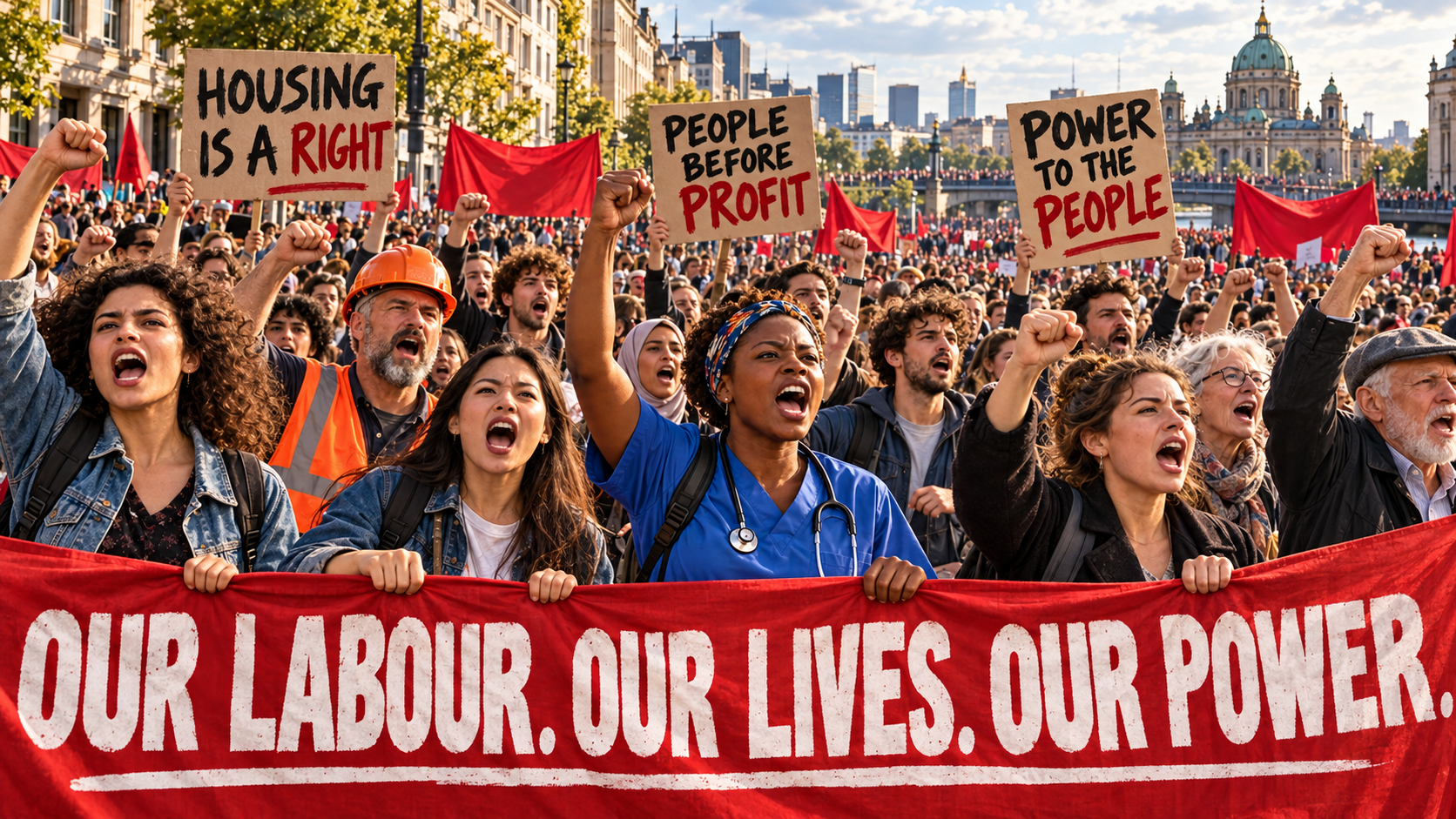
Social Protest, Private Ownership, and the Crisis of Capitalist Society
Hamid Akhavi | October 22, 2026
Across different societies, people enter the streets over different immediate grievances: an inadequate pension, an unaffordable bus journey, a threatened farm income, exclusion from public employment, corruption, police violence, or the denial of women’s freedom. Their demands cannot be reduced to a single slogan. Yet an analysis that treats each confrontation as an isolated disturbance misses a deeper question: why does a society with expanding productive capabilities repeatedly fail to provide security, dignity, and an effective voice to the people whose cooperation makes that production possible?
The argument developed here is that many of these conflicts become more intelligible through the contradiction between social production and private appropriation. Wealth depends on collective labour, accumulated knowledge, public infrastructure, and increasingly global networks of cooperation. Decisions over investment, employment, land, technology, and the resulting surplus remain concentrated in owners of capital and institutions insulated from popular control. The people who sustain society can therefore find themselves excluded from determining its priorities.
In the current wave of October 2026, Europe is a prominent focus of protest. The country discussion therefore begins with France, Spain, Greece, Italy, Albania, Belgium, Portugal, and Serbia, before turning to Asia and South America. The connection across these regions concerns livelihoods, ownership, and people’s authority over their social future. [20-27]
This is the organizing perspective of this article, consistent with A New Social Order in the Age of Consciousness and the site’s discussions of production and democratic planning. It is an interpretation of the evidence, not a declaration that every protester shares a socialist programme. The dated cases below span 2019-2026; they are comparative examples, not a claim that all these countries are experiencing simultaneous uprisings this week. [1-3]
1. Social production and private property: what is the contradiction?
No modern factory, hospital, university, agricultural network, or digital platform operates through an isolated individual’s activity. Production depends on workers, suppliers, care work, education, transport, scientific research, and inherited social knowledge. Even the apparently individual transaction rests on institutions and resources created by generations.
Private ownership of productive assets gives particular people or corporations enforceable rights to direct these interconnected processes and claim their returns. This distinction concerns ownership and control of productive resources, rather than possession of personal belongings. It is also necessary to distinguish a small producer working with family members from a corporation controlling essential infrastructure and thousands of livelihoods.
The contradiction becomes politically visible when the requirements of profitability conflict with social needs. A profitable housing investment may raise rents beyond workers’ means. A company may improve its accounts by dismissing employees while increasing the insecurity of the surrounding community. Publicly educated researchers may help generate a technology whose benefits become enclosed behind private intellectual property and subscription payments.
Ownership does not mechanically determine every outcome. Unions, taxation, public services, regulation, and democratic struggles can modify the distribution of power and income. Nevertheless, these struggles take place within an order in which investment remains strongly influenced by expected private returns. People must repeatedly defend the conditions of life against decisions over resources they help produce but do not effectively control.
2. How capitalist contradictions become crises of everyday life
The wage relationship contains a recurring tension. A business treats wages as a cost to contain; society also depends on wages as purchasing power. If many employers restrain pay while productive capacity expands, the ability to sell output can become a problem. Household borrowing, export markets, or public spending can compensate, but each introduces limits and dependencies. This is one route to crisis, rather than a complete explanation of every recession.
Investment is also fragmented. Each enterprise anticipates profitable demand, while no single private decision guarantees that total investment will correspond to society’s needs. Excess capacity in one sector can coexist with shortages of affordable housing, care, or essential medicines. Overproduction in this context means production exceeding profitable sales under existing conditions; it does not mean that human needs have been satisfied.
The commodification of necessities intensifies these tensions. Access to housing, education, transport, and healthcare may depend on income and debt rather than need. A worker contributes to collective prosperity at work and then faces rent, interest, fees, and utility charges that absorb the resulting wage. The conflict over distribution extends beyond the workplace into the reproduction of daily life.
Debt adds another layer. When governments prioritize debt servicing or fiscal targets, disputes arise over who finances adjustment. The existence of financing constraints is real, but their social allocation involves choices: which taxes rise, which benefits fall, which creditors or asset owners absorb losses, and which services receive protection. Austerity can turn an accounting exercise into a confrontation over the value assigned to human life.
These mechanisms do not establish capitalism’s imminent collapse. They explain why growth and technological advance can coexist with insecurity, and why recurrent crises can occur within an expanding economy. The political issue is whether society’s growing capacity becomes a common resource or a means of concentrating wealth and command.
3. Why people mobilize: grievances need organization
Material hardship does not automatically produce collective action. Workers may fear dismissal; precarious workers may lack time; citizens may distrust opposition leaders. A grievance becomes a movement when people develop a shared interpretation, practical networks, and some belief that acting together can change conditions.
Students, unions, farmers’ organizations, women’s groups, neighbourhood associations, Indigenous organizations, and informal mutual aid can connect experiences that previously appeared personal. A pensioner sees that inadequate income is a public decision. A student connects exclusion from employment with patronage. A delivery worker recognizes that insecure work and privileged political allowances belong in the same argument over social priorities.
Digital communication can accelerate this process, but communication is not equivalent to organization. A viral image can gather a crowd without creating accountable leadership, a negotiating mandate, or institutions able to implement change. Sustainable movements need ways to deliberate, resolve disagreements, protect minorities, and hold their own representatives accountable.
Repression may deter participation, provoke wider resistance, or fragment a movement. The result depends on institutions, organization, and circumstances. Peaceful assembly, civil disobedience, riots, and attacks intended to overthrow democratic institutions must be distinguished. Violence by some participants does not erase others’ rights; opposition to a government does not by itself establish an emancipatory purpose.
4. Europe as the First Focus of the Current Protest Wave
In October 2026, the spread of protests across several European countries, from schools and universities to workplaces and urban squares, has made the continent a prominent focus of social discontent. Recent reporting describes overlapping struggles over living costs, housing, and public services. The regional discussion therefore begins with Europe before turning to Asia and South America. [20]
Here, a centre of gravity describes the prominence and connections of the current European wave. Establishing whether Europe has more protests or participants than every other region would require comparable data covering the same period. Today’s European protests must also be distinguished from historical examples elsewhere. The purpose is to examine the mechanisms through which insecurity becomes collective action under different circumstances.
France: From Education Protests to Society’s Priorities
French school and university mobilizations in October demanded educational resources and better study conditions. In its October 13 statement, the CGT labour confederation supported connecting this mobilization with higher wages and pensions, action against rising prices, and defence of public services. This source expresses the position and assessment of an organization participating in the movement. [21]
In political economy, a school is more than an item of expenditure: it forms part of the social infrastructure producing knowledge, skills, and cooperation. Society finances the development of people and productive capacities. If access to good education depends on household income and place of residence, however, these collective achievements reproduce unequal opportunities. Education protests can consequently become a challenge to the priorities governing the use of social wealth.
Within the book’s framework, a response must give teachers, staff, pupils, students, and families an effective role in educational decisions. Councils with real authority could identify needs, oversee resource allocation, and monitor delivery. Adequate funding and democratic administration are connected parts of that response.
Spain: Housing as a Right and Housing as an Investment Asset
October reporting describes the continuing housing encampment in Madrid’s Puerta del Sol and related protests elsewhere, including Barcelona. Teachers in Madrid also went on strike for better pay and working conditions. These struggles bring living costs and public services into the same political discussion. [20,22]
Spain offers a clear example of the contradiction between social production and private ownership in housing. A neighbourhood’s value is produced through more than a property owner’s investment. Public transport, schools, clinics, residents’ work, and collective cultural life also contribute. Yet the resulting increase in value can become private income through rents and land prices, excluding the very people who helped create it.
Tourism income must likewise be assessed against the social costs of land use and housing conversion. This is an analytical argument; the respective contributions of short-term letting, supply shortages, credit, and investment require investigation in each city. A democratic housing programme could connect the construction and maintenance of public housing, tenant protection, and local oversight of land use. Its purpose would be effective access to a home, backed by the resources and capacity needed to provide it.
Greece: The Cost of Studying and the Cost of Surviving
On October 21, 2026, thousands of students and teachers marched in Athens for affordable student housing and greater investment in education. Demonstrations also took place in Thessaloniki and Patras, while teachers went on strike. [23]
This case shows why the right to education cannot be limited to enrolment. When housing, food, and transport are unaffordable, formal admission does not become a real opportunity. Families and education workers face many of the same costs as students. Through these connections, an educational demand can become part of a wider struggle over the reproduction of social life.
Democratic planning would consider education, student accommodation, and transport budgets together. Students’ and staff members’ participation in identifying needs, combined with published costs and oversight of implementation, could narrow the gap between a declared right and the ability to exercise it. Analysis must also investigate present decisions rather than attribute every current problem exclusively to past austerity.
Italy: Supply Chains Reveal Society’s Interdependence
On October 21, Reuters reported that truck drivers’ protests over fuel prices and living costs were disrupting deliveries in Italy. Retailers said some food was stranded and spoiling in vehicles and warehouses; farmers also joined the protests. [24]
The situation makes the social character of production concrete. Food existing on a farm or in a warehouse does not ensure that people can obtain it. Production, transport, energy, storage, and distribution must connect. When cost pressures become intolerable in one link, their effects spread. Food spoiling during a transport disruption must not automatically be presented as evidence of overproduction: the reported problem here is interrupted delivery to consumers.
Owner-drivers, transport firms, wage workers, and farmers do not occupy identical positions. A social programme would clarify each group’s costs and bargaining power while maintaining access to food and essential services. Transparent accounts, fair contracts, and participation by workers’ and consumers’ representatives could improve coordination beyond fragmented decisions and the passing of costs along the chain.
Albania: Contesting the Appropriation of Shared Resources
Associated Press reporting in mid-October connected student and school-pupil protests in Tirana with demands for education reform, opposition to corruption, and resistance to a luxury tourism development on the southern coast. Some demonstrations involved clashes and property damage. Allegations of corruption and opposition to the project must be identified as protesters’ positions, distinct from judicial findings. [25]
The class significance lies in ownership and authority over territory. Tourism investment may generate income and employment, but assessing its social benefit requires asking how land is allocated, what contracts provide, which costs communities bear, and who receives long-term gains. The arrival of capital cannot substitute for that assessment.
A party’s Socialist label also establishes neither social ownership nor democratic decision-making. The test is whether people can obtain information, participate in decisions, and hold officials accountable. Within the book’s framework, natural resources and public infrastructure require oversight that local communities and elected institutions can actually exercise, alongside protected rights to dissent and protest.
Belgium and Brussels: Who Pays for Adjustment?
On October 9, union members and students marched in Brussels against planned budget cuts. Reuters cited a police estimate of around 30,000 participants in the main march. Unions opposed placing the burden of adjustment on workers, pensioners, and low-income households. Brussels is Belgium’s capital, not a separate country in this comparison. [26]
This conflict highlights the difference between balancing government accounts and preserving viable lives. Deficits and debt costs are real. Whether the response uses service cuts, taxes on higher incomes, changes to exemptions, or a combination of policies remains a matter of choice and social struggle. Presenting one option as the only technical necessity removes that choice from public debate.
Education, care, and transport form part of society’s productive capacities. Cutting them may transfer costs from the government budget to household time and income. Democratic planning would assess those transferred costs and involve workers and service users in setting priorities. The presence of European Union institutions in Brussels underscores the transnational dimension of coordination, without removing responsibility for particular Belgian government decisions.
Portugal: Wages, Pensions, and Services Converge
In its October 21 report, Portugal’s CGTP-IN trade union confederation described October 17 demonstrations in Lisbon, Porto, and Coimbra. Its stated demands centred on higher wages and pensions, better public services, and action against rising living costs. Participation estimates in this source are those of the organizer. [27]
This connection shows why nominal wages alone cannot measure well-being. Higher incomes can be absorbed by rising rents and service costs. Conversely, good public services can improve people’s lives in ways that cash payments alone do not capture. The struggle over labour’s share of social wealth therefore takes place both at work and in the provision of essential needs.
The ownership question concerns whether investment and services are organized primarily around private returns or become subject to social decision-making. Workplace and neighbourhood councils could connect wages, service budgets, and housing policy in a programme with clear costs, implementation responsibilities, and mechanisms for correction.
Serbia: Public Accountability and Political Change
The Associated Press’s October 19 report recorded the continuing student-led anti-corruption movement in Serbia and its connection with political competition. Alongside other European cases, it shows how accountability can grow from a specific grievance into a question about the country’s governance. [20]
Corruption is more than an individual’s moral failure. Contracts, spending oversight, and public access to documents must also be examined. Yet fighting corruption alone does not transform ownership and distribution. Even a lawful contract may undermine collective interests in favour of private profit. Durable change requires connecting political accountability with oversight of economic decisions and independent rights to organize.
Europe’s Common Questions: Social Production and Private Ownership
Teachers, students, tenants, pensioners, drivers, and workers enter these protests from different positions. Their connection can be examined through the gap between broad participation in producing wealth and social capacity and limited authority over the results. Schools and universities develop future capabilities; neighbourhoods and transport create value and enable work; supply chains sustain everyday life. Decisions over these resources can nevertheless remain beyond their participants’ effective control.
This convergence establishes neither a common leadership nor a shared socialist programme. Nor does every street confrontation represent an entire movement. Demands, organizations, peaceful action, violence, and government responses require separate examination. For the book’s argument, the European wave matters because productive growth and institutional development have not removed the need to democratize ownership and decision-making. From here, Asia and South America reveal different forms of the same question under other historical conditions.
5. Asia: different routes from insecurity to political confrontation
Bangladesh: employment, privilege, and state power
Bangladesh’s 2024 student protests began over the reinstatement of quotas in public employment. OHCHR documented how an initially peaceful movement faced serious violations and expanded into a crisis culminating in the government’s resignation on August 5. [4]
The political economy question is why access to public employment becomes such a decisive struggle. Where secure opportunities are scarce, the rules allocating them carry exceptional weight. Perceived patronage converts an employment dispute into a judgment on the legitimacy of the state. This does not mean all quotas have the same purpose or that the dispute can be understood without Bangladesh’s history.
The case illustrates a wider problem: participation in the production of national wealth does not necessarily provide young people with a credible route to security or an effective voice. Removing a government can open possibilities, but the quality of the transition depends on employment institutions, civil liberties, independent organization, and protection against new exclusions.
Sri Lanka: debt becomes shortages in the household
Sri Lanka’s 2022 mobilization developed amid a debt and foreign exchange crisis, inflation, fuel and essential-goods shortages, and power cuts. UN experts also documented allegations of excessive force and detention of peaceful protesters. [5]
The crisis showed how financial vulnerability can enter everyday life through a queue for fuel, interrupted electricity, or an unaffordable food basket. External financing, domestic policy failures, and governance interacted; describing the crisis solely as either foreign domination or individual corruption would leave important mechanisms unexplained.
In the book’s framework, the central question is how public priorities are determined when foreign exchange is scarce. Transparent accounts, scrutiny of debt arrangements, and public deliberation over essential imports could make the distribution of sacrifice contestable. Changing leaders alone cannot guarantee those conditions.
India: producing food while struggling for a livelihood
Farmers who returned to protest in February 2024 sought stronger guarantees for agricultural prices. Human Rights Watch documented barriers to peaceful assembly, internet restrictions, and excessive force. The protests followed the earlier movement that secured repeal of agricultural laws in 2021. [6]
Agriculture makes the distinction between production and appropriation concrete. Society needs farmers’ output, but the ability to remain on the land depends on prices, input costs, credit, procurement, and bargaining power along the supply chain. The production of something essential does not ensure a secure livelihood for its producer.
Small farmers are not identical to wage workers, and rural class relations require separate analysis. A democratic programme would bring producers, agricultural labourers, and consumers into decisions over procurement, ecological limits, food affordability, and the distribution of risk. A fair farm income and affordable food must be planned together.
Nepal: blocked communication and blocked futures
Nepal’s September 2025 youth mobilization was triggered by extensive restrictions on social media against a background of anger over corruption and economic disparity. Amnesty International investigated unlawful force against largely peaceful protesters on September 8 and distinguished those events from subsequent violence. [7]
The movement illustrates how a restriction on expression can activate much broader grievances. When established channels appear unresponsive, an attempt to close digital communication may become a symbol of exclusion from national decision-making. Generational language can unite participants, but age alone does not define a common class position or political programme.
The lasting question is whether youth acquire institutions through which they can influence education, employment, public investment, and the conduct of officials after the emergency passes.
Indonesia: insecure work confronts political privilege
In August and September 2025, Indonesian demonstrations challenged low wages, tax increases, and lawmakers’ benefits. Amnesty documented police abuses; public anger intensified after a police vehicle killed a motorcycle delivery driver. [8]
The contrast between precarious livelihoods and protected official privilege helped connect economic grievance with political outrage. Delivery work also offers a useful analytical example: income can depend on a digitally coordinated system whose workers have limited influence over the terms governing their labour.
The relevant questions extend beyond replacing individual officials. Who sets work rules? How can workers contest a dismissal or exclusion? Who receives the gains from productivity? Democratic participation in these decisions would bring political rights into the organization of production itself.
Iran: freedom, equality, and the right to shape life
The Woman, Life, Freedom movement that followed Jina (Mahsa) Amini’s death in custody in September 2022 placed women’s freedom and opposition to state coercion at the centre of political life. UN investigators have documented grave violations connected with the protests and continuing repression. [9]
A class analysis must explain how domination works through gender, ethnicity, and political exclusion. It cannot treat women’s bodily autonomy as a secondary issue to be postponed until an economic transformation. Freedom of expression, association, belief, and personal life are constitutive elements of emancipation.
For the site’s argument, Iran also clarifies why property formally held by the state or state-linked bodies cannot automatically be described as social ownership. The decisive questions are who exercises control, who benefits, and whether workers and citizens can inspect, challenge, and change decisions. Opposition to repression and to foreign military intervention can rest on the same commitment to people’s independent capacity to determine their future.
6. South America: distribution, land, and the struggle over democracy
Argentina: whose lives are adjusted?
Argentina’s pension and university conflicts show how fiscal adjustment becomes a dispute over social priorities. Amnesty’s account of 2025 describes the impact of austerity on older people and people with disabilities, restrictions on protest, and university funding pressures. Pensioners continued their weekly mobilization in September 2026. [10-11]
Inflation and financing constraints cannot simply be wished away. But a fiscal programme must be assessed through its distributional consequences: the purchasing power of pensions, access to medicines, wages in education, and the treatment of wealth and corporate interests. An improvement in a headline indicator does not settle whether the burden has been fairly allocated.
Universities are especially revealing. Society finances capacities essential to future production, while reductions in public provision can force households to carry higher costs. Defending education is therefore a struggle over society’s ability to reproduce and develop its common knowledge.
Peru: insecurity, corruption, and exclusion
Human Rights Watch’s review of 2025 links Peru’s protests to rising crime, corruption, and disputes over political authority. It also records youth opposition to pension changes and continuing failures of accountability for deaths in the 2022-2023 protests. [12]
Security here includes the ability to work without extortion and to participate politically without abuse. A state can expand exceptional police powers while failing to protect livelihoods or dismantle criminal structures. Treating the crisis as a contest between order and disorder obscures questions about public institutions and the social conditions of vulnerability.
The capitalist dimension should be examined through employment insecurity, uneven development, and access to protection. It should not become a substitute for investigating the particular criminal and political networks involved.
Ecuador: fuel, Indigenous organization, and control over territory
Ecuador’s September-October 2025 protests followed the removal of diesel subsidies and were led by the country’s largest Indigenous organization. Human Rights Watch documented excessive force and restrictions on peaceful assembly. Separately, Indigenous and environmental organizations sought enforcement of the 2023 referendum against oil extraction in part of Yasuní National Park. [13-14]
These are distinct struggles that intersect around who decides the use of shared resources. Fuel policy affects transport and production costs; extractive investment affects territories, ecosystems, and future livelihoods. Fiscal revenue cannot be the only measure of public benefit.
The democratic issue includes whether affected communities have effective authority and whether a publicly expressed decision is implemented. Indigenous rights cannot be absorbed into a generic majority vote or dismissed as an obstacle to national development.
Chile: social rights behind an apparently successful economy
Chile’s 2019 mobilization remains an important historical comparison. OHCHR identified social and economic inequality among the movement’s roots and documented serious violations during the response to demonstrations, most of which were peaceful. [15]
Its significance lies in the distance between macroeconomic performance and lived access to dignity. The questions raised around pensions, education, healthcare, and daily costs concern the organization of social provision. An economy can demonstrate productive success while the institutions distributing its benefits generate persistent discontent.
This example does not prove that a particular constitutional or electoral outcome is inevitable. It shows why durable reform must address both social rights and the institutions through which competing proposals receive democratic legitimacy.
Colombia: a tax proposal reveals accumulated grievances
Colombia’s 2021 protests initially focused on proposed tax changes and broadened around inequality, unemployment, poor services, and police violence. Human Rights Watch documented serious abuses in the response. [16]
A tax dispute asks who finances the state, whose income is protected, and what people receive in return. When public trust is already weak, a measure presented as technical can become the point around which accumulated grievances converge.
The larger lesson is that workers, informal earners, students, and marginalized communities can recognize related pressures without having identical interests. A common programme requires negotiation over resources and priorities, not simply the assertion that everyone is part of one undifferentiated people.
Brazil and Venezuela: street mobilization must be judged by its direction
Brazil’s January 8, 2023 attacks on democratic institutions, involving calls for military intervention, demonstrate why collective action cannot automatically be celebrated as progressive. Popular anger can be organized to narrow democracy and strengthen authoritarian power. [17]
Venezuela presents a different challenge: the UN fact-finding mission documented severe repression following the July 2024 election. A government invoking socialism or sovereignty does not thereby acquire the right to suppress political participation. [18]
The two cases differ in their actors and circumstances. Together they establish a consistent criterion: does a political project expand people’s equal capacity to organize, choose, scrutinize, and remove those exercising power? Neither market rhetoric nor socialist language can substitute for that test.
7. Capitalism’s crisis is also a crisis of democratic power
The common thread is not a hidden command directing all movements. It is the recurrence of conflicts over who benefits from collective activity and who bears the risks when the system is strained. Governments, employers, creditors, landlords, and platform owners occupy different positions, but their decisions can converge on the household through lower income, higher costs, and weaker public provision.
Corruption must be punished, yet corruption alone is an insufficient explanation. An entirely legal arrangement can concentrate land, permit monopoly pricing, or allocate investment away from essential needs. Conversely, a structural explanation must not excuse incompetence, authoritarian decisions, or specific policy failures.
Democratic institutions matter because they influence whether grievances can be addressed before confrontation escalates. But political democracy is weakened when people formally possess a vote while having little effective influence over the economic decisions governing employment, housing, and essential infrastructure. The book’s concept of participation in power extends democracy into these decisions.
Economic crisis can create openings for solidarity, but also for racism, nationalism, misogyny, and authoritarianism. Class consciousness is not a mechanical product of deprivation. It develops through explanation, shared organization, political freedom, and practical experience of acting together.
8. AI intensifies the ownership question
AI makes social production particularly visible. Its capabilities draw on scientific traditions, workers, public investment, infrastructure, and vast bodies of socially generated knowledge and data. Rights over the systems and their commercial use can nevertheless remain highly concentrated.
Under those conditions, productivity gains could become higher profits, stronger managerial surveillance, or labour displacement while workers receive little security. These are institutional possibilities and risks, not a claim that AI caused all the protests discussed here. Other arrangements could direct gains toward shorter working time, better services, and improved access to knowledge.
Amnesty’s August 2026 investigation of AI-driven surveillance in Argentina gives the connection a concrete political dimension: technological capacity can increase the state’s ability to monitor civic activity and chill participation. The institution controlling a system, the rules governing it, and the rights of those affected are therefore central to the analysis. [19]
The technological capacity to coordinate society does not confer a democratic right to govern it. An algorithm can compare scenarios, but it cannot legitimately choose whose needs count or which freedoms can be sacrificed.
9. From protest to democratic social ownership
The alternative proposed within the Age of Consciousness framework begins by connecting ownership with continuing public authority over production. Public ownership is meaningful as social ownership only when workers and communities can participate in decisions, inspect the accounts, contest abuses, and replace those responsible.
Workplace councils would give workers a defined role in investment, working conditions, automation, safety, and the use of productivity gains. Neighbourhood and consumer councils would articulate needs around housing, care, transport, food, and public space. These bodies require actual powers and resources; merely naming a committee a council changes little.
Councils, historically also described as soviets, must be freely elected, pluralistic, and accountable to their constituencies. Delegates should have clear mandates, limited terms, and workable recall procedures. Participation must include care workers, unemployed people, informal workers, and others excluded by a system based solely on formal employment. No party or technical stratum should monopolize representation.
National coordination remains necessary for energy, railways, public health, regional equality, and ecological limits. Democratic centralization would combine shared public goals and redistribution with local knowledge and binding participation. Information must move in both directions; central authorities must explain decisions, publish alternatives, and accept revision through established democratic procedures.
An intelligently organized economy would compare needs, labour, materials, environmental costs, and financing through an iterative process. Councils could propose priorities; technical teams could assess feasibility; the public could examine trade-offs; authorized institutions could adopt plans; implementation would be monitored and corrected. Shortages and mistakes would remain possible. The advantage sought is accountable correction and social purpose, rather than a claim to perfect prediction. [2-3]
Civil liberties form part of this system’s structure: freedom of speech, press, association, parties, unions, assembly, and strike; independent courts; protection for religious, ethnic, sexual, and other minorities; and the ability to oppose the government. Majority decisions cannot extinguish these protections. Transparency means exposing budgets, contracts, ownership interests, and institutional decisions, while protecting personal information and private life.
10. What a transition would have to do in practice
Immediate struggles over wages, pensions, public services, debt relief, and housing can develop capacities for broader democratic control. Their value does not depend on waiting for a complete transformation. Winning access to information, collective bargaining rights, and participation over investment can alter the balance of power while meeting urgent needs.
Consider a region facing electricity shortages alongside proposals for large data centres. Democratic planning would publish expected demand, water use, grid costs, employment, and possible alternatives. Workers, residents, local authorities, and affected communities would deliberate over enforceable priorities for essential services. Technical models could inform choices; public institutions would remain responsible for them.
Or consider a pension system under pressure. Public discussion would examine contribution rates, employment patterns, tax financing, administrative costs, and distribution across income groups. Retirees and workers would participate before burdens were assigned. The institution implementing the plan would publish results and remain answerable when assumptions failed.
Neither example abolishes resource constraints. Both change who has authority to define the problem, compare solutions, and revise the outcome. That is the practical meaning of connecting collective productive capacity with participation in power.
11. The question raised by the movements
The movements discussed here have different histories and objectives. Their strongest common question is whether the people who sustain society can acquire effective control over its direction. A change of personnel may leave concentrated economic power intact. Formal nationalization may reproduce domination through an unaccountable state. Technological advance may strengthen either possibility unless institutions place it under public control.
The contradiction between social production and private appropriation becomes a crisis of capitalist society when collective capabilities repeatedly fail to secure livelihoods and democratic agency. Understanding that contradiction allows scattered grievances to be connected without erasing their specific causes or claiming a predetermined outcome.
The emancipatory horizon is a society in which common productive capacities support freedom and security, ownership carries democratic obligations, and people continuously participate in shaping their shared future. The passage from protest to such an order requires organization, social learning, protected dissent, and institutions capable of turning collective awareness into accountable power.
Sources
[1] Hamid Akhavi, From Brussels to Delhi: Why Is the Growth of Capital Accompanied by Insecurity in Everyday Life? October 20, 2026. https://hamidakhavi.com/مقالات-دیگر-other-articles/global-capitalism-crises-brussels-delhi-en/
[2] Hamid Akhavi, Anarchy of Production, the Contradiction of Capitalist Organization, and the Horizon of Transition in the Age of Consciousness. https://hamidakhavi.com/مقالات-دیگر-other-articles/anarchy-production-age-consciousness-en/
[3] Hamid Akhavi, Artificial Intelligence, the Socialization of Production, and the Possibility of Scientific Socialism. https://hamidakhavi.com/مقالات-دیگر-other-articles/artificial-intelligence-the-socialization-of-production-and-the-possibility-of-scientific-socialism/
[4] OHCHR, Preliminary Analysis of Recent Protests and Unrest in Bangladesh, August 16, 2024. https://www.ohchr.org/sites/default/files/2024-08/OHCHR-Preliminary-Analysis-of-Recent-Protests-and-Unrest-in-Bangladesh-16082024_2.pdf
[5] UN Special Procedures, communication LKA 5/2022, January 16, 2023. https://spcommreports.ohchr.org/TMResultsBase/DownLoadPublicCommunicationFile?gId=27752
[6] Human Rights Watch, India: Protect Farmers’ Right to Peaceful Protest, February 29, 2024. https://www.hrw.org/news/2024/02/29/india-protect-farmers-right-peaceful-protest
[7] Amnesty International, Nepal: We went there to raise our voice, not to be killed, December 8, 2025. https://www.amnesty.org/en/documents/asa31/0529/2025/en/
[8] Amnesty International, Indonesia: Police beat protesters and unlawfully used tear gas to crush protests, December 9, 2025; and Indonesia 2025 country report. https://www.amnesty.org/en/latest/news/2025/12/indonesia-police-beat-protesters-and-unlawfully-used-tear-gas-to-crush-protests-new-investigation/ ; https://www.amnesty.org/en/location/asia-and-the-pacific/south-east-asia-and-the-pacific/indonesia/report-indonesia/
[9] UN Independent International Fact-Finding Mission on Iran, update, September 13, 2024. https://www.ohchr.org/sites/default/files/documents/hrbodies/hrcouncil/ffmi-iran/FFM-Iran-Update-13-September-2024.pdf
[10] Amnesty International, Argentina 2025 country report. https://www.amnesty.org/en/location/americas/south-america/argentina/report-argentina/
[11] NurPhoto via Reuters Connect, Retirees’ Protest at Congress in Buenos Aires, Argentina, September 30, 2026. https://www.reutersconnect.com/item/retirees-protest-at-congress-in-buenos-aires-argentina/dGFnOnJldXRlcnMuY29tLDIwMjY6bmV3c21sX01UMU5VUlBITzAwMFpISU9ORA
[12] Human Rights Watch, World Report 2026: Peru, events of 2025. https://www.hrw.org/world-report/2026/country-chapters/peru
[13] Human Rights Watch, Ecuador: Abusive Response to Protests, October 21, 2025. https://www.hrw.org/news/2025/10/21/ecuador-abusive-response-to-protests
[14] Human Rights Watch, Ecuadorian Rights Group Files Case to Enforce Amazon Oil Referendum, November 14, 2025. https://www.hrw.org/news/2025/11/14/ecuadorian-rights-group-files-case-to-enforce-amazon-oil-referendum
[15] OHCHR, Report of the Mission to Chile, October 30-November 22, 2019. https://www.ohchr.org/Documents/Countries/CL/Report_Chile_2019_EN.pdf
[16] Human Rights Watch, Letter to Secretary Blinken on Human Rights in Colombia, October 19, 2021. https://www.hrw.org/news/2021/10/19/letter-secretary-blinken-human-rights-colombia
[17] Human Rights Watch, Bolsonaro Supporters’ Attack on Democratic Institutions in Brazil, January 11, 2023. https://www.hrw.org/video-photos/audio/2023/01/11/bolsonaro-supporters-attack-democratic-institutions-brazil
[18] UN Independent International Fact-Finding Mission on Venezuela, A/HRC/57/57, September 17, 2024. https://www.ohchr.org/sites/default/files/documents/hrbodies/hrcouncil/sessions-regular/session57/advance-versions/a-hrc-57-57-en.pdf
[19] Amnesty International, Argentina: Unchecked deployment of AI-driven surveillance reinforces a techno-authoritarian infrastructure of social control, August 2026. https://www.amnesty.org/en/latest/news/2026/08/argentina-unchecked-deployment-of-ai-driven-surveillance-reinforces-a-techno-authoritarian-infrastructure-of-social-control/
[20] Associated Press, From France to Albania, social unrest is setting Europe’s streets ablaze, October 19, 2026. https://abcnews.com/International/wireStory/france-albania-social-unrest-setting-europes-streets-blaze-137383294
[21] CGT, October 13 demonstrations and young people’s demands, October 13, 2026. https://www.cgt.fr/comm-de-presse/manifestations-du-13-octobre-une-nouvelle-etape-reussie-pour-gagner-sur-les-revendications-des
[22] Reuters, Spain faces more fury over housing after parliament rejects decree, October 2, 2026. https://www.reuters.com/world/ally-spanish-pm-threatens-derail-housing-decree-fury-over-evictions-grows-2026-10-02/
[23] Associated Press, Thousands of students and teachers march through Greek capital to protest high cost of living, October 21, 2026. https://apnews.com/article/athens-greece-protest-student-education-cost-living-55e0df1ba0be02ae573bd0a55a520b3a
[24] Reuters, Italian retailers warn of food shortages caused by truck drivers’ protest, October 21, 2026. https://www.reuters.com/world/italian-retailers-warn-food-shortages-caused-by-truck-drivers-protest-2026-10-21/
[25] Associated Press, Youths clash with police in Albania’s anti-government protests, October 2026. https://apnews.com/article/albania-protests-tirana-police-clashes-2c04ef79a5bbbfcf054b161111c85b50
[26] Reuters, Protesters clash with police in Brussels as unions and students march, October 9, 2026. https://www.reuters.com/world/europe/protesters-clash-with-police-brussels-unions-students-march-2026-10-09/
[27] CGTP-IN, Demonstrations in Lisbon, Porto and Coimbra, October 21, 2026. https://www.cgtp.pt/informacao/comunicacao-sindical/22846-milhares-sairam-a-rua-em-lisboa-porto-e-coimbra

