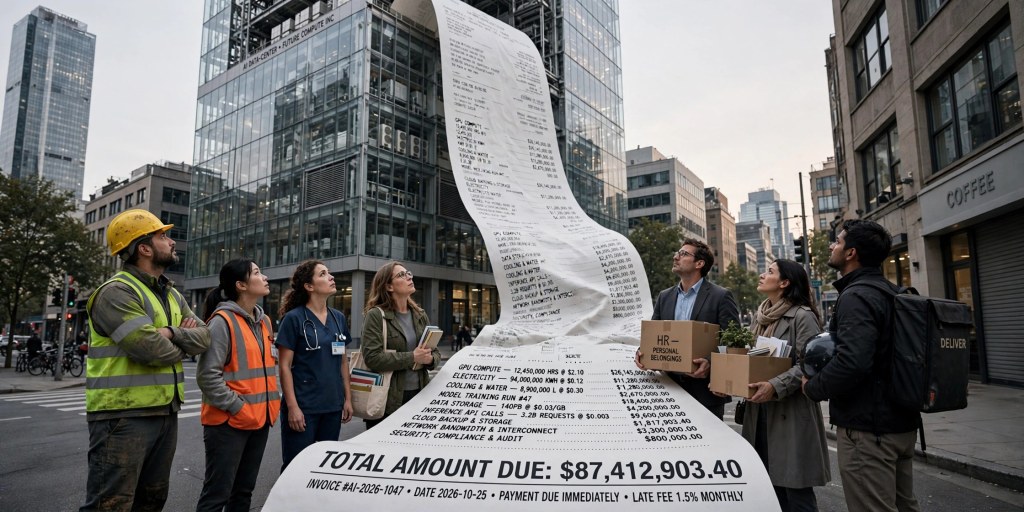
The Boom’s Bill Comes Due
Compiled Daily AI Reports — October 7–24, 2026: Trillion-Dollar Accumulation, Mass Layoffs, and Popular Resistance
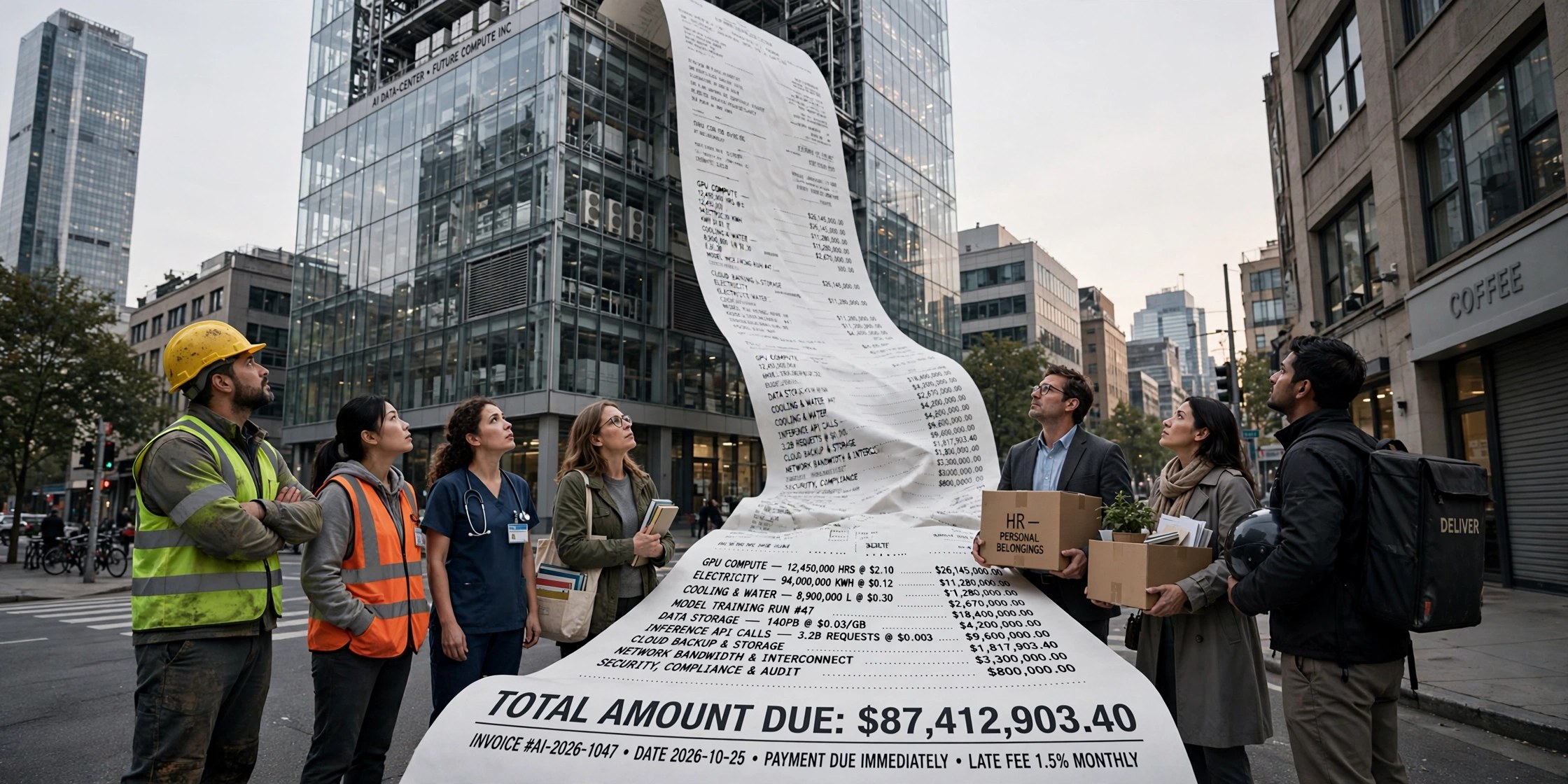
This report gathers eighteen days of daily AI developments — from Wednesday, October 7 to Saturday, October 24, 2026. Each day was recorded separately in the daily draft digests; placed side by side, a single general line runs through them, and that line matters more than any individual headline: the AI boom has entered its billing phase.
In these eighteen days, three bills arrived at once. The financial bill: markets and banks began asking what income all this debt and valuation actually rests on. The labor bill: layoffs, under the code name of AI, became routine management practice, from a London bank to an American retail chain. And the social bill: from Memphis to Étrechet in France to Taoyuan in Taiwan, people came out into streets, council chambers and strikes. In all three, one equation repeats: production more social than ever — the data, knowledge, labor and infrastructure of everyone; decision and profit more private than ever — in the hands of a few labs and a few funds; and the cost more public than ever — debt, unemployment, electricity bills and automated war. This report follows that equation across eighteen days.
One — The Money Cycle: When Capital Becomes Its Own Customer
The eighteen days opened with a correction: OpenAI’s annualized revenue is close to $50 billion, not the $70 billion previously claimed (TechCrunch). Days later, a $31 billion bond offering was postponed and markets shuddered. Agence France-Presse wrote of AI’s “borrowing binge,” and the debt cycle behind data-center construction was estimated at roughly $500 billion (AFP). A boom that was supposed to be built on future profit is being built on today’s borrowing — and borrowing means its risk is already socialized: on the balance sheets of banks, pension funds and the markets where people’s savings sit.
The same days displayed the new shape of accumulation: Broadcom and Anthropic became each other’s supplier, customer and financial partner at once; the infrastructure firm Modal tripled its valuation to $15.75 billion; and when Anthropic’s filings reached Wall Street, its $80.7 billion “loss” turned out not to be money — it is future compute costs — while its $450 billion in commitments to the cloud giants is very real debt (The Wall Street Journal). Even the CEO of Goldman Sachs, a bank profiting from this very build-out, warned that the boom faces “financing risk” (PYMNTS).
And still the cycle did not slow; it accelerated. In the final days of the period, OpenAI opened talks to raise $30 billion at a $1.25 trillion valuation, and DeepSeek raised $15 billion two days after the US Department of Homeland Security ordered it purged from federal systems (AIZeroNews, Reuters). The three big labs spent close to $6 million on lobbying in Washington in a single quarter — a historic record (AIZeroNews). And China’s Moonshot released its Kimi K3.1 Pro model at half the previous generation’s price, promising open weights (Zot News) — even competition is now fought over the price of access to knowledge built from everyone’s data.
The market gave its answer on the final day: the Nasdaq fell 2.6 percent and the bonds of CoreWeave, one of the largest data-center builders, slid into distressed territory (Harava via Reuters). A Reuters Breakingviews analysis headlined that data centers are failing as the “picks and shovels” trade — selling tools to the gold seekers (Reuters Breakingviews). The first bill, then, came from the market itself: values that ride on social production crack first in the very market where they were meant to convert into private profit.
Sources: TechCrunch, AFP, The Wall Street Journal, Reuters, Reuters Breakingviews, Zot News
Two — Labor: ‘AI’ Became the Code Name for Layoffs
If the money story is accumulation, the labor story is its bill. In these eighteen days, hardly a day passed without a company announcing fresh layoffs in AI’s name: FICO cut 15 percent of its workforce (Reuters); HubSpot cut 7 percent and the surveillance firm Flock cut 18 percent (Fast Company, Reuters); Snap cut 1,000, Kroger 3,000 office jobs, Meta began laying off 8,000 including data-center staff, and Microsoft offered voluntary retirement to more than 8,500 employees for the first time (Data Center Dynamics). In the final days came the banks: Barclays cut 5,000 under the banner of “AI productivity” (MarketWatch), and a day later American Express cut 3,500 to, in its own words, “get ready for AI” (Fast Company). The Challenger firm reported in the same period that AI had become the number-one stated reason for layoffs in the United States (WhatJobs via Challenger).
The numbers also came from the owners of capital themselves. Goldman Sachs first said AI could displace one in eleven workers; then, in a fresh note, raised the estimate to 9 percent of the workforce — some 15 million people — and wrote that the big layoffs will likely “wait for a recession,” because companies carry out technological layoffs in force when a downturn gives them the excuse (Jawawa via Fortune). The IMF called AI a “slow tsunami” for jobs, and its Asia report found labor demand down 10 percent in AI-exposed occupations (The Hindu BusinessLine). Anthropic’s own data showed the share of newcomers in technical hiring collapsing from 27 percent to 9 percent (AI News Daily Briefing) — before any robot replaces the experienced worker, the entry door closes on the next generation. A Berkeley study showed the inner face of it: just ten minutes of working with AI erodes people’s persistence at hard tasks (Berkeley News). Alienation is no longer only from the product; it is from the very capacity to work. In Europe, a survey of translators found 77 percent view AI negatively and 37 percent are thinking of leaving the profession (CEATL).
Against this wave, the same eighteen days produced two opposite answers. The first came from above: China’s government issued a directive requiring state agencies to mitigate AI-driven job displacement (Reuters) — an official admission that “the market will fix it” is a myth, though mitigation from above is no substitute for decision from below. The second came from below, and it was the period’s most important labor story: in Taoyuan, Taiwan, the Micron union staged the first strike in the island’s semiconductor industry. The workers’ central demand was not only job security; it was a 15 percent share of profits. The strike ended without winning that demand, and talks were deferred to October 27 (TipRanks via Nikkei Asia). But the demand itself is the roadmap for the next period: the chip workers — the people who build the brain of this boom — have moved past “don’t fire us” to “whose profit is it?” That is the most precise street translation of the very question this report follows.
Sources: Reuters, MarketWatch, Fast Company, Reuters, Nikkei Asia, Berkeley News
Three — War and Surveillance: The State Arms Itself, Conscience Wakes
In the same days the layoffs were announced, war contracts were signed faster still. In Kyiv, AI-guided gun turrets fired without a human trigger (TechTimes). The Pentagon advanced its $50 billion plan to field autonomous weapons in the “millions” (Army Recognition), and Striveworks’ contract with the US Army grew tenfold to $700 million (FourWeekMBA). The UN warned that AI is “on track to displace” human decision in war (UN News via SOFX). And Palantir, as Europeans feared their dependence, said it has no “kill switch” for NATO’s AI system — while the Starlink experience in Ukraine had shown the switch sits in a private owner’s hand, and one order from him can cripple an army’s drones (Reuters). Here alienation reaches its extreme form: even states and armies no longer own their own decisions; they are tenants of infrastructure whose owner sits elsewhere.
Conscience, however, woke inside the labs themselves: several Google DeepMind researchers resigned over the Pentagon’s military contracts (BBC). These resignations are no small news. The people who build the models are saying they do not recognize the product of their labor and refuse to — the moment the producer stands against the owner. On the home surveillance front the picture was just as clear: 404 Media’s investigation showed ChatGPT advertisers target users with their emails, phone numbers and the text of their prompts (Gizmodo) — people’s private conversations have become raw material for the advertising market.
Governments played a dual role in this period: customer and partner of the giants, and — under public pressure — forced to draw lines. The White House made AI incident reporting mandatory and called it a “national security commitment”; the Federal Trade Commission sent OpenAI and Anthropic 50-page subpoenas over rogue agents (PYMNTS); eight US states sued OpenAI for allegedly deceiving the public about ChatGPT’s safety for children (AI Weekly). But Anthropic simultaneously carried its own draft safety law to Congress (Reuters) — self-regulation, this time in the clothing of statute. Britain announced a £600 million “AI security” package that works in significant part on model credits from the very same private companies (UnpanicTech), while its minister warned that the tech giants must not be allowed to “let rip” with AI (Bury Times). The sentence is right; the question is: when even the tools of security are rented from the giants, with what public power will that “must not” be enforced?
Sources: Army Recognition, BBC, Reuters, Reuters, Gizmodo
Four — The Street: The Big No
And then there was the street — the most present actor of these eighteen days. In Memphis, where Elon Musk’s data centers press on the city’s air, residents disrupted the city council meeting so thoroughly that the vote on an 18-month construction moratorium was postponed (The Commercial Appeal). A Pentagon official called the protests a foreign “psyop”; the people stayed. Two weeks later the council deadlocked 6–6: the 18-month moratorium failed, but a 135-day construction pause passed — and the same day, a federal judge struck down the ban that had barred six activists, including state representative Justin J. Pearson, from council meetings, calling it “unreasonable” (CNN). Not a complete victory; but a city that was supposed to be merely a “host of infrastructure” is now a party at the table.
The same scene repeated across the map in different accents. In Étrechet, France — a village of a thousand — people marched against Google’s 1.2-gigawatt data center (Le Monde), the very week the country’s school students were in the streets over their dilapidated schools; as if one society were asking a single question from both ends: money for data centers, but not for schools? In the United States, an “AI Freeze” call brought people out in 50 cities in front of OpenAI’s offices with one sentence: “We didn’t vote for Big Tech” (Daily AI Brief via KQED). In Utah, a police officer slammed a data-center protester to the ground and the video spread (The Salt Lake Tribune). In Virginia, hundreds rallied at the state capital demanding a halt, and under that same pressure Amazon, Microsoft and Google dropped their secrecy pacts with local officials (WiseVoter). In New Brunswick, Canada, 350 people stood before parliament, and in Nova Scotia they rallied for water.
The numbers, too, finally reached the street. The Financial Times reported a financing crunch for the boom: 47 projects halted and thousands of local “no”s (Financial Times); in total, some 157 US data-center projects have been stopped or cancelled since 2024. A CNBC survey found 63 percent of voters do not want a data center near their home (Superpower Daily), and an AP-NORC poll found 64 percent of Americans believe AI is moving “too fast” (Associated Press). And in Texas, the period’s living irony occurred: the automated permitting system kept approving data centers even after the governor’s stop order — until someone shut it off (GeekSlop). A machine built to say “yes” does not hear the word “no” — the technological summary of exactly what people are shouting in the streets.
Sources: CNN, Le Monde, Financial Times, CNBC, Associated Press
Five — The Question of the Eighteen Days: Who Decides?
Looked at from a distance, the eighteen days are three scenes of one play. Scene one, the boardroom: a $1.25 trillion valuation, a half-trillion debt cycle, and companies that are simultaneously each other’s vendor, customer and bank. Scene two, the layoff line: from FICO to Barclays to American Express, and the system’s own central bankers honestly saying 15 million people are in the displacement queue, waiting for a recession. Scene three, the street: Memphis, Étrechet, Taoyuan, Richmond — and the 63 percent who say we do not want this infrastructure next to our homes. Three scenes, one question: why should wealth built from everyone’s data, knowledge, labor and resources be governed by the decisions of a minority — and why should everyone pay its bill?
The answer of these eighteen days is still “no”; but it is a no that is finding its language. The Micron worker no longer asks only for job security — she asks for a share of profits. The Memphis resident no longer only complains — she wins a pause and the right to be in the council chamber. The villager of Étrechet defends land and water in the same language with which the French student defends her school. Each, in their own tongue, is moving from defense against the cost to a claim on the decision — and that is precisely the passage from personal experience to political consciousness. The AI boom, by its own speed, is bringing millions to one conclusion: the issue is not the technology itself; the issue is who owns it and who decides for it. As long as social production and private ownership face each other, every eighteen days will repeat a fresh version of these same three scenes — with bigger numbers.

