فارسی English
A nontechnical guide to how AI works, what it can and cannot do, and why ownership and democratic control matter
Hamid Akhavi | Revised September 2026
The main idea
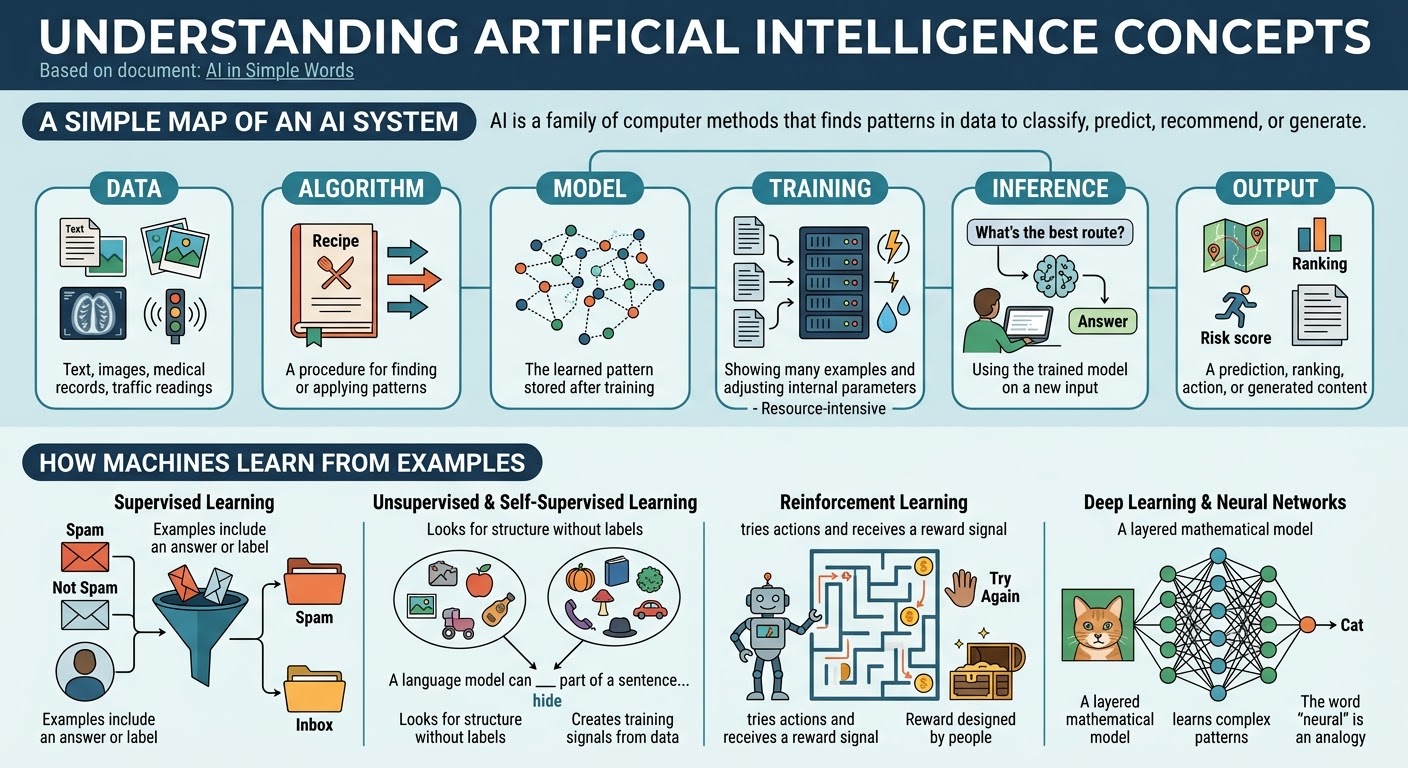
Artificial intelligence is not a thinking machine in the human sense. It is a family of computer methods that finds patterns in data and uses those patterns to classify, predict, recommend, or generate an output. A language model, for example, produces text by estimating which pieces of language are likely to follow the text already supplied. Its fluency can be impressive, but fluency is not proof of truth, understanding, or judgment.
AI is also more than software. Every system depends on people, data, electricity, chips, data centers, communication networks, and institutions that decide its purpose. Understanding AI therefore requires two questions at once: How does the technology work, and who owns, directs, benefits from, and bears the costs of it? This second question connects the technology to A New Social Order in the Age of Consciousness.
A simple map of an AI system
| Part | Plain meaning | Everyday example |
|---|---|---|
| Data | Examples used to build or operate a system | Text, images, medical records, traffic readings |
| Algorithm | A procedure for finding or applying patterns | A recipe for adjusting a model after an error |
| Model | The learned pattern stored after training | A spam filter or language model |
| Training | The resource-intensive learning stage | Showing many examples and adjusting internal parameters |
| Inference | Using the trained model on a new input | Answering a prompt or recognizing an image |
| Output | The prediction, ranking, action, or generated content | A route, recommendation, risk score, or paragraph |
How machines learn from examples
In conventional programming, a person writes explicit rules. In machine learning, people specify a learning process and provide data; the system adjusts many numerical values, called parameters, so its predictions better match the examples. The result is a model. Learning here means mathematical adjustment, not human experience or consciousness.
Supervised learning
The training examples include an answer or label. A model might learn from messages labeled spam or not spam. It is tested on examples it did not train on, because memorizing the training set is not the same as working reliably in the world.
Unsupervised and self supervised learning
Unsupervised methods look for structure without human-provided answer labels, such as grouping similar customers. Self-supervised learning creates training signals from the data itself. A language model can hide part of a sentence and learn to predict the missing text. This reduces manual labeling, but it does not eliminate human choices about data, objectives, filtering, and evaluation.
Reinforcement learning
A system tries actions and receives a reward signal. It adjusts toward actions that earn higher rewards. The reward is designed or selected by people, so an incomplete objective can encourage unwanted behavior. Human feedback may also be used to make a language model more helpful or safer.
Deep learning and neural networks
A neural network is a layered mathematical model. Deep learning uses many layers to learn complex patterns in images, sound, language, or other data. The word neural is an analogy to biological neurons; these systems are not small electronic brains.
How generative AI and language models work
Generative AI creates new combinations of text, images, audio, video, or code. A large language model is trained on enormous collections of language and learns statistical relationships among tokens. A token may be a word, part of a word, punctuation, or another unit. When prompted, the model repeatedly predicts a likely next token. This explains both its versatility and a central weakness: a likely sentence is not necessarily a true sentence.
Transformer
The transformer is the architecture behind many modern language models. Its attention mechanism lets the model weigh relationships among different parts of an input. The 2017 paper Attention Is All You Need introduced the influential architecture. Attention is a mathematical operation, not human attention or awareness.
Embedding
An embedding turns an item such as a word, paragraph, or image into a list of numbers that places similar items near one another in a mathematical space. Embeddings help search for meaning rather than exact wording, but similarity does not establish truth or fairness.
Foundation model and fine tuning
A foundation model is trained broadly and can be adapted to many tasks. Fine-tuning continues training on a smaller, more specialized set of examples. The same base model can therefore support different applications, but each application still needs testing for its actual users and conditions.
Prompt and context engineering
A prompt is the instruction or input given to a model. Prompt engineering improves the wording and structure of that instruction. Context engineering is broader: it supplies the model with relevant documents, tools, memory, rules, and limits. Better context can improve results, but it cannot guarantee accuracy.
Retrieval augmented generation
Retrieval-augmented generation, or RAG, first searches a selected collection and then gives relevant passages to the language model as context. It can make answers more current and traceable. It does not automatically make them correct: retrieval can find the wrong passage, a source can be poor, or the model can misrepresent it.
Agentic AI
An AI agent combines a model with tools, memory, and a loop for planning and acting. It may search, calculate, write files, or call services. More autonomy creates more opportunities for error, manipulation, and unintended action, so permissions, logs, testing, and meaningful human control become increasingly important.
What AI can do well and where it fails
AI can rapidly search, summarize, translate, classify, detect patterns, draft text, generate media, assist with coding, and support scientific analysis. In narrow and well-tested settings, it can improve speed and consistency. It can also widen access for people who face language, disability, or technical barriers.
Its limitations are not side issues. They define when a system should and should not be trusted.
- Hallucination or confabulation: a generative model may produce a confident, plausible statement with no adequate support.
- Bias: training data and design choices can reproduce or magnify unequal treatment.
- Distribution shift: a model tested under one set of conditions may fail when people, language, or circumstances change.
- Opacity: even developers may be unable to give a simple causal explanation for a complex model’s output.
- Automation bias: people may defer to a machine because it appears objective or authoritative.
- Privacy and surveillance: personal data can be collected, inferred, combined, and used beyond the purpose a person expected.
- Security risks: attackers can manipulate inputs, poison data, steal model information, or use AI to scale deception.
- Concentrated power: control of chips, cloud infrastructure, proprietary data, and leading models can convert technical advantage into economic and political power.
- Material costs: training and operating AI require labor, energy, water, minerals, facilities, and supply chains whose burdens are unevenly distributed.
Useful measurements without the mathematics
Accuracy is not one universal score. The right measure depends on the harm caused by different mistakes. In a medical screening example, a false negative misses a condition, while a false positive raises an unnecessary alarm.
- Precision asks: among the cases marked positive, how many were actually positive?
- Recall asks: among all actual positive cases, how many did the system find?
- F1 score combines precision and recall when both matter.
- Benchmark results measure performance on a chosen test, not reliability in every real setting.
- A useful evaluation also asks how results differ among groups, how performance changes over time, and whether people can challenge a harmful decision.
Safe everyday use
- Do not enter passwords, financial records, medical details, confidential work, or another person’s private information unless the service and your authorization clearly permit it.
- Treat generated text as a draft. Verify names, dates, quotations, statistics, legal claims, medical claims, and links against reliable sources.
- Ask for sources, then open and read them. A model can invent a citation or cite a real source that does not support its claim.
- Use higher scrutiny when an output affects liberty, employment, credit, education, health, housing, or public benefits.
- Keep a record of important prompts, sources, edits, and decisions so responsibility remains visible.
- Watch for synthetic images, cloned voices, impersonation, and emotionally urgent requests. Confirm identity through a separate channel.
- Remember that human review is meaningful only when the reviewer has time, knowledge, authority, and the ability to reject the machine’s recommendation.
AI through the lens of a new social order
A technical explanation answers how an AI system produces an output. A social explanation asks why that system was built, which objective it optimizes, whose data and labor made it possible, who can inspect or challenge it, and who receives the benefits. These are not external political additions to the technology; they shape the technology itself.
Social production and private control
Modern AI is highly socialized production. Models draw on collective language, culture, research, public investment, global supply chains, user activity, and the labor of engineers, data workers, artists, writers, moderators, and communities. Yet ownership of the resulting infrastructure and revenue is often concentrated. This sharpens the contradiction discussed in A New Social Order in the Age of Consciousness between social production and private ownership.
Productivity can become freedom or insecurity
AI can reduce necessary labor and expand society’s productive capacity. Under institutions that tie income, health, and dignity to full-time employment, the same productivity can eliminate jobs, weaken bargaining power, and deepen insecurity. The outcome is not predetermined by the model. It depends on ownership, labor rights, shorter working time, public services, and how technological gains are distributed.
Participation in power
Democratic AI governance cannot mean consultation after deployment. Workers and affected communities need participation in setting objectives, choosing data, testing impacts, auditing results, and deciding whether a system should be used at all. Public institutions should disclose procurement, evaluation, environmental costs, incidents, and avenues of appeal. AI may support transparent planning by processing real-time social needs, but it must not replace political judgment or become a source of legitimacy above the people.
Awareness rather than technological worship
The age of consciousness does not mean that machines become conscious. It means that citizens understand the systems shaping their lives and acquire the practical power to govern them. An aware and responsible citizen neither rejects AI as inherently evil nor accepts it as an independent authority. The goal is to turn a socially produced capacity toward human need, equality, ecological limits, freedom, and peace.
Questions every citizen should ask
- What problem is this system supposed to solve, and who defined the problem?
- What data were used, with whose consent, and what important experiences are missing?
- Who owns the model, chips, cloud service, and resulting data?
- Who performs the visible and hidden labor, and under what conditions?
- Who benefits financially, and who bears environmental or social costs?
- How is performance measured, including errors across different groups?
- Can a person obtain an explanation, appeal a decision, and reach an accountable human?
- Could a less intrusive, non-AI solution work better?
- Can the public audit, modify, or democratically refuse the system?
A corrected glossary
| Term | Plain meaning |
|---|---|
| Artificial intelligence | Computer systems designed to perform tasks associated with perception, language, prediction, reasoning, or action. |
| Machine learning | Methods that improve a model’s performance by learning patterns from data. |
| Model | A learned mathematical representation used to produce predictions or outputs. |
| Parameter | A numerical value adjusted during training; it is not the same as a fact stored in a database. |
| Training data | Examples used to adjust a model. |
| Inference | Using a trained model to produce an output for a new input. |
| Generative AI | AI that produces new content such as text, images, audio, video, or code. |
| Large language model | A generative model trained on large amounts of language to predict and produce sequences of tokens. |
| Token | A unit processed by a model; often a word fragment, word, punctuation mark, or symbol. |
| Context window | The limited amount of material a model can consider in one interaction. |
| Multimodal model | A model that can process or generate more than one kind of data, such as text and images. |
| Knowledge graph | A structured network of entities and relationships. It is distinct from an LLM, though the two can be combined. |
| Edge AI | AI processing performed on or near a device instead of entirely in a remote data center. |
| AGI | A debated term for broadly capable, human-level or greater general intelligence. No universally accepted test or definition exists. |
| Explainability | Methods for helping people understand factors associated with an AI output; an explanation may still be incomplete. |
| Human in the loop | A workflow in which a person participates in review or decision-making. Its value depends on real authority and competence. |
Conclusion
AI is a powerful pattern-making technology embedded in a human system. It can assist people, expand knowledge, and reduce burdensome labor, but it can also automate inequality, surveillance, exploitation, and concentrated control. Technical literacy helps us use AI carefully. Social awareness helps us decide collectively what it should be used for. The decisive question is not whether AI will shape society, but whether society can consciously and democratically shape AI.
References and further reading
- Akhavi, Hamid. A New Social Order in the Age of Consciousness, Volume One. First English Edition, 2026.
- Bender, Emily M., et al. “On the Dangers of Stochastic Parrots.” Proceedings of FAccT, 2021. https://doi.org/10.1145/3442188.3445922
- Devlin, Jacob, et al. “BERT: Pre-training of Deep Bidirectional Transformers for Language Understanding.” 2018. https://arxiv.org/abs/1810.04805
- European Union. Regulation EU 2024 1689 laying down harmonised rules on artificial intelligence. 2024. https://eur-lex.europa.eu/eli/reg/2024/1689/oj
- International Energy Agency. Energy and AI. 2025. https://www.iea.org/reports/energy-and-ai
- International Labour Organization and NASK. Generative AI and Jobs A Refined Global Index of Occupational Exposure. 2025. https://www.ilo.org/publications/generative-ai-and-jobs-refined-global-index-occupational-exposure
- Lewis, Patrick, et al. “Retrieval-Augmented Generation for Knowledge-Intensive NLP Tasks.” 2020. https://arxiv.org/abs/2005.11401
- National Institute of Standards and Technology. Artificial Intelligence Risk Management Framework AI RMF 1.0. 2023. https://doi.org/10.6028/NIST.AI.100-1
- National Institute of Standards and Technology. Artificial Intelligence Risk Management Framework Generative Artificial Intelligence Profile. 2024. https://doi.org/10.6028/NIST.AI.600-1
- OECD. Recommendation of the Council on Artificial Intelligence, amended 2024. https://legalinstruments.oecd.org/en/instruments/OECD-LEGAL-0449
- Vaswani, Ashish, et al. “Attention Is All You Need.” 2017. https://arxiv.org/abs/1706.03762

