In the 2026 earnings season, the CEOs of the world’s largest technology companies — for all the rivalry and disagreement among them — repeated one sentence in almost the same words: “We are capacity-constrained.” Sundar Pichai, CEO of Alphabet, said Google’s cloud revenue “would have been higher if we could have met this demand.” Amy Hood, Microsoft’s chief financial officer, said the company “remains capacity-constrained.” And Satya Nadella, when asked about the risk of overbuilding, answered that the bottleneck is not chips at all; it is power and “warm shells” — ready buildings that have electricity so the chips can be switched on inside them.
This collective confession reveals the real map of competition in the age of AI. A better language model no longer decides the winner on its own; training data is abundant, and algorithms imitate each other within months. What is scarce, and not easily copied, is physical capacity: land, power, buildings, racks of processors and cooling networks. The data center has turned from a supporting infrastructure into the battlefield itself: whoever switches on more capacity sooner takes the customers, the profit and the market share; and whoever arrives late is left standing in line, even with the best model. This article first dissects the anatomy of these giants — from the processor to the cooling, from raw materials to the people who run them — then lays out their world map, and then shows how this capacity battle redistributes profit and market share, what money finances it, and who pays its bill.
1. Anatomy: What Goes On Inside an AI Data Center?
The basic unit of computing in the AI age is no longer the server; it is the rack. Today’s reference rack is Nvidia’s GB200 NVL72: 72 Blackwell graphics processors (GPUs) together with 36 Grace central processors, in a liquid-cooled cabinet, with 13.4 terabytes of high-speed memory and roughly 120 kilowatts of power draw — ten times an ordinary enterprise rack, which draws 5 to 15 kilowatts. Behind this single rack alone run more than two miles (nearly 3.2 kilometers) of copper cabling, because for the internal links between processors Nvidia preferred copper to optical fiber. Each rack is estimated to cost about $3 million. Now put that number at the scale of a hall: a 100-megawatt data center fits about 800 such racks — that is, more than 55,000 graphics processors in one building — and the newest campuses have passed one gigawatt.
The power chain is the second layer of the anatomy, and today its slowest link. Power enters from a transmission substation, passes through enormous transformers, goes through the uninterruptible power supply (UPS) system with its lithium battery rooms, and reaches the racks; and behind all of it stands a fleet of multi-megawatt diesel or gas generators, ready to take over the load within seconds of an outage — with stored fuel for 48 to 96 hours of operation. The lead time for a large power transformer today averages 128 weeks, and for some types it has passed 160 weeks (Wood Mackenzie research); an order placed today arrives three years from now. That is why the CEOs talk about “warm shells”: a building without power is just a shed.
The third layer is cooling. The 120 kilowatts of heat from each rack cannot be carried away by ordinary air; the new standard is direct-to-chip liquid cooling: copper cold plates sit on the processors, and the coolant carries 70 to 90 percent of the heat directly to the coolant distribution unit (CDU) and from there to the facility water loop and finally to cooling towers or dry coolers outside the building. The rest of the heat — memory, power supplies, network equipment — is still removed by air; so AI halls are hybrids: liquid for the processors, air for the rest. The product of this engineering shows up in the power usage effectiveness (PUE) index — the ratio of the building’s total power to the power of the computing equipment: the industry average is 1.54 (Uptime Institute survey, 2025), but the new liquid-cooled halls have reached 1.1 to 1.2; that is, nearly all the power reaches the computation, and the cooling overhead has fallen to a tenth.
And finally, the materials. The cloud is made of metal. A Bank of America estimate (June 2026) says each megawatt of new capacity requires 60 to 75 tons of metal; copper’s share alone is estimated at about 27 tons per megawatt — meaning a 100-megawatt data center buries nearly 2,700 tons of copper in its cables, busbars, transformers and cooling — and this industry’s aluminum demand will more than double by 2030. The frame of a 100-megawatt building swallows more than 50,000 tons of concrete and structural steel, and the heart of its transformers depends on a special electrical steel for which the United States has only one domestic producer. When in the sections that follow we speak of the “capacity race,” start from here: it is a race over copper and steel and transformers and turbines, before it is a race over software.
2. Clean Air: Advanced Ventilation and a Near-Cleanroom Regime
A data center is not a cleanroom — chip factories operate at cleanliness classes 1 to 5 of the ISO standard, up to a hundred thousand times cleaner than the air of a data center, and in them full body coverings and laminar airflow are mandatory. But AI hardware is pushing the data center, step by step, in the same direction. The industry’s reference guide is the document of Technical Committee 9.9 of ASHRAE, the American society: the air temperature at server inlets is kept in the recommended range of 18 to 27 degrees Celsius, and for the new high-density class (H1), which ASHRAE added in the 2021 edition specifically for AI hardware, the range is narrower and cooler: 18 to 22 degrees. Humidity is no longer measured by relative humidity but by dew point — between minus 9 and plus 15 degrees — because air that is too dry creates static electricity, and air that is too humid creates corrosion and condensation.
Clean air has three shields. First, filtration: the building’s incoming air passes through filters of MERV grades 11 to 13, and the air inside the hall is continuously filtered at grade 8, so that dust reaches class 8 of the ISO 14644 standard. Second, positive pressure: the halls are kept slightly more pressurized than the surrounding space, so dust is pushed out instead of entering. Third, and most stringent, gases: the invisible sulfur vapors of city air eat the copper on electronic boards and tarnish the silver, silently killing the boards. The permissible corrosion ceiling, written identically in the technical specifications of manufacturers such as Dell and Supermicro, is less than 300 angstroms per month for copper and less than 200 angstroms for silver — the “mild” class of the ISA-71.04 standard. Wherever a test exceeds this ceiling, chemical filtration with activated carbon enters the circuit, and the humidity ceiling is compressed below 50 percent. The water of the cooling loops has its own regime too: continuous chemical treatment against scale, corrosion and microbial growth. In short, today’s AI data center is a controlled-climate factory: temperature, humidity, dust, gas and water chemistry — all five are held in ranges that until yesterday were seen only in the semiconductor industry.
3. The People: How Many People Run a One-Gigawatt Giant?
The short answer: surprisingly few. The most authoritative gauge is the study by the research arm of the Virginia legislature (JLARC, December 2024): a typical operating facility has about 50 full-time employees — nearly half of them contractors — while that same building, at the peak of its construction, has about 1,500 workers. At gigawatt scale, the ratio is even more inverted: Meta’s Hyperion campus in Louisiana, on its way to 5 gigawatts, will have more than 5,000 construction workers but only about 500 permanent operating jobs — that is, a tenth of a job per megawatt. In Abilene, Texas, the site of Stargate, 6,000 to 9,000 construction workers have been reported, and the permanent-jobs figure is disputed: about 300 in the city’s agreement documents, up to 1,000 in Oracle’s statements.
Who are those 50 people? The backbone of every site is the critical-facilities technicians — electricians and mechanics who keep the UPS, the generators, the switchgear and the cooling running — alongside electrical, mechanical and facilities engineers, network and server technicians, building-management-system operators, and security guards, who at large sites are sometimes the largest group of all. The work runs 24 hours a day, 365 days a year: rotating twelve-hour shifts, and of those 50 people, at three in the morning only a small handful are in the hall, ready to respond within minutes if the power or the cooling fails. And the industry cannot find exactly these people: the Uptime Institute’s 2025 survey of more than 800 operators shows that 46 percent have trouble finding qualified staff, 37 percent have trouble retaining them, and 35 percent say their staff are poached by competitors; the shortage is worst of all in operations management and electrical engineering. At 80 percent of operators, women are 10 percent or less of the operations teams. So human labor, too — like the transformer — is one of the real bottlenecks of this race, even if it is seen less in the headlines.
4. The World Map: Where Does the Capacity Sit?
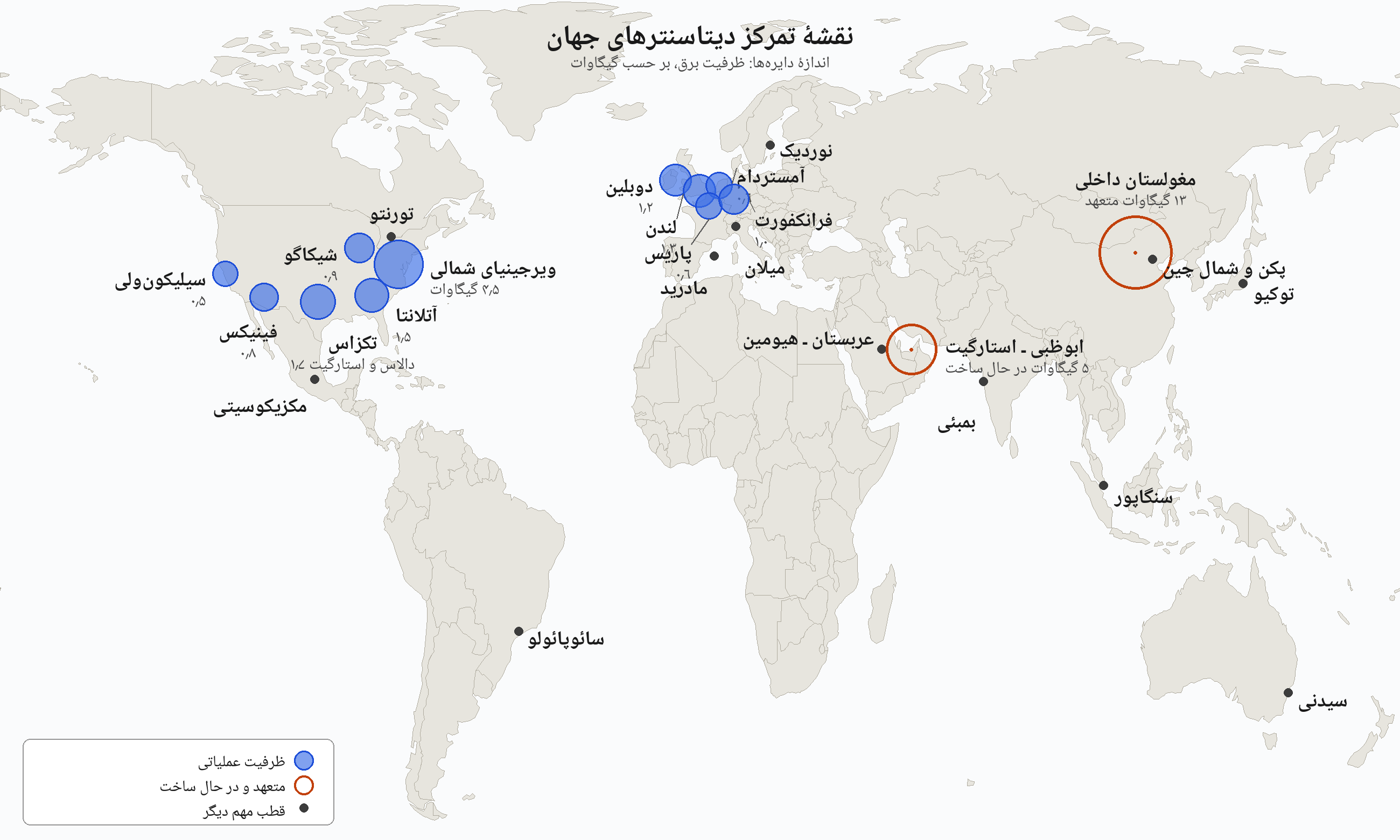
Before we follow the money, let us see the geography. The world’s computing today has three poles: by the International Energy Agency’s (IEA) estimate, the United States consumes 45 percent of the world’s data-center electricity, China 25 percent and Europe 15 percent; and by the data of the research firm Synergy, of the 122 gigawatts of installed capacity in the world at the start of 2025, the United States held 44 percent, Europe 17 percent and China 16 percent. Inside the United States, the world’s largest market is “Data Center Alley” in Northern Virginia, with about 4.5 gigawatts of operating capacity; after it come Atlanta, Dallas, Chicago and Phoenix, and the new wave of construction has been pushed toward Texas and the Midwestern states, because in Virginia the power and the land have run out. In Europe, five cities — Frankfurt, London, Amsterdam, Paris and Dublin — are the backbone. In China, the state program “Eastern Data, Western Computing” has pushed construction toward Inner Mongolia and the west — in the Ulanqab cluster alone, nearly 13 gigawatts of capacity have been committed — and SemiAnalysis estimates that by the end of 2026 China will have more than 24 gigawatts of delivered AI capacity, more than Europe and the rest of Asia combined. And the newcomers to the map are the Gulf states: Abu Dhabi is building the 5-gigawatt Stargate campus, and Saudi Arabia, with its company HUMAIN, is buying gigawatts. The map below shows this concentration.
The point of the map is precisely this concentration: computing — that is, the raw material of AI — has been concentrated in a few dozen geographic clusters and in the hands of a few dozen companies, and it is this concentration that, in the next section, becomes a concentration of profit.
5. The Capital Race: When Capacity Is Pre-Sold
Now the money. The capital expenditure (capex) of the four American giants — Microsoft, Alphabet, Amazon and Meta — was about $224 billion in 2024; in 2025 it reached about $413 billion; and the official spending guidance for 2026 adds up to $720 to $740 billion: Amazon about $220 billion, Alphabet $195 to $205 billion, Microsoft about $170 billion, and Meta $135 to $145 billion. In the third quarter of 2026 alone, these four companies spent $208.7 billion — that is, one quarter almost equal to the whole of 2024. Alphabet, in that same quarter, for all its record-breaking profit, recorded negative free cash flow of $9.1 billion; and a few months earlier it had sold $85 billion of new shares — including $10 billion to Berkshire Hathaway — to pour concrete. A giant whose cash reserves are legendary sells shares to build data centers, because the race does not wait.
Why is this spending not a blind gamble? Because the capacity is sold before it is built. Look at the backlogs of three companies: Google Cloud has $561 billion of signed contracts in its delivery queue; Microsoft’s remaining performance obligations have reached $627 billion; and Oracle’s order book stands at $664 billion. These queues mean that customers — including the AI companies themselves — are begging for capacity in advance. In such a market, capacity that is switched on turns into revenue almost immediately, and capacity that is not built is a share the rival takes. That is why none of the four giants, even with negative cash flow, touches the brakes: in a race whose prize is the next decade’s market, standing still means losing.
6. Capacity Means Market Share; Market Share Means Profit
That capacity turns into market share is no longer a theory; it is recorded in Synergy’s tables. The global market for cloud infrastructure services reached $167.7 billion in the third quarter of 2026, with 55 percent growth over the previous year — an acceleration that Synergy attributes directly to generative AI. In this same market, the share of Amazon Web Services (AWS) has fallen from 32 percent in mid-2024 to 26 percent, and Google’s share has risen from 12 to 16 percent; Microsoft, too, has slipped from 23 to 19 percent. All three are growing in dollars, but the two players that added capacity more slowly are losing share, and the player that built faster is gaining it.
The profit went to the same place. In the third quarter of 2026, Google Cloud’s revenue rose 103 percent to $30.7 billion, and its operating profit tripled: $11.1 billion, with a profit margin of 36.2 percent — a cloud that a few years ago was loss-making now produces 62 percent of Alphabet’s total revenue growth. Microsoft’s Azure grew 48 percent, and its annual revenue passed $100 billion; Amazon, at $46.0 billion, is still the world’s largest cloud, but with 39 percent it has the slowest growth of the three. The structural picture says the same thing: hyperscale operators owned 48 percent of all the world’s data-center capacity at the end of 2025, and by Synergy’s forecast they will reach 67 percent by 2031; and the three companies Amazon, Microsoft and Google alone hold 58 percent of the world’s hyperscale capacity. The capacity race is, in practice, a race for ownership of the century’s computing infrastructure — and its scoreboard is read every quarter in the financial reports.
7. Gigawatt Deals: Buying Capacity, Leasing the Future
Alongside building their own, a second market has formed: buying and leasing capacity at gigawatt scale. Its flagship is the Stargate project — the coalition of OpenAI, Oracle and SoftBank — announced in January 2025 at the White House with the promise of $500 billion and 10 gigawatts. The Oracle–OpenAI contract alone is 4.5 gigawatts and more than $300 billion over five years; the largest capacity contract in this industry’s history. But the headline must be read against delivery: Oracle said in its September 2026 report that 618 megawatts had been delivered at the main Abilene campus — that is, about 6 percent of the 10-gigawatt promise, after nearly two years. This gap between “announced” and “delivered” is the unwritten law of this market, and every gigawatt figure in the news must be read with it. The total of OpenAI’s compute contracts through 2030 is estimated, on the basis of multiple reports, at about $600 billion.
Anthropic shows another path: a company that has almost no infrastructure of its own and has leased capacity from all its rivals at once. From Amazon it has taken up to 5 gigawatts — its backbone is Project Rainier in Indiana, which, with about 500,000 of Amazon’s Trainium chips and an estimated nearly one gigawatt of operating capacity, is, by Epoch AI’s estimate, the largest operating AI campus in the world. From Google and Broadcom, up to another 5 gigawatts; from Microsoft, $30 billion of Azure capacity; with Fluidstack, a $50 billion investment program; and, in a full emblem of capacity scarcity, it has even taken the entire capacity of Colossus 1 — more than 300 megawatts and 220,000 processors — from its rival xAI. According to Reuters’ reporting on Anthropic’s IPO documents, its total commitments are at least $518 billion, about 80 percent of them non-cancellable. In this market, even to be a rival you must buy capacity from the giants; the gatekeepers of computing are your rivals themselves.
And downstream in this chain stands CoreWeave: the pure merchant of capacity, which buys gigawatts with loans and sells them to AI companies. In the third quarter of 2026 its revenue rose 168 percent to $3.66 billion and its backlog reached $132.5 billion; but its interest expense in that same quarter was $846 million — four times its operating profit of $207 million — and it closed the quarter with a net loss of $709 million and total debt of nearly $46.9 billion. CoreWeave is the pure specimen of this new economy: capacity is an asset; but an asset bought with debt, whose rent must arrive from the customer before the interest falls due.
8. The Real Bottleneck: Power, Not Chips
If capacity is the battlefield, power is its armory. The four giants have so far contracted 14.1 gigawatts of nuclear capacity — its emblem is Microsoft’s twenty-year contract with Constellation to restart Unit 1 of the Three Mile Island plant with 835 megawatts, from 2027 — but of this mountain of contracts, by the end of 2027 only that same 835 megawatts will arrive; nuclear is the answer of the 2030s, not of this year. The ordinary grid has no room either: in the queue for connection to the US grid, more than two thousand gigawatts of projects are waiting, and the median time from request to operation has passed five years. So the giants are building their own parallel grid: more than 130 gigawatts of behind-the-meter generation — mostly gas — has been proposed for data centers alone, and GE Vernova’s gas turbine order book has reached 116 gigawatts; a turbine ordered today will be delivered around 2030.
The cost of this scramble lands on people’s bills. In the PJM power market — the grid of 13 states and the capital, with 67 million people — the capacity auction price jumped 833 percent in one year, and the independent market monitor attributed about 63 percent of this increase, that is $9.3 billion, to data-center demand; a cost that was spread over the bills of all 67 million people. The world’s data centers consumed about 415 terawatt-hours of electricity in 2024 — 1.5 percent of the world’s electricity — and under the International Energy Agency’s base scenario they will reach about 950 terawatt-hours by 2030, roughly equal to Japan’s entire consumption today. US data centers directly consumed 66 billion liters of water in 2023, but the water embedded in the electricity they draw was about 800 billion liters; and Google’s water consumption in 2025 reached 10.9 billion gallons, 34 percent more than the year before. Public electricity and water have become the private inputs of the race.
9. Circular Money and Hidden Debt
With what money does this mythical construction turn? Part of the answer is the circle we also saw in the article “The Money Loop”: Nvidia signed a letter of intent in September 2025 to invest up to $100 billion in OpenAI — money that was supposed, with that same money, to buy Nvidia’s chips. What was finally closed was Nvidia’s $30 billion stake in OpenAI’s $122 billion funding round (February 2026); but Nvidia has gone one step further: it has guaranteed up to $105 billion of OpenAI’s data-center leases, and at the same time holds about 11.5 percent of CoreWeave’s shares and has committed to buy its unsold capacity through 2032. The chip seller is at once a shareholder of the customer, the guarantor of its leases, and the guaranteed buyer of its intermediary’s product. The money turns in a circle, and with each turn the risk reaches more distant hands.
A larger part of the money does not appear on balance sheets at all. The five giants have together disclosed about $1.3 trillion of signed-but-not-yet-started data-center leases, which do not count as debt today. Its complete specimen is Hyperion: Meta’s 5-gigawatt campus in Louisiana is owned by a joint company 80 percent of which belongs to Blue Owl funds; that company sold $27.3 billion of bonds at 6.58 percent interest, and its anchor buyer was PIMCO — that is, pension and insurance money. Meta takes the campus back from 2029 on short-term leases so the debt does not sit on its balance sheet, but it has guaranteed its residual value up to about $28 billion. Morgan Stanley estimates the world’s data-center capital needs through 2028 at about $2.9 trillion and its financing gap at $1.5 trillion, more than $800 billion of which must come from private credit; and McKinsey puts the cumulative need through 2030 at $6.7 trillion. The first crack has appeared as well: SoftBank recorded a net loss of about $7 billion in the July–September quarter of 2026, of which $3.7 billion was the burning of non-refundable prepayments for data-center power equipment. When the leases fall due — whether the AI revenue has arrived or not — the bill stays in place; and the experience of 2008 says that risk parked in pension funds is, in the end, socialized.
10. The Other Side of the Map: China and the States That Buy Gigawatts
This race is not only American. China, with a state program, cheap electricity, and grid connections that take three to six months instead of five to seven years, has delivered more than 24 gigawatts of AI capacity. China’s three internet giants — Alibaba, Tencent and Baidu — in the second quarter of 2026 alone spent a combined $20 billion of capex, and all three at the same time had negative free cash flow; a familiar picture. But China’s bottleneck is the reverse of America’s: not power, not buildings; chips. SemiAnalysis estimates that the fleet of Huawei’s Ascend chips produces less than 4 percent of Nvidia’s total AI computing power, and US export controls press exactly on this point. Beijing’s answer is twofold: build domestically at any speed, and lease capacity beyond its borders, where export controls reach less.
And the third ring is the states that buy gigawatts the way they buy aircraft carriers: Saudi Arabia, with HUMAIN, has won the promise of 500 megawatts of Nvidia capacity and has raised its target to 6 gigawatts by 2034; the Emirates is building Abu Dhabi’s 5-gigawatt Stargate campus with a gigawatt from OpenAI and Oracle. But the decisive point is this: sovereign money buys gigawatts, but the chips still require Washington’s license — the conditional export licenses issued in November 2025 for HUMAIN and G42. In the new order of computing, sovereignty, too, has a hierarchy.
11. The Social Bill — and Society’s Answer
So far we have spoken of profit; now the cost, and who pays it. At least 36 US states have dedicated tax exemptions for data centers; Virginia in fiscal year 2025 gave up about $1.9 billion of its tax revenue, and Texas loses $1.3 billion a year — for facilities whose construction cost per permanent job sometimes passes one million dollars. The newest official audit has darkened the picture: in its November 9, 2026 review, Virginia’s Joint Legislative Audit and Review Commission (JLARC) cut its estimate of the exemption’s return from 48 cents to just 22 cents of state revenue for every dollar, because it abandoned the earlier assumption that 90 to 100 percent of data-center activity happened because of the exemption; it now puts the real share at about half. The exemption cost $4.5 billion over fiscal years 2021 to 2025 in total — 60 percent of all the state’s economic-development incentives in a decade — and its net impact on employment is estimated at 18,130 jobs. And the matter reached politics too: the next day, Virginia’s governor and Democratic legislative leaders proposed for the 2027 legislative session that every data center above 25 megawatts require a local vote, that confidential agreements between companies and local officials be banned, and that minimizing cooling-water use be required. Virginia is the clear example of this mechanism: billions of dollars of taxpayers’ money, under the name of “economic development,” are handed to the richest companies in the world, and for every dollar of it only 22 cents come back to the treasury — this is how citizens’ wealth is sucked into the giants’ profits. In Ireland, data centers consume 22 to 23 percent of the country’s entire electricity, more than all urban homes combined. And these figures come before counting the PJM electricity bill and the power plants’ water.
Society is no longer a spectator either — and this is only the beginning of the story. People whose bills, wells and air are at stake have moved past watching: in the past three years and on four continents, they have stopped projects, taken them to court, shrunk them and redesigned them. The next section is the map of this very resistance — and it shows that in the capacity battle, people are a third force that none of the giants had counted in their financial models.
12. People’s Resistance: Where the Construction Machine Stopped
On November 6 and 7, 2026, the Stop Dirty Data Centres coalition — more than a hundred groups in nearly 15 European countries — staged about 90 protest actions, with one clear demand: an immediate halt to the construction of large data centers “until we, the people, have democratically decided.” In Amsterdam, activists occupied the construction site of Microsoft’s 78-megawatt campus and stopped work for a day; 150 to 200 people were detained and all were released — their victory so far is political, not administrative, and they say so themselves. In Zaragoza, Spain, and in Dublin, about two thousand people marched in each. Three days earlier, in the US midterm elections, of 41 local ballot measures on data centers in 10 states, 40 moved toward restriction (Ballotpedia’s count); and in Hubbard, Ohio, voters, with 76.6 percent — 2,622 votes to 802 — adopted a complete ban on data centers in the city, after months of anger that the mayor had signed a secret agreement with a data-center company without their knowledge. Fifty-six percent of American voters said AI and data centers were an important or decisive factor in their vote, and Bernie Sanders wrote the day after the election: “National data center moratorium now.” The Data Center Watch tracker has calculated that from May 2024 to March 2025 alone, local opposition blocked or stalled $64 billion of projects in the United States — the work of 124 grassroots groups in 24 states — and in the second quarter of 2025 alone, another $98 billion.
Europe has seen the first great victories. In Zeewolde in the Netherlands, Meta’s 200-megawatt campus — which would have been the country’s largest data center — died at the hands of residents and political pressure: the Senate closed the sale of state land, Meta first halted the work and on June 30, 2022 officially cancelled the project. The wave of that cancellation reached the law: the Netherlands banned hyperscale construction across the whole country, except in two designated areas. In Ireland, the four-year de facto halt on new connections was finally lifted in December 2025 only on the condition that every large site must bring all of its own dispatchable power and offset 80 percent of its consumption with new renewable energy. And in the village of Kilmeaden in County Waterford — with a population of less than 300 — about 500 letters of objection from the residents led the county council, on October 15, 2026, to the complete rejection of Echelon’s three-building campus. Five hundred signatures from a village of three hundred: hold on to that ratio; it returns again and again in this battle.
In Latin America, the battlefield has been water — and people have taken their water back. In Cerrillos, Santiago, the MOSACAT neighbors’ movement and the municipality took Google to court: on February 27, 2024, Chile’s environmental court partially annulled the permit of a project that was to draw 169 liters per second from the capital’s aquifer, because the effect of climate change had been ignored in the assessment. In September 2024 Google withdrew the permit altogether, and the project started from zero with air cooling — six years of delay, and the complete death of the water-based design. Tania Rodríguez, the founder of MOSACAT, said: “We don’t need more data centers here taking our water so people in the Global North can draw funny pictures on AI.” In Canelones, Uruguay, activists first, by suing, forced the court to make the water figure public — 7.6 million liters a day, equal to the drinking water of 55,000 people — and that in the worst drought in 74 years; under the slogan “It’s not drought, it’s pillage” (No es sequía, es saqueo), Google shrank the project and abandoned water cooling altogether. In Querétaro, Mexico, where people have written on the wall “We don’t want data centers, we want water,” the battle has not yet reached victory; but its front line has taken shape.
In the United States itself — the capital of this industry — local democracy and the courts twice pushed the giants back. In Loudoun County, Virginia, the heart of the world’s “Data Center Alley,” the Board of Supervisors on March 18, 2025 voted 7 to 2 to abolish by-right construction, approval without debate: from now on, every project needs a public hearing and a special permit. In the neighboring county, Prince William, residents took the “Digital Gateway” rezoning — 2,100 acres beside the historic Manassas battlefield — to court, and on March 31, 2026 the Virginia Court of Appeals unanimously upheld its annulment; the same county in September 2026 voted 8 to 0 to cut the zone where data centers are permitted from 9,700 acres to 3,641 acres. In Tucson, Arizona, the “No Desert Data Center” coalition brought the city council to a unanimous 7-to-0 vote against the land annexation and water contract for Amazon’s 600-megawatt project; the city project died, and its water cooling with it, although the developer took an altered version to county land and the battle continues — Tucson’s lesson is this very honesty: a people’s “no” can kill a project as proposed and set it back a year, but capital has ways of going around too. And in Memphis, xAI, to deliver power to Colossus, placed 35 unpermitted gas turbines beside Boxtown — the historic Black neighborhood built by the descendants of the enslaved. The residents sued in federal court with the NAACP, and on October 30, 2026 the judge rejected xAI’s motion to dismiss the case — even though the Trump administration’s Justice Department had entered the case in xAI’s defense. Sarah Gladney, a Boxtown resident, says: “We the people deserve to breathe clean air.”
The newest front is France, and it is still open: in Étrechet, a village in Indre, Google wants to build, on 195 hectares of farmland, a campus that will reach up to 1.2 gigawatts. The mayor and a number of council members resigned in September 2026 in protest against a decision being made over the village’s head; on October 17 the people marched on that very land with the slogan “A data center, neither here nor anywhere”; and the project is now stuck in the formal public consultation of the National Commission for Public Debate (CNDP) — a file in which it emerged that the campus, because of its generators’ fuel storage, is classified in the Seveso category of hazardous installations.
Now let us step back and look at the people themselves, because they are the main characters of this section: the neighbors who fill the city council meeting, the farmers whose land is to go under concrete, the parents who read the electricity bill and the water well together, the council of a three-hundred-person village that gathers five hundred signatures. Their weapons are not money and not lobbyists; they are the public hearing, the petition, the referendum and the court, and, when every door is closed, the bodies that sit down on the construction site. Their everyday experience — the bill that has gone up, the water that comes three days a week, the air that smells of gas — turns right there into a structural demand, and the demand the November coalition said in one sentence is, in fact, this movement’s program: take the decision about infrastructure out of the closed rooms. For the capacity battle, its consequence is entirely material: in their financial models, the giants had counted land, water, power and permits as “inputs”; people turned all four into political questions. Every year of delay in Hubbard and Zeewolde and Cerrillos makes the interest on those hidden debts of section 9 more expensive and scrambles the road map of section 6. Capacity can no longer be bought with money alone; it must also pass through the people.
Conclusion: Gatekeepers of the Age of Consciousness
Seen from outside, a data center can look like a windowless shed; but in the political economy of AI, this building is the decisive step: the point at which model and algorithm become assets, and assets become profit and market share. Whoever holds capacity is the gatekeeper of computing and collects a toll from every flow of AI; whoever does not must buy permission to pass from a rival — as Anthropic bought from xAI, and OpenAI from Oracle. That is why four companies buy $740 billion of concrete, copper and turbines in a single year, why billion-dollar backlogs are locked in before construction, and why cloud market share shifts, quarter by quarter, exactly at the pace of construction.
But this article’s dissection also showed an inversion. The inputs of this private asset are almost all social: grid electricity that generations built with public money, river water, city land, exemptions that come out of the taxpayer’s pocket, the savings of the pensioners who hold Hyperion’s bonds, and the knowledge born in public universities. Production and cost and risk, social; ownership and profit and decision, private and more concentrated every day — from 48 percent of the world’s capacity in the hyperscalers’ hands, toward 67 percent. The question of the age of consciousness is posed, in the end, right here, beside the electricity meters of these sheds: whose is the world’s computing capacity, and to whom is it answerable? We have seen the market’s answer. The other answer — democratic ownership and control over the infrastructure on which everything rides — is the same horizon that the November protests, from Amsterdam to Dublin, spoke in the language of the street: until we, the people, decide ourselves.
Glossary
- Capex (capital expenditure): the money a company spends on long-term assets — buildings, equipment, infrastructure — as opposed to current expenses.
- Hyperscaler: a very large cloud and data-center operator, such as Amazon, Microsoft, Google and Meta.
- Backlog: signed contracts that have not yet been delivered and turned into revenue; in this industry, the queue of demand for capacity.
- PUE (power usage effectiveness): the ratio of a data-center building’s total power consumption to the power of the computing equipment; the closer to one, the lower the cooling and distribution overhead.
- CDU (coolant distribution unit): a liquid-to-liquid heat exchanger that connects the servers’ cooling loop to the facility water loop.
- Private credit: lending by non-bank funds and institutions; a growing channel of data-center financing, outside banking supervision.
- Warm shell: a ready data-center building whose power connection and cooling are in place and which only awaits the installation of processors.
Sources
International Energy Agency, “Energy and AI” (2025) and the 2026 update — IEA
Lawrence Berkeley National Laboratory, “United States Data Center Energy Usage Report” (December 2024) and “Interconnection Queue” (2026) — LBNL
Synergy Research Group — cloud market share and hyperscale capacity (2025–2026) — Synergy Research Group
CBRE, North America data-center trends (second half of 2025) — CBRE
Good Jobs First, “Cloudy Data, Costly Deals” (November 2025) — Good Jobs First
JLARC Virginia, “Data Centers in Virginia” (December 2024) — JLARC
Financial reports and Q3 2026 earnings calls of Alphabet, Microsoft, Amazon and Meta; CoreWeave’s Q3 2026 results (November 10, 2026); SoftBank’s results (November 10, 2026) — The Motley Fool
Bank of America Global Research, “Data Center Construction and the Resource Shock” (June 2026) — Bank of America Institute
McKinsey, “The Cost of Compute” (April 2025) — McKinsey
Le Monde, “Protests Against Data Centers Held Across Europe” (November 9, 2026) — Le Monde
Also: the ASHRAE TC 9.9 thermal guidelines (fifth edition, 2021); the Uptime Institute global survey (2025); Epoch AI’s estimates of AI campuses (fall 2026); SemiAnalysis data on China’s capacity (September 2026); the documents and reports of companies (Nvidia, Oracle, Anthropic, Constellation, GE Vernova); and Stanford University’s STORM report on the water, electricity, size and location of data centers, examined in preparing this article as a secondary source. For the resistance section: the Data Center Watch tracker (10a Labs); Ballotpedia and the official results of Trumbull County, Ohio (November 2026); Le Monde (October and November 2026); The Guardian (July 2023); Time (2026); the Irish Examiner and RTÉ (October 2026); county board documents of Loudoun and Prince William counties and the Virginia Court of Appeals ruling (March 2026); Bloomberg Law and CNBC on the NAACP’s case against xAI (October 2026); the Business & Human Rights Resource Centre on the Cerrillos, Chile case; Virginia Mercury’s coverage of JLARC’s November 2026 review of the Virginia tax exemption.
Method note: the capacity figures for individual campuses, except Abilene’s 618-megawatt delivery (announced by Oracle) and Colossus 1’s 150 megawatts (a Memphis power company document), are companies’ estimates or program figures, not meter readings. The figures for the commitments of private companies (OpenAI and Anthropic) rest on press reports and leaked documents and are not audited. A commitment or a contract must not be taken as one with delivered capacity.

