And on that same Thursday, the market cast its vote as well: the Nasdaq closed down 5.5 percent, 11.9 percent below its October record — the correction confirmed at the close — the semiconductor index fell about 11 to 12 percent, its worst day since March 2020, and data-center shares tumbled at the close: CoreWeave 9.8 percent, Nebius 14.9 percent and Iren 17 percent; shares of Elon Musk’s Tesla fell 10.8 percent, as analysts noted that a Democratic Congress could put Musk’s federal contracts under scrutiny. Two causes were named: doubt that the enormous AI spending will turn into profit any time soon, and fear that the Democrats’ victory and the wave of local bans will slow the expansion of data centers. The market, two days late, repeated the verdict of the ballot box.
1. The Strait Through Which Data Passes
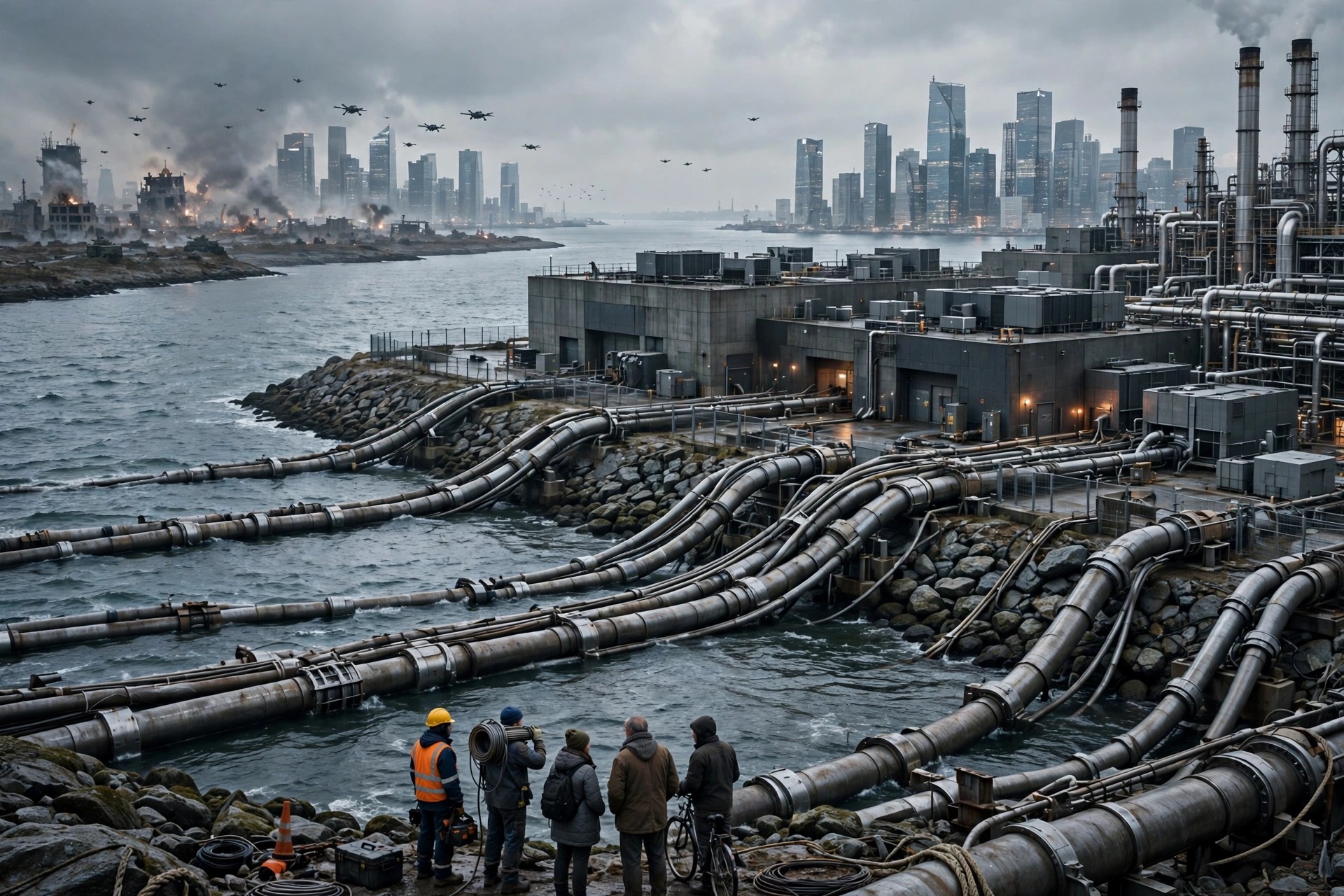
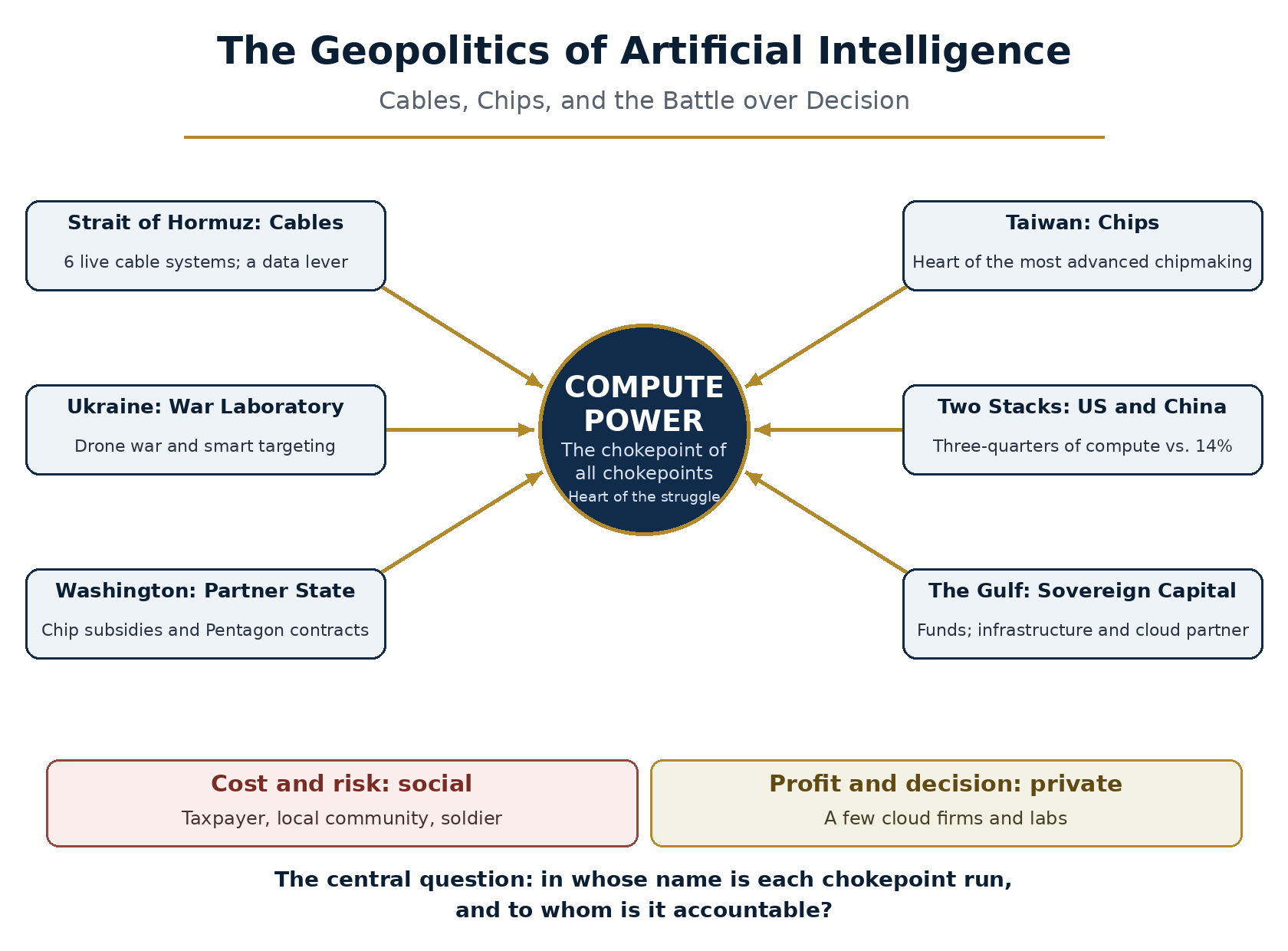
More than 99 percent of international internet traffic passes through undersea cables, and at a point like the Strait of Hormuz those cables become a pressure point. Iran’s recent threat to target Gulf cables is a response to sanctions and Western pressure; but its meaning goes beyond a military threat. The issue here is not who cuts the cable; it is who can cut off data, reroute it, or extract rent from it. Reuters, as republished by an outlet, reported that Tehran has a plan to attack Gulf cables.[1] An Israeli outlet also warned that the Revolutionary Guard is seeking a new “lever of pressure” in the Strait of Hormuz.[2]
A geopolitical question takes shape here: if data is the oil of the twenty-first century, where is its Strait of Hormuz? The answer is clear: wherever cables pass through the water. Iran has even raised the idea of a “transit fee” for Hormuz cables, an idea that recalls the tolls of straits in the history of maritime trade.[3] An analysis from the University of Maryland also treated this threat as more serious after the 2026 US midterm elections.[16] For the Iranian reader, the meaning of this news is closer: in a world where data has become the path of economic life, control over the path of data is a new kind of power.
One important distinction must be made here: threatening to cut a cable is different from actually cutting it. A threat is itself a geopolitical instrument — one whose cost is lower than action, but whose psychological effect can be greater. The key point is this: when the vital infrastructure of a technology is exposed to threat, decisions about that technology are no longer merely technical; they are geopolitical.
2. A Two-Stack Race: The United States and China
The US–China race over AI is a two-stack race: the stack of models and the stack of infrastructure. In the stack of models, the performance gap between American and Chinese models has narrowed to about 3 percent; competition at the model level has become nearly equal.[5] But in the stack of infrastructure — compute, chips, electricity, and supply chains — the United States is still ahead; and that lead is not only technical, but political. New data show that the US share of global compute capacity and electricity generation remains larger than China’s.[4]
A common error exists here: the idea that the AI race is a race over “who builds the better model.” That is only half the story. The other half is the race over “who controls the infrastructure”: who makes the chips, who supplies power to data centers, and who lays the cables. China has closed the gap on models, but it is still behind on infrastructure; and that lag is America’s point of pressure on China.
3. Ukraine: A Laboratory Without Borders
Ukraine has become a laboratory for military AI. In January 2026, Ukraine launched a military data hub called Brave1 to collect battlefield data for training models.[6] At the same time, the Pentagon signed contracts worth $200 million with four leading AI labs to put their models to military use.[7] Those contracts, especially after the Anthropic–Pentagon court case in September 2026, have raised serious questions about the boundary between commercial and military technology.[8]
The issue here is not only Ukraine; it is that war has become a technology laboratory. Battlefield data is the fuel of military models, and models trained in war return to the market after the war. This cycle erases the boundary between peace and war. Palantir, active in Ukraine, reported striking financial results in the third quarter of 2026, but at the same time faced political pressure in the United States.[12] This shows that the market of war is a profitable market — but also a costly one.
4. The State, the Silent Partner of the Giants
In the United States, the state has gradually changed from regulator to partner of the tech giants. That shift was not sudden, but gradual. The Pentagon signs contracts with AI labs; the government buys data from companies; and companies sell services to the government. This relationship, especially in the second Trump administration, has become an open partnership.[7][8] When the government is the largest customer of AI companies, regulating those companies becomes difficult — because the regulator has itself become a customer.
This partnership is not only financial; it is also political. Tech companies, especially in Silicon Valley, have become financial supporters of politicians; and politicians have become supporters of companies. This cycle weakens democracy, because decisions about the future of technology are made not in parliament and the courts, but in closed negotiating rooms between the government and companies.
5. Subsidy: The Second, Larger Form of Support
Government support for the tech giants is not only contracts; it is also subsidy. US states offer large tax incentives to attract data centers — incentives whose cost is paid by taxpayers.[9] These subsidies, especially in the states where data centers are built, run into the billions of dollars. But the question is: at what price are these subsidies given? Data centers consume large amounts of electricity and water, and local people pay the cost of that consumption.
There is an obvious contradiction here: the government subsidizes companies that are themselves among the richest in the world, and the subsidy comes from the pockets of taxpayers who are themselves excluded from those companies’ services. In the midterm elections of November 3, 2026, in several cities, voters voted against building new data centers — a sign that people feel the cost of these subsidies.[11] That opposition, especially in the cities where data centers have been built, has become a local movement.
6. The Musk Case: Private Wealth on the Shoulders of Public Risk
The case of Elon Musk is a clear example of this partnership. The Washington Post reported in February 2025 that Musk’s companies have received $38 billion in government support.[10] That support includes contracts, subsidies, and tax breaks. In November 2026, Forbes placed Musk on its list of the rich; but on the same day, after the midterm elections, his wealth fell by $34 billion.[13][14] That swing shows that Musk’s wealth depends not only on the market, but on politics — and politics on the market.
The question here is: when a private individual, with government support, becomes the richest person in the world, who bears the risk? The answer is clear: the public. If Musk’s companies fail, the government loses; but if they succeed, the profit goes into Musk’s pocket. That is the classic definition of “privatizing profit and socializing loss.” In this model, the risk is public, but the profit is private.
7. Does It Advance or Hold Back?
An important question must be answered here: does this partnership between the government and the tech giants serve the public? The answer depends on how “the public” is defined. If what is meant is consumers of technology, the answer is yes — because cheaper and better technology reaches them. But if what is meant is citizens of a democracy, the answer is no — because decisions about the future of technology have left their hands.
A clear example: in November 2026, Oracle cancelled its $7 billion contract with the Chinese company Tencent.[15] That decision was not only a commercial decision, but a geopolitical one. When large technology contracts become geopolitical decisions, the market is no longer a market; it is a field of political war. In that field, people are only spectators, not players.
8. The Central Question: In Whose Hands Are the Chokepoints?
This article began with a question: who decides the future of AI? Now that question can be answered: whoever controls the chokepoints. The chokepoints are the points examined in this article: undersea cables, chips, data-center electricity, government contracts, and battlefield data. Whoever controls these chokepoints controls the future of AI.
The future of AI is decided not in laboratories, but in these very chokepoints. The question is not where AI is going; the question is who takes it there. If the answer is “the people,” AI can be an instrument of emancipation. If the answer is “private companies,” AI becomes an instrument for concentrating power. This article was written to answer that question — and the answer is in our hands.
Sources
Reuters report on Iran’s plan for Gulf cables, October 23, 2026 — Reuters (republished)
Strait of Hormuz cable systems and the IRGC warning — JFeed / Windward
Demands for a cable transit fee from Hormuz, May 2026 — dev.ua
US–China compute race; Epoch AI data and the Stanford Index — Live Trading News
Closing of the US–China model gap to 3 percent — Bloomberg Intelligence
Launch of the Brave1 data hub, Ukraine Defense Ministry statement, January 21, 2026 — GlobalSecurity
Pentagon’s $200 million contracts with four labs — MarketScale / Forrester
Anthropic case and Court of Appeals ruling, September 2026 — Radar Digital
State data-center incentives and their cost to taxpayers — Good Jobs First
Musk’s business empire and $38 billion in government support, February 26, 2025 — Washington Post
Data-center referendums in the November 3, 2026 election and voters’ negative votes — Inman / Ballotpedia
Palantir’s Q3 2026 financial results and political pressure on the company — Bloomberg Tech / Nikk
Forbes rich list, November 1, 2026 — Forbes
Musk’s $34 billion wealth drop on the day after the election — Billionaires Africa / Forbes
Cancellation of Oracle’s $7 billion contract with Tencent — PYMNTS
Hormuz cable threat after the midterms; University of Maryland analysis — The Observer

