From technical capacity to social realization—in the framework of A New Social Order in the Age of Consciousness
Abstract
Artificial intelligence is transforming the capacity for economic planning. Large-scale data processing, demand forecasting, scenario simulation, real-time monitoring, and optimization of complex networks can reduce many of the computational limitations that constrained earlier planning systems. Yet no technology creates justice, democracy, or a new social order on its own. The direction of AI depends on who owns its infrastructure, how power is organized, which laws govern it, what social goals it serves, and how consciously people participate.
This article argues that AI can become one important technical condition for a planned, democratic, and transparent economy—one that organizes production around human need, ecological sustainability, and the reduction of exploitation rather than maximum profit. Realizing that possibility, however, requires institutions that disperse power, treat data as a shared social resource, and guarantee the public’s right to know, participate, and challenge consequential decisions.
Key points
- AI can make calculation and coordination easier, but it cannot solve the problems of power and legitimacy.
- Democratic planning is not the same as centralized administrative command; it must be participatory, multilevel, and accountable.
- Public ownership without public oversight is insufficient. The decisive questions are who decides and to whom decision-makers are answerable.
- Data, knowledge, and computational infrastructure should be treated as public and social infrastructure rather than an exclusive source of corporate or state power.
- A transition toward a new social order is a possibility, not a guarantee: technology creates capacity, while society determines its direction.
1. The central question: What has AI changed?
Economic planning has always faced a fundamental question: how can the needs of millions of people, the capacities of thousands of productive units, limited natural resources, and the social consequences of decisions be coordinated? Markets perform much of this coordination through prices, competition, and purchasing power. As a result, the needs of those without purchasing power may disappear from economic calculation, while profitable demand—even when socially less important—directs production.
Twentieth-century centralized planning also encountered serious limitations: delayed and poor-quality information, coordination difficulties, incentives for inaccurate reporting, weak feedback, and concentrated administrative authority. Some failures were computational; others arose from power structures and the absence of free participation. The shortcomings of earlier systems therefore cannot be attributed to inadequate computers alone.
AI changes the situation in an important respect. Data on production, inventories, transportation, energy, water, demographic needs, and environmental effects can now be collected and analyzed much faster. Forecasting models, digital twins, and multi-agent simulations can compare consequences before implementation. These advances make planning more manageable, but the choice of goals remains political and social.
2. Consciousness and knowledge as a new productive force
Within the theoretical framework of A New Social Order in the Age of Consciousness, today’s transformation is more than the arrival of another tool. Data, accumulated knowledge, communication networks, and collective processing capacity have become decisive productive forces. AI itself is socially produced through scientific knowledge, cultural works, user data, labeling labor, and public infrastructure.
The central contradiction intensifies when knowledge production becomes increasingly social while models, chips, data centers, and platforms remain concentrated in a small number of corporations or unaccountable institutions. The same technology that could expand social coordination and universal access may instead reinforce surveillance, monopoly, job displacement, and concentrated wealth.
AI is therefore neither a savior nor an autonomous historical force. Technology creates capacity; people, property relations, political institutions, and collective consciousness determine its use. A conscious transition toward a more just economy has become more feasible, but no technical law guarantees it.
3. How AI can strengthen planning
Data integration
Intelligent systems can combine information about production, inventories, supply chains, energy, skills, labor capacity, and social needs into an updated picture. This can narrow the distance between macro-level decisions and local realities. Its preconditions are reliable data, interoperability, and safeguards against manipulation or exclusion.
Forecasting and scenarios
Statistical and machine-learning models can anticipate changes in demand, shortages, equipment failures, and ecological pressures. Prediction is not certainty. Models must disclose their assumptions, uncertainty, and which groups may bear the consequences of error.
Multi-objective optimization
A human economy cannot be directed by a single variable such as profit or GDP growth. Intelligent planning can evaluate basic needs, inequality, free time, worker health, energy, water, carbon, and local resilience at once. The weights assigned to these goals cannot be decided in a closed technical room; society must determine priorities democratically.
Monitoring and adaptive correction
Continuous comparison between a plan and actual implementation can reveal bottlenecks sooner. AI may recommend reallocations or scheduling changes, but consequential decisions should remain reviewable, explainable, and contestable. AI should support public decision-making, not become society’s invisible ruler.
4. From central planning to democratic multilevel planning
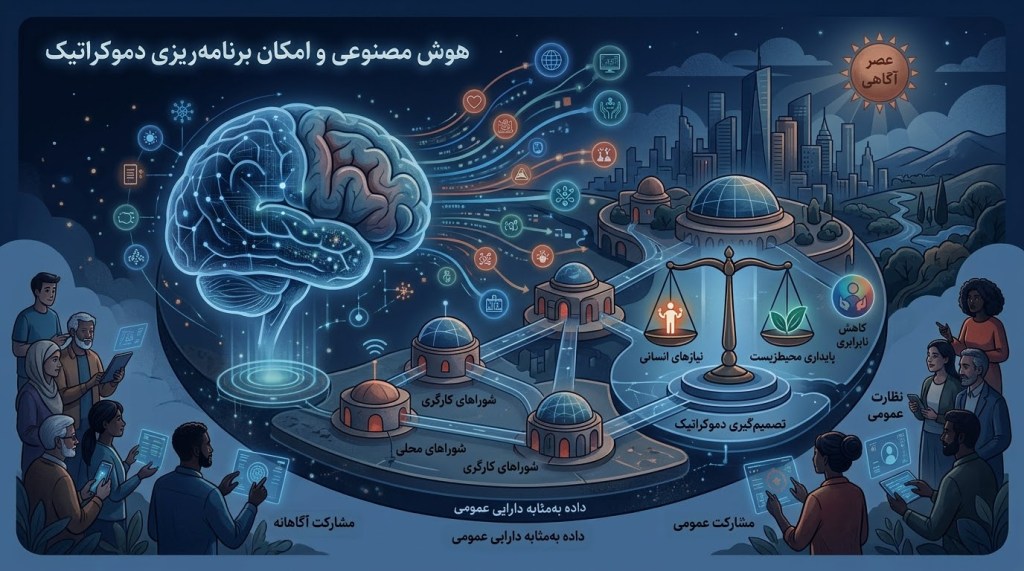
Democratic planning does not require concentrating every decision in a ministry or central computer. A multilevel structure can allow workplace and neighborhood councils to express needs and capacities; sectoral bodies to coordinate across units; and society-wide institutions to establish shared goals, basic rights, and ecological limits. Information must move in both directions, and higher-level decisions must be open to review.
Productive units should retain operational autonomy within a social framework. The general plan establishes protected rights and common priorities, while those with direct knowledge of production decide how work is carried out wherever possible. This reduces administrative bottlenecks without turning local autonomy into unaccountable power.
Ownership can take diverse forms: public, social, cooperative, municipal, commons-based, or limited and regulated private ownership. The legal label is not enough. The important tests are how decision-making power is distributed, who benefits from the surplus, and to whom managers are accountable. Public ownership without freedom, transparency, and participation can reproduce concentrated power.
5. A proposed architecture for a conscious economy
A democratically planned conscious economy can be understood through five layers:
- Social needs: identifying basic needs and public preferences while protecting privacy and avoiding permanent surveillance profiles.
- Productive capacity: current information about materials, equipment, skills, energy, and ecological constraints.
- Public analysis: auditable models that present forecasts, simulations, and multiple options rather than imposing one answer.
- Democratic decisions: councils, public assemblies, informed voting, and negotiated coordination among producers, consumers, and communities.
- Implementation and feedback: phased execution, measurement of effects, the right to pause, appeals, and continuous revision.
The information cycle begins with needs and capacities. Public models then present several scenarios and their consequences; democratic institutions select priorities; and implementation is monitored and revised. Human beings and society—not the algorithm—are the beginning and end of the cycle.
6. Justice as a measurable objective, not a general slogan
Data-informed planning can translate justice into multiple measurable goals: universal access to housing, health care, education, food, energy, communication, and free time; reduced inequalities among regions and social groups; and an explicit accounting of who bears the costs and receives the benefits of each policy. But no mathematical indicator can provide the final definition of justice.
Justice criteria must be established publicly and remain revisable. Equality, need, effort, freedom of choice, sustainability, and the rights of future generations may sometimes conflict. AI should reveal these tensions and the consequences of different choices—not conceal value judgments inside an optimization function.
7. Project Cybersyn: evidence of possibility, not final proof
During Salvador Allende’s government in Chile, Project Cybersyn attempted to use communications networks and cybernetic tools to move information from productive units to coordination centers more rapidly. The experiment showed that technology could shorten information flows and enable new forms of economic coordination. Eden Medina’s historical study also emphasizes the connections among technology, politics, and aspirations for participation [1].
Cybersyn was nevertheless a limited and unfinished experiment that ended with the military coup. It cannot prove the success of a complete economic system. Its lasting value is the question it poses with renewed force today: can computational networks be designed to expand participation, self-management, and public accountability rather than top-down control?
8. Calculation and coordination in a planned economy: What has been solved, and what remains?
Advances in computing, optimization, and machine learning have weakened many older claims that large-scale calculation is inherently impossible. In their research, Paul Cockshott and Allin Cottrell proposed computational and democratic planning procedures [2]. More recent scholarship has reopened the question of computerized economic planning [3].
The debate is not over. Critics point out that needs and preferences are not always known in advance, innovation cannot be reduced entirely to optimization, and some knowledge is local, tacit, and constantly changing [4]. These objections do not necessarily invalidate democratic planning, but they show why a single, fully centralized model is inadequate.
The more careful conclusion is that the computational dimensions of planning have become far more tractable, while the political, epistemic, and institutional dimensions remain open. Advanced calculation must therefore be combined with continuing participation, limited trials, local autonomy, and the capacity for correction.
9. Rights, freedoms, and safeguards against concentrated power
Every intelligent planning system must operate within a clear charter of rights. Basic rights cannot depend on algorithmic scores or majority preference. Freedom of speech, association, unions, strikes, the press, parties, assembly, and minority rights are infrastructure for collective consciousness. Without them, social data are distorted and planning degenerates into administrative command.
Essential safeguards include:
- Transparency about a model’s purpose, data, limitations, and the responsible decision-maker.
- A right to understandable explanations and a right to challenge consequential decisions.
- Privacy protection, data minimization, and a prohibition on mass surveillance.
- Independent audits, publication of errors, and the ability to suspend high-risk systems.
- Separation of powers among data, planning, implementation, auditing, and appeals institutions.
- Direct participation by workers, consumers, experts, and local communities in setting goals.
The NIST AI Risk Management Framework emphasizes validity, safety, transparency, explainability, privacy, and fairness [5]. The OECD AI Principles likewise stress human rights, democratic values, transparency, and the ability to challenge outcomes [6]. These principles become meaningful when translated into enforceable rights and independent institutions.
10. A transition path: from public pilots to broader coordination
The transition should not begin by promising to hand an entire economy to one central system. A realistic path starts with limited, transparent, and reversible pilots in fields with clear public needs and relatively reliable data: energy grids, water, public transportation, medicine supply chains, social housing, and health-care capacity.
Proposed steps include:
- Create non-monopolistic public data infrastructure with common standards and legal protections.
- Establish data trusts and cooperatives so people participate in decisions about the use of their data.
- Publish models, assumptions, and decision criteria for public auditing.
- Run city- or sector-level pilots and compare their results with existing methods.
- Create elected and expert oversight councils to hear appeals and revise criteria.
- Expand only after independent evaluation of economic, social, and environmental effects.
This path supports social learning. Society becomes not merely a consumer of AI outputs, but a participant in defining problems, setting goals, and evaluating results. That is the connection between the development of productive forces and the growth of collective consciousness.
11. Conclusion: historical possibility and conscious responsibility
AI can make the coordination of production and distribution faster, more precise, and more responsive. It can bring human needs and ecological limits into calculations that markets often marginalize. It can also help build the technical foundations of an economy in which reducing arduous labor, guaranteeing basic needs, and ending exploitation become practical objectives.
But AI does not decide society’s direction. If ownership and power remain concentrated, intelligent planning may become a more efficient form of managing inequality and surveillance. If infrastructure is socialized and freedom, transparency, pluralism, and conscious participation are placed at the center, the same technology can serve a more just social order.
The central question, then, is not whether AI can create a new social order on its own. It is whether society can consciously organize this new productive force, democratize ownership and power, and place collective knowledge at the service of a life that is more dignified, free, and secure. The future is not guaranteed; building it is our shared responsibility.
Questions for discussion
- Which sectors are most suitable for beginning data-informed democratic planning, and why?
- How can extensive data use be reconciled with the right to privacy?
- What safeguards can prevent experts, managers, or algorithm designers from becoming a new unaccountable class?
- Which measures should define a conscious economy’s success: growth, equality, free time, health, sustainability, or a combination?
Selected traceable sources
- [1] Eden Medina, Cybernetic Revolutionaries, MIT Press.
- [2] W. Paul Cockshott and Allin Cottrell, Towards a New Socialism.
- [3] Stylianos Samothrakis, Artificial Intelligence and Modern Planned Economies, AI & Society.
- [4] Emanuele Martinelli, An Agent-Based Approach to the Limits of Economic Planning, AI & Society.
- [5] National Institute of Standards and Technology, AI Risk Management Framework 1.0.
- [6] OECD AI Principles: Human Rights, Democratic Values, Transparency and Accountability.
- [7] Friedrich Engels, The Origin of the Family, Private Property and the State.

